
Fake Facebook accounts fall into three categories, scammers, political bots and impersonators, and the removal route depends on which one you face. For impersonation, preserve the profile URL, copied photos and messages with timestamps before engaging, then report the account as pretending to be someone else with an identity comparison showing the authentic profile and the copied material.
Key facts
- Record the direct profile URL and capture date, since display names and usernames can change before review.
- Do not contact the impersonator before preserving evidence; engagement can trigger deletion or a replacement account.
- Meta treats coordinated inauthentic behavior at network level, so linked accounts need a mapped, connected submission.
- Removed accounts are often recreated, so monitoring for replacement profiles is part of the takedown.
Where ContentRemoval.com comes in. ContentRemoval.com handles fake and impersonation Facebook profiles for executives, public figures and family offices: preserving the evidence, drafting the identity comparison Meta’s reviewers need, escalating through intellectual-property and privacy channels where they apply, and watching for replacement accounts. A chief of staff, general counsel or security adviser usually makes contact once clients have been messaged. A free 15-minute Exposure Scan maps what is removable and the report is yours to keep. Get a Free, Confidential Exposure Scan or read how our Facebook content removal work is done.
A senior executive discovers the problem when a client forwards a private message that appears to come from him. The profile uses his name, photograph, employment history, and familiar language. It asks for a confidential payment and directs the client to a separate contact. By the time the executive sees it, several people have already interacted with the account.
That isn’t ordinary spam. It is an identity-based reputation attack. A fake Facebook account can misdirect clients, solicit money, publish false statements, expose private information, or create a record that appears authentic in search results and screenshots. For a high-net-worth individual, executive, public figure, or family office, the practical question isn’t whether the account violates a platform rule. The question is whether someone can use the account to damage trust before the platform acts.
The Silent Threat of Fake Identities
A chief executive may learn about an impersonating profile from a confused investor, an employee, or a family member. The account may have copied a professional photograph and a short biography, then begun sending connection requests to people in the executive’s network. It may not publish anything dramatic at first. It builds familiarity, watches who responds, and waits for a credible opportunity to ask for information, money, or access.
That sequence matters. A visible fake account is a nuisance. A convincing fake identity is an operational threat. It can create false instructions, invite contacts into private conversations, and make later denials look defensive. If the impersonator uses a real photograph, authentic corporate language, or details drawn from public interviews, recipients may not recognize the deception until they have acted.
The risk extends beyond the individual. A copied executive profile can affect a company, charitable foundation, investment vehicle, law firm, or family office. Counterparties may question whether a message was genuine. Employees may follow a fraudulent request because it appears to come from leadership. A public dispute can then create secondary material that spreads across Facebook, search engines, forums, and private groups.
Risk principle: Treat an impersonating profile as evidence of a potential campaign, not as a single bad page.
The public record shows why a narrow spam analysis is inadequate. In its August 2012 SEC filing, Facebook disclosed that about 8.7% of 955 million active accounts, roughly 83 million accounts, were illegitimate. The filing identified 4.8% duplicate profiles, 2.4% user-misclassified accounts, and 1.5% undesirable accounts. Those figures are preserved in Facebook’s account authenticity guidance, and they established an early benchmark for the scale of non-genuine activity.
For a person facing impersonation, the lesson is direct. Facebook has long operated in an environment where account authenticity is measured at enormous scale. A report submitted without a clear identity comparison, preserved evidence, and an explanation of the harm may compete with a large volume of routine abuse reports. Professional handling becomes necessary when the profile has contacted important people, used private material, copied a brand, or appears connected to other accounts.
If photographs have been used in a broader deception, document the use before contacting the operator. The guidance on responding to photos used in a catfishing scheme is relevant because image misuse often forms part of a wider identity attack.
Categorizing Malicious Account Types
The phrase fake Facebook accounts describes several different threats. Classification controls the response. A basic spam account may justify a platform report. An impersonation network may require evidence mapping, legal notices, and coordinated escalation.
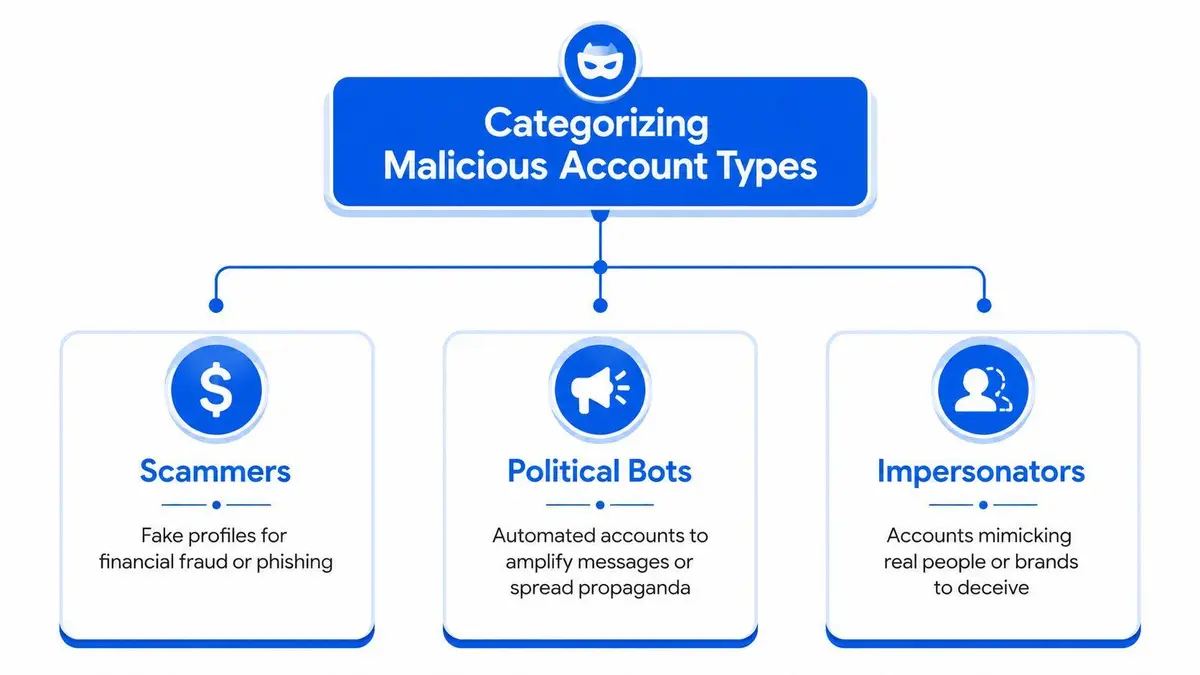
Scammers pursue access or money
A scammer designs a profile to produce a transaction or obtain sensitive information. The account may pose as an executive, a relationship prospect, a recruiter, a financial professional, or a representative of a known business. Its value lies in the reaction it produces, not in the authenticity of its public biography.
Indicators include urgent requests, unusual payment instructions, requests to move the conversation away from Facebook, and links that imitate legitimate services. A scammer may use several profiles, each with a different name and photograph, while directing victims toward the same destination. That pattern changes the matter from isolated abuse to a connected fraud operation.
Political bots manipulate attention
Political bots and influence accounts seek amplification. They may use automation, coordinated posting, copied narratives, or manufactured engagement to make a position appear more widely supported than it is. Their purpose may not involve direct financial fraud. The harm can instead arise from false association, manufactured controversy, or the apparent endorsement of a cause by a person or organization that never gave it.
Meta defines coordinated inauthentic behavior as coordinated efforts to manipulate public debate that rely centrally on fake accounts to mislead people about identity and coordination. In 2021, Meta said it disrupted 52 networks across 34 countries, as described in its threat-reporting materials. The distinction is critical. A coordinated network requires a network-level submission, not a single-profile complaint.
Impersonators attack trust
Impersonators mimic a real person, brand, executive, charity, or institution. They may copy photographs, names, logos, employment details, and writing patterns. Unlike generic spam, impersonation exploits an existing reputation.
A recent reported case involving an influence operation included 510 Facebook accounts, 32 Instagram profiles, and one group, with accounts impersonating groups such as Jewish students, African Americans, and concerned citizens. That example, reported by Newsweek’s coverage of Meta’s enforcement activity, demonstrates why the most dangerous profiles may look semi-authentic rather than automated.
| Threat type | Primary objective | Correct response |
|---|---|---|
| Scammer | Obtain money, credentials, or access | Preserve the fraud indicators and report the account and linked material |
| Political bot or influence account | Manipulate public debate or perceived support | Map related accounts, narratives, and coordination |
| Impersonator | Borrow a trusted identity to deceive contacts | Establish the real identity and submit a focused impersonation complaint |
Don’t describe every fake account as a bot. That label can weaken a report when the issue is impersonation, fraud, or coordinated deception.
Forensic Collection of Evidence
A removal request should be treated as an evidence package. Preserve the record before the account changes its name, deletes messages, blocks witnesses, or replaces the profile photograph.
Capture the profile as it exists
Open the profile from a controlled device and record the account’s direct URL, display name, username, profile photograph, cover image, biography, employment claims, location, listed contact details, group memberships, and visible posts. Capture screenshots that show the full browser or application context, including the URL where possible. Don’t crop away identifying details that help establish authenticity.
Record the date and time of every capture, including the time zone. A screenshot without timing information can still help, but a dated evidence log is stronger because it establishes when the account displayed the relevant material.
Create a separate entry for every post, comment, message, and link connected to the threat. Note who received the communication, what the account claimed, whether it requested money or information, and whether the recipient acted on it. Preserve message headers and the original message view where Facebook makes them available.
Establish the identity comparison
Collect the legitimate person’s official Facebook profile, corporate website biography, verified social profiles, public photographs, and any evidence showing that the person controls the authentic account. The comparison should identify copied material, false employment claims, reused images, and misleading contact information.
Use a table for internal review:
| Evidence field | What to preserve |
|---|---|
| Identity | Real name, authentic profile, professional role, and official contact channel |
| Duplication | Copied photograph, biography, logo, or wording |
| Conduct | Messages, requests, claims, links, and contact attempts |
| Reach | Known recipients, groups, pages, and related profiles |
| Timing | Capture date, message date, and sequence of account activity |
Don’t contact the impersonator before preserving evidence unless there is a compelling safety reason. Engagement can signal that the target has noticed the account. It can also provoke deletion, retaliation, or migration to another profile.
Preserve the chain of custody
Store original screenshots in a restricted folder. Keep an untouched copy and a working copy for annotations. Record who collected each item, when it was collected, how it was obtained, and whether anyone altered it. Save URLs as text in the evidence log, but don’t rely on the URL alone because profile names and handles can change.
If a recipient has received a fraudulent message, ask that person to preserve the original conversation and provide a written account of what happened. Don’t ask witnesses to rewrite, forward, or edit the material. Their original record may matter if the matter develops into a business dispute, regulatory issue, civil claim, or criminal complaint.
Evidence rule: Capture the account, the conduct, the audience, and the connection between them. A profile screenshot alone rarely explains the full threat.
Facebook says its systems remove accounts at sign-up by detecting signs of malicious behavior, as explained in its account-enforcement explanation. That means a profile may disappear before a victim can preserve it. Speed isn’t cosmetic. It protects the record.
Executing Platform Removal Actions
Use Facebook’s reporting path that matches the conduct. A report identifying the profile as an impersonation should explain who is being impersonated, why the identity is false, what material was copied, and how the account has used that identity. Don’t submit a vague complaint that only says the page is fake.
Begin with the profile itself. Select the option for reporting the account as pretending to be someone else, then identify whether it represents you, a public figure, a friend, or another person or organization. Follow the prompts carefully. If the account has published separate posts, reported those posts as well may create an additional record, but the profile-level complaint should remain the central submission.
Attach evidence that makes the comparison easy to verify. Include the authentic profile or official website, the fake profile URL, screenshots of copied photographs or biographies, and examples of messages sent to third parties. If the account requests money, credentials, documents, or a private meeting, state that fact plainly.
Write for the reviewer
Platform reviewers need a concise factual sequence, not a long narrative. Use a structure such as:
- Identity: State the person’s name and role.
- Authentic presence: Provide the official profile or website.
- False account: Provide the exact Facebook URL and copied identifiers.
- Deceptive conduct: Describe messages, requests, false claims, or linked content.
- Risk: Explain who may be deceived and what harm may follow.
- Requested action: Ask for removal of the impersonating profile and associated material.
Do not accuse a named person of operating the account unless you have evidence supporting that conclusion. Report the observable facts. Unsupported allegations can distract from the clear violation and create avoidable defamation concerns.
Escalate methodically
Save the report confirmation, reference number, submitted text, attachments, and response. If Facebook rejects the report or takes no effective action, compare the response with the evidence. A resubmission should address the deficiency, not repeat the same wording.
For posts published by an account you don’t control, use a focused process rather than attempting to manage the entire profile informally. The guidance on removing a Facebook post that isn’t yours can help frame the distinction between reporting a specific publication and challenging the account behind it.
If the account targets a company, submit the complaint through the appropriate authorized representative where possible. If it targets an individual, the subject should provide the identity comparison and explain the impersonation directly. A lawyer, authorized agent, or specialist removal firm may be able to present the evidence more coherently, especially when multiple profiles and jurisdictions are involved.
Escalating Beyond Standard Reporting
A routine fake profile and an organized impersonation campaign don’t belong in the same queue. The first may be operated by an opportunist who abandons it after a report. The second may involve copied identities, coordinated messaging, linked domains, multiple administrators, and replacement accounts. Treating both cases identically wastes time.

Identify the campaign pattern
Look for repeated photographs, identical biographies, similar usernames, synchronized posts, common language, shared contact details, and links that lead to the same destination. Record the relationship between accounts in an evidence map. The aim isn’t to prove more than the evidence supports. The aim is to show why separate reports describe one connected threat.
Meta’s own disclosures support this network-based analysis. The company estimated that about 5% of its 2.4 billion monthly active users, roughly 119 million accounts, were fake in a May 2019 update, after previously estimating a range of 3% to 4%. It also said it had removed more than 3 billion fake accounts between October and March, as reported by PBS NewsHour’s account of the enforcement update. Those figures don’t establish who operated a particular profile. They do show why high-volume enforcement doesn’t eliminate the need for a precise, individualized submission.
A legal notice can be appropriate when the account uses protected photographs, trademarks, confidential material, or demonstrably false statements that cause identifiable harm. The notice should identify the content, explain the legal basis, establish authority to act, and state the requested remedy. It should not overstate the law or threaten consequences that the sender cannot pursue.
Use the correct escalation channel
Escalation may involve Facebook’s additional reporting forms, intellectual-property procedures, privacy complaints, legal correspondence, or law-enforcement reporting where fraud, threats, stalking, or extortion is present. Each route has a different purpose. A copyright complaint isn’t a substitute for an impersonation complaint, and a defamation theory may not address a copied photograph.
Escalation standard: Increase legal pressure only when the evidence supports the theory. Precision gives a serious complaint credibility.
A specialist can coordinate the platform report, legal notice, search-result suppression, and monitoring response. ContentRemoval.com offers Facebook content removal work that includes fake and impersonation profiles, alongside broader online reputation and content-removal services. That can be useful when the profile is only one part of a wider exposure involving search results, websites, or reposted material.
Escalation should also account for replacement behavior. A removed account may be recreated under a different name or photograph. Preserve the original evidence, identify the recurring signals, and report the replacement as connected conduct. If the threat includes immediate financial loss or personal safety concerns, notify the relevant bank, security team, counsel, or law-enforcement agency without waiting for Facebook’s response.
For executives, the practical objective is containment. Stop recipients from relying on the false identity, preserve the record, remove the account, and prevent the same material from becoming a durable search result.
The enforcement cycle remains adversarial. Meta said it acted on 1 billion fake accounts in Q1 2025 and 687 million in Q2 2025, while estimating fake accounts at about 4% of Facebook daily active people in Q3 2025 and 5% in Q4 2025, according to the Meta enforcement summary. The figures describe platform-wide enforcement, not the probability of removal in an individual case. They reinforce one conclusion: takedown is a continuing process, not a single event.
Preventative Monitoring Strategies
Reactive reporting leaves the target behind the impersonator. A high-value individual should know when a new profile appears, not when a client forwards the damage. Monitoring should cover Facebook search results, public pages, groups, usernames, photographs, brand terms, executive names, and recurring phrases associated with prior incidents.
The objective isn’t to collect an endless stream of alerts. It is to establish a response threshold. A newly created profile using a public name may require review. A profile using the name and photograph of an executive, then contacting clients, requires immediate preservation and escalation. A cluster of accounts using similar language and shared links requires campaign analysis.
Build a defensible response system
Assign responsibility before an incident occurs. The executive shouldn’t be the only person deciding whether a profile is genuine while managing a transaction, board matter, media inquiry, or family concern. A trusted communications lead, security adviser, general counsel, or external specialist should maintain the evidence log and control communications.
The protocol should define:
- Verification: Confirm the authentic profile and approved contact channels.
- Preservation: Capture the profile, messages, URLs, and timing before engagement.
- Notification: Warn affected clients, employees, family members, or advisers through trusted channels.
- Removal: Submit the appropriate Facebook complaint and preserve the response.
- Escalation: Move to legal, security, or law-enforcement channels when the conduct warrants it.
- Follow-up: Monitor for replacement profiles, reposts, and search-result exposure.
Your public profiles should also reduce ambiguity. Use consistent professional details, publish clear warnings about official contact methods, and ensure that assistants and family-office personnel know how to verify unusual requests. Don’t disclose unnecessary personal information that an impersonator can reuse.
For high-profile people, reputation monitoring services can provide continuous detection and structured escalation across social platforms and search environments. Monitoring is most valuable when it connects detection to action. An alert without an evidence process merely transfers the anxiety to another inbox.
Platform enforcement will continue to remove large volumes of inauthentic accounts. Facebook’s historical disclosures and later enforcement reports show that removals and account abuse coexist. Your defense therefore needs to do more than count deleted profiles. It must identify who is being impersonated, whom the account is targeting, what the account is trying to obtain, and whether the same operators are returning.
ContentRemoval.com provides confidential assistance with fake Facebook accounts, impersonation profiles, coordinated reputation attacks, and related online material. Visit ContentRemoval.com to request an assessment and receive a clear action plan for evidence preservation, platform takedown, escalation, and ongoing monitoring.
Frequently asked questions
How do I report a Facebook account pretending to be me?
Open the profile, choose the option for reporting an account that is pretending to be someone else, and identify whether it represents you, a public figure or an organization. Attach the authentic profile or website, the fake profile URL, screenshots of copied photos or biography, and examples of messages sent to third parties. State plainly if the account has requested money or credentials.
What evidence do I need before reporting a fake Facebook profile?
Capture the profile URL, display name, username, photos, biography, employment claims and visible posts with full browser context and a dated log including time zone. Add a separate entry for every message or contact attempt, noting who received it and whether they acted. Keep an untouched original copy and record who collected each item.
What if Facebook removes the fake account and it comes back under a new name?
Treat the replacement as connected conduct. Preserve the original evidence, identify the recurring signals such as reused photos, similar usernames or shared links, and report the new profile with reference to the earlier removal. Ongoing monitoring of names, photos and brand terms is what catches the next one before a client does.