
Removing a fake Yelp review means reporting it under a policy category Yelp can verify, not arguing with the reviewer. Businesses cannot delete reviews directly. They submit a report with independently checkable evidence such as transaction records and reverse image searches, then wait several days for Yelp’s decision. For vaguely worded attacks, the case rests on timing and pattern.
Key facts
- Yelp categories that work: not based on a real experience, conflict of interest, inappropriate content, extraordinary circumstances.
- Evidence includes reservation and CRM searches, reviewer profile screenshots and reverse image search results.
- Yelp investigates reports over several days and sends a notification when it has decided.
- Neutral fake reviews are proven by clustered timing, shared phrasing and thin profiles, not by disputing the words.
Where ContentRemoval.com comes in. ContentRemoval.com takes on Yelp cases once a documented report has been declined or the reviews look coordinated: forensic pattern analysis across accounts, evidence preservation, and the legal escalation needed to identify an anonymous poster where the harm justifies it. Owners, operations leads and their counsel usually make contact when the attack follows a lost bid or a terminated employee. A free, confidential 15-minute Exposure Scan maps which reviews are removable, and the report is yours to keep. Get a Free, Confidential Exposure Scan or read how our review removal work is done.
You see the review before your team does. It’s short, calm, and damaging. No profanity. No obvious lie that leaps off the screen. Just enough negativity to pull down trust and invite doubt. You check the name. No clear customer record. No meaningful profile history. Your operations lead says the story doesn’t match any real interaction. Yet there it is on Yelp, public and indexed, doing its work.
That kind of review unsettles smart operators because it feels designed to. It isn’t loud enough to look reckless. It’s subtle enough to survive casual scrutiny, and if you’re running a company where reputation affects deal flow, hiring, investor confidence, or high-ticket conversions, you can’t afford to treat this as a customer service nuisance.
The right question isn’t “How do I argue with Yelp?” The right question is how do I remove fake Yelp reviews by building a case Yelp can verify and act on. That requires discipline, evidence, and, in harder cases, forensic pattern analysis. Emotion won’t move a moderator. A clean evidentiary record might.
The Anatomy of a Modern Reputation Attack
A modern Yelp attack rarely looks theatrical. It looks plausible.
A founder finds a review claiming the experience was “underwhelming” or “not great.” Nothing in it is dramatic enough to trigger an obvious policy violation. But the timing is suspicious. It appears right after a competitor loses a bid, an employee is terminated, or a public controversy puts the business in the spotlight. Then another review follows. Similar tone. Similar vagueness. Similar effect.
Why fake reviews are usually strategic
Most executives make the same initial mistake. They read the review as a personal insult or an unfair complaint. That’s understandable, but it’s strategically unhelpful. A fake Yelp review is usually a business tactic. Someone wants an upper hand, retaliation, distraction, or quiet reputational erosion.
That matters because your response has to match the threat. If you answer an organized attack with a generic customer service reply, you’ve already surrendered the initiative. If you want a broader framework for digital trust protection beyond Yelp, this comprehensive guide on online reputation for businesses is a useful companion resource.
Practical rule: Treat suspicious reviews as potential evidence of coordination until proven otherwise.
There’s also an important policy backdrop here. Yelp expanded its moderation approach during the COVID-19 era by adding an “extraordinary circumstance” reporting reason, which marked a real shift from narrow rule enforcement toward context-aware moderation in exceptional situations, as Yelp explains in its support guidance on removing reviews. That change tells you something useful. Yelp’s system is rigid, but it isn’t static. Moderators do evaluate context when the report fits a recognized category.
Stop debating the review and start framing the violation
Executives under pressure often want to rebut every sentence. Don’t. Yelp doesn’t remove content because your rebuttal is persuasive. It removes content when the review falls into a policy category and your supporting material is independently credible.
That means your task is not to prove the reviewer was unfair. Your task is to show one of two things:
- The review violates a recognizable rule such as conflict of interest, irrelevance, inappropriate content, or lack of a genuine customer experience.
- The review is part of a broader pattern that indicates bad faith rather than ordinary consumer criticism.
That second category is where many businesses fail. They look at one review in isolation when the true story sits in the pattern across accounts, timing, language, and business context. If you’re dealing with a competitor-driven campaign, this strategic executive response to faked reviews lays out the wider corporate implications.
Building an Airtight Case for Removal
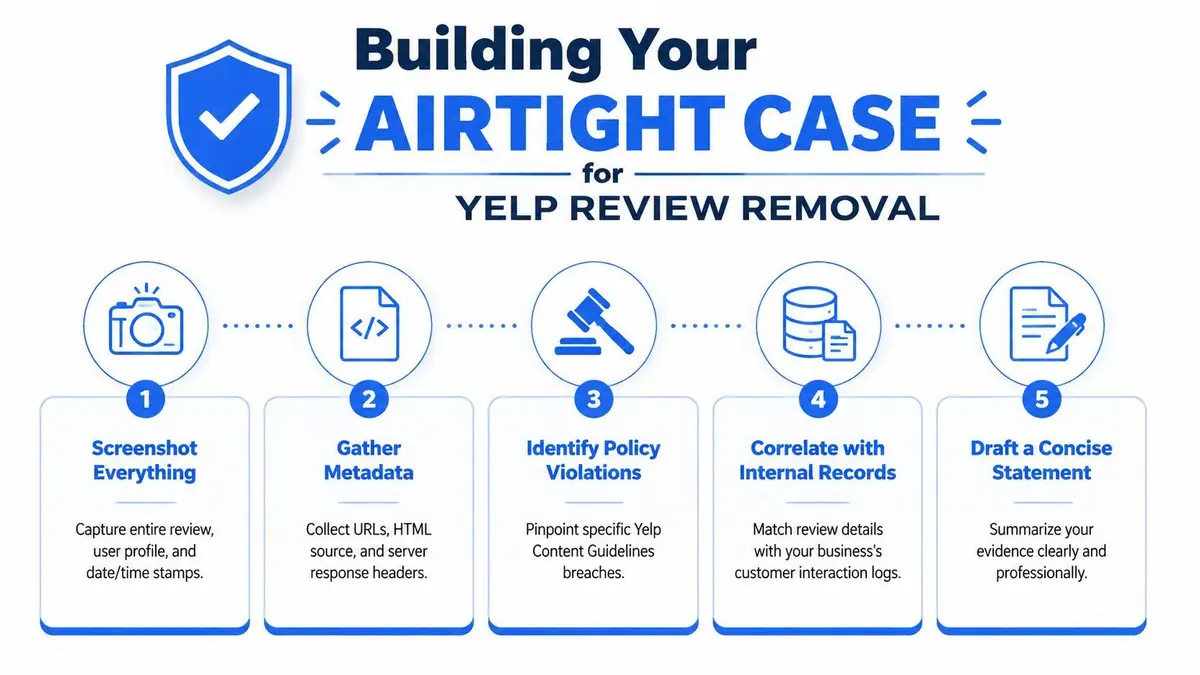
The difference between a failed report and a successful one is usually the file you build before you click “report.” Most businesses submit a complaint. You need to submit a dossier.
What belongs in the evidence file
Start with the obvious materials, but don’t stop there. Yelp moderators aren’t there to investigate your business from scratch. Your job is to reduce their workload by making the violation legible.
A strong evidence package can include transaction records showing no customer relationship, screenshots demonstrating conflict-of-interest patterns, and reverse-image-search results for profile photos or review images, which are identified as useful indicators in this guidance on spotting fake Yelp reviews and what to do next.
Build it like counsel would
Don’t dump screenshots into a folder and call it done. Organize the material so a moderator can understand it in minutes.
- Capture the review in full. Screenshot the review itself, the reviewer profile, the business listing context, and visible date and time details.
- Preserve the URL trail. Save direct URLs to the review and profile. If the content changes later, your original record matters.
- Cross-check internal records. Search bookings, invoices, CRM logs, support tickets, call logs, visitor management records, and employee notes.
- Test the profile for authenticity. Review the account’s other activity. Look for repeated attacks on similar businesses, suspicious account patterns, or a profile image that appears elsewhere online.
- Write a short chronology. State when the review appeared, what operational event may relate to it, and what your records do or don’t show.
Here’s the standard I use: if a moderator skimmed your file in two minutes, would the answer be obvious?
What to document for common fake-review scenarios
A brief table helps separate instinct from proof.
| Scenario | Best evidence |
|---|---|
| No record of the reviewer as a customer | Reservation logs, invoices, CRM search results, service records |
| Suspected competitor attack | Screenshots linking reviewer activity to competing businesses, overlapping themes, profile behavior |
| Former employee retaliation | Employment records, timing relative to separation, internal incident chronology |
| Fabricated images or profile identity | Reverse-image-search results, duplicate image matches, inconsistent profile details |
| False event description | Timestamped records showing the claimed visit or incident didn’t occur |
The moderator doesn’t need your outrage. The moderator needs something independently verifiable.
For larger organizations, this is also a governance issue. If different departments gather evidence inconsistently, you lose clarity fast. A formal corporate policy for removing fake reviews keeps legal, operations, customer service, and marketing from working at cross-purposes.
The statement that accompanies the file
Your written statement should be dry, short, and precise. That’s not a stylistic preference. It’s tactical.
Use this structure:
- Identify the review by date, reviewer profile, and URL.
- Name the violation category you believe applies.
- Summarize the evidence in plain terms.
- Request review under Yelp’s guidelines without threatening, pleading, or narrating your frustration.
Example:
We are reporting this review as not based on a genuine customer experience and potentially involving a conflict of interest. We have searched our transaction, reservation, and support records for the reviewer name, the facts described, and the date range referenced, and found no corresponding customer interaction. We are attaching screenshots of the reviewer profile, our internal record search, and profile indicators that suggest inauthentic activity for moderator review.
That is the tone. No speeches. No adjectives. No speculation you can’t support.
Executing the Removal Request Within Yelp
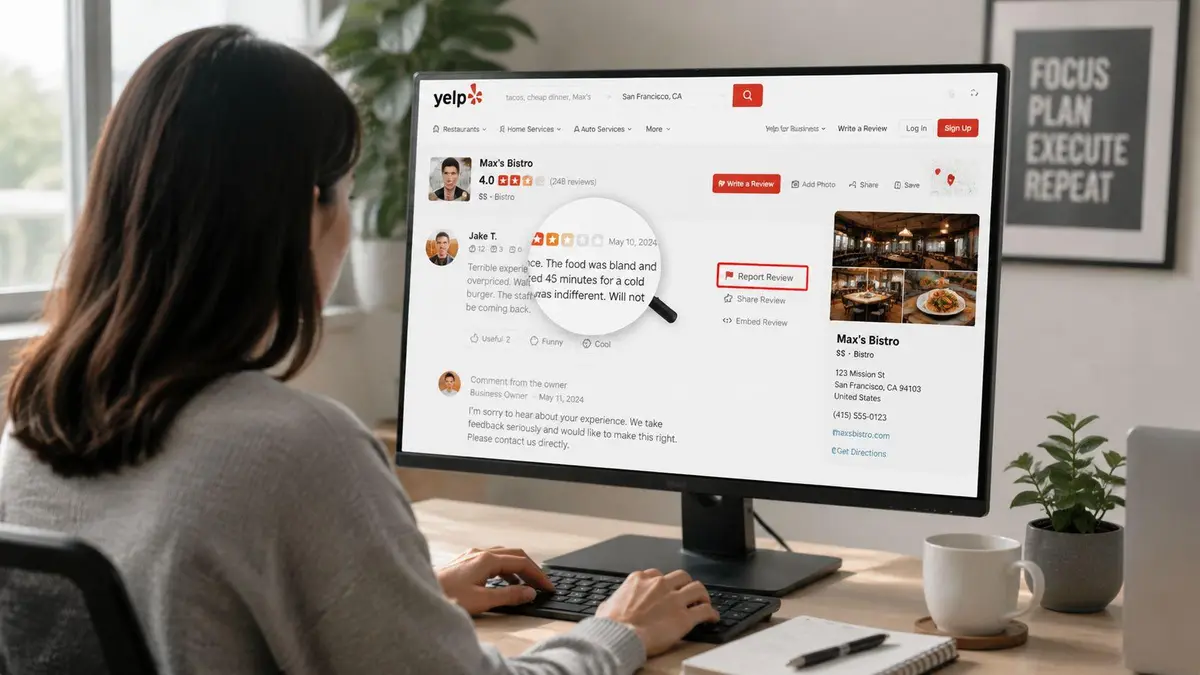
Once your evidence file is ready, use Yelp’s reporting system with discipline. Don’t treat the form like a complaint box. Treat it like a submission to a decision-maker who has limited time and no interest in your broader grievances.
Think like a moderator
Yelp’s own support guidance says businesses can’t directly delete reviews. They must report a review, provide information moderators can independently verify, and then wait while Yelp investigates, which may take several days, after which Yelp sends a notification, as stated in Yelp’s support article on false or defamatory reviews. That tells you exactly how to approach the process.
Moderators aren’t deciding whether the review feels unfair. They’re deciding whether the content violates a policy and whether your evidence can be corroborated without relying solely on your word.
Match the report to the strongest category
Don’t choose a category because it sounds emotionally satisfying. Choose the one your evidence supports best.
- Not based on a real experience works when your records show no customer relationship.
- Conflict of interest is stronger when the reviewer appears tied to a competitor, former employee, or interested party.
- Inappropriate content applies if the post includes hate speech, threats, privacy breaches, or other prohibited material.
- Extraordinary circumstances may apply in rare context-specific situations recognized by Yelp’s policy framework.
If you overload the report with every possible allegation, you weaken it. Pick the clearest path.
How to write the actual submission
A useful submission has three parts.
First, identify the review and category. Second, summarize the evidence in a few sentences. Third, attach or reference the supporting material in a clean sequence. If your report reads like a legal brief written in anger, rewrite it.
Here’s a simple model:
- Opening sentence: “We request review of this post under the ‘not based on a real experience’ category.”
- Evidence sentence: “Our reservation, transaction, and support records show no matching customer interaction for the reviewer identity, date, or factual scenario described.”
- Supporting sentence: “Attached are screenshots of the review, reviewer profile, relevant record searches, and additional indicators for moderator verification.”
That’s enough. More words usually make the request worse.
A short explainer can help your internal team understand the native process before they file:
What to do while Yelp reviews it
Don’t sit idle, and don’t panic-post.
If the review is visible, prepare a public response that is professional and restrained. Don’t accuse the reviewer of fraud in public unless you’re prepared for escalation. A better response acknowledges the concern, states that you can’t identify the interaction from your records, and invites offline contact.
Use this period to preserve more evidence as well. Profiles change. Reviews disappear. Associated accounts may post again. The quiet days while Yelp reviews a report are often the best time to map the wider pattern.
Targeting Advanced Threats The Anonymous Neutral Review
The most difficult fake Yelp reviews aren’t the absurd ones. They’re the quiet ones.
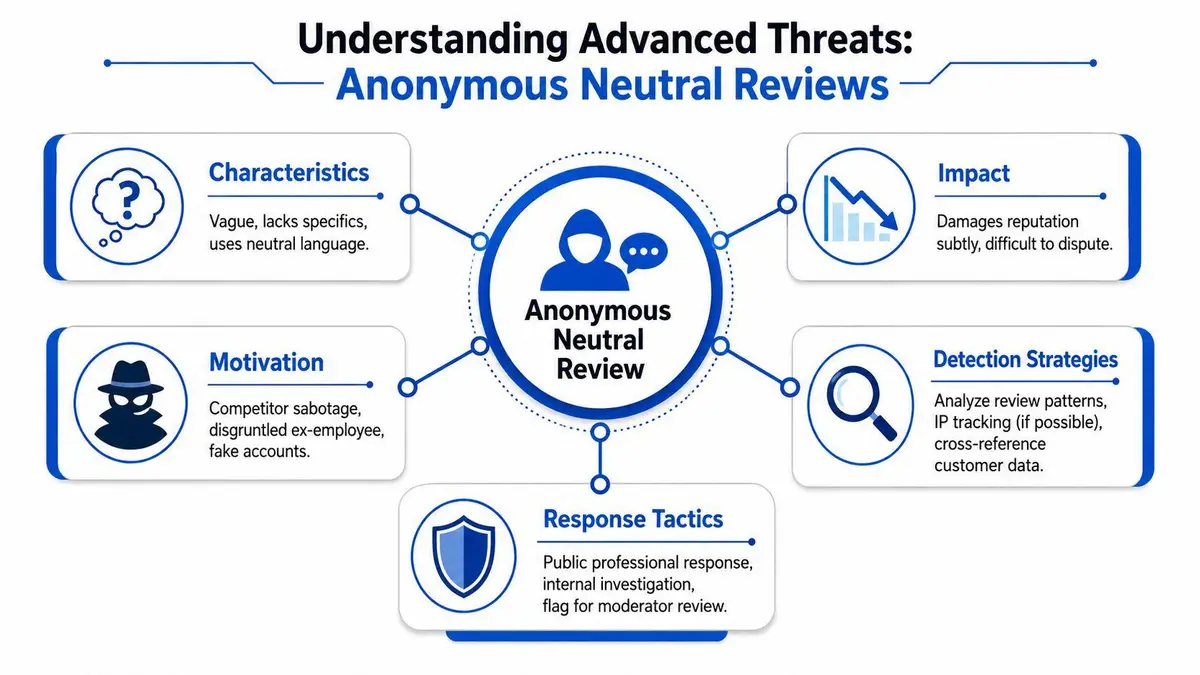
These reviews use mild, non-defamatory language. They don’t accuse you of criminal conduct. They don’t contain slurs, threats, or obvious falsehoods. They say the experience was “fine but disappointing” or “not what I expected.” Each one, standing alone, looks ordinary. In combination, they can degrade a rating, shape perception, and create hesitation among prospective clients.
Why these reviews are harder to remove
This is the blind spot in most guidance on how to remove fake Yelp reviews. Standard moderation is good at obvious violations. It is weaker against content designed to look authentic while remaining strategically vague.
In the last 12 months, platform data from major markets showed a 45% surge in anonymized fake reviews using vague, non-defamatory language, and 30% of successful removals for these neutral fake reviews required third-party forensic analysis of user accounts and IP logs. Those are the two numbers serious operators should remember because they confirm what many executives are already experiencing: the threat has become more subtle, and basic flagging is often insufficient.
Shift from content analysis to pattern analysis
When the text itself won’t carry the removal argument, look at behavior.
Ask these questions:
- Timing. Did several mild negative reviews appear around a competitive event, personnel dispute, or media issue?
- Account behavior. Does the reviewer have thin activity, unusual review clustering, or a suspicious mix of businesses reviewed?
- Language similarities. Do multiple accounts use the same phrasing, cadence, complaint structure, or oddly generic adjectives?
- Customer record mismatch. Can any of the factual fragments in the reviews be tied to real transactions?
- Cross-platform spillover. Do similar themes appear elsewhere under different names?
No single clue is decisive. The pattern is.
Neutral wording doesn’t make a review legitimate. It often makes the attack harder to detect.
What bad-faith proof actually looks like
You’re trying to demonstrate coordinated misconduct or bad-faith intent without overclaiming. That means assembling circumstantial evidence carefully.
A strong advanced-threat file often includes:
- A review timeline showing clustered publication windows.
- A comparison grid of recurring phrases and themes across multiple accounts.
- A customer-record analysis showing no support for the claimed interactions.
- Profile comparisons identifying suspicious overlap in business categories targeted or posting habits.
- Third-party forensic findings, where appropriate, when a matter is valuable enough to justify deeper technical work.
| Signal | Why it matters |
|---|---|
| Repeated vague phrasing across accounts | Suggests coordination rather than independent consumer experience |
| Negative posts aimed at similar competitors | Points toward organized market interference |
| No underlying transaction trail | Undermines authenticity of the claimed experience |
| Pattern begins after a business trigger | Supports motive analysis |
Inexperienced teams often fail. They keep trying to “prove falsity” in a review that was drafted precisely to avoid a clean factual dispute. The better strategy is to prove intent and pattern.
Escalation Pathways Beyond Yelp’s Platform
A rejected report isn’t the end of the matter. It means Yelp didn’t find enough, on that submission, to remove the content under its own process. If the review is materially harmful and your evidence is strong, escalation becomes part of the same campaign, not a separate idea.
When the platform route stalls
There are three common reasons to escalate. First, the review is fake but carefully drafted. Second, the reviewer is anonymous and the business impact is serious. Third, the pattern suggests a coordinated campaign rather than an isolated post.
At that point, stop repeating the same report with slightly angrier wording. Move to a structured escalation plan.
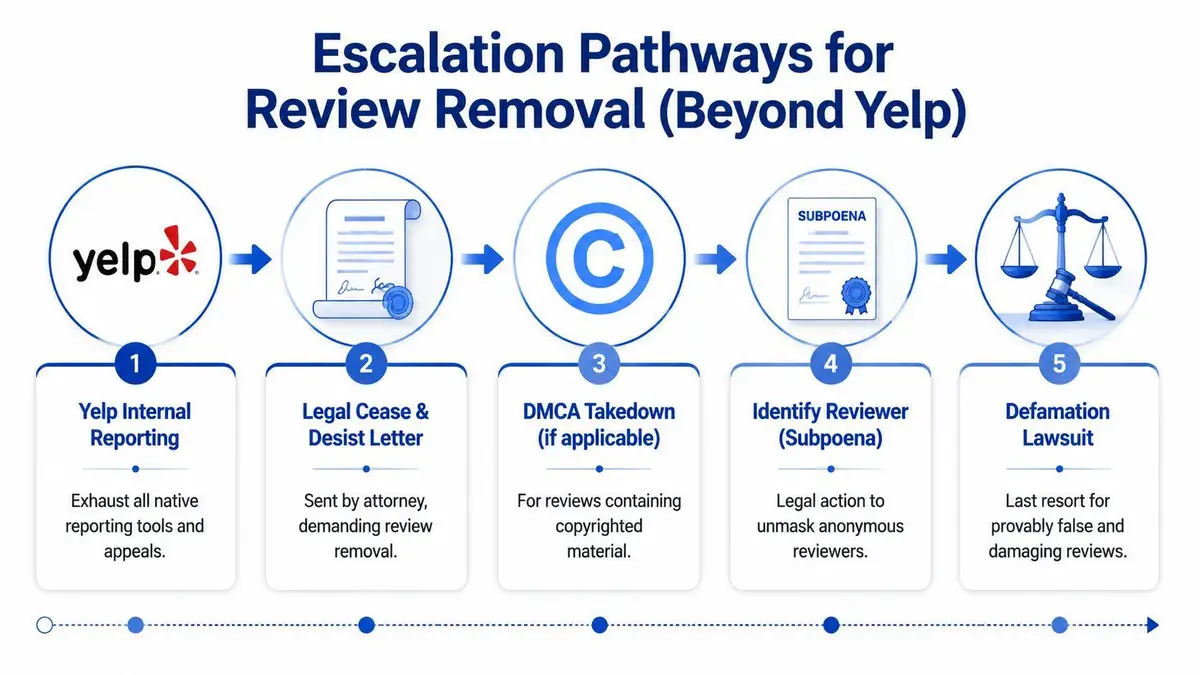
The escalation ladder
A sound escalation path usually follows this sequence:
- Complete the internal platform record. Preserve your original report, attachments, and any notification from Yelp.
- Send a lawyer-led demand where justified. A formal letter can frame the misconduct, preserve claims, and put the reviewer or relevant parties on notice.
- Use copyright tools if the review includes stolen material. If a reviewer used a copyrighted image or copied protected content, a DMCA route may apply.
- Seek to identify the reviewer. In serious matters, counsel may pursue subpoenas or court processes to unmask an anonymous actor where the law allows.
- Consider defamation or related claims. This is a last resort, reserved for provably false factual assertions that cause measurable harm.
Executive view: A platform denial is often just the point where evidence collection shifts into legal procedure.
Match the remedy to the misconduct
Not every bad review supports a lawsuit. Opinions are hard to attack. Provably false statements of fact are different. A fake review from a competitor or former insider may also raise issues beyond defamation, including interference, impersonation, or breach-related claims depending on the facts and jurisdiction.
The strongest escalations are selective. They focus on the review that opens the best legal path, not necessarily the most annoying one. If you’re dealing with concentrated review attacks across platforms, this strategic guide to removing review bombing on Google is useful because the escalation logic often overlaps even when the platform mechanics differ.
Preserve the optics while you escalate
Legal pressure and public posture should stay separate. Don’t advertise your escalation strategy in a public Yelp response. Keep the public reply calm and narrow. Let counsel handle the harder arguments privately.
That discipline matters. Judges, platforms, and counterparties all respond better when your public conduct looks measured and your private file looks meticulous.
When to Engage Professional Reputation Specialists
You can handle a straightforward fake review internally if the evidence is simple and the stakes are limited. Many cases are not like that.
If multiple suspicious reviews appear in a compressed period, if the language is carefully neutral, if there’s a credible link to a competitor or former insider, or if Yelp has already declined to act, the matter has moved beyond routine community management. It’s now a reputation risk issue with legal, technical, and operational dimensions.
The real cost of doing this slowly
Executives often hesitate at exactly the wrong moment. They tell themselves they’ll “watch it for a week” or let a junior marketer handle it. That delay gives bad actors room to post again, alter profiles, and harden the narrative around your business.
Specialists matter when the case requires more than reporting. That includes forensic review analysis, evidence preservation, coordinated platform and legal strategy, discreet handling for high-profile principals, and careful public positioning while the takedown effort runs in the background.
The threshold for outside help
Use outside specialists when one or more of these conditions are present:
- The review appears anonymous but coordinated with other posts or business events.
- The allegations carry reputational sensitivity for investors, clients, regulators, boards, or personal brand exposure.
- Your first report failed despite a credible policy argument.
- You need speed and discretion because public friction creates more risk than the review itself.
- The reviewer may need to be identified through legal or forensic channels.
A complex fake-review problem is rarely about one line of text. It’s about whether you can prove intent, protect your position, and suppress further damage before the pattern spreads.
If the issue is small, handle it cleanly. If it touches enterprise value, executive standing, or a personal reputation built over years, don’t improvise.
If you’re facing fake Yelp reviews and need a confidential, strategic response, ContentRemoval.com can assess the threat, determine whether the strongest path is platform reporting, forensic analysis, legal escalation, or a combined takedown strategy, and move quickly with the discretion high-value clients expect.
Frequently asked questions
Can a business delete a review on Yelp?
No. Yelp’s own guidance says businesses must report a review, supply information moderators can independently verify, and wait while Yelp investigates. Removal happens only when the review fits a policy category and the evidence holds up without relying solely on your word.
How do I prove a Yelp review is fake if it does not say anything obviously false?
Shift from content to pattern. Build a timeline showing reviews clustered around a business event, a comparison grid of repeated phrases across accounts, a customer record search showing no matching interaction, and profile comparisons showing thin or suspicious activity. No single clue is decisive; the combination is.
Should I reply publicly to a fake Yelp review while it is under investigation?
A restrained reply is fine. Acknowledge the concern, state that you cannot identify the interaction from your records, and invite offline contact. Do not accuse the reviewer of fraud in public or reveal any escalation plans, and use the waiting period to preserve more evidence before profiles change.