
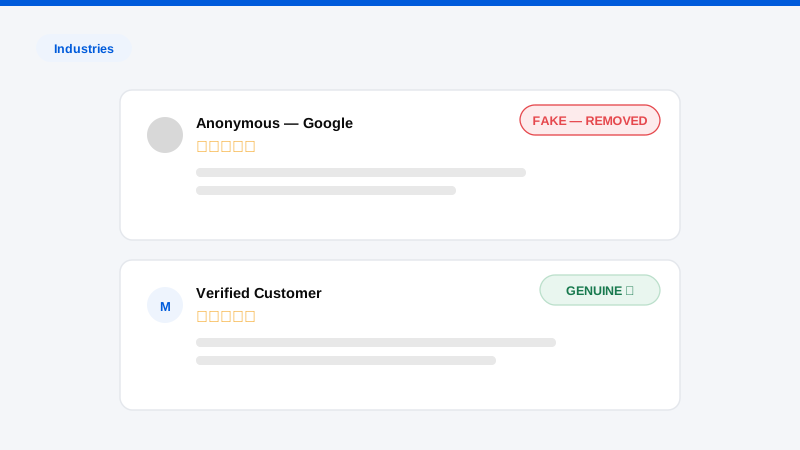
Reputation management for hotels and resorts is the discipline of controlling what travelers, travel agents, and booking algorithms see when they evaluate your property online. For a hotel, reputation is not a marketing abstraction. It is a revenue input that sits directly upstream of occupancy, average daily rate, and the ranking position your property holds on TripAdvisor, Google, Booking.com, and Expedia. When hostile or false content enters that ecosystem, it does not sit quietly. It compounds.
Most hoteliers discover this the hard way: a one-star review campaign after a disputed chargeback, a guest incident filmed on a phone and clipped for maximum outrage, a former employee posting accusations across review platforms, or an old news item about a prior owner that still ranks for the property’s name. The instinct is to respond publicly, apologize, and hope the algorithm moves on. It rarely does. Review platforms and search engines are built to surface engagement, and negative content about hotels generates engagement reliably.
This guide defines the threat landscape for hotels and resorts, explains what is actually at stake when damaging content takes hold, and describes what professional, removal-first reputation protection looks like, the model Content Removal has built its practice around. It is not a how-to. Removal is specialist work, and the properties that treat it that way recover fastest.
Why hotels and resorts are targeted
Hotels occupy a uniquely exposed position online. Almost no other business type combines all of the following: a physical premises open to the public around the clock, hundreds or thousands of strangers passing through every month, a purchase decision made almost entirely on the strength of reviews and photos, and a name that travelers actively search before paying.
That combination attracts several distinct categories of attacker and adversarial content:
Aggrieved guests seeking leverage. A guest disputing a cancellation fee, a damage charge, or an eviction for policy violations knows that a one-star review, or the threat of one, is negotiating leverage. Some follow through across multiple platforms at once, and some recruit friends and family to pile on, turning a single dispute into what looks like a pattern.
Coordinated review attacks. Competitors, disgruntled former staff, and organized review-bombing groups can flood a listing with negative ratings in days. Because OTA and TripAdvisor ranking algorithms weigh recency and velocity, a burst of fresh one-star reviews damages ranking position faster than years of steady five-star service built it.
Viral incident clips. A confrontation at the front desk, a pool altercation, a housekeeping dispute: filmed vertically, stripped of context, captioned for outrage, and posted to TikTok, Instagram, or X. The clip names the property, the platform’s algorithm rewards the outrage, and within days the video ranks in search results and appears in AI-generated answers about your hotel.
Extortion and fake-guest schemes. Hotels are frequent targets of review extortion: demands for refunds, upgrades, or payment in exchange for not posting (or for deleting) negative reviews. These reviews often come from people who never stayed at the property at all.
Legacy press and third-party content. A crime that occurred near the property, a lawsuit involving a previous operator, a health-inspection story from years ago, search engines do not retire this content on their own. It ranks beside your booking engine indefinitely unless something is done about it.
Key takeaway: Hotels are targeted not because they do anything wrong, but because their revenue model depends on public trust signals that anyone (guest, ex-employee, competitor, or stranger) can manipulate in minutes.
What’s at stake for a hotel’s revenue and ranking
The damage from hostile content is not limited to the content itself. It propagates through every system that decides whether a traveler sees, considers, and books your property.
Direct booking conversion. Travelers comparison-shop. When a prospective guest searches your property name and encounters a viral incident clip, a cluster of recent one-star reviews, or a defamatory forum thread, many simply book the property next door. You never see the lost booking; it registers only as softening pace.
OTA visibility and ranking. Booking platforms rank properties partly on review score and review recency. A depressed score pushes the property down the results page, which reduces impressions, which reduces bookings, which reduces the flow of fresh positive reviews, a self-reinforcing downward loop that discounting alone cannot break.
Rate integrity. Properties carrying visible reputation damage tend to defend occupancy by cutting rate. That decision cascades: lower ADR, lower RevPAR, a guest mix that reviews more harshly, and a brand position that takes seasons to rebuild.
Group, corporate, and event business. Meeting planners, wedding parties, and corporate travel managers run diligence before signing. Damaging search results that an individual traveler might scroll past can disqualify a property from an RFP entirely, silently and without feedback.
Asset value and flag relationships. For owners and management companies, sustained reputation damage surfaces in brand quality audits, franchise compliance reviews, and ultimately in valuation conversations. Lenders and buyers search the property’s name too.
AI-generated answers. Increasingly, travelers ask AI assistants where to stay. Those systems synthesize reviews, news, and forum content, including the damaging kind. Once false or hostile material is absorbed into AI answers about your property, it reaches travelers who never visit a review site at all. This is why AI reputation protection has become part of serious hotel reputation work.
Key takeaway: A single piece of damaging content doesn’t cost you one booking. It quietly re-ranks your property across every channel travelers use to decide, and the loss shows up as pace, not as a line item you can see.
See what guests find before they book.Free confidential Exposure Scan: live results on a 15-minute call, yours to keep either way.
Book Your Free ScanWhat professional reputation management for hotels looks like
Professional protection for hotels and resorts is removal-first. That ordering matters, and it is the core of how Content Removal works.
Most reputation vendors lead with suppression: publishing floods of new content to push damaging results down the page. Suppression has a place, but as a first move it has a fundamental flaw, the damaging content still exists, still ranks for long-tail searches, still feeds AI answers, and can resurface any time an algorithm shifts or a journalist links to it. For a hotel, “page two of Google” is not safety. It is deferred risk.
A removal-first engagement runs in a different order:
1. Full exposure assessment. Before anything else, a specialist maps every damaging item: fake and policy-violating reviews, defamatory posts, viral clips, hostile forum threads, outdated press, and scraped duplicates. Most properties are surprised by what a systematic sweep finds beyond the two or three items they already knew about.
2. Removal of what can be removed. Every major platform (Google, TripAdvisor, Booking.com, Expedia, Yelp, TikTok, Reddit) maintains content policies prohibiting fake reviews, extortion, harassment, impersonation, and defamation. Specialists who work these channels daily know how each platform’s enforcement actually functions, what evidence each one credits, and how to escalate when a first-line decision is wrong. This is the work behind our review removal and defamation removal services.
3. Search-level remediation. Content that cannot be removed at the source can often be addressed at the search-engine layer, through de-indexing pathways and search result removal strategies that eliminate the result from the queries that matter: your property name, your brand plus “reviews,” your general manager’s name.
4. Suppression and asset-building, in their proper place. Once removable content is gone, remaining items are displaced with truthful, well-structured positive assets. Suppression built on top of removal is durable; suppression built instead of removal is a subscription to anxiety.
5. Ongoing monitoring and protection. Reputation attacks recur, and review platforms never sleep. Continuous reputation monitoring catches new threats while they are hours old, before ranking algorithms and AI systems metabolize them. Our Protection Plans put a standing team behind the property so that new incidents are handled as routine operations rather than emergencies.
6. Earned-media counterweight. For flagged properties and resort brands, legitimate positive press placements strengthen the search landscape and give AI systems authoritative, current material to draw from.
Key takeaway: Removal-first protection eliminates threats instead of burying them. Everything else (suppression, monitoring, press) works better and lasts longer when it’s built on top of removal rather than instead of it.
Why DIY and generalist approaches fail hotels
Hotel operators are capable people, and the temptation to handle removals in-house is understandable. In practice, three things defeat the DIY approach.
First, platform enforcement is opaque and inconsistent. The public “report” button is the lowest-priority intake channel every platform operates. Reports written without the platform’s specific policy language, evidence standards, and escalation pathways are routinely rejected, and a rejected report can make later, properly constructed attempts harder.
Second, the response burns operational hours the property doesn’t have. General managers and front-office leaders end up spending revenue-generating time fighting platform bureaucracies, usually during the exact periods (post-incident, high season) when the property most needs them running operations.
Third, mistakes escalate. Responding angrily to a defamatory review, threatening a poster directly, or filing a clumsy legal demand can convert a contained problem into a story, the well-documented dynamic where heavy-handed responses amplify the original content. Specialists sequence actions to resolve problems quietly, not enlarge them.
Generalist marketing agencies fail for a different reason: removal is not marketing. It is a distinct discipline built on platform policy expertise, evidence preparation, and escalation experience across thousands of matters. An agency that “also does reputation” typically means an agency that does suppression.
Occupancy follows search results.Find out exactly what's dragging on your bookings with a free, confidential Exposure Scan, reviewed live with a specialist in 15 minutes.
Book Your Free ScanWhy hotels and resorts choose Content Removal
Content Removal LLC exists to do one thing at a professional standard: get damaging content taken down, keep it down, and protect the client from what comes next. Hotels and resort operators engage us because of how that focus shows up in practice.
Removal is the product, not an upsell. We lead with elimination of damaging content, then build monitoring and protection around the cleaned result. Our case studies reflect that ordering.
Platform-by-platform expertise. Review sites, OTAs, social platforms, forums, and search engines each have their own policies, intake channels, and escalation paths. Our specialists work those channels every day, across the full range of content types hotels face, from fake reviews to viral clips to hostile threads.
Discretion by default. Hotel reputation matters are handled confidentially. No public spectacle, no signature responses that advertise the problem, no case details shared without consent.
Honest scoping. We are not a law firm, and we do not promise outcomes, no honest firm can, because final decisions rest with platforms and publishers. What we commit to is a professionally executed effort by people who do this work constantly, and a clear-eyed assessment up front about what is realistically removable, what should be handled at the search layer, and what calls for suppression or press.
Standing protection, not one-off firefighting. Through our Protection Plans, properties get continuous monitoring, priority response when new content appears, and a team that already knows the property’s history, which is precisely what shortens response time when the next incident hits.
Frequently asked questions
Can fake or malicious hotel reviews actually be removed?
Frequently, yes, when they violate platform policy, and most malicious reviews do. Fake stays, extortion attempts, reviews from people with conflicts of interest, defamatory factual claims, and coordinated attacks all breach the published rules of Google, TripAdvisor, and the major OTAs. The gap between “policy-violating” and “actually removed” is where specialist work lives: evidence assembly, correct policy framing, and escalation when initial decisions go the wrong way. No firm can promise a specific result, but professionally prepared removal requests succeed far more often than button-click reports.
What about a viral video that names our property?
Viral clips are addressed on several fronts at once: platform policy review of the clip itself (harassment, privacy, and misinformation policies often apply), duplicate and repost tracking as the clip spreads, search-level remediation for the property-name queries where it ranks, and monitoring so new reposts are caught early. Speed matters more with video than with any other content type, because algorithmic distribution front-loads the damage into the first days.
Should we respond publicly to a review attack while removal is underway?
Usually with restraint, and sometimes not at all. Public responses are permanent, quotable, and visible to every future guest, and a defensive reply under a malicious review often does more harm than the review itself. Part of a professional engagement is deciding, item by item, what merits a measured public response, what should be handled silently through removal channels, and what should simply be left alone until it is gone.
Is ongoing protection worth it for a single independent property?
Independent properties are often the most exposed, because they lack a brand’s corporate support and a national flag’s weight with platforms. A single damaging cluster of content affects an independent’s entire revenue base rather than one property in a portfolio. Ongoing monitoring and a standing response arrangement are how smaller properties get enterprise-grade reaction time without an enterprise headcount.
Find out what’s already out there
Every hotel reputation problem was small once. The properties that avoid the expensive version are the ones that see the threat early, before the ranking damage, before the AI systems absorb it, before a meeting planner quietly strikes them from an RFP. Start with a free, confidential Exposure Scan: a specialist runs a live sweep of what travelers, algorithms, and AI assistants currently find on your property, walks you through it on a 15-minute call, and you keep the findings whether or not we work together. If there is nothing to worry about, you’ll know. If there is, you’ll know exactly what it is and what can be done about it.