
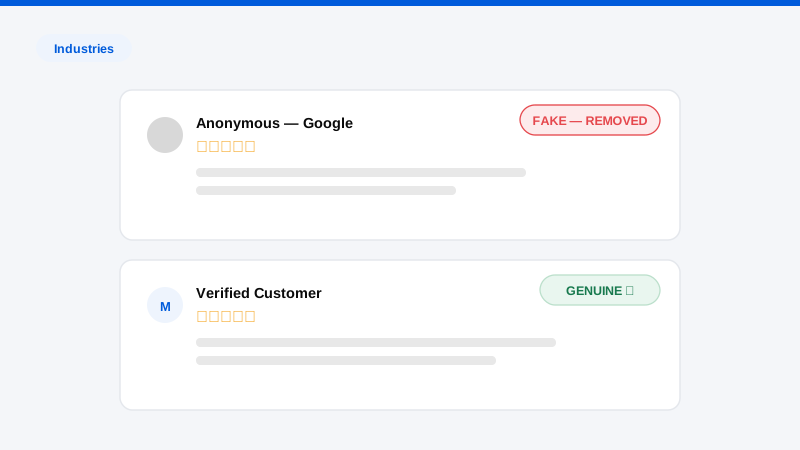
Reputation management for law firms is the discipline of controlling what clients, referral sources, opposing parties, and lateral candidates find when they research a firm and its partners online, and removing damaging content at its source rather than trying to shout over it. For a law firm, this is not a marketing exercise. It is risk management for the single asset every practice is built on: the presumption that the firm is competent, discreet, and safe to trust with a client’s worst problem.
Law firms occupy an unusual position in the reputation landscape. The firm’s brand and its partners’ individual names are researched separately and simultaneously, adversaries have both motive and sophistication, and the ethical rules that govern lawyer advertising and client confidentiality sharply limit how a firm can respond in public. A general counsel deciding between two firms for a bet-the-company matter will never tell you that a page-one complaint site result or a one-star review cluster tipped the decision. The firm simply doesn’t get the call.
This guide defines the threat landscape law firms face, explains what is actually at stake at the firm and partner level, and describes what professional, removal-first reputation management for law firms looks like in practice, including why firms that have tried to handle it internally almost always end up engaging specialists.
What reputation management for law firms actually means
Reputation management for law firms means auditing every result that appears when the firm name, its practice groups, and its individual partners are searched; removing or suppressing the content that damages client trust; and maintaining continuous monitoring so new attacks are caught within days instead of after a pitch is lost. The removal-first distinction matters. Most agencies that sell “reputation management” to law firms sell content marketing: blog posts, directory profiles, and press releases intended to push bad results down. That approach leaves the damaging content live, indexed, and one algorithm update away from page one.
A removal-first firm inverts the sequence. First, it works to get the damaging content itself taken down, de-indexed, or corrected at the platform level: defamatory posts, fake or policy-violating reviews, complaint-site entries, doxxing, and misattributed coverage. Only after removal avenues are exhausted does suppression become the fallback, and even then it is engineered around the specific queries clients actually run, not generic brand terms.
Key takeaway: For law firms, reputation management is a removal and search-integrity discipline first and a publishing discipline second. Anything that leaves the attacking content live has only managed the symptom.
Why law firms are targeted
Law firms attract online attacks at a rate that surprises even seasoned managing partners, because the practice of law manufactures adversaries as a byproduct of doing the job well.
Opposing parties and their proxies. Every contested matter produces at least one party with a grievance against the firm on the other side. Litigants who lose, or who simply resent the pressure of competent opposing counsel, increasingly take that grievance to Google reviews, complaint boards, and forums. These attackers are distinctive: they were never clients, they often have documents and case details that make their posts sound credible, and they sometimes coordinate across family members, business associates, or online communities. A review from someone who was never a client is a policy violation on most platforms, but platforms rarely act without a properly framed challenge.
Ex-client campaigns. A fee dispute, an adverse outcome, or a personality clash can convert a former client into a persistent publisher. Unlike a restaurant’s unhappy diner, an aggrieved legal client can post for years, across a dozen platforms, mixing genuine matter details with distortions in a way that is uniquely hard for the firm to rebut, because confidentiality obligations prevent the firm from telling its side. The asymmetry is total: the ex-client can say anything; the firm can say almost nothing.
Client diligence pressure. Sophisticated clients (general counsel, insurers, referral counsel, private-equity sponsors) run structured diligence on firms before engagement. They search the firm, the relationship partner, and the associates likely to staff the matter. Anything negative becomes a data point in a memo, and no one writes a memo defending a firm with visible baggage when a clean alternative exists.
Partner-level exposure. A firm’s search reputation is only as strong as its most-exposed partner. Divorce filings, decades-old bar coverage, a partner’s name in unrelated litigation, mugshot sites, and personal disputes all surface under name searches, and clients do not distinguish between the partner’s personal baggage and the firm’s fitness. Executive-level protection for named partners is inseparable from firm-level protection.
Lateral and associate recruiting. Candidates research firms as aggressively as clients do. Glassdoor narratives, law-school forum threads, and “toxic culture” posts shape which laterals return a recruiter’s call, long before the firm knows it was ever in consideration.
What’s at stake for a law firm
The stakes compound because legal services are purchased on trust, at high price points, in moments of stress, the exact conditions under which negative search results carry maximum weight.
Silent pipeline loss. The defining mechanism of law-firm reputation damage is that it is invisible to the victim. A prospective client who finds a “scam” thread or a cluster of hostile reviews does not call to ask about it. They call the next firm on the list. The matter never appears in the pipeline, so the loss never appears in any report. Firms routinely discover the scale of the problem only when a candid referral source mentions what they saw.
Referral network erosion. Law firms live on referrals from other lawyers, accountants, bankers, and past clients. A referrer stakes their own credibility on every introduction, and referrers are the most risk-averse audience a firm has. One visible controversy is enough for a referrer to quietly route work elsewhere, and referral loss, unlike a lost pitch, is never disclosed.
Rate and negotiation pressure. Clients who arrive having seen negative content arrive with leverage. Visible reputational damage translates directly into discount pressure, more aggressive outside-counsel guidelines, and shorter leashes.
Panel and RFP disqualification. Institutional clients, insurers, and lenders maintain approved-counsel panels with formal diligence. Adverse online content can disqualify a firm from a panel without the firm ever learning why the application stalled.
Confidentiality traps in DIY responses. This risk is unique to law firms. Partners who respond publicly to reviews or posts, even carefully, have drawn bar complaints for confirming representation or revealing matter details. The instinct to defend the firm in a reply is precisely the instinct that creates a second, worse problem. The safe response channel is removal, handled by a third party, not rebuttal.
AI-generated summaries. Prospective clients increasingly ask AI assistants “is [firm] reputable?” before they ever reach a search page. Those systems synthesize whatever is indexed, including complaint-site content and hostile reviews, into confident summaries. A firm that has never audited what AI systems say about it has an unmonitored front door.
See what prospects find before they call you.Free confidential Exposure Scan: live results on a 15-minute call, yours to keep either way.
Book Your Free ScanWhat professional protection looks like
Professional protection for a law firm is a standing program, not a one-time cleanup. Attacks recur because the adversary supply never stops. Every new matter creates new potential attackers. A serious program has four layers.
1. A full exposure audit. The engagement begins by mapping the firm’s actual search surface: firm name, common misspellings, every named partner, practice-group terms, and the “near me” and “[firm] reviews” queries clients actually type. The audit covers Google and Bing results, review platforms, complaint sites, forums, social platforms, image results, autocomplete suggestions, and AI-assistant answers. Most firms have never seen their exposure mapped this way, and the map alone changes how leadership thinks about the problem.
2. Removal at the source. Each damaging item gets an individual removal strategy based on what it is, where it lives, and which platform policies, legal frameworks, or de-indexing pathways apply. Fake and policy-violating reviews are challenged through platform enforcement channels with properly documented violations. Defamatory posts and complaint-site entries are pursued through the defamation-removal pathways appropriate to each platform. Where content cannot be removed at the host, search de-indexing can take it out of the results that matter. This is specialist work: the difference between a removal request that succeeds and one that is auto-rejected is usually in the framing, the evidence package, and knowing which escalation path each platform actually responds to.
3. Suppression engineered for legal-services queries. For the residue that cannot be removed, professional suppression builds durable, authoritative assets around the queries clients actually run: partner-name searches, “[firm] reviews,” practice-plus-city terms. Where it fits the firm’s profile, earned press placement adds the kind of high-authority coverage that both ranks and reassures.
4. Continuous monitoring and standing protection. The firms that stay clean are the ones under continuous reputation monitoring, with alerting on firm and partner names so a new attack is caught in days, while it is one post, not a thread with momentum. Structured Protection Plans put removal capacity on standby, which matters because speed is the single biggest variable in whether an attack becomes permanent: content challenged early, before it accumulates engagement and backlinks, comes down far more often than content challenged after it has settled into the index.
Key takeaway: Cleanup fixes the past; only a standing program with monitoring and on-call removal capacity protects the future. Law firms generate new adversaries with every matter, protection has to be continuous.
Why specialists outperform DIY reputation management for law firms
Law firms are the profession most tempted to handle this internally, the building is full of lawyers, and the profession for which DIY fails most predictably.
The core problem is that content removal is not primarily a legal exercise. Platforms are not courts. They respond to their own policies, their own evidence formats, and their own escalation channels, and a demand letter that would move a business counterparty is often the worst possible opening move with a platform’s trust-and-safety queue, or with an attacker who screenshots it and turns it into new content. Specialists work these channels daily and know, platform by platform, what actually gets acted on.
There is also the confidentiality problem: a partner engaging directly with an attacking ex-client walks a line the ethics rules make treacherous. A third-party specialist removes that risk entirely, and there is the attention problem, partner and marketing-team hours spent fighting platforms are hours billed at the firm’s opportunity cost, spent learning by trial and error what specialists already know. Firms that litigate reputational matters for clients routinely engage reputation-management specialists for their own exposure, for the same reason surgeons don’t operate on themselves.
See what prospects find before they call you.Free confidential Exposure Scan: live results on a 15-minute call, yours to keep either way.
Book Your Free ScanWhy law firms choose Content Removal
Content Removal LLC is a removal-first firm: our practice is built around getting damaging content taken down, de-indexed, or corrected at the source, not around content-marketing retainers dressed up as reputation work. That focus is why law firms in particular engage us.
We understand the constraints firms operate under. We never ask a firm to disclose matter details, we never engage attackers in ways that create ethics exposure for the firm, and we are not a law firm ourselves. We work alongside a firm’s own counsel where legal action is warranted, and handle the platform-level work courts can’t reach. We work at both levels a firm needs: the firm brand and the individual partners whose names carry the client relationships. Engagements are confidential by default, priced against defined scopes, and honest about odds. We tell firms upfront which items are strong removal candidates and which will need suppression, because no reputable firm guarantees outcomes in this field. Our case studies show the pattern of the work; a scoping call shows what it looks like against your firm’s actual exposure.
Key takeaway: Choose a partner on three criteria: removal-first methodology, confidentiality discipline, and candor about odds. A vendor who guarantees outcomes is telling you they don’t understand the work.
Frequently asked questions
Can negative reviews from people who were never clients be removed?
Often, yes, reviews from non-clients violate the review policies of most major platforms, and opposing parties, adverse witnesses, and their proxies are among the most common sources of fake law-firm reviews. Success depends on documenting the policy violation in the form the platform’s enforcement process actually acts on, which is exactly the specialist’s job. No outcome can be guaranteed on any single item, but non-client reviews are among the stronger categories for removal.
Should a partner ever respond publicly to a negative review or post?
Almost never, and for law firms the risk is unusually sharp: public replies have generated bar complaints for confirming representation or revealing client information, and replies feed engagement signals that can make hostile content rank better. The productive channels are platform enforcement, removal, and de-indexing, pursued by a third party so the firm itself never engages the attacker.
Our problem is one partner’s name, not the firm. Is that a firm issue?
Yes. Clients research the relationship partner as thoroughly as the firm, and diligence memos do not distinguish personal baggage from professional fitness. Partner-name exposure is firm exposure, which is why serious programs cover named partners individually alongside the firm brand.
How long does removal work take for a law firm?
It varies by item. Clear platform-policy violations can resolve in days to weeks; complaint-site content and de-indexing efforts can take months; suppression around competitive queries builds over months and then holds. A credible partner gives you item-by-item expectations after auditing your actual exposure rather than quoting a single timeline for everything.
Every day damaging content stays visible, it is quietly filtering the clients, referrals, and laterals who never call. The first step is simply knowing what your prospects see. Book a free, confidential Exposure Scan and walk through your firm’s live search results, partner by partner, on a 15-minute call. The findings are yours to keep whether or not we work together.