
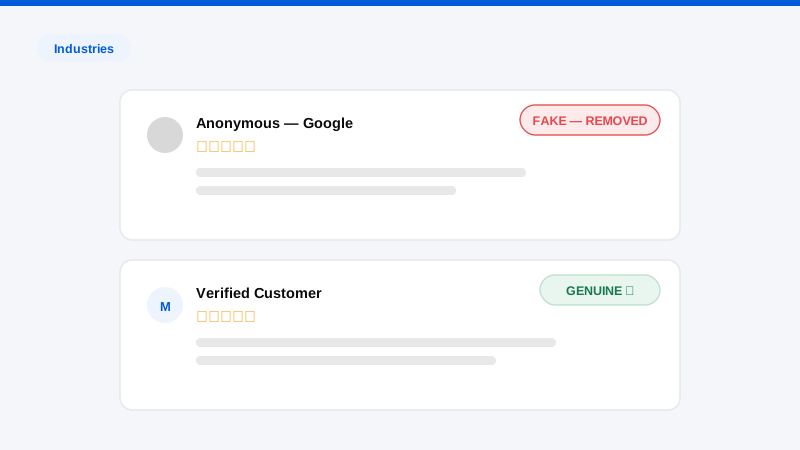
Reputation management for insurance companies is the discipline of monitoring, removing, and containing the hostile online content that policyholders, claimants, and their advocates publish about an insurer, before it hardens into the search results that shape buying decisions, agent recruitment, and regulator perception. Insurance faces a reputational physics unlike any other industry: the product is a promise, the moment of truth is a claim, and every claim decision that disappoints someone produces a motivated critic at the exact moment they are angriest, most sympathetic to outside observers, and most likely to write about it.
No insurer, however well run, escapes this dynamic. Underwriting discipline requires that some claims be denied, adjusted, or delayed for investigation, and the public narrative machinery of reviews, social platforms, and forums does not distinguish between a fraudulent claim properly denied and a valid claim wrongly handled. Both produce the same one-star review, the same outraged post, the same “this company will take your premiums and abandon you” story. The insurer’s side, bound by privacy obligations and litigation caution, mostly goes untold. Over years, this asymmetry accumulates into review profiles and search results that are structurally worse than the insurer’s actual conduct.
This guide defines the threat landscape insurance companies operate in, explains the mechanisms by which claim-denial outrage and review pile-ons convert into commercial and regulatory cost, and sets out what professional, removal-first reputation management for insurance companies looks like, and why carriers, MGAs, and large agencies increasingly treat it as standing infrastructure rather than crisis response.
What reputation management for insurance companies involves
Reputation management for insurance companies involves four coordinated functions: continuous monitoring of the insurer’s name, products, and executives across review platforms, social media, forums, and search; removal of fabricated, misattributed, and policy-violating content at the source; containment of viral outrage events while they are still containable; and long-term engineering of the search results that policyholders, producers, and institutional counterparties actually see. The removal-first orientation is the defining choice: rather than accepting every hostile item as permanent and trying to publish over it, a removal-first program first asks, item by item, whether the content violates platform policy, defames, misattributes, or otherwise qualifies for takedown or de-indexing, because removed content cannot resurface, while buried content can and does.
This is materially different from the social-listening dashboards and PR retainers most insurers already have. Listening tells you what is being said; PR shapes what you say. Neither gets a fabricated review off your Google profile, a doxxing post about an adjuster taken down, or an outdated pile-on de-indexed from “[company] reviews.” That is removal work, and in most insurance organizations nobody owns it.
Key takeaway: Insurers typically have monitoring and messaging but no removal capability, the middle function that actually reduces the volume of hostile content rather than measuring or answering it.
Why insurance companies are targeted
The structure of insurance guarantees a continuous supply of attackers, and several accelerants make the industry’s exposure sharper than other financial services.
Claim outcomes create motivated critics at scale. Every denied, reduced, or delayed claim disappoints someone experiencing a loss: a totaled car, a flooded home, a medical crisis, a death in the family. Emotion, sympathy, and a villain-shaped narrative slot are all pre-loaded. The policyholder’s story writes itself; the insurer’s response (often legitimate, sometimes not) is trapped behind privacy law and litigation exposure. The result is a permanent one-way flow of negative content that has nothing to do with whether the insurer is good at its job.
Denial stories are built for virality. Among all consumer grievances, the claim-denial story is uniquely shareable: high stakes, identifiable victim, faceless institution. Social platforms reward exactly this shape, and a single sympathetic post (accurate, partial, or false) can gather thousands of shares, spawn copycat threads, trigger review floods, and attract media follow-up within days. Public sentiment toward insurers means the audience arrives pre-convinced; the industry has, at various moments, watched individual denial narratives dominate national attention for weeks. Virality is not a tail risk in insurance. It is a standing weather condition.
Review pile-ons follow every event. Catastrophe seasons, premium increases, nonrenewal waves, and viral posts each trigger surges of one-star reviews. Many from people who are not policyholders at all but arrived via the outrage. Pile-on reviews are frequently policy-violating (no customer relationship, coordinated origin), which makes them removable in principle; in practice they are removed only when challenged quickly and correctly, as a documented pattern.
Aggregators, attorneys, and advocacy sites. An ecosystem of complaint aggregators, bad-faith-litigation marketing pages, and advocacy content targets insurer brand queries deliberately, pages engineered to rank for “[company] claim denied” and “[company] complaints” because the traffic has commercial value to someone else. These are professional adversaries for whom the insurer’s search results are the product.
Executives and adjusters as individual targets. Outrage increasingly personalizes: executives are named in viral posts, and front-line adjusters have been doxxed and harassed over claim decisions. Executive-level protection and rapid takedown of doxxing content are now part of an insurer’s duty of care to its own people, a dimension of the threat model that barely existed a decade ago.
What’s at stake
The costs of unmanaged reputational damage in insurance run through four distinct channels, several of them unique to the industry.
Direct-channel acquisition and retention. Insurance shopping is search-driven and comparison-heavy. Prospects evaluating carriers read reviews and search “[company] reviews” as a matter of course; a profile dominated by denial outrage raises acquisition costs across every marketing channel, because paid traffic and organic traffic alike arrive at the same damaged surface, and quote-to-bind conversion quietly absorbs the loss. At renewal, hostile content works on existing policyholders the same way, priming them to shop.
Distribution-channel erosion. Independent agents and brokers place business where claims reputation supports the sale, because a carrier’s claim-handling reputation lands on the agent who recommended it. Producers read the same reviews consumers do, and a carrier whose search profile makes it harder to sell loses shelf space silently, no agent announces they’ve stopped leading with you. Agency recruitment suffers on the same surface.
Regulator and legal perception. Insurance is a conduct-regulated industry, and regulators are human readers. Visible accumulations of complaint content shape the ambient perception in which market-conduct inquiries, rate filings, and complaint-ratio reviews happen, and plaintiff’s attorneys actively mine hostile reviews and viral threads for bad-faith narrative material and potential clients. Reducing the volume of false and policy-violating content in the index is, among other things, litigation-surface reduction. None of this replaces actual conduct compliance; it ensures the public record reflects the insurer’s real conduct rather than an accumulation of distortions.
AI-mediated shopping. Consumers now ask AI assistants which insurers to trust and whether a given carrier “actually pays claims.” These systems synthesize review profiles, forum threads, and news coverage into confident summaries that shape shortlists before a human ever reaches the insurer’s site. An insurer that has never audited what AI systems say about it has ceded its most scalable first impression to whatever the index happens to contain.
See what prospects find before they call you.Free confidential Exposure Scan: live results on a 15-minute call, yours to keep either way.
Book Your Free ScanWhat professional protection looks like
For an insurer, professional protection is standing infrastructure with an event-response capability, closer to a security function than a marketing program.
Enterprise exposure audit. The engagement begins with a full map of the insurer’s hostile-content surface: review profiles across every platform and location page, complaint aggregators, forum and social threads, attorney-marketing and advocacy pages ranking on brand queries, executive-name results, autocomplete, and AI-assistant summaries. For multi-line, multi-state insurers this surface is large and usually unowned: distributed across brand, claims, legal, and regional teams, with no single view. The audit creates that view and triages it: removable, de-indexable, containable, suppressible.
Removal at the source. Fabricated and policy-violating reviews are challenged through platform enforcement: non-customer reviews, pile-on patterns, misattributed complaints intended for other companies, coordinated floods documented as events rather than flagged one by one. Defamatory and harassing content (false factual claims, doxxing of adjusters and executives, impersonation accounts) is pursued through each platform’s actual takedown machinery. Content that cannot be removed at the host is evaluated for de-indexing from the brand queries where it does its commercial damage. At insurer scale, this work is a pipeline, not a project: a standing docket of items moving through platform processes continuously.
Outrage-event containment. When a denial story goes viral, the first seventy-two hours decide most of the outcome. Professional containment runs parallel tracks: identifying and challenging the policy-violating portions of the surge (fake reviews, doxxing, fabricated documents) while they are provably anomalous; coordinating with the insurer’s communications and legal teams on what the company itself says; and protecting named employees. Containment does not mean suppressing legitimate criticism. It means preventing an emotional event from permanently installing false and policy-violating content in the insurer’s search profile.
Suppression, authority, and press. For the hostile residue that survives removal, and at insurer scale there is always residue, professional suppression builds durable authority around the brand queries that matter, with earned press coverage supplying the high-authority assets that both rank and reframe. Standing monitoring with executive-name coverage and a Protection Plan keeps detection and removal capacity always-on, because the next event is never far away.
Key takeaway: Insurers should treat reputation the way they treat catastrophe exposure: continuous monitoring, pre-positioned response capacity, and the understanding that events are recurring, not exceptional. The carriers that fare best in outrage events are the ones whose protection was standing before the event began.
Why specialists beat in-house reputation management for insurance companies
Insurers have communications teams, social teams, and in-house counsel, and still lack the specific capability this work requires, for reasons that are structural rather than a talent gap.
Platform enforcement is its own practice area. The difference between a removed fake review and a rejected flag lies in policy fluency, evidence formatting, and escalation-path knowledge that only accumulates across hundreds of matters on each platform, volume no single insurer’s internal team ever develops. Worse, in-house teams burn strong cases on weak first attempts, and platforms treat re-challenges of rejected flags skeptically.
Legal instincts misfire in moderation queues. The corporate reflex (demand letters, legal threats) is often counterproductive with platforms and radioactive with viral content, where a screenshot of an insurer’s legal threat becomes the story’s second act. Specialists calibrate pressure to the venue: policy challenge where that works, host-level request where that works, legal referral where the facts genuinely warrant it, always with an eye on how the move reads if published.
Event response cannot be improvised. During a viral denial story, the communications team is fully consumed by the message; nobody has spare capacity to run item-level removal across five platforms with correct documentation under time pressure. That is what a standing reputation-management partner is for. The removal track runs on specialist capacity while internal teams run the narrative track.
See what prospects find before they call you.Free confidential Exposure Scan: live results on a 15-minute call, yours to keep either way.
Book Your Free ScanWhy insurance companies choose Content Removal
Content Removal LLC is a removal-first firm: our practice is the item-level work of getting hostile content taken down, de-indexed, and corrected at the source, the capability insurers consistently lack in-house. Carriers, MGAs, and large agencies engage us for the specific strengths their threat model demands.
We run removal as a pipeline, at the scale and cadence insurer exposure requires, with reporting that shows leadership exactly what came down, what was de-indexed, and what remains. We respond to pile-on events as events, with the speed that determines whether a flood becomes permanent history. We protect the people as well as the brand, executives and front-line claims staff targeted by doxxing and harassment. We integrate cleanly with existing functions: alongside your communications team, alongside your counsel, we are not a law firm and do not provide legal advice, and inside your confidentiality requirements, without ever needing claimant data to do our work, and we are candid about odds, item by item, because no one can guarantee outcomes in this field and an insurer, of all buyers, should distrust anyone who guarantees against uncertainty. Our case studies show the shape of the work.
Key takeaway: The right partner for an insurer operates like a standing capability, not a campaign: pipeline removal, event response, executive protection, and honest item-level probabilities.
Frequently asked questions
Can reviews from people who were never policyholders or claimants be removed?
Frequently, yes. Major platforms require a genuine customer relationship, and pile-on reviews from outrage traffic, misattributed complaints meant for other insurers, and coordinated floods all violate policy. The work is in the documentation, establishing the pattern or the non-relationship in the form each platform’s enforcement process accepts, and in acting while the anomaly is still provable. Individual outcomes can’t be guaranteed, but non-customer reviews are among the most consistently winnable categories.
A claim-denial story about us is going viral right now. What can removal work actually do?
It cannot and should not erase legitimate criticism, but viral events always carry a removable layer: fake reviews from non-customers, doxxing of employees, impersonation accounts, fabricated documents, and defamatory embellishments that platforms prohibit. Challenging that layer in the first days, while the surge is provably anomalous, determines how much of the event becomes permanent search history. The narrative itself belongs to your communications team; the removable layer belongs to specialists, and both tracks need to run at once.
Does removing false content risk looking like we’re silencing policyholders?
Removal-first work properly done targets content that violates platform rules or misstates facts (fabricated reviews, non-customer pile-ons, doxxing, defamation) through the platforms’ own enforcement processes. Genuine customer criticism is addressed through service recovery and suppression-by-authority, not takedown attempts that would fail anyway. The distinction is not cosmetic: platforms adjudicate every challenge, and the process only removes what their policies prohibit.
How does this interact with our regulatory and litigation posture?
Carefully and cooperatively. Removal work reduces the volume of false and policy-violating content in the public record, which matters because regulators, plaintiff’s attorneys, and jurors all read the same internet. It never substitutes for conduct compliance, and it must be coordinated with counsel, which is how we operate by default. We are not a law firm; we execute the platform-level work courts and regulators do not reach, alongside the advisors who handle the rest.
Somewhere in your book of business, the next outrage post is already being drafted, and whether it becomes a permanent fixture of your search results depends mostly on what is standing before it lands. See your current exposure first: book a free, confidential Exposure Scan and walk through your company’s live results (brand, products, and executives) on a 15-minute call. The findings are yours to keep either way.