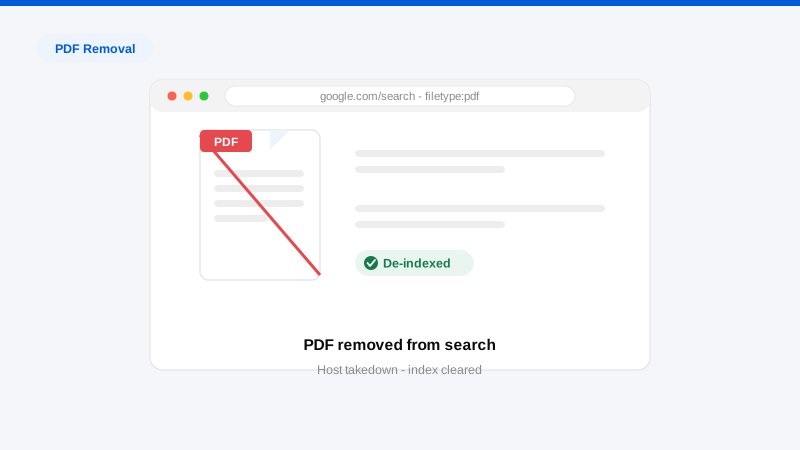
To remove a PDF from Google Search, you remove or restrict the file at its host, then tell Google the source changed — using the Refresh Outdated Content tool for dead files or, if you control the site, Search Console’s removals tool. If the file can’t come down, Google’s policy-based removals still apply to PDFs: files exposing personal information (Social Security numbers, financial account data, contact details in doxxing contexts) qualify under the personal-information policies, and copyrighted documents qualify for DMCA de-indexing. PDFs are ordinary URLs to Google — the difficulty isn’t the format, it’s that the documents involved (court records, old filings, directories) tend to have uncooperative hosts.
Executives meet this problem in predictable forms: a court filing uploaded by a docket aggregator, a decades-old donor or member directory, a university or association newsletter, a scanned legal notice, a leaked internal document. Each has a different best route, but the architecture is always the same: source first, index second.
What kinds of PDFs qualify for removal?
PDFs on sites you (or your organization) control. The simple case: delete or de-index the file, then use Search Console’s removals tool for immediate hiding and permanent drop-out after recrawl. Old prospectuses, board minutes, and event programs on your own domain are a ten-minute fix that organizations somehow leave ranking for years.
PDFs exposing personal data. Google removes results containing government ID numbers, bank and credit card numbers, images of signatures, and medical records under its longstanding personal-information policy — and its results-about-you process covers contact details (address, phone, email) in many cases. Old directories, membership rosters, and scanned forms frequently qualify. This pairs with our personal data removal service, since the same data usually also sits on broker sites.
Court documents and dockets. The official court record generally can’t be removed, but the copies often can. Docket aggregators and law-blog reposts respond to takedown requests at meaningful rates, sealed or expunged matters support demands to third-party hosts, and many filings contain personal data that triggers redaction rules or Google’s policies. The full playbook — including per-aggregator behavior — is in our court record removal service.
Copyrighted documents. Leaked reports, book chapters, paid research, and internal materials posted without authorization come down via DMCA notice to the host, then de-indexing for stragglers — our DMCA takedown service handles both ends.
What doesn’t qualify: accurate public-interest documents on legitimate hosts — regulatory actions on agency sites, court opinions on official portals, news outlets’ document uploads. For these, the honest strategies are contextual (updates, responses) and positional (suppression), not removal.
Step-by-step: the PDF removal process
- Map every copy. Search the document’s distinctive phrases in quotes, plus
filetype:pdfqueries with your name and the document title. PDFs get mirrored, scraped, and re-uploaded; a removal plan that misses copies fails in week two. - Classify each URL. Own domain, cooperative third party, aggregator, official government host, or hostile host — the route differs for each.
- Remove at the source. Delete files you control. For third parties, send the appropriate instrument: a takedown or redaction request citing the specific harm, a DMCA notice for copyrighted material, or a legal demand for sealed/expunged matter. Aggregators and site owners honor well-founded, specific requests far more often than executives expect — and ignore vague “please remove this” emails.
- Restrict what can’t be deleted. Cooperative webmasters who won’t delete will often add a noindex directive or block the file in robots.txt — for your purposes, de-indexed is functionally removed.
- Clear the index. For files now dead or changed: Google’s Refresh Outdated Content tool (see our strategic guide to the refresh tool). For your own domains: Search Console removals. For qualifying personal data: Google’s personal-information removal forms via our Google hub. Repeat on Bing.
- Verify and monitor. Quoted-phrase searches a week later confirm the sweep. Then monitor — documents recirculate, especially litigation-related ones, and catching a re-upload in week one keeps it from re-ranking.
Get a Free, Confidential Exposure Scan
Honest timelines — and why PDFs rank so stubbornly
Source removals at cooperative hosts run days to weeks; aggregators and court-adjacent hosts, weeks to months; DMCA takedowns, typically under two weeks at U.S. hosts. Index cleanup after a source change is fast — hours to days. Policy-based de-indexing of personal data usually resolves in one to three weeks.
Why PDFs hold rankings so tenaciously: they live on old, high-authority domains (courts, universities, associations); they’re text-dense and keyword-rich, exactly matching name searches; they rarely get edited, so Google sees a stable document it has trusted for years; and they accumulate links from citations. The same properties mean that once a PDF is genuinely gone and de-indexed, the result usually stays gone — PDF problems are hard to start solving and unusually durable once solved. What no one can promise: removal of official records from government sites or accurate documents from major news organizations. Suppression and context are the honest tools there, and we’ll tell you so in the first conversation.
Frequently asked questions
Can Google remove a PDF if the website won’t take it down?
Only under its removal policies: personal information (ID numbers, financial data, contact details in qualifying cases), NCII, or copyright via DMCA. Outside those categories, Google won’t de-index a live file on someone else’s site — which is why the source-first strategy isn’t optional, it’s the whole strategy.
How do I remove a court filing PDF that shows my personal information?
Three parallel tracks: ask the court about redaction (most rules prohibit unredacted SSNs and financial account numbers in filings), send removal requests to the third-party hosts and aggregators carrying copies, and file Google personal-information removals for qualifying data. Sealed or expunged matters add legal leverage against republishers — see court record removal.
The PDF is gone but still shows in search results. Why?
Google hasn’t recrawled the dead URL yet — listings routinely outlive their files by weeks. Submit the URL through the Refresh Outdated Content tool; dead-file removals typically clear within days. Check for mirrored copies if the snippet persists from a different URL.
Someone re-uploaded a document we already removed. Do we start over?
The second removal is almost always faster — you have the template, the host list, and (for copyright) a repeat-infringement record that hosts take seriously. The real fix is monitoring so re-uploads get caught at day one instead of after they rank. That continuous coverage is what our Protection Plans provide.
Can you remove a PDF from an official government website?
Generally no, and be wary of anyone who says otherwise. What’s achievable: redaction under court and agency rules, sealing/expungement where law allows, removal of the unofficial copies that actually rank for your name, and de-indexing of qualifying personal data. That combination resolves most of the practical harm in most cases.
If a PDF is surfacing in searches for your name or your company, the first step is mapping every copy and classifying what’s removable. Request a free, confidential Exposure Scan — you’ll get a route-by-route assessment through our process before committing to anything.