
Removing New York City arrest mugshots works on three fronts at once: source removal through DMCA or host notices, search de-indexing through URL-level Google submissions, and legal demands built on record status, particularly CPL Article 160 sealing and Civil Rights Law 52-b for New York-based publishers. Start with a full audit, because the image rarely lives in one place.
Key facts
- Audit name plus borough, arrest terms, and charge labels across web, image, cached, and social results, then reverse image search
- CPL Article 160 sealing becomes the legal backbone once a case ends in dismissal or acquittal
- Civil Rights Law 52-b turns a polite request into a statutory notice for New York-based publishers
- Do not contact every site at once; some operators clone pages or change URLs when pressured carelessly
Where ContentRemoval.com comes in. ContentRemoval.com coordinates the three fronts for New York clients: publisher notices matched to record status, Google web and image de-indexing, and continuous monitoring for scraper reposts and AI-generated fakes. Criminal defense counsel, a family office, or the executive’s chief of staff usually makes contact, often ahead of a financing or board review. A free 15-minute Exposure Scan maps what is removable, and the report is yours to keep. Get a Free, Confidential Exposure Scan or read how our mugshot removal work is done.
You search your name before a board meeting, an investor dinner, a financing close, or a media appearance. A stark booking photo appears. Sometimes it sits on a mugshot site. Sometimes it’s cached in Google Images. Sometimes it has already been copied into smaller scrape-and-republish sites you’ve never heard of.
For a high-profile person, this is not a nuisance. It’s a live reputational event. Clients, lenders, journalists, political opponents, school communities, and family offices don’t investigate context with much patience when a search result hands them a mugshot.
Most advice on new york city arrest mugshots is amateurish. It assumes one takedown request solves the problem. It doesn’t. Effective work is coordinated, evidence-driven, and legal from the start. If you mishandle the first week, you make the cleanup slower, more public, and less durable.
The Moment a Mugshot Surfaces
The shock is predictable. The response usually isn’t.
A founder gets flagged by a colleague before a fundraising roadshow. A physician sees a booking image after a credentialing review. A public figure learns that a years-old arrest image now outranks their official biography. The details vary, but the underlying problem is the same. Search results flatten nuance. They turn an arrest, a dismissal, a sealing issue, or even stale data into a permanent headline.
The first mistake is emotional action. People email the site owner directly, threaten litigation before they understand the record status, or start clicking every result repeatedly, which only confirms relevance signals and spreads the link internally. The second mistake is assuming the image came from one place. It rarely does. Arrest data moves through official systems, public records channels, aggregators, and secondary scrapers. If you don’t understand that pipeline, you’ll remove one copy and leave ten others untouched.
For a concise explanation of how this ecosystem works, review this breakdown of how mugshot sites work. It tracks the mechanics frequently ignored until a crisis occurs.
What this discovery actually means
A visible mugshot does three things immediately.
- It reframes your identity: Searchers now see an arrest image before they see your qualifications, company profile, or published work.
- It invites replication: Smaller sites copy larger ones. Social users screenshot and repost.
- It changes the burden of proof: You now have to explain something you may not legally need to explain in any other context.
Practical rule: Treat the first discovery as evidence of a distribution problem, not a single-page problem.
What sophisticated clients do next
They stop improvising. They preserve evidence, isolate who needs to know, and start a controlled response. If criminal counsel is already involved, reputation counsel and digital takedown specialists need to coordinate with that legal posture rather than freelance around it.
That discipline matters because mugshot removal is often less about argument and more about sequencing. The correct filing, the right screenshot, the right de-indexing submission, and the right legal basis used in the right order can change the result. Sloppy outreach can harden a publisher’s position and create a record you didn’t need.
Initial Assessment and Damage Control
The first 48 hours should be methodical. You are building a case file, not venting frustration.

Start with a full digital audit. Search your name in quotes, your name plus borough, your name plus arrest-related terms, and your name plus any known charge label. Review web results, image results, cached results, and social mentions separately. Then run reverse image searches on the mugshot itself. Google is only the front door. The distribution trail usually extends well beyond it.
Document everything. Capture screenshots that show the URL, page title, date, visible image, and any defamatory annotations. Save the source code or a PDF copy where useful. Build a spreadsheet with columns for domain, URL, status, host, indexed or not indexed, contact route, and legal basis. If you later need to push host notices, search removals, or legal demands, this record is the difference between a controlled operation and chaos.
What to look for in the audit
Don’t limit the search to obvious mugshot domains. You’re looking for:
- Primary publishers: The original page hosting the photo or arrest profile.
- Search engine visibility: Standard search, image search, cached snippets, and related-search associations.
- Secondary copies: Data brokers, scraper blogs, forum reposts, and social shares.
- Context contamination: Autocomplete, “people also search for,” or false charge labels attached to the image.
One fact matters here because it corrects a common and dangerous assumption. Data from ContentRemoval.com’s case studies shows that 78% of NYC clients in a 2025 analysis of 500+ cases sought mugshot removals for non-conviction arrests, with a 92% success rate via DMCA notices and legal demands, while public searches revealed persistent images 5+ years post-release, as referenced in the NYC custody lookup context at NYC 311 arrest and inmate information.
Triage by exposure, not emotion
Not every result deserves the same immediate effort. Prioritize by actual damage potential.
| Priority level | What it includes | Why it goes first |
|---|---|---|
| Critical | Google page-one results, Google Images, major mugshot sites | These shape first impressions fastest |
| High | Indexed secondary reposts, social screenshots, high-authority forums | These spread and can outlive the original |
| Medium | Non-indexed copies, obscure aggregator pages | Lower visibility, but still part of the footprint |
If the matter ended in dismissal or acquittal, don’t assume the internet knows that. It doesn’t. Your audit has to identify every page still presenting the arrest as current, unresolved, or simply stripped of context.
What not to do
Three moves routinely make matters worse:
- Don’t contact every site immediately. Some operators react by cloning pages, changing URLs, or becoming harder to deal with.
- Don’t rely on one search term. High-profile subjects often have alternate spellings, middle initials, company-name associations, and image-only visibility.
- Don’t let internal teams freelance. An assistant, in-house PR person, or junior lawyer can create an inconsistent paper trail in hours.
Control starts with inventory. Until you know the full spread, you don’t have a takedown strategy. You have guesswork.
Executing a Multi-Pronged Takedown Strategy
A one-lane approach fails because the exposure exists on three fronts at once. The site hosts the image. Search engines amplify it. The legal record behind it may or may not support publication anymore.
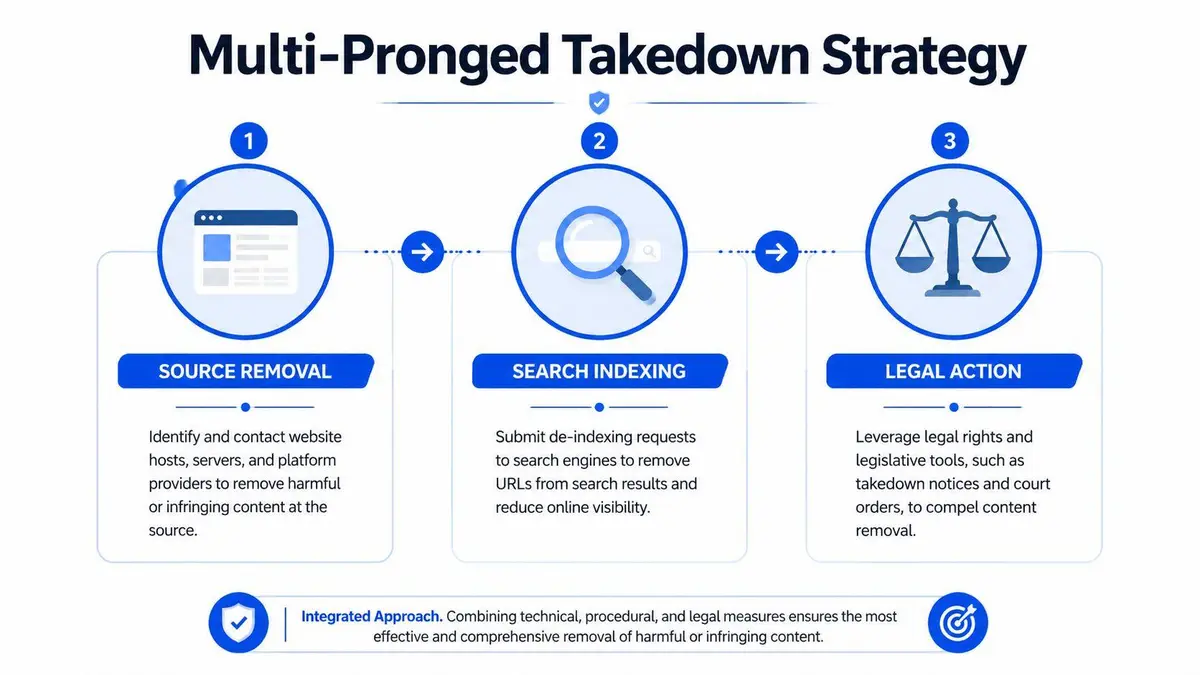
Treat those as separate battlefields. They require different tools, different wording, and different timing.
Front one is source removal
Many individuals start at this point, and many fail because of poor execution.
For compliant sites, direct takedown pressure works. Removal success rates for compliant sites average 85-95% via targeted de-indexing and source takedowns. The process involves DMCA notices to hosts with 92% compliance, New York Civil Rights Law §52-b takedown letters with 98% success, and Google de-indexing with 48-72 hour processing, according to the NYPD year-end 2023 enforcement report.
That doesn’t mean you blast out generic templates. It means you identify whether the publisher is New York-based, whether the host is responsive, whether the image is being used in a way that opens a copyright route, and whether the page contains false or stale annotations that justify a more aggressive legal posture.
Front two is search suppression by de-indexing
This is not the same as removal. It is often faster, and for many clients it’s the most urgent first containment step.
If a URL disappears from Google search and image results, public exposure drops sharply even if the file still exists on the source domain. That’s why search work should run in parallel, not after source removal fails. Use accurate URL-level submissions. Match the request type to the problem. If the content changed, use outdated-content removal. If the issue is privacy or legal status, the submission has to reflect that basis clearly.
For a focused explanation of this part of the process, see this protocol for getting a mugshot off Google Images.
Front three is legal leverage
High-profile matters separate from mass-market takedown services in these instances. You need a legal theory that matches the record status and the publisher’s position.
Here is the clean comparison:
| Takedown path | Best use case | Limitation |
|---|---|---|
| DMCA or host notice | Responsive US hosts, unauthorized image use, fast action | Weak against offshore or evasive operators |
| Search de-indexing | Immediate visibility control | Doesn’t always remove the source itself |
| Statutory and record-based legal demand | Sealed, dismissals, non-convictions, NY-based publishers | Requires accuracy and documentation |
The right sequence is usually parallel, not linear. You don’t wait for one channel to fail before you activate the next.
The mistake executives make
They assume money or status gives them an advantage with the publisher. It usually doesn’t. Precision does.
A flawed demand letter can educate a bad actor without cornering them. A vague search request gets rejected. An uncoordinated legal filing can conflict with criminal counsel’s priorities. High-visibility clients need quiet pressure, exact evidence, and a documented path to permanence.
This is also why “reputation management” isn’t just SEO in this setting. SEO might help later. At the crisis stage, the work is takedown law, records analysis, platform procedure, and search mechanics.
Navigating New York’s Unique Legal Landscape
New York gives you stronger tools than many people realize. It also punishes sloppy assumptions.
The broad background matters because it explains the pipeline. Between 2011 and 2018, New York City witnessed a 50% decrease in misdemeanor arrests and an 83% drop in criminal summonses. This policy shift, driven by reforms curtailing stop-and-frisk practices, directly impacts the volume of new arrest records entering public-facing databases, according to the Data Collaborative for Justice enforcement analysis.
That trend is helpful at the population level. It does nothing for the individual whose image is already online. If your mugshot exists, your case turns on record status, sealing, publisher location, and the accuracy of the page.
CPL sealing is not optional leverage
If the arrest ended in dismissal, acquittal, or another qualifying outcome, New York’s sealing framework under Article 160 can become the legal backbone of the takedown campaign. Once sealed, the event should not continue functioning as a public identity marker on third-party sites.
But here’s where clients go wrong. They think “sealed” is a magic word. It isn’t. You need the actual documentation, you need to present it correctly, and you need to apply it to each publisher and search channel in a way they can process. A sealed record that never gets operationalized into takedown notices is just paperwork sitting in a file.
Civil Rights Law §52-b matters more than most people think
For New York-based publishers, §52-b can be a powerful direct lever. It shifts the conversation away from politeness and toward legal obligation. The difference is practical. A request asks. A statutory notice compels.
That’s why understanding the current legality of mugshot publication matters. This analysis of whether mugshot sites are legal is useful because it maps the regulatory posture rather than treating every site as if it operates under the same risk profile.
The legal question is often bigger than the mugshot
In some cases, the arrest image sits inside a broader dispute involving misconduct, wrongful force, or bad police process. When that happens, reputation strategy should align with litigation strategy. If the underlying arrest itself is contested because of officer conduct, review resources on New York police excessive force lawsuits to understand how the factual foundation of the arrest may intersect with digital cleanup.
A takedown campaign is strongest when the legal record, the publisher notice, and the search submissions all tell the same story with the same dates and the same documents.
What New York clients should demand from counsel
- Record-status clarity: Was the case dismissed, adjourned, reduced, sealed, or left in a posture that still needs motion practice?
- Publisher-specific strategy: A New York publisher is not the same as an offshore scraper.
- Search-ready documentation: Court orders and sealing records should be prepared for platform review, not just filed and forgotten.
For new york city arrest mugshots, New York law is not background color. It is a removal tool. Used properly, it changes the negotiation entirely.
Confronting Advanced Threats and Proactive Defense
The idea that one takedown solves the problem is outdated.

Publishers scrape each other. Search engines recrawl. Images get reposted to low-visibility domains that later surface when authority shifts. If you remove a mugshot once and stop monitoring, you haven’t solved the problem. You’ve paused it.
The newer threat is worse because it doesn’t even require a real arrest image. An emerging threat is the surge in AI-generated fake NYC arrest mugshots, with reported deepfake incidents rising 340% since Q2 2025. Over 60% of these fakes mimic mugshots, targeting high-net-worth individuals for extortion, as described in the NYC inmate lookup context page.
Reuploads are not an edge case
A removed image can return through:
- Scraper networks: One source site feeds several clones.
- Cached visibility: Search snippets or image thumbnails outlast the page.
- Forum reposts: Users upload screenshots that evade the original takedown basis.
This is why high-profile clients need ongoing watch systems, not periodic vanity searches. Google Alerts can help at the edges, but they won’t catch everything. Reverse image searching, proprietary crawlers, and structured brand monitoring are what close the gap.
Fake mugshots create a different kind of crisis
A fake arrest image is often harder for the public to dismiss than you’d expect. People don’t stop to authenticate. They react first.
That means your response has to include forensic review. Check metadata where available. Compare image artifacts across known booking standards. Verify whether the alleged arrest appears in official custody or case systems. Then move quickly on platform impersonation, fraud, extortion, and manipulated-media grounds where appropriate.
The reputational damage from a fabricated mugshot can equal the damage from a real one. Sometimes it’s worse, because false images often spread with more sensational captions.
What a proper defense posture looks like
| Threat | Reactive response | Proper defense |
|---|---|---|
| Re-indexing | Submit one more removal request | Monitor continuously and trigger repeat actions fast |
| Clone sites | Focus on the original publisher only | Track downstream copies and hosts |
| AI fakes | Deny publicly and hope it fades | Authenticate, preserve evidence, remove, and watch for variants |
At this level, reputation protection looks more like security operations than public relations. That’s the correct model.
Building Your Long-Term Reputation Shield
If you only chase visible URLs, you’ll stay in cleanup mode forever.
The stronger position is governance. That means reviewing old matters for sealing eligibility, aligning criminal record strategy with digital exposure strategy, and putting your name, image, and known identifiers into continuous monitoring before the next problem appears. High-profile people don’t need a better apology cycle. They need less surface area.
The long-term legal side matters. New York’s Clean Slate framework gives some individuals a route to reduce the records that keep feeding public visibility. The technical side matters just as much. Facial recognition hashing, image matching, and active watchlists help catch resurfacing before it reaches page one.
The payoff for being proactive is not subtle. For long-term protection, proactive strategies combining legal avenues like NY’s Clean Slate Act with AI facial recognition hashing deliver 96% reputation recovery, compared with 40% for untreated or reactive approaches, according to the Data Collaborative for Justice 2024 report.
The right mindset for high-stakes clients
- Treat this as infrastructure: Reputation protection should sit beside legal, security, and communications planning.
- Assume recurrence: If an image existed once, act as if it may return.
- Build discreetly: The best shield is usually invisible to the public and disciplined behind the scenes.
A mugshot crisis feels personal because it is personal. But the solution is not emotional. It is strategic, layered, and persistent. That’s how you get from exposure to control, and from control to permanence.
If a mugshot, arrest record, or AI-generated fake is threatening your name, move fast and keep the response contained. ContentRemoval.com works with executives, public figures, family offices, and legal teams on discreet takedown strategy, de-indexing, monitoring, and long-term reputation protection. Start with a confidential assessment and get a precise action plan before the problem spreads further.
Frequently asked questions
How do I get a NYC mugshot removed from Google Images?
Run search de-indexing in parallel with source removal, not after it. Submit each URL to Google with the request type matched to the problem: outdated-content removal if the page changed, or a privacy and legal-status basis where the record is sealed or the case was dismissed. Removing the result from web and image search drops exposure sharply even if the file still exists on the host.
Does a sealed record in New York force mugshot sites to take the photo down?
Sealing under CPL Article 160 gives the takedown campaign its legal backbone, but the word alone does nothing. You need the actual documentation, presented correctly to each publisher and search channel in a form they can process. For New York-based publishers, a Civil Rights Law 52-b notice adds statutory weight.
What if the mugshot showing up is fake or AI-generated?
Treat it as a manipulated-media and extortion case. Check metadata, compare artifacts against known booking standards, and verify whether the alleged arrest appears in official custody or case systems. Then move on platform impersonation, fraud, and manipulated-media grounds, preserve evidence, and watch for variants.