
To find info on a person lawfully, start with a written purpose and off-limits list, then map the digital footprint with search operators such as site:, filetype: and inurl:, username enumeration and reverse image search. Move to corporate registries, court dockets and property records, treat phone and email lookups as leads only, and verify identity, timing and source hierarchy first.
Key facts
- Open-source research is generally lawful until conduct escalates into repeated contact, deception or intrusion.
- Primary documents outrank reposts, screenshots and forum retellings; ten echoes of one claim are one source.
- No federal law compels data brokers to remove accurate public records, and sex offender status is excluded from opt-outs.
- Removal timelines vary: social content 2 to 7 days, publisher outreach 1 to 3 months, legal up to 6 months.
Where ContentRemoval.com comes in. ContentRemoval.com is where this kind of search usually ends up when it turns up something harmful: impersonation accounts, leaked material, false allegations or data broker exposure tied to you, a principal or a family member. We verify what is real, choose the correct removal pathway and sequence source removal, de-indexing and suppression. Counsel, a family office or a security lead usually makes contact. A free 15-minute Exposure Scan maps what is removable and the report is yours to keep. Get a Free, Confidential Exposure Scan or read how our content removal work is done.
You’re usually not trying to find info on a person because you’re curious. You’re trying because something already feels wrong.
A prospective partner has a story that doesn’t line up. A former employee has started circling your staff online. A family office is vetting someone who suddenly appeared in an inner circle. Litigation is coming, or already here, and you need facts before the other side shapes the record first. In those situations, sloppy searching is dangerous. It produces noise, misses the core issue, and can create legal exposure you didn’t have when you started.
The right approach is defensive, disciplined, and built around one principle. You are not collecting gossip. You are building an evidentiary map. If you need to find info on a person, do it with a risk framework, a verification standard, and a clear stopping point.
Framing the Inquiry Legally and Ethically
High-stakes searches need a lawful reason before they need a search bar. If your purpose is due diligence, threat assessment, internal security, witness location, or fact development for counsel, you’re on firmer ground. If your purpose drifts into intimidation, manipulation, or personal fixation, you’re creating a second problem.
The line matters because open-source intelligence is not the same thing as harassment. Publicly available information can often be reviewed lawfully. Repeated contact, deceptive access, impersonation, account intrusion, or attempts to bypass privacy controls can turn a defensible inquiry into misconduct fast. A 2026 analysis of privacy concerns around free people-search tools noted that non-law entities are increasingly using these tools for OSINT that can border on harassment, and that searching itself is generally lawful until conduct escalates into something actionable (Reddit privacy discussion on OSINT and legality).
Start with purpose, not tools
Before you search, answer three questions in writing.
- What decision are you trying to make? Hiring, partnership, threat response, settlement posture, family protection, or vendor diligence.
- What would change your decision? A criminal filing, undisclosed business interest, impersonation network, media archive, or litigation history.
- What sources are off-limits? Private accounts, pretext calls, credential sharing, and anything that would violate law, platform rules, or your own governance standards.
That last point is where experienced clients often fail. They assume urgency justifies improvisation. It doesn’t.
Practical rule: If you’d be uncomfortable defending the method to opposing counsel, a regulator, your board, or a judge, don’t use it.
Regulated contexts change the rules
If the inquiry touches housing, employment, lending, or consumer reporting, your process needs another layer of discipline. A landlord screening a tenant, for example, can’t treat online rumor as verified adverse data. The same compliance logic appears in broader background review settings, which is why practical guidance on landlord FCRA risk control is useful even outside real estate. It forces the right question: what are you allowed to collect, how are you using it, and what proof supports it?
Ethics isn’t a soft concern here. It’s operational control. A legally clean inquiry preserves your options later. A reckless one damages credibility, alerts the subject, and can compromise any future removal, litigation, or security response.
Initial Digital Footprint Mapping
The first phase is broad but not casual. You’re creating a structured map of public exposure. Individuals often type a name into Google, scan the first page, and think they’ve done research. They haven’t. They’ve looked at what the algorithm chose to show them.
To find info on a person properly, you need to force precision.
Use search operators like instructions
Start with the obvious identifiers: full legal name, common variations, city, employer, school, known usernames, email fragments, and phone number formats. Then narrow and expand using search operators.
- Use
site:to isolate a platform or domain. Search one network, one forum, one county site, or one publication at a time. - Use
filetype:when you’re hunting for PDFs, resumes, pleadings, meeting minutes, presentations, or cached reports. - Use
inurl:to surface profile pages, author archives, docket paths, and directory structures. - Use quotation marks around exact names, then remove them to catch misspellings and fragmented mentions.
- Exclude noise with minus operators when a common name collides with celebrities, academics, or unrelated executives.
This isn’t about cleverness. It’s about reducing false positives. A common-name subject can generate pages of useless material unless you cage the query tightly.

Map platforms, then map relationships
Social media research is rarely about what the subject posts directly. It’s about what others reveal around them. Tagged photos, public comments, event attendance, old bios, repost patterns, and dormant accounts often expose more than a polished primary profile.
Check LinkedIn, X, Facebook, Instagram, TikTok, YouTube, Reddit, GitHub, Medium, Substack, and niche industry forums. Then look sideways. Who tags them repeatedly? Which accounts share contact details, old usernames, or location clues? Which profile photos are reused?
A surprisingly effective tactic is username enumeration. One handle often travels across multiple platforms for years. If the subject uses the same username on a gaming forum, a professional network, a marketplace, and an old photo site, those fragments can form a coherent timeline. That same logic also explains why data broker exposure becomes dangerous, especially for executives and families; this deeper privacy risk is covered well in this guide to what data brokers are and why they matter for executive privacy.
Search behavior itself can become part of the threat landscape. What starts as lawful OSINT can become harassment when a third party begins monitoring, targeting, or escalating against the person they researched.
That distinction matters because the target usually has no early intervention option. The Reddit privacy analysis cited earlier makes the point clearly: lawful searching often occurs long before conduct crosses into something authorities will act on.
Build a record while you search
Don’t trust memory. Log each result with:
- URL and platform
- Date accessed
- Why it matters
- Confidence level
- Whether it appears primary, derivative, or manipulated
That last label saves time later. If ten pages repeat one false claim, you don’t have ten facts. You have one source with nine echoes.
Beyond Search Engines and Social Media
Once the surface web is mapped, the inquiry gets more technical. At this point, you stop asking “what can I find?” and start asking “which systems are most likely to hold the right type of information?”
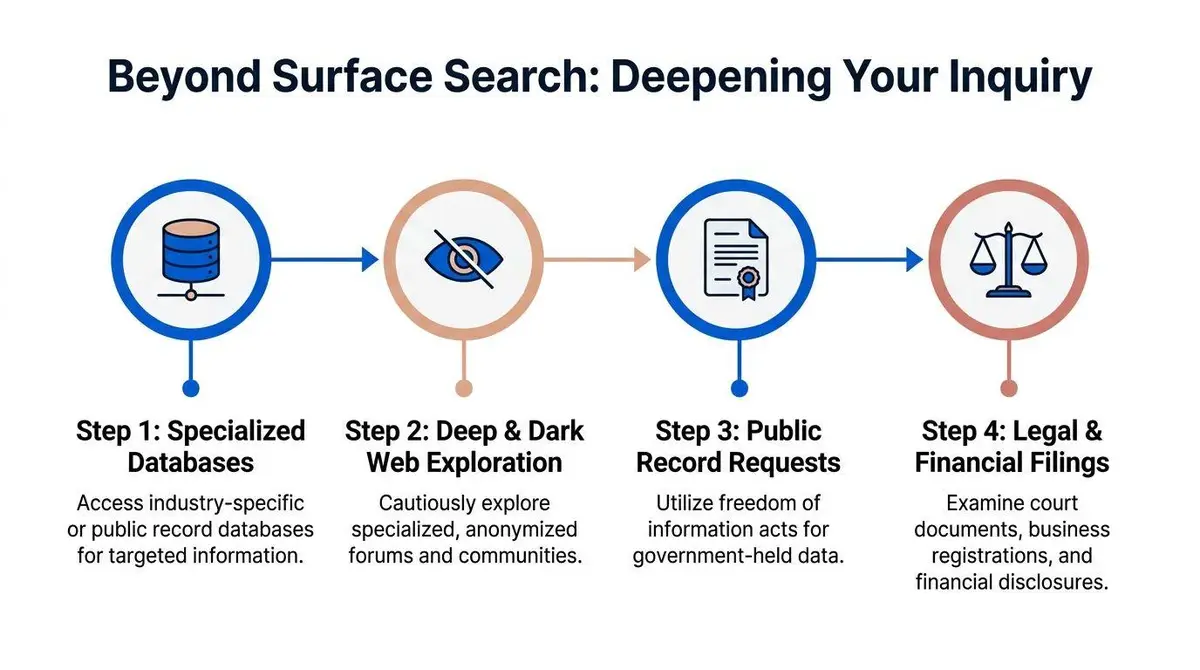
Use specialized systems for specific questions
Professional networks tell you one thing. Academic archives tell you another. Corporate registries, licensing boards, court portals, and industry directories often reveal the affiliations that ordinary search results bury.
A clean way to think about it is this:
| Source type | Best use | Common trap |
|---|---|---|
| Professional networks | Career chronology, role claims, mutual connections | Taking self-reported titles as verified |
| Academic databases | Publications, citations, institutional ties | Confusing authors with similar names |
| Corporate registries | Entity ownership, officer roles, registration history | Missing state-by-state variation |
| Reverse lookup tools | Directional leads from phone or email | Treating stale broker data as fact |
If your inquiry overlaps with real estate, distressed assets, or ownership tracing, the tactical mindset used in selecting tools to find motivated sellers is relevant. Not because you’re prospecting, but because it shows how professionals compare fragmented records, contact data, and public filings without assuming any single tool is authoritative.
Reverse image search is underused
A single photograph can reveal more than a bio ever will. Run profile photos, event images, and cropped headshots through reverse image tools to locate older accounts, reposts, impersonation profiles, or original publication sources.
Use reverse image search for four things:
- Identity confirmation when multiple profiles share a face but different names
- Impersonation detection when a subject’s image appears on fraudulent accounts
- Timeline reconstruction by tracing the earliest upload you can find
- Context recovery when an image was clipped out of a larger article, event page, or legal notice
Archived material becomes critical here, especially if pages were changed or removed after attention began. In such cases, older captures, caches, and preserved snapshots can be useful. For a more technical treatment of this layer, review how to find archived private information.
Treat phone and email lookups as leads, not evidence
Phone and email lookup services can be useful, but mostly as pointers. They may suggest past addresses, alias spellings, social profiles, relatives, or associated businesses. They also produce stale, blended, and occasionally wrong data.
Use them to generate hypotheses, not conclusions.
The right standard is simple. If a phone lookup result would matter in a legal, employment, or security decision, verify it somewhere else before you rely on it.
The same caution applies to dark web discussion boards and invite-only forums. They can reveal risk, but they also contain fabrication, impersonation, and recycled leaks. If you’re not trained to work in those environments safely, don’t wander into them.
Navigating Public Records and Databases
Public records feel definitive because they’re structured. That confidence is useful, but it can also mislead. Government databases still contain gaps, delays, jurisdictional inconsistencies, and records that require interpretation.
What records usually matter most
For high-stakes diligence, four categories tend to matter first:
- Property records for ownership, transfers, liens, and mailing addresses
- Court dockets for civil disputes, criminal matters, restraining orders, and procedural posture
- Corporate filings for officer roles, registered agents, and entity history
- Voter and local registration data where lawfully accessible and relevant
County clerk sites, secretary of state databases, assessor portals, and federal court systems are often the core sources. But they’re fragmented. One county posts scanned PDFs. Another uses text entries with minimal detail. A federal docket may show filings that a local site doesn’t, and vice versa.
If your concern is detention status, custody verification, or recent arrest processing in a specific jurisdiction, a practical locator tool such as search Colorado detention facilities can help narrow where to look next. It shouldn’t replace official verification, but it can reduce wasted time.
The clean slate myth
Some records aren’t merely hard to remove. They’re legally designed to persist in public circulation. That’s where many people-search opt-out strategies break down.
The Federal Trade Commission explains that while sites such as TruePeopleSearch may allow opt-outs for some information, they exclude sex offender status and other mandatory public disclosures, and 87% of Americans believe they should have the right to remove embarrassing information online. The same FTC guidance also makes clear that no federal law compels data brokers to remove non-consensual public records unless specific inaccuracies are proven under FCRA for credit agencies (FTC guidance on people-search sites and your information).
That’s the part people don’t want to hear. You can often reduce visibility around some data. You cannot assume every public record can be erased.
Read records for what they prove, not what they imply
A docket entry proves a filing occurred. It does not prove the allegations are true. A property deed proves ownership or transfer. It doesn’t prove occupancy. A broker listing may reflect an old snapshot, not current reality.
The disciplined approach is to separate existence, status, and meaning. Most mistakes happen when people collapse those into one conclusion.
Verifying Information and Identifying Red Flags
Collection is easy. Verification is where judgment shows up.
If you need to find info on a person for a serious decision, unverified data is not an asset. It’s a liability. Search results can be manipulated. Old material can be resurfaced strategically. False narratives can be copied across enough domains to look legitimate.
A useful rule from the content removal field is the viability assessment. One established methodology for addressing negative information evaluates each item individually, then shifts to de-indexing and suppression when source deletion isn’t possible. That same framework exposes a hard truth: online information can be shaped, amplified, and made to appear more authoritative than it is, which is exactly why verification has to be rigorous (analysis of removal viability, de-indexing, and suppression strategy).
Begin the verification phase with this checklist.
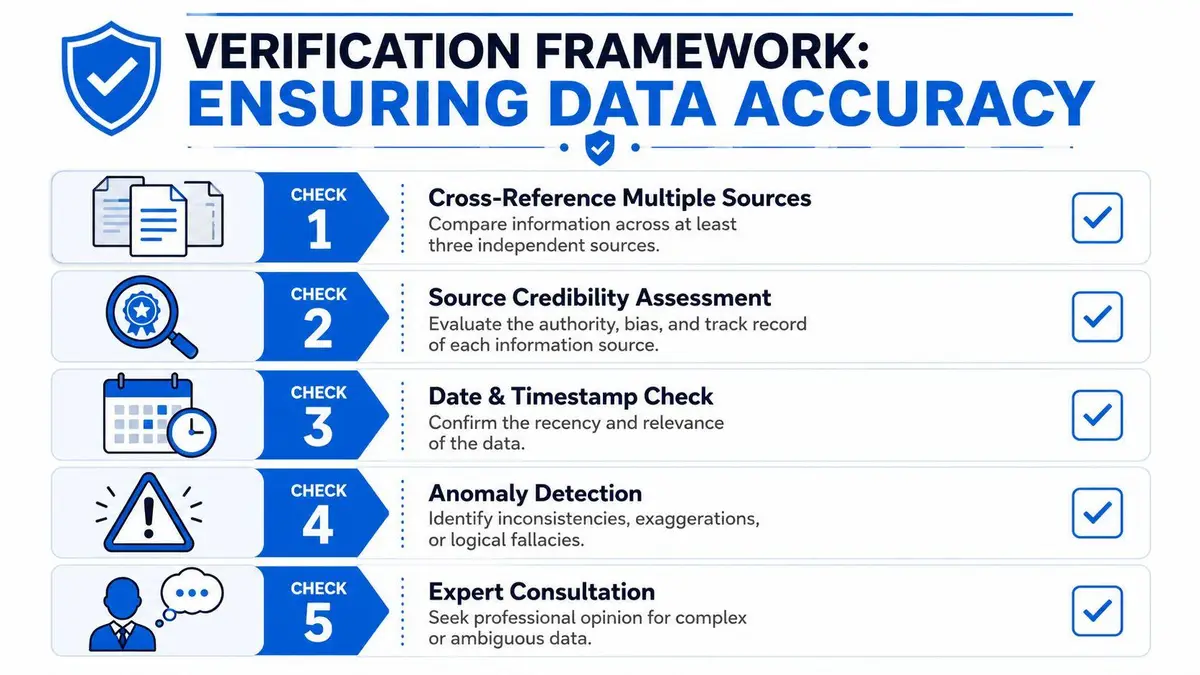
What to verify first
- Identity match. Confirm the same person appears across records by cross-checking location, employer, age range, associates, and historical usernames.
- Time sequence. A true fact from years ago can be misleading if presented as current.
- Source hierarchy. Primary documents outrank reposts, commentary, screenshots, and forum retellings.
- Conflict points. When two records disagree, pause there. Don’t average them mentally. Resolve the contradiction.
Here’s a practical example. A profile says someone is a current managing partner. A state filing shows they resigned. A conference bio still lists the old title. Which one governs? The dated filing usually has more evidentiary weight than the marketing page.
The video below gives a useful general perspective on checking the reliability of online information before acting on it.
Red flags that deserve immediate scrutiny
Some patterns show up repeatedly in fabricated or weaponized material.
- Credential inflation where titles are grander on personal pages than in filings or employer records
- Synchronized repetition where multiple low-quality sites repeat identical language
- Timestamp anomalies such as fresh publication dates on recycled allegations
- Context-stripped screenshots with no source URL, no archive, and no surrounding thread
- Narrative over-documentation where dramatic claims appear without primary records
Verify the ugly claim and the flattering claim with equal skepticism. People launder both kinds of falsehood online.
Dark web checks belong at the end, not the beginning. Use specialist services or secure monitoring to look for leaked credentials, exposed emails, or compromised identifiers associated with the subject. Don’t turn that environment into your primary research method. It’s a validation layer for breach risk, not a substitute for disciplined evidence review.
The Strategic Limits of DIY Investigation
Most do-it-yourself investigations fail for one of two reasons. The person searching stops too early and misses the underlying issue, or pushes too far and creates risk that outweighs the value of the search.
The tripwires are real
The moment you start testing platform limits, using deceptive identities, contacting third parties impulsively, or trying to access semi-private spaces through technical workarounds, you’ve left prudent inquiry behind. The same is true when your search begins to alert the subject. A profile view, a message to an administrator, or a poorly framed outreach attempt can trigger deletion, retaliation, or counter-allegations.
Legal boundaries also get tighter than most executives expect. Privacy law, contractual terms of service, employment rules, cross-border data restrictions, and internal governance obligations can all apply at once. If counsel would need to clean up your method later, the method was wrong.
DIY breaks down when stakes rise
A useful dividing line is this table:
| Situation | DIY may work | Escalate |
|---|---|---|
| Basic reputation scan | Yes | |
| Public profile inconsistencies | Yes, with verification | |
| Active impersonation or leaked content | Yes | |
| Litigation-related fact development | Yes | |
| Cross-border privacy issues | Yes | |
| Hostile actor monitoring your staff or family | Yes |
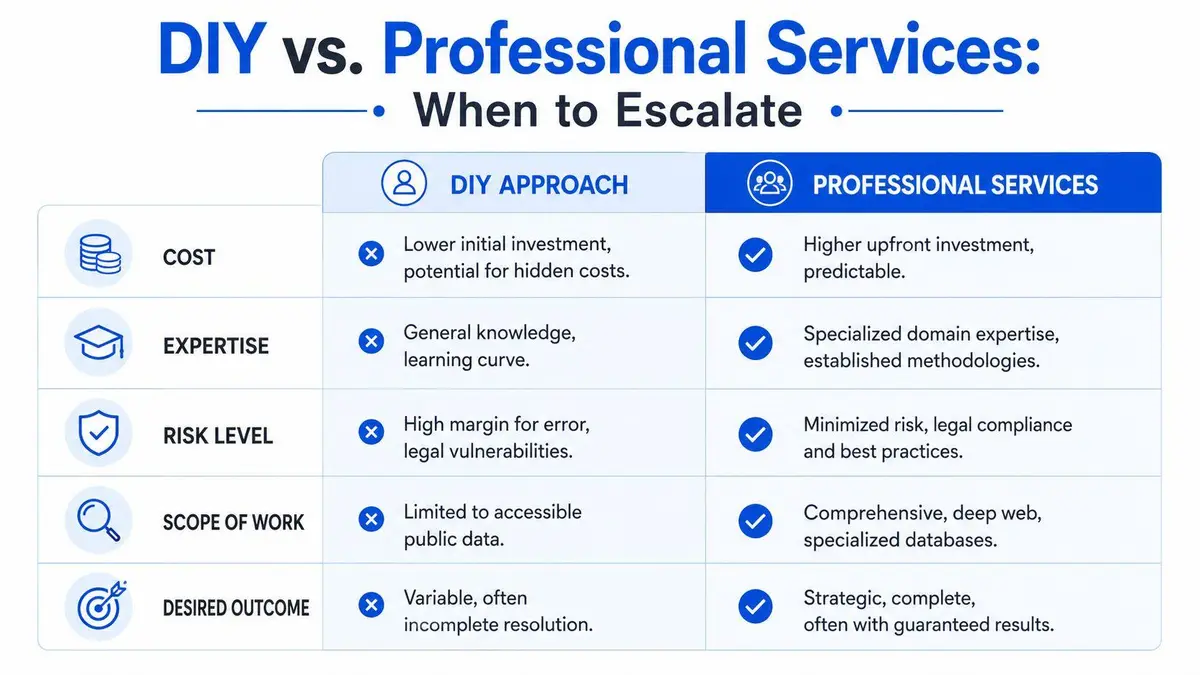
You also need to know what DIY cannot deliver. It can gather. It usually can’t compel. It can flag. It often can’t resolve. Once the issue involves takedowns, de-indexing, platform legal forms, publisher negotiation, or a coordinated response across multiple sites, amateur efforts tend to waste time and harden resistance.
When your search objective changes from “understand the problem” to “make the problem stop,” you’re no longer doing research. You’re managing risk.
That’s the point where discipline means stepping back, not digging harder.
When to Escalate to Professional Services
Escalation makes sense when the facts matter enough that delay, error, or exposure would be expensive. That includes defamation, leaked private material, impersonation, coordinated harassment, false reviews, executive targeting, sensitive litigation support, and any case where direct outreach from the subject would make things worse.
Professional intervention is not just “more searching.” It’s a managed campaign that combines legal analysis, publisher contact, platform procedures, privacy arguments, and technical de-indexing where removal isn’t available. Industry descriptions of content removal work consistently point to the same operating model: manual specialist intervention for source-page takedowns, platform appeals, legal notices, publisher contact, and search suppression for high-stakes clients who need direct legal and technical action (overview of specialist content removal work).
Timing is a strategic variable
Content problems don’t all move at the same speed. Documented removal timelines vary sharply by channel. Social media content can take 2 to 7 days, publisher outreach can take 1 to 3 months, complex legal requests can take up to 6 months, and de-indexing can require 1 to 6 weeks if the host is uncooperative (content removal timelines and bottlenecks).
Those ranges matter because they expose the bottlenecks. Delay usually isn’t caused by the victim’s urgency. It’s caused by queue times, unresponsive publishers, weak initial framing, or using the wrong mechanism for the content type.
What professionals actually add
Professionals add three things that DIY usually lacks.
- Correct pathway selection. Copyright claims, privacy-based requests, defamation assertions, and terms-of-service complaints are not interchangeable.
- Defensible communication. Publishers and platforms respond differently when the request is structured properly and supported by evidence.
- Operational sequencing. Source removal, de-indexing, and suppression need to happen in the right order or the campaign loses its effectiveness.
If you’re evaluating firms, use a hard standard. Ask what they can remove at the source, what they can only de-index, how they handle reuploads, what evidence they require, and how they scope jurisdiction. This executive-focused guide to evaluating professional content removal services is a useful starting point.
One caution. Guaranteed removals are a myth. Websites generally aren’t obliged to remove negative content unless there’s a valid legal or policy basis. Serious firms will tell you that plainly. Anyone promising certainty before reviewing the content, host, jurisdiction, and evidence is selling confidence, not competence.
If you need to find info on a person because the stakes are real, treat the search as the start of a risk strategy, not a private detective hobby. ContentRemoval.com works with executives, public figures, family offices, and counsel to assess digital threats, verify what’s real, and act on harmful content through lawful, discreet, and high-speed intervention. Start with a confidential assessment, and get a clear action plan before the situation spreads further.
Frequently asked questions
Is it legal to look someone up online?
Reviewing publicly available information is generally lawful when the purpose is due diligence, threat assessment, security or fact development for counsel. It becomes a problem when the method involves pretext, impersonation, credential sharing or bypassing privacy controls, or when the searching turns into repeated contact or monitoring. If you could not defend the method to a judge or regulator, do not use it.
How reliable are phone and email lookup sites?
They are pointers, not evidence. They can suggest past addresses, aliases, relatives and linked accounts, but the data is often stale, blended or wrong. If a lookup result would influence a legal, employment or security decision, confirm it in a primary source first.
When should I hand a background search to professionals?
When the objective shifts from understanding the problem to making it stop: active impersonation, leaked content, litigation fact development, cross-border privacy issues or a hostile actor monitoring your staff or family. DIY can gather and flag; it usually cannot compel removal, de-index or run a coordinated response across sites.