
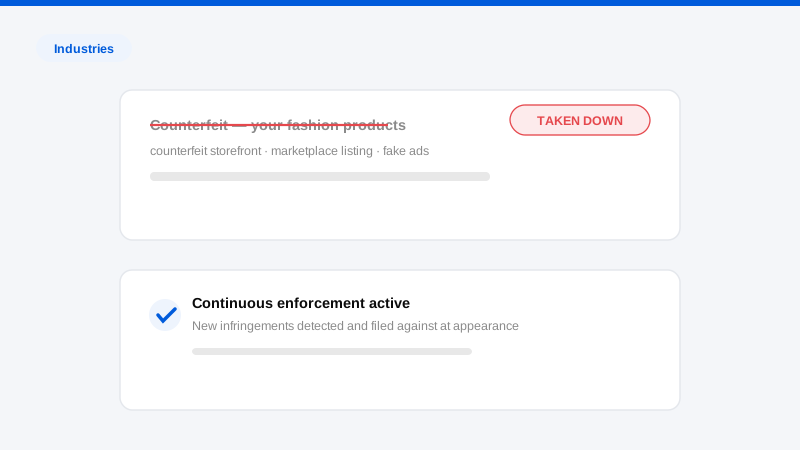
Brand protection for fashion brands is the discipline of finding and removing the counterfeit listings, cloned storefronts, stolen campaign imagery, and fake sale scams that trade on a label’s name, before they reach the customers who were about to buy the real thing. For a fashion label, the brand is not a supporting asset. It is the product. The fabric, the cut, and the construction matter, but what a customer actually pays for is the meaning attached to the name on the label, and that meaning is exactly what counterfeiters, cloners, and scammers extract when they operate unchecked.
Most fashion founders discover the problem the same way: a customer emails asking why the dress they ordered from “your sale site” never arrived, or arrived as a bag of polyester that looks nothing like the campaign photo. The founder searches, and finds an entire shadow economy built on their brand: replica listings on marketplaces, a cloned storefront running paid ads with their own lookbook images, Instagram accounts running “90% off closing down” scams against their followers. None of it is theirs. All of it is trading on their name.
This guide defines that threat landscape, explains what is genuinely at stake for a fashion label, and lays out what professional, removal-first brand protection looks like, and why fashion brands that take the problem seriously bring in a specialist firm rather than fighting it with in-house takedown emails or a generic PR agency.
What brand protection for fashion brands actually covers
Brand protection for fashion brands covers four connected threat categories: counterfeit product listings, cloned or lookalike storefronts, stolen creative assets, and impersonation scams that target the brand’s own customers. These are usually treated as separate problems: legal handles counterfeits, marketing worries about stolen imagery, customer service fields the scam complaints. In practice they are one problem: an infringement ecosystem that grows wherever a fashion brand builds demand.
Counterfeit listings are the most visible layer. Replicas of your bestsellers appear on marketplaces, social commerce platforms, and standalone sites, often within weeks of a product gaining traction. They undercut your pricing, intercept your search demand, and put your name on garments you never made.
Cloned storefronts are more dangerous than most brands realize. These are full websites built from your own product photography, copy, and branding, sometimes pixel-for-pixel copies of your real store, running paid social ads to your target audience. Customers who buy from them either receive counterfeits or receive nothing at all. Either way, they blame you.
Stolen campaign imagery is the fuel for everything else. Your lookbook, your influencer content, your product photography. This is what makes a counterfeit listing or fake ad convincing. A scam ad built with your own campaign assets is nearly indistinguishable from a real one, which is precisely why infringers steal creative rather than producing their own. Removing stolen imagery at scale is a core function of copyright infringement removal, and it is one of the fastest ways to collapse a counterfeit operation’s ability to sell.
Fake sales and impersonation scams attack your audience directly. Fraudulent accounts and ads promising implausible discounts (“warehouse clearance, everything $19”) harvest payment details from your most engaged followers. The victims are your customers, and the reputational damage lands on you.
Key takeaway: Counterfeits, cloned stores, stolen imagery, and fake sales are not separate problems. They are one ecosystem feeding on your brand’s demand, and it has to be dismantled as an ecosystem, not swatted one listing at a time.
Why fashion brands are targeted
Fashion brands are targeted because they combine three things infringers love: visual products that are easy to imitate convincingly online, demand generated by marketing the infringer never has to pay for, and margins wide enough to make even crude knockoffs profitable.
A photograph does most of the selling in fashion ecommerce. That means a counterfeiter does not need to replicate your garment quality to capture your sale. They only need to replicate your photograph, which they can do by right-clicking it. The customer sees your image, your styling, your brand equity. What ships is whatever the counterfeiter can produce for a fraction of your landed cost.
The targeting also scales with success. Every viral product, every sold-out drop, every influencer moment produces a demand spike, and unmet demand is exactly what counterfeit networks are built to intercept. A sold-out hero product is a gift to infringers: thousands of buyers searching for an item they cannot buy from you will happily buy it from someone who appears to be you. Fast-growing direct-to-consumer labels are hit hardest, because their audiences are young, mobile, and used to buying from social ads, the exact channel cloned storefronts use.
Finally, fashion infringement is industrialized. The operators behind replica networks and cloned-store farms run hundreds of sites and accounts across dozens of brands. They register domains in bulk, rotate payment processors, and relaunch within days of a takedown. They are not opportunists; they are businesses, with your brand as their inventory.
What’s at stake
What’s at stake for a fashion brand facing unchecked infringement is not just diverted revenue. It is the erosion of the three assets a label cannot rebuild quickly: customer trust, pricing power, and the exclusivity that justifies the brand’s position.
Revenue diversion is the visible cost. Every counterfeit sale is a sale you might have made, captured with demand you paid to create. Cloned storefronts running ads against your own audience are, in effect, spending your marketing equity to fund your competitor, except the competitor is a fraud operation.
Trust erosion is the compounding cost. Customers scammed by a fake store rarely understand they were scammed by an impersonator. They post the one-star review, the chargeback complaint, the “this brand is a scam” TikTok, against you. Those complaints accumulate in search results and on review platforms, and they poison the research of every future customer who searches your name before buying. This is where infringement bleeds into reputation: fake-store victims generate defamatory and misleading content that outlives the fake stores themselves.
Pricing power is the silent casualty. When your product appears to be available for $30 on a dozen sites, your $180 price point stops reading as quality and starts reading as markup. Wholesale partners notice. Full-price sell-through suffers. The perceived scarcity and integrity that let a fashion brand command its margin are exactly what a counterfeit ecosystem destroys.
And increasingly, AI is the new front. Shopping assistants and AI search summaries now mediate what buyers learn about your brand. If counterfeit listings, scam complaints, and cloned stores dominate the open web, they become the raw material for AI-generated answers about your brand, and an AI that has ingested a scam ecosystem will describe one.
See what buyers find when they search your brand.Free confidential Exposure Scan: live results on a 15-minute call, yours to keep either way.
Book Your Free ScanWhat professional brand protection for fashion brands looks like
Professional brand protection for fashion brands is removal-first: the primary objective is to make infringing content cease to exist at its source, not to bury it, spin it, or respond to it. Everything else (de-indexing, brand assets in the press, monitoring) builds on that foundation. The sequence matters, and it looks like this.
First, remove at the source. Counterfeit listings come down at the marketplace level. Cloned storefronts come down at the host, registrar, and payment-processor level, a fake store that cannot take payment is dead even before its domain is. Stolen imagery comes down through intellectual property enforcement across platforms, ad networks, and hosts. Source removal is the only outcome that actually protects customers, because content that no longer exists cannot scam anyone, appear in search, or feed an AI summary.
Second, de-index what resists removal. Some infringing content sits with slow or unresponsive hosts. While source removal is pursued, de-indexing from Google and other search engines cuts the content off from the discovery that makes it profitable. An infringing page nobody can find is an infringing page that stops converting.
Third, build authoritative press assets. Removal clears the negative; owned authority fills the space. Earned press placements in credible publications give your brand ranked, authoritative assets that dominate your search results, so a buyer researching your label finds your story, told by publications that vetted it, rather than a vacuum an infringer can fill again.
Fourth, monitor continuously. Infringement networks relaunch. Serious protection means continuous reputation and infringement monitoring: watching marketplaces, ad libraries, domain registrations, and search results so that new counterfeit listings and cloned stores are caught in days, before they accumulate sales, reviews, and ranking. This is why established fashion brands run ongoing Protection Plans rather than one-off cleanups: the economics of infringement mean the attackers always come back, and the brands that stay clean are the ones with a standing defense.
Key takeaway: Removal-first means the threat is eliminated at the source, then de-indexed where removal is slow, then displaced by authoritative press assets, then kept out by continuous monitoring. Each layer makes the next one stronger.
Why DIY and generic agencies fall short
DIY brand protection for a fashion label usually means a marketing manager filing takedown forms between campaigns. It fails for a structural reason: takedowns are a volume-and-leverage game, and an in-house generalist has neither. Each platform has its own reporting pathways, evidentiary standards, and escalation routes. Registrars, hosts, and payment processors respond very differently to a first-time complainant than to a firm that works with their abuse teams every week, and a whack-a-mole approach that removes listings one at a time never touches the network behind them, the operator simply relists.
Generic PR and marketing agencies fail for a different reason: their toolkit is publishing, not removal. A PR agency responds to a counterfeit crisis with messaging: statements, content, “getting ahead of the story.” None of that removes a single fake store. The scam ads keep running while the brand issues warnings about them. Publishing has a role, but only after removal; content built on top of an active infringement ecosystem is a lighthouse next to a shipwreck.
Law firms, meanwhile, are essential for litigation but slow and expensive for volume enforcement. Suing one counterfeiter takes months; his network relaunches in days. The practical layer of brand protection (the daily, cross-platform dismantling of infringing content) is a specialist operational discipline, not a legal one.
Counterfeiters found your brand. Find out what else is out there.Get a free confidential Exposure Scan: we walk you through the live results on a 15-minute call, and the findings are yours to keep.
Book Your Free ScanWhy fashion brands choose Content Removal
Fashion brands choose Content Removal because dismantling infringement ecosystems at the source is the firm’s core discipline, not a service line bolted onto PR, SEO, or legal work. The distinction shows up in outcomes: content that is gone, storefronts that are dead, networks that stop relaunching.
The firm’s fashion credentials are concrete. For Saski Collection, the activewear label founded by Tammy Hembrow, Content Removal dismantled the counterfeit operations trading on the brand: the replica listings, cloned stores, and stolen-imagery infrastructure that had grown around one of the most-imitated labels in its category. For Sweat, the fitness platform, the firm stopped a fraud operation on track to divert an estimated $10 million from the brand’s customers. Client work spans consumer and enterprise brands including Danone: the full record is in our case studies, and the Saski engagement in particular is the closest analogue for any fashion label evaluating this work.
Three things define the engagement model. First, removal-first execution: the firm’s practitioners work at the platform, host, registrar, and payment-processor level, with the relationships and evidentiary practice that volume enforcement demands. Second, discretion: fashion brands live on perception, and enforcement is conducted quietly, no public spectacle, no drawing attention to the problem while it is being solved. Third, honesty about scope: Content Removal is not a law firm and does not guarantee outcomes; it commits to a rigorous, transparent process and reports exactly what came down, what is pending, and what the monitoring layer is catching.
Key takeaway: The right question for any fashion brand evaluating protection is not “who can send takedown notices?” but “who has actually dismantled a counterfeit ecosystem for a brand like mine?” That track record is the qualification.
Frequently asked questions
How do counterfeiters find and target a fashion brand?
They monitor demand signals (viral products, sold-out drops, trending hashtags, rising ad spend) and move on whatever is selling. Most counterfeit networks operate across many brands simultaneously and add new targets as soon as a product shows traction. Practically, if your label has had a hit product or a strong influencer moment, you should assume you are already being targeted and verify it with a scan rather than waiting for customer complaints to surface the problem.
Can’t we just report fake listings and stores ourselves?
You can, and for a handful of one-off listings it may be enough. The problem is scale and recurrence: organized infringers run networks, not listings, and they relaunch faster than an in-house team can report. Effective enforcement requires working multiple pressure points at once (platform, host, registrar, payment processor, ad network) with the documentation standards each one requires. That is a full-time operational discipline, which is why brands with a real infringement problem engage specialists and keep ongoing protection in place afterward.
Will removing counterfeits improve our search results?
Generally, yes, removing and de-indexing infringing pages takes them out of the results buyers see, and pairing removal with authoritative press placements fills the cleared space with assets you control. The precise effect on any given search result cannot be guaranteed, because search rankings are ultimately controlled by the engines. What removal-first work changes is the underlying reality: when the counterfeit pages no longer exist, there is nothing for search, or AI shopping tools, to surface.
How is this different from hiring a law firm?
Content Removal is not a law firm and does not provide legal advice or litigation. What it provides is the operational layer of brand protection: high-volume, cross-platform removal of infringing content, de-indexing, press asset development, and continuous monitoring. Many clients use both, a law firm for legal strategy and litigation against identifiable infringers, and Content Removal for the day-to-day dismantling of the infringement ecosystem. For most fashion brands, the operational layer is where the immediate damage is stopped.
Every week an infringement ecosystem operates, it compounds: more listings, more scammed customers, more damage to the search results and AI answers that shape how buyers see your label. The first step costs nothing: a free, confidential Exposure Scan that shows you exactly what is trading on your brand right now (counterfeit listings, cloned stores, stolen imagery, fake sales) reviewed live with you on a 15-minute call. What we find is yours to keep, whatever you decide to do next.