
Brand protection for watch and jewelry brands is the discipline of dismantling the replica networks, grey-market listings, and counterfeit advertising that trade on a maison’s name, in the one category where the product itself is a store of value, and where every fake in circulation is an attack on the worth of every genuine piece already sold. A watch or jewelry house does not merely sell objects; it sells certainty, of provenance, of craftsmanship, of value that holds. The entire threat landscape for this category is, in one way or another, an assault on that certainty.
No consumer category supports a more sophisticated counterfeit industry. Replica watchmaking has evolved into a tiered manufacturing economy with its own forums, reviewers, and “superclone” grades marketed on their indistinguishability from the genuine article. Jewelry counterfeiting trades on stamped hallmarks and lab-report fraud, and around both sits a grey-market and scam-advertising layer (unauthorized sellers, fraudulent “authorized dealer” sites, and paid ads built from stolen campaign imagery) that blurs the line between genuine, diverted, and fake until buyers can no longer tell where the brand ends and the parasite economy begins.
This guide defines that landscape, explains what is at stake for a house whose products are also assets, and lays out what professional, removal-first protection looks like, and why serious watch and jewelry brands retain a specialist firm rather than leaving enforcement to occasional legal letters.
Why watch and jewelry brands are targeted
Watch and jewelry brands are targeted because they sit at the intersection of every incentive a counterfeiter has: extreme price points, products whose value is carried by a name and a design rather than by anything a buyer can verify at a glance, and a global buyer base already conditioned to purchase from photographs.
Replica networks are industrial, tiered, and openly marketed. Watch counterfeiting is no longer a street-corner trade. Manufacturing operations produce replicas in explicit quality grades, marketed through dedicated forums, social channels, and review content that treats fakes as a legitimate product category. The highest tiers are sold precisely on the claim that only a watchmaker could tell the difference, a claim aimed directly at the signal value that justifies the genuine article’s price. Jewelry faces the parallel problem: counterfeit hallmarks, misrepresented stones, and fraudulent certification documents that dress base product in a house’s name.
The price gap funds sophistication. When a genuine piece sells for five or six figures, a counterfeiter can invest heavily in convincing fakes, convincing websites, and convincing advertising and still enjoy margins no legitimate business earns. The category’s prices don’t deter counterfeiters; they capitalize them.
Grey-market ambiguity gives cover. Watches and jewelry have a legitimate secondary and parallel-import market, and counterfeiters exploit that ambiguity deliberately. Fake pieces are laundered through listings styled as grey-market or pre-owned sales; scam storefronts pose as “authorized dealers” offering implausible discounts; diverted and fake inventory mingle on the same platforms. The buyer cannot tell the layers apart, which is the point.
Stolen imagery makes every scam credible. Campaign photography, product renders, boutique imagery, the house’s own creative assets are the raw material of counterfeit ads. A fraudulent ad built from genuine campaign imagery, run on major ad platforms against lookalike audiences, is nearly indistinguishable from the house’s own media. The victims pay real money for fake goods, or for nothing, and attribute the experience to the brand whose name was on the ad.
Key takeaway: In watches and jewelry, the counterfeit economy is not a nuisance at the brand’s edges. It is a parallel industry, professionally manufactured and professionally marketed, whose entire business model is the value your house created.
What’s at stake
What’s at stake for a watch or jewelry brand is the integrity of its products as assets: the residual-value proposition, collector confidence, and pricing power that distinguish a maison from a manufacturer. This category’s stakes are unique because its customers are, in a real sense, investors.
Residual value depends on scarcity and certainty. The case for paying a maison’s prices rests partly on the belief that the piece holds value, and that belief rests on scarcity and verifiable authenticity. A large, visible replica economy attacks both. When “superclones” are openly discussed as indistinguishable, every secondary-market transaction inherits doubt, authentication friction rises, and the confidence premium that supports both primary and resale prices erodes. Counterfeiting in this category doesn’t just steal sales; it devalues the installed base owned by the house’s best clients.
Search contamination intercepts the highest-intent buyers. A five-figure purchase is researched exhaustively. Buyers search the model name, “price,” “authorized dealer,” “how to spot a fake.” If those searches surface replica sites, scam dealers, and counterfeit-ad residue, the house is losing buyers at maximum intent, or worse, losing them to fraud conducted in its name, after which the scammed buyer’s complaints become part of the brand’s permanent search record, alongside other defamatory and misleading content no maison should have to stand next to.
Scam victims become brand liabilities. Every buyer defrauded by a fake “authorized dealer” or counterfeit ad is a real person with a real loss and the sincere belief that the brand was involved. Their complaints, chargebacks, and warning posts accumulate against the house’s name, and increasingly feed the AI-generated answers that prospective clients consult about where to buy safely and whether a seller is legitimate.
Authorized-dealer relationships absorb the damage. Retail partners watch the brand’s online integrity closely. A name surrounded by replica listings and scam-dealer results is harder to sell at full price in the showroom, and the wholesale conversation gets harder with it.
See what buyers find when they search your brand.Free confidential Exposure Scan: live results on a 15-minute call, yours to keep either way.
Book Your Free ScanWhat professional brand protection for watch and jewelry brands looks like
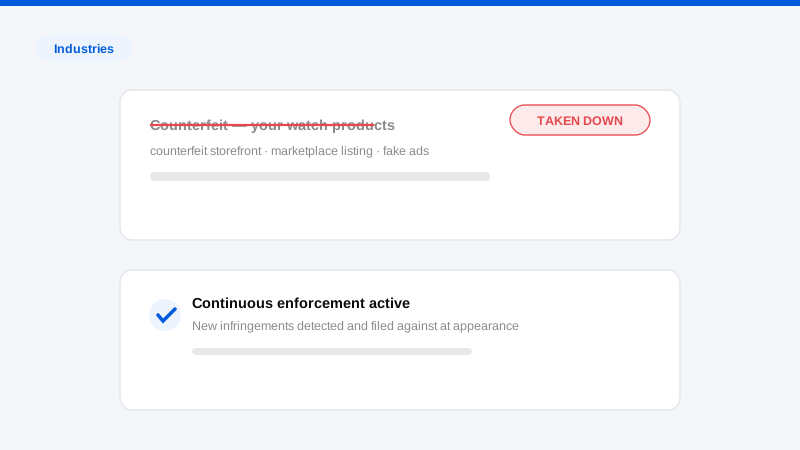
Professional brand protection for watch and jewelry brands is removal-first: the objective is to make replica listings, scam dealer sites, and counterfeit advertising cease to exist at the source, because in a category selling certainty, the only adequate outcome is a landscape in which the fakes are simply not there. The professional sequence runs in four layers.
Remove at the source. Replica listings come down at the marketplace and platform level. Scam “dealer” sites are dismantled at the infrastructure layer: host, registrar, and payment processor, because a fraudulent storefront that cannot take payment is dead whatever its domain does. Counterfeit ads are removed at the ad-network level, and the stolen campaign imagery that powers them is pursued through copyright infringement removal wherever it appears. All of it is intellectual property enforcement executed as an operational discipline: network mapping first (shared infrastructure, payment rails, ad accounts) then dismantling at the choke points, so the operation dies rather than relists.
De-index what resists removal. Replica forums, offshore storefronts, and grey-zone content can sit with unresponsive hosts. While source removal is pursued, de-indexing from search engines removes that content from the research journey of the buyers who matter, a replica site that no longer appears against the model-name searches has lost its customer acquisition channel.
Build authoritative press assets. Removal clears the landscape; authority must hold it. Earned press placements in publications the category’s buyers respect give the house ranked, credible assets across its search results, so a collector researching a reference or a bride researching a jeweler finds vetted coverage of the brand’s actual story rather than a parasite economy’s marketing.
Monitor continuously. Replica networks relaunch, counterfeit ad campaigns rotate creative weekly, and grey-market listings churn daily. Serious houses maintain continuous monitoring across marketplaces, ad libraries, domain registrations, forums, and search, with removal capacity standing ready. This is why houses run ongoing Protection Plans rather than annual cleanups: against an industrialized adversary, protection is a perimeter, not a project.
Key takeaway: Against replica networks, one-off takedowns are theater. The professional standard is to map the network, dismantle it at its choke points (hosting, payments, advertising) and hold a monitored perimeter so relaunches die in days.
Why brand protection for watch and jewelry brands can’t rest on occasional legal action
Most established watch and jewelry brands do take action against counterfeiters: episodically, through counsel, against the largest and most identifiable targets. That work matters, and nothing here replaces it. But as a protection strategy for the daily landscape, it has three structural gaps.
Litigation moves in months; networks move in days. By the time a case concludes against one operator, the ecosystem has relisted, re-registered, and rotated payment processors many times over. The long tail of replica listings, scam ads, and fraudulent dealer sites, where most buyer harm actually occurs, is never touched by marquee enforcement actions.
Legal process is the wrong tool for volume. The daily work of brand protection is operational: hundreds of reports across dozens of platforms, each with its own evidentiary standards, filed by practitioners whose volume and track record determine how fast abuse teams respond. That is not associate work billed in six-minute increments; it is a specialist discipline with its own accumulated craft.
PR and marketing agencies cannot fill the gap. A communications firm responds to a counterfeit problem with content: awareness campaigns, statements, “education.” None of it removes a single listing, and a public anti-counterfeit campaign can amplify the very association the house needs dissolved. Publishing has a role only after removal has cleared the ground.
Replica networks are advertising against your name today.Get a free confidential Exposure Scan: live findings walked through with a specialist on a 15-minute call, yours to keep whatever you decide.
Book Your Free ScanWhy watch and jewelry brands choose Content Removal
Watch and jewelry brands choose Content Removal because dismantling counterfeit ecosystems at the source is the firm’s founding discipline, executed with the discretion a maison requires and measured in outcomes a maison can verify: listings down, storefronts dead, ads stopped, search results clean.
The credentials are concrete. Content Removal dismantled the counterfeit operations trading on Saski Collection: replica listings, cloned storefronts, and the stolen-imagery infrastructure behind them, the same architecture replica watch and jewelry networks use. For Sweat, the firm stopped a fraud operation on track to divert an estimated $10 million from the brand’s customers, the impersonation-and-scam-advertising playbook at scale. Client work spans consumer and enterprise brands including Danone; the full record is in our case studies.
For this category specifically, the engagement is defined by three commitments. Network-level enforcement: the firm maps operations before dismantling them, so takedowns collapse ecosystems instead of trimming them. Structural discretion: engagements are confidential and enforcement is conducted through platform and infrastructure channels, never as public spectacle. The house’s name stays out of the story. Honest scope: Content Removal is not a law firm, does not provide legal advice, and does not guarantee outcomes, platforms and processors make their own decisions. What the firm commits to is rigorous process, transparent reporting of what came down and what is pending, and a standing monitoring perimeter that catches the relaunch attempts every serious adversary will make.
Frequently asked questions
Replica sellers operate offshore and anonymously. Can they actually be stopped?
Anonymity protects the operator’s identity, not their infrastructure. Every replica operation depends on visible, jurisdiction-bound services: marketplaces, hosts, registrars, ad networks, and, above all, payment processing. Enforcement at those choke points does not require knowing who the operator is; it requires documented violations presented to each provider’s standard. An operation that cannot list, advertise, or take payment is commercially dead regardless of where its operator sits. Persistent actors relaunch, which is why removal is paired with continuous monitoring that catches new infrastructure early.
How do we handle the grey market without harming legitimate resale?
By separating the layers before acting. Legitimate pre-owned and parallel-import activity is a fact of the category and often serves the brand’s clients; the targets are the fraudulent layers hiding inside it, counterfeit pieces laundered through resale-styled listings, fake “authorized dealer” sites, and scam sellers using stolen imagery. Professional enforcement is evidence-driven and precise: it removes the fraud and the counterfeits while leaving lawful commerce alone, which is also what keeps the brand’s enforcement credible with platforms.
Counterfeit ads using our campaign photography keep reappearing. Why, and what works?
They reappear because ad-level takedowns treat symptoms: scam operations run portfolios of ad accounts and rotate creative and domains faster than one-at-a-time reporting can follow. What works is attacking the operation rather than the ad (the stolen imagery through copyright enforcement across networks, the destination sites through host, registrar, and payment-processor action, and the account networks through platform escalation) combined with monitoring of ad libraries so each new campaign is hit within days of appearing, before it accumulates victims.
Does counterfeiting really affect our genuine clients if they’d never buy a fake?
Yes: through value, not through purchase behavior. Your clients own pieces whose worth rests on scarcity, signal, and secondary-market confidence. A visible replica economy erodes all three: it cheapens the signal of ownership, injects doubt into resale transactions, and raises authentication friction across the market. Protecting the brand from counterfeits is, quite directly, protecting the asset value of every genuine piece your clients already hold, which is why collectors take a house’s enforcement posture as seriously as its complications.
The buyers researching your references this week will find either your house’s story or the replica economy’s marketing, and at these price points, they research everything. See your landscape as they see it. Book a free, confidential Exposure Scan: a specialist walks you through live results (replica networks, scam dealers, counterfeit ads, search and AI surfaces) on a 15-minute call, and the findings are yours to keep either way.