
Online defamation is a false statement of fact published on the internet that harms a person’s or business’s reputation. To be actionable it must be a provable factual claim rather than opinion, published to a third party, made with at least negligence, and damaging. It differs from traditional defamation because the content replicates through reposts, screenshots and search results.
Key facts
- A claim needs a false statement of fact, publication, fault and harm, and public figures must show actual malice.
- Opinion, criticism and hyperbole are generally protected, only false factual assertions create a defamation problem.
- The first 48 hours matter for preserving URLs, timestamps, usernames and full-context screenshots.
- Source removal, search de-indexing and legal takedown are separate tools that solve different problems.
Where ContentRemoval.com comes in. ContentRemoval.com takes on the removal side of online defamation once the content has been preserved: platform escalation, publisher requests, search de-indexing and monitoring for reposts, coordinated with your counsel where a legal claim is in play. Executives, their lawyers and family office staff are usually the ones who reach out. A free 15-minute Exposure Scan maps each false publication and its likely route, and the report is yours to keep. Get a Free, Confidential Exposure Scan or read how our defamation removal work is done.
Online defamation is a false statement of fact published online that hurts someone’s reputation. In practice, 97 of 189 defamation cases, or 51.3%, in a 2013 to 2017 Australian study were digital cases, which shows how much the internet has changed the problem.
You’re probably looking at a post, review, thread, or article that feels impossible to contain. That feeling is justified, because online statements travel fast, stay searchable, and keep harming you long after the first person sees them.
What Is Online Defamation and Why It Is Different
A client searches their name at 6 a.m. and finds a blog post accusing them of fraud. The post is false, but it’s already indexed, shared, and sitting there like a public record. That’s online defamation in the world, not in a law school hypothetical.
The legal core is straightforward. Online defamation is a false statement of fact published on the internet that harms reputation, and the law usually cares about publication to a third party, fault, and damage. The important part is not just that the statement feels unfair. It has to cross the legal line from protected speech into a false factual claim.
Why digital publication changes the game
Traditional defamation was hard enough. Online defamation is worse because the content doesn’t fade, it replicates. A single accusation can move from a forum to a social feed to a screenshot to a search result, and each copy extends the life of the harm.
That’s why this is an operational problem as much as a legal one. You are not just deciding whether to sue. You’re deciding how to preserve evidence, stop spread, and limit the search footprint before the content becomes embedded in your reputation. The clock matters because every repost makes cleanup harder.
Practical rule: treat the first post as the start of a spread event, not a one-off insult.
The 2013 to 2017 Australian data makes the point clearly, with 97 of 189 cases classified as digital and 66 of 189 cases ending in success for plaintiffs (EFF summary of the study). Online defamation can be actionable, but it’s not something you win by reacting emotionally.
The Legal Elements of Online Defamation
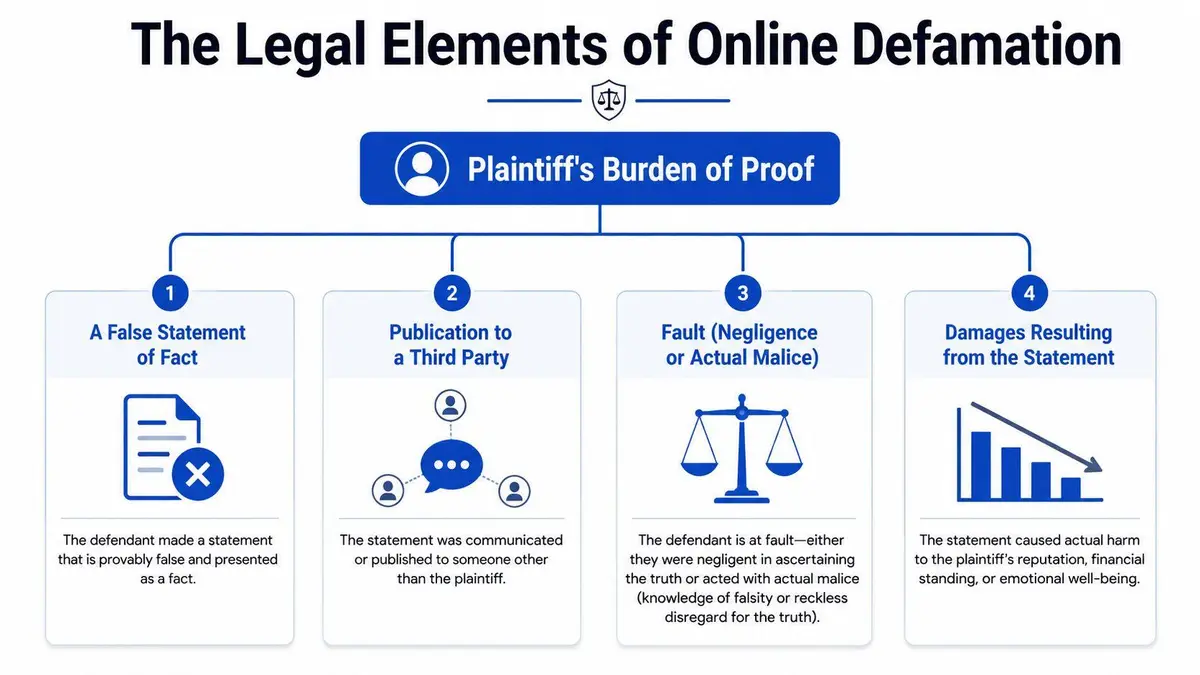
A plaintiff doesn’t win by saying, “This hurt me.” The claim has to fit the legal test, and in the online setting that usually means proving four things: a false statement of fact, publication to others, fault, and harm.
The statement must be factual, not just rude
Courts focus on whether the post asserts something that can be proved true or false. If someone writes that a CEO is “corrupt” or a restaurant is “the worst in town,” that may be opinion or hyperbole. If they say the owner stole money or the company forged documents, that’s a factual accusation, and it can be actionable if false.
That distinction matters because a lot of online speech is sloppy. Reviews, memes, quote posts, and commentary often blur fact and opinion, but only false factual claims create a defamation problem. The line is narrower than many assume, and that’s where many weak claims die.
Publication, fault, and harm are not optional
Publication means the statement reached someone other than the target. Online, that’s usually easy to show because the content was posted publicly, emailed, or shared into a group. Fault means the publisher acted at least negligently, and in some cases with much higher blame.
Damages are the reputational injury itself, or the concrete losses tied to it. Under U.S. law, a plaintiff generally has to prove a false and defamatory statement of fact, at least negligence, publication on an online platform, and resulting damage (Purdue Global Law School). For public figures, the barrier is higher because they must also prove actual malice, meaning knowledge of falsity or reckless disregard for the truth.
Libel matters more than slander online
In the digital world, most harmful material is fixed in writing, video, or a recorded form. That means it usually looks like libel, not slander, even if the original attack began as spoken gossip. Once a false statement gets posted, recorded, or transcribed, the legal and evidentiary stakes get much bigger.
How to prove defamation in practical terms becomes a question of collecting the original post, the context, and the audience, not just proving that you felt attacked.
Bottom line: if the content is vague, framed as opinion, or impossible to verify, the claim gets weaker fast.
Jurisdictional Differences That Affect Your Case
A false post does not become easy to handle just because it lives online. The moment it crosses a border, the strategy changes. The speaker’s location, the target’s location, the platform’s location, and the place where the harm lands can all change the result.
The United States and the United Kingdom don’t play by the same pressure points
In the United States, public figures face the hardest standard because they must prove actual malice. That is a steep barrier for executives, celebrities, and founders who want a false statement corrected fast. In the United Kingdom, the procedure works differently, and claims have followed a distinct litigation pattern, including 227 cases in 2014, 142 in 2013, a peak of 323 issued claims in 2019, and 101 new defamation claims in 2024 in the Media and Communications List (Repulex statistics).
Those figures matter because they show the forum is not a side issue. Forum choice, enforcement posture, and the cost of pressing a case shape what is realistic from the start.
Cross-border publication creates a tactical mess
A victim in one country can be targeted by content hosted in another, posted by an anonymous account, and indexed everywhere at once. The question is not only whether the statement was defamatory. The question is which court has jurisdiction and which remedy changes the outcome.
Takedown strategy and litigation strategy are different tools. A court may be available but too slow for removal. Another forum may support search deindexing or platform escalation better than a lawsuit. The right move depends on where the content sits and where it spreads next.
Choose the forum that gives you an advantage, not the forum that sounds dramatic.
The claim that India receives over 40,000 content-removal requests to Google annually and that Google removes over 10,000 URLs per year in response to Indian legal requests also shows how geography affects enforcement reality (Repulex statistics). Online defamation is an enforcement problem as much as a legal one.
For the European side of that problem, Understanding the right to be forgotten in the EU context shows why removal tools are available in some jurisdictions and far harder to use in others.
Real Examples of Online Defamation on Common Platforms
A bad review isn’t automatically defamation. A harsh post isn’t either. The hard question is whether the content states a false fact that harms reputation, or whether it’s just opinion dressed up as outrage.
Reviews, forums, and impersonation posts
A fake review claiming a surgeon botched a procedure, when no such event happened, is different from a customer saying they “would never go back.” The first can be a false statement of fact. The second is criticism, even if it’s unfair. The same split applies to anonymous forum posts accusing a business owner of embezzlement versus saying their service is terrible.
Impersonation makes the problem uglier. A fake social account can post allegations under someone else’s name, and readers often treat the content as authenticated because it looks official. That’s not just reputation damage. It can trigger downstream confusion with clients, vendors, and employees.
Viral comments and algorithmic spread
A single false accusation in a comment thread can be screenshotted and reposted until it outruns the original discussion. Once that happens, the content no longer lives in one place, and the audience starts to treat repetition as confirmation. The internet rewards speed and engagement, not accuracy.
A meme can also cross the line when it asserts an actual fact. If the joke is obvious exaggeration, it may be protected. If the meme is used to claim that a person committed a crime, cheated a client, or ran a scam, it starts looking like a factual allegation. The format doesn’t save it.
Why opinion is the line people miss
Most weak online defamation complaints fail because the speaker never made a provable factual claim. Courts generally protect criticism, commentary, and hyperbole. They do not protect false assertions passed off as facts.
That gap is why tone matters less than content. A cruel post can still be lawful, and a polished, professional-looking post can still be defamatory if it asserts something false. The surface style of the content is not the test.
The Reputational and Business Impact of Online Defamation
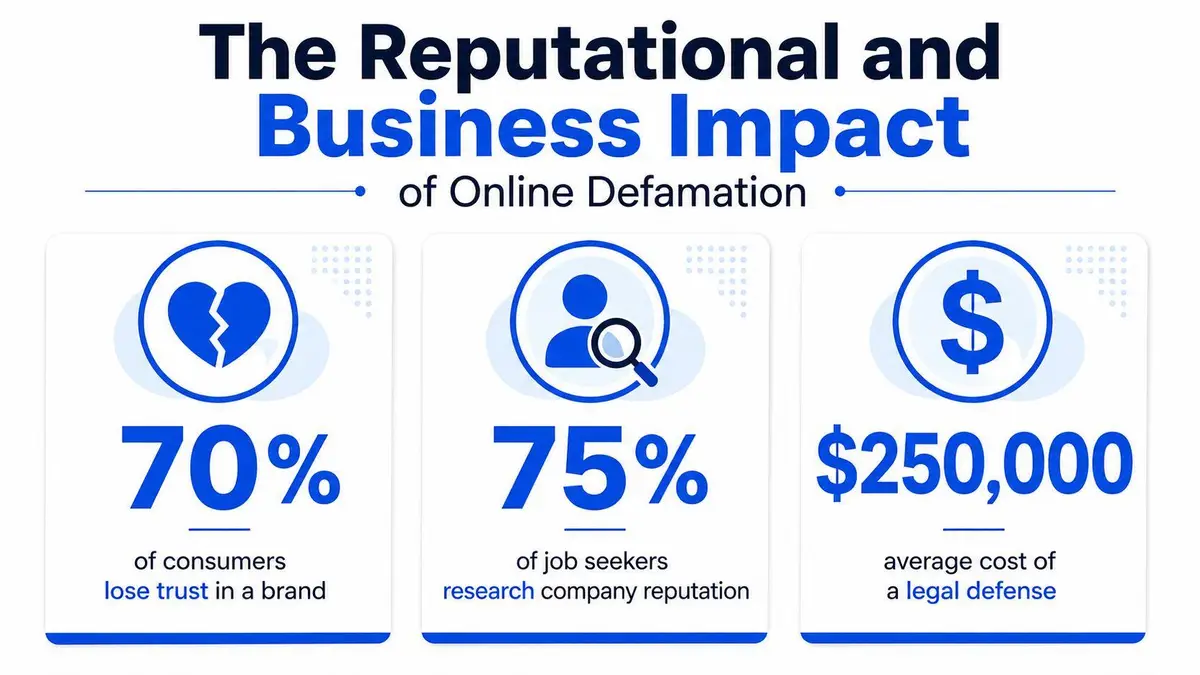
A defamatory post does more than bruise pride. It changes how people decide. Customers hesitate, partners slow down, hiring gets harder, and personal safety can become a real concern. Once false content is public, the audience starts forming opinions before you can correct the record.
Social media usually concentrates the harm. False claims spread fastest there, screenshots detach from context, and repeated exposure makes the allegation feel established even when it is not. Search engines then preserve the trail, so a single post can keep showing up long after the original account has moved on.
The result is operational, not abstract. A false allegation can interrupt deals, push away partners, and make legitimate prospects stall. For individuals, it can affect employment, licensing, and professional standing. For companies, it can poison sales conversations and force teams to spend time denying falsehoods instead of building trust.
That is why speed matters. If the allegation looks credible and stays visible, people may believe it before you even know it exists. Response time is a business decision, and delay gives the post more room to harden into the record.
Preservation matters just as much. If you need to document how a false claim appeared on a platform, a Facebook preservation request guide shows the kind of evidence you should secure before anything is deleted or edited.
Key takeaway: reputational harm builds over time, and every new view makes reversal harder.
The legal problem and the commercial problem meet at the same point. If the content changes how others behave toward you, the damage is already real.
Immediate Response Steps to Protect Your Reputation
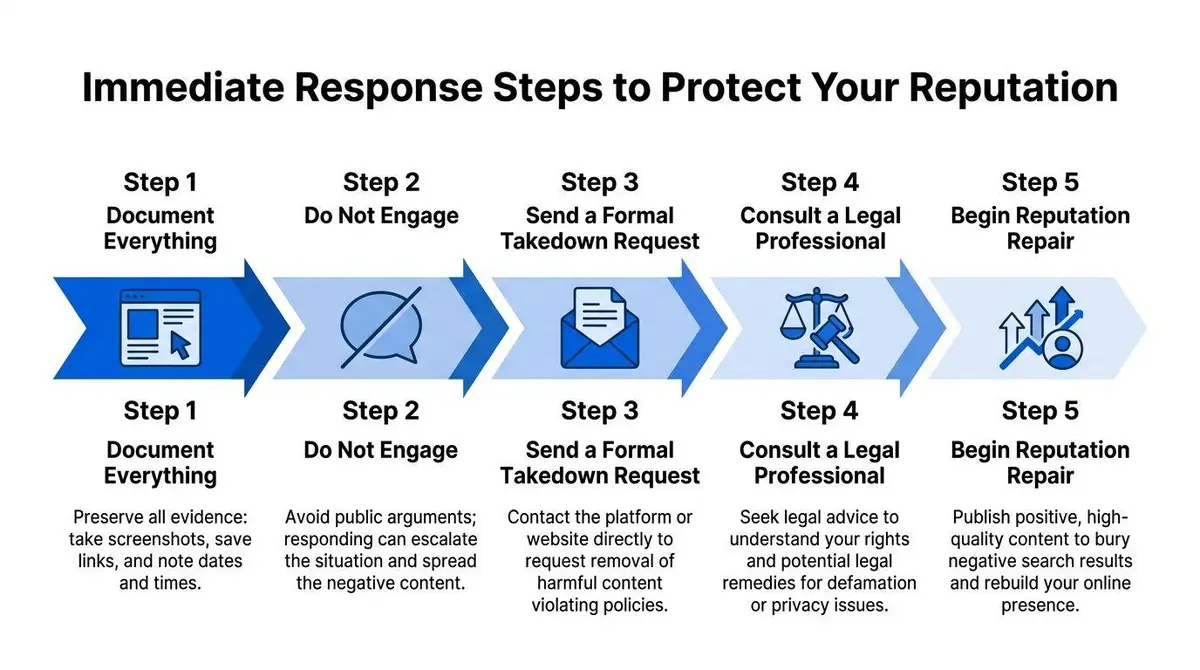
The first 48 hours are critical. If you lose the original post, the timestamp, or the URL chain, you make it harder to prove what happened and harder to force removal later. Evidence first, cleanup second.
Document before you argue
Save the exact URL, timestamp, username, profile name, and visible comments. Capture screenshots that show the full context, not just the offensive line. If possible, preserve the source page and any platform metadata before the content disappears or gets edited.
That urgency exists because content can be deleted, renamed, mirrored, or re-uploaded. The same statement can survive in copies even after the original disappears, which is why preservation has to happen early. If you wait, you may be chasing fragments across multiple platforms instead of building one clean record.
Don’t feed the post
Do not attack the poster publicly first. That often gives the content more visibility and can turn a small issue into a larger thread. It can also complicate later legal messaging because the exchange becomes harder to untangle.
Use platform tools, formal notices, and counsel-driven communication instead of emotional replies. If the content is anonymous, the identity problem makes casual back-and-forth even less useful. You need a record, not a shouting match.
Separate removal from indexing
Source removal, de-indexing, and legal takedown are different tools. One removes the content where it was posted, another limits how easily it can be found, and the third uses legal pressure or procedural rights to force action. You need to know which problem you’re solving before you choose the remedy.
Preservation requests for Facebook content are useful when the evidence itself may vanish. The point is to force a paper trail before the platform or poster changes the record.
Prevention, Monitoring, and When to Engage Specialists
Waiting to see whether harmful content “dies down” is a weak strategy. The internet rewards repetition, and anonymous reposts don’t respect your timeline. You need monitoring that catches problems before they spread, not after they’ve already been indexed and copied.
Monitoring should be continuous, not occasional
Search alerts and manual checks help, but they’re not enough for high-risk individuals or brands. Defamatory content can appear in a comment thread, migrate into a forum, and then resurface in search results under a different title. If nobody is watching, the first sign of trouble may be a client, banker, board member, or reporter asking about it.
Specialist help makes sense when the problem gets messy
Engage outside help when the content crosses jurisdictions, when the poster is anonymous, when the same allegation keeps reappearing, or when the damage touches revenue, relationships, or safety. That’s the point where guesswork gets expensive. A structured removal strategy can combine evidence capture, platform escalation, de-indexing, and legal coordination.
ContentRemoval.com handles defamation matters as part of its content removal work, including review of the issue and a customized strategy for removing harmful content. It also runs AI-driven monitoring and begins most actions within 24 to 48 hours, which matters when reposts and reuploads can move faster than ordinary legal process.
Decide based on leverage, not pride
Self-service can work for a simple false post on a cooperative platform. It breaks down when the content is anonymous, cross-platform, or persistent. That’s when you stop treating it like a nuisance and start treating it like an active reputation incident.
If you’re dealing with false posts, copied allegations, or search results that keep resurfacing, get a structured response instead of improvising. Visit ContentRemoval.com to request a confidential assessment and get a removal strategy built around your specific case, jurisdiction, and risk level.
ContentRemoval.com helps executives, family offices, and public figures respond to false online content with a focused removal strategy, not guesswork. If you’re facing online defamation, the firm can assess the issue, prioritize takedown options, and coordinate reputation protection around the content that’s hurting you most.
Frequently asked questions
Is a bad review the same as defamation?
Not usually. A customer saying they would never go back is criticism, even if unfair. A review claiming a surgeon botched a procedure that never happened asserts a false fact and can be actionable. The test is whether the statement can be proven true or false.
Should I reply to a defamatory post before anything else?
No. The article says to document first: save the URL, timestamp, username and full context before the post is edited, deleted or mirrored. Public arguments with the poster often increase visibility and complicate later legal messaging.
Does it matter which country the defamatory content was posted from?
Yes. The speaker’s location, your location, the platform’s location and where the harm lands all affect the available remedies. A court in one forum may be too slow for removal while another jurisdiction supports search de-indexing or platform escalation better, so choose the forum that gives you a usable advantage.