

The EU right to be forgotten, codified as the right to erasure in GDPR Article 17, lets a person ask a search engine to de-index results tied to their name or ask a publisher to erase the source. It is not absolute: freedom of expression, public-interest archiving and legal claims can defeat it, and executives should expect public-interest objections.
Key facts
- The remedy began with the 2014 Google Spain ruling and was codified in GDPR Article 17 in May 2018.
- Controllers must act without undue delay, commonly interpreted as about one month to respond.
- De-indexing by a search engine does not remove the article from the publisher, archives or mirror sites.
- A successful EU request does not change what appears in US or other non-EU search results.
Where ContentRemoval.com comes in. ContentRemoval.com prepares and sequences Article 17 requests for executives, founders and family offices: separating search de-indexing from source erasure, building the present-relevance argument, and mapping every mirror and archive so one success does not leave the rest standing. The principal, their chief of staff or their lawyer usually makes contact. A free 15-minute Exposure Scan maps what is removable and the report is yours to keep. Get a Free, Confidential Exposure Scan or read how our content removal work is done.
The call usually starts the same way. A board seat is under discussion, a financing is live, a journalist has resurfaced an old story, or a personal matter that was resolved years ago suddenly appears on the first page of a name search. The article may be dated, incomplete, or technically accurate but professionally misleading. None of that matters when a lender, investor, regulator, prospective partner, or family member sees it before they speak to you.
That’s where most public guidance on the eu right to be forgotten fails high-stakes clients. It treats the issue like an online form problem. It isn’t. Your real problem is that search visibility and source publication are different layers of risk, controlled by different actors, evaluated under different standards, and blocked by different defenses.
If you’re an executive, founder, or public figure, you need a more disciplined view. You need to know when de-indexing is realistic, when source removal is possible, when public-interest exceptions will kill the request, and when a badly framed application hands the other side a better reason to refuse you.
An Inconvenient Digital Past
A chief executive searches his name before a governance review. Near the top of the results sits a years-old article about an allegation that never matured into anything commercially relevant. The business survived. The issue was addressed. The market moved on. Google didn’t.
That single result now alters every first impression. It reaches investors before your IR team does. It reaches recruitment candidates before your headhunter does. It reaches your children’s school community before you can explain the context. If you’re visible enough, the issue isn’t just embarrassment. It can be used against you.
The instinct is to ask, “Can I remove this from Google?” That’s a reasonable starting point, but it’s usually the wrong framing. Search engines may agree to de-index a result tied to your name while the publisher keeps the underlying article online. A publication may refuse removal while a search engine narrows discoverability. An archive, mirror site, or data broker may continue spreading the same material after the original source changes.
Practical rule: Don’t treat visibility, publication, and replication as one problem. They are three separate problems, and they rarely yield to one request.
For high-net-worth clients, that distinction changes strategy. If the content is a stale forum post, the path may be relatively direct. If it’s a legitimate news article involving your company, financial conduct, or public role, the public-interest obstacle becomes the central issue. In those matters, the eu right to be forgotten is less about asserting outrage and more about presenting a disciplined argument for why continued discoverability is disproportionate.
The clients who do well in this process are the ones who stop asking whether they’re offended by the content and start asking whether the law gives a controller or search engine a clean basis to keep processing it.
Legal Foundations of the Right to Erasure
The modern European framework didn’t begin as a broad moral right. It began as a targeted remedy. The 2014 Google Spain (Costeja) ruling effectively recognized that individuals could request de-indexing of certain search results tied to their names, and that concept was later narrowed and standardized under the GDPR, which came into force in May 2018 and reframed the issue as the right to erasure in Article 17, as summarized in this overview of the European framework.

From court remedy to operating rule
That shift matters more than most guides admit. In 2014, the remedy was driven by case law around search visibility. By 2018, Article 17 created a codified framework that organizations across the EU and EEA had to operationalize. That changed the conversation from “can this search result be challenged?” to “does a controller still have a lawful basis to keep processing this personal data?”
For an executive client, that’s the difference between a one-off argument and a compliance process. Controllers now need workflows, verification steps, legal review, response handling, and downstream action where erasure is justified. Search engines and publishers may still resist, but they can’t pretend the request is novel.
If you want a practical comparison of GDPR takedown mechanics before filing, ContentRemoval’s guide to GDPR content removal is a useful operational reference.
Why precision beats indignation
Article 17 is not a reputation-management slogan. It is a legal test. If you file a request built around personal frustration rather than statutory triggers, you weaken your own position. The better approach is to match the request to data lifecycle, purpose, consent withdrawal, objection grounds, unlawful processing, or another valid erasure basis.
That’s also why I tell clients to review how organizations define their own handling of personal information. A company’s published data handling policy can reveal the language, categories, and processing logic you’ll later need to challenge.
The right works best when you frame the issue as unnecessary or unjustified processing. It works poorly when you frame it as “I don’t like what people find.”
For high-profile individuals, this legal history leads to one practical conclusion. The eu right to be forgotten is strongest when you present it as a disciplined data-processing dispute, not a public-relations complaint.
Defining the Scope and Its Critical Limitations
Most bad advice on the eu right to be forgotten tells people what they want to hear. It says you can ask for erasure, then skips the part where the request is refused because another right carries more weight. That omission is expensive.
Under EU guidance, the right is not absolute. Processing may continue where erasure would conflict with freedom of expression and information, legal-claims defense, archiving in the public interest, scientific or historical research, or statistical purposes, and Google’s own guidance ties delisting decisions to whether information is inaccurate, inadequate, irrelevant, or excessive, as outlined in this Article 17 analysis.
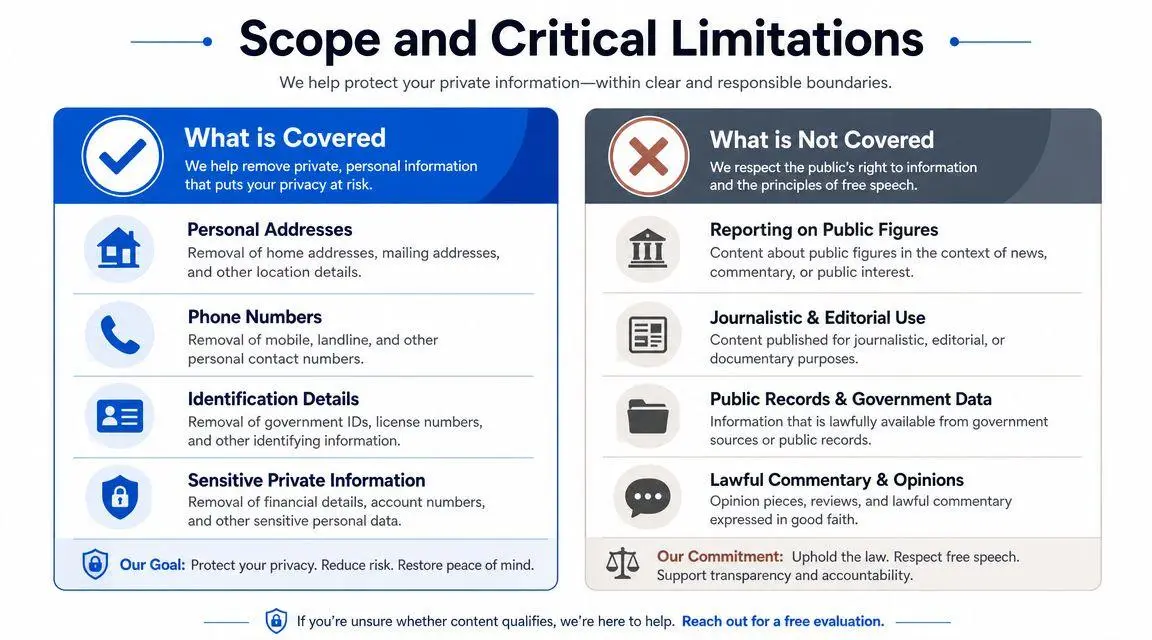
What the right usually covers
If personal data no longer serves the purpose for which it was processed, your position improves. If consent has been withdrawn and no other lawful basis remains, your position improves. If the processing was unlawful from the outset, your position improves further.
That’s why stale profile pages, outdated people-search listings, copied biographies, old forum discussions, and irrelevant database entries can be good candidates. These often have weak public-interest value and weak necessity arguments.
What usually defeats the request
News publishers, public archives, and entities dealing with matters of legitimate public concern are different. If the content relates to corporate leadership, investor-facing conduct, criminal matters, regulatory scrutiny, or questions bearing on public trust, the controller can argue that continued accessibility serves freedom of information.
Here’s the practical distinction:
| Content type | Typical obstacle | Strategic reality |
|---|---|---|
| Old directory listing | Weak necessity for continued processing | Often worth pursuing directly |
| Forum or blog mention | Replication and anonymous hosts | Requires cleanup beyond one URL |
| News article on executive conduct | Public-interest balancing | Hardest category for full removal |
| Archived public record | Statutory or archival defense | May allow de-indexing but not deletion |
The balancing test that clients underestimate
Search engines and regulators don’t ask whether content embarrasses you. They ask whether keeping it discoverable remains justified. That’s a balancing exercise between your privacy and the public’s access to information.
If you run a public company, lead a regulated business, or market yourself as a trusted authority, expect the public-interest argument to be used against you.
This is why a true article and a fair article aren’t the same thing, but that distinction alone won’t save you. For delisting, you need to show why continued name-based prominence is now disproportionate. For source removal, you need a stronger argument because you’re no longer talking about search discoverability. You’re trying to alter or eliminate the publication itself.
Propagation is the hidden complication
There’s another operational limit embedded in Article 17. Where a controller made data public and a valid erasure ground exists, it must take reasonable steps to inform other controllers to erase links, copies, or replications. In plain terms, removal becomes a propagation problem.
That means one success rarely finishes the job. If the material was indexed, mirrored, cached, reposted, or summarized elsewhere, each node may require separate handling. Savvy clients should assume the internet keeps receipts. Your strategy should too.
The Practical Process for Submitting Requests
A viable request starts by separating the target. Are you asking a search engine to stop showing a result in name searches, or are you asking the publisher or controller to erase the source material? Those are different applications, and they shouldn’t be merged into one unfocused complaint.

Under GDPR, the right is framed as the right to erasure in Article 17, triggered only in specific circumstances, and the controller must act without undue delay, with guidance commonly interpreting the response window as about one month for handling the request and communicating the outcome, as summarized in this GDPR right-to-erasure guide.
Route one through the search engine
This is the faster and more realistic path when the article is hard to delete at source but easier to challenge in name-based search. You are not arguing that the page must vanish from the internet. You are arguing that tying it so prominently to your name is no longer justified.
Your submission should usually include:
- Identity verification: Enough documentation to prove you are the person affected. Give what is necessary and no more.
- Precise URLs: Every offending result should be listed individually. General complaints are weak.
- Search queries involved: If the problem is your name, say so clearly. Delisting often turns on name association.
- Legal basis: Tie the request to a proper Article 17 trigger, not a generic privacy grievance.
- Context material: Include documents showing the matter is outdated, resolved, inaccurate in part, or excessive in current relevance.
If you need a baseline on Google-facing mechanics, review this practical guide on how to submit a Google legal request.
Route two through the publisher or controller
This route is harder because you are now challenging the source itself. The publisher may rely on journalistic freedom, public record, or public-interest exceptions. Your burden rises accordingly.
A serious publisher-side request should identify the exact data being processed, the reason continued publication is no longer necessary, and the legal ground for erasure. If the article remains online for archive, legal, or public-information reasons, expect resistance.
A short explainer on the mechanics can help frame expectations:
What a strong file looks like
Weak requests are emotional, vague, and overbroad. Strong requests are documented, restrained, and specific. They avoid exaggeration. They don’t argue every point available. They argue the points that matter.
Use this internal checklist before filing:
- Separate de-indexing from deletion
If you ask for both, make clear which remedy applies to which target. - Build the chronology
Show what happened, what changed, and why the old publication context no longer reflects present reality. - Preempt the obvious defense
If you are a public figure, address public-interest objections directly instead of pretending they won’t arise. - Prepare for follow-up
One month is the compliance window commonly used for response handling. That does not mean the matter ends there.
A rushed request often gets rejected for the wrong reason. A disciplined request forces the recipient to confront the right reason.
Navigating Cross-Jurisdiction Enforcement
A successful EU request doesn’t create global invisibility. That is the mistake multinational executives make most often. They assume a European win solves an American, Asian, or Middle Eastern exposure problem. It usually doesn’t.
The internet is global. The legal remedy is not. Even inside Europe, implementation is uneven. The EDPB said in 2026 that the right to erasure is one of the most frequently exercised GDPR rights, that DPAs frequently receive complaints, and that coordinated enforcement found challenges hindering full implementation, as noted in the EDPB’s 2026 statement on erasure enforcement.

Why geography still matters
Search visibility can change by region, domain, and user context. A result may be suppressed in one European market and remain accessible elsewhere. A publisher hosted outside Europe may reject your request outright or ignore the legal theory if it doesn’t map cleanly onto local law.
That matters if your reputation risk is transatlantic. A family office with European residency but U.S. investments, or a founder who sells globally, can’t rely on a purely EU solution. If your principal counterparties search on non-EU services or consume international press databases, the reputational exposure persists.
Fragmentation is part of the problem
Different platforms ask for different evidence. Different regulators apply different practical expectations. Different legal cultures assign different weight to speech, archives, and public accountability. None of that is surprising, but it does mean a “successful GDPR request” can still be operationally incomplete.
A useful comparison point is ContentRemoval’s overview of the right to be forgotten in the US, which helps clients understand where the European approach doesn’t travel.
What executives should do instead
Treat jurisdiction as a planning issue at the start, not as an unpleasant surprise later.
- Map the exposure footprint: Identify where the content is hosted, indexed, republished, and most likely to be seen by the people who matter.
- Prioritize by commercial harm: EU-only de-indexing may be enough for some matters and useless for others.
- Plan for layered remedies: De-indexing, source requests, complaint escalation, and suppression strategy may all be needed.
If your profile is global, a single-country filing is a partial tactic, not a solution.
Strategic Considerations for Executives and Public Figures
For public figures, the eu right to be forgotten is not a paperwork exercise. It is an argument about proportionality under pressure. If you are a founder, celebrity, major shareholder, regulated professional, or public company executive, the central question is not whether the content hurts you. It is whether you can persuade a decision-maker that continued prominence of the content is no longer justified despite the public-interest case.
That’s why executives, celebrities, and founders need to understand that de-indexing and source removal are different remedies, and that the stronger the public-interest angle, the harder full removal becomes, as discussed in this analysis of the balancing framework.
Build the case around present relevance
Most high-profile clients make the same tactical mistake. They fight the historical truth of the article instead of attacking its current necessity and discoverability. If the core facts are broadly correct, denial won’t help. A better approach is to focus on age, resolution, incompleteness, changed circumstances, limited current value, and disproportionate harm from name-based indexing.
That argument is especially strong where the content captures a temporary issue but now functions as a permanent character judgment.
Time the request intelligently
Timing changes outcomes. Filing while litigation, regulatory scrutiny, activist pressure, or a funding dispute is active will usually strengthen the publisher’s public-interest defense. Filing after the matter is resolved, documented, and no longer part of any current controversy often gives you a cleaner runway.
Don’t file at the peak of public attention unless you have a separate legal reason to move immediately. Peak attention hardens opposition.
Separate reputational priorities
Not every harmful result deserves the same remedy. I usually tell clients to classify targets into three groups:
- Low-friction targets such as stale directories, scraped profiles, or minor reposts. Remove these first.
- Mid-friction targets such as forum discussions, cached copies, and pseudo-news sites. These need persistence and monitoring.
- High-friction targets such as mainstream reporting about corporate conduct, disputes, or investigations. These require a carefully argued public-interest rebuttal.
That triage matters because legal merit and reputational payoff are not always aligned. Sometimes the right strategic move is to de-index aggressively, leave the source fight for later, and reduce overall visibility while the harder negotiation develops.
When to Escalate Beyond a Standard Request
There is a point where self-help stops being efficient. Experienced individuals often cross that line early, then keep filing DIY requests because they assume persistence alone will turn refusal into compliance. It won’t.
Escalation is justified when the obstacle is structural, not administrative. If a search engine rejects the request on public-interest grounds, if a publisher invokes freedom of expression, if the content has spread across multiple domains, or if the matter touches allegations of dishonesty, criminality, fiduciary conduct, or investor-facing statements, the case is no longer a simple takedown exercise.
The red flags that matter
Here is the decision framework I use with private clients:
| Situation | What it usually means | Recommended move |
|---|---|---|
| Initial rejection with generic reasoning | Automated or standardized refusal, not necessarily final | Reframe and resubmit with tighter evidence |
| Publisher is a recognized news organization | Speech and public-interest defenses will dominate | Move to legal-strategic review before pressing harder |
| Content exists on many sites | Replication risk outweighs single-URL tactics | Build a node-by-node removal map |
| The story concerns executive conduct or money | Public accountability argument is strong | Prepare a balancing case, not a complaint letter |
Why amateur escalation backfires
Poor escalation often creates a worse paper trail. A badly framed complaint can lock the other side into a speech-defense posture. An angry demand can encourage a publisher to preserve, highlight, or republish. A vague legal threat can expose that you don’t have a coherent Article 17 basis.
Specialist handling earns its keep, not because the law is mystical, but because sequence matters. The order in which you contact a search engine, publisher, host, archive, and regulator can affect the outcome. So can the way you present identity materials, chronology, legal grounds, and evidentiary attachments.
If the stakes are material to your business, your family, or an ongoing transaction, treat this the same way you’d treat a serious tax dispute or regulatory inquiry. Get the right people involved before you harden the other side’s refusal.
Frequently Asked Questions
Can I use the eu right to be forgotten against a major news publication
Sometimes, yes. Often, not fully. A publisher can rely on freedom of expression, public-information arguments, archival justifications, or other carve-outs. In practice, it may be easier to seek de-indexing of name-based search results than deletion of the underlying article.
If Google removes a result, is the problem solved
Usually only in part. De-indexing reduces discoverability in relevant searches. It doesn’t necessarily remove the article from the publisher’s site, from archives, or from other websites that copied it. If the matter is commercially sensitive, you need a broader map of where the content lives.
How long does the process take
For controllers handling a valid Article 17 request, guidance commonly interprets the response window as about one month. Real-world resolution can take longer when identity verification, legal-basis disputes, public-interest objections, or follow-up complaints enter the picture. Complex matters do not move at the speed of a simple form submission.
What should I do after a rejection
First, read the rejection for the actual reason given. If the refusal turns on public interest, rewrite the argument around present necessity, proportionality, and relevance. If the refusal is procedural, fix the evidence package. If the matter is high stakes, escalate before repeating the same failed request.
Can I remove true information if it is old and damaging
Truth does not automatically defeat an erasure or delisting request. But if the information concerns professional conduct, public-facing responsibility, or matters the public may still reasonably care about, the resistance becomes stronger. Age helps. Public-interest context often hurts.
Should I start with an audit before filing requests
Yes. A proper visibility audit prevents you from wasting effort on the wrong URLs and missing the ones that influence perception. For clients managing broader reputational cleanup, this practical guide on how to audit your online feedback is a useful starting point for reviewing what people find first and what needs intervention.
Is it worth hiring a specialist firm instead of doing it myself
If the content is minor, self-submission can be fine. If it involves mainstream media, replicated content, allegations touching your role, or a meaningful public-interest defense, professional handling is usually the rational choice. High-stakes removal is part law, part platform process, and part sequencing discipline.
If a search result, article, archive entry, or replicated post is putting your role, transaction, or family privacy at risk, ContentRemoval.com can assess the matter confidentially and help determine whether de-indexing, source removal, escalation, or a multi-jurisdiction strategy is the right path.