
A Facebook preservation request is a formal legal directive to Meta under 18 U.S.C. 2703(f) asking it to preserve specified account data so it is not deleted in the ordinary course. It does not disclose data or remove any post. Meta holds the records for 90 days, during which counsel must serve a subpoena, court order or warrant.
Key facts
- Preservation freezes account data; disclosure still requires separate legal process such as a subpoena or warrant.
- Meta’s hold lasts 90 days and can be extended only on a showing of case necessity.
- Identify the account by user ID or full profile URL, since usernames change; pair a username with the date.
- Emergency Disclosure Forms are reserved for imminent harm, not ordinary reputational crises.
Where ContentRemoval.com comes in. ContentRemoval.com runs the removal track alongside a preservation request: reporting impersonation, harassment and privacy violations under Facebook’s policies, tracking reposts and copycat accounts, and de-indexing where search exposure is the problem, without disturbing the evidence your lawyer needs. Attorneys and general counsel usually bring us in once the preservation letter is sent. A free 15-minute Exposure Scan maps what is removable and the report is yours to keep. Get a Free, Confidential Exposure Scan or read how our Facebook content removal work is done.
A false post goes live at 6:40 a.m. By 7:15, board members have seen it. By 8:00, screenshots are moving through investor chats, family office staff are forwarding links internally, and someone has already copied the allegations to a second account. If you’re the target, the first instinct is usually removal. That makes sense. But when the attack involves Facebook, evidence disappears fast, accounts change names, posts get edited, and direct messages can vanish before counsel is fully engaged.
That is why a Facebook preservation request matters so early. It is not a public relations move. It is not a takedown. It is the legal step that protects the evidentiary layer before the platform, the bad actor, or routine system behavior leaves you with fragments instead of proof. For executives, founders, public figures, and families managing sensitive exposure, that distinction is where the case is often won or lost.
The clients who handle these incidents well usually do two things at once. They stabilize the public problem, and they lock down the forensic record. The ones who wait for the situation to calm down often discover later that the critical account metadata, login history, or message context they needed is no longer available in the form they expected.
Your First Move in a Digital Crisis
A coordinated smear campaign rarely arrives as a single post. It tends to surface as a cluster. A fake profile copies your headshot, an anonymous account publishes allegations, a former insider begins messaging your contacts, or a private family matter appears in a public thread. The visible content is only part of the problem. The deeper issue is attribution. Who ran the account, from where, and in connection with what other activity?
In that moment, a Facebook preservation request is often the first disciplined move. It gives your legal team a chance to secure the account state before deletions, edits, or platform churn strip out context. If the incident later becomes a civil defamation matter, a harassment claim, a trade secrets dispute, or a criminal referral, that preserved record can become the bridge between suspicion and proof.
The scale of this process matters. In the first half of 2024, Facebook received over 99,000 user data preservation and disclosure requests from Indian law enforcement agencies, followed by the United States with over 81,000 requests, according to global Facebook government request data. That volume tells you something useful. This isn’t an obscure remedy. It is an established part of serious investigative practice.
What high-profile targets usually get wrong
The most common mistake is treating the incident as purely reputational. Counsel gets pulled in late. Screenshots get collected informally. Staff members report the page through ordinary platform channels and assume the platform will keep a full record. That assumption is dangerous.
A second mistake is using the wrong escalation path for the wrong goal. If your concern is active defamation, impersonation, or targeted harassment, your content strategy has to run in parallel with evidence preservation. A useful reference on that dual-track approach is this guide on what to do if someone is slandering you on social media.
Practical rule: If the account is harming you now and may matter later in court, preserve first, remove second, and coordinate both from the start.
The first hours matter more than most clients expect
You don’t need perfect information to act. You need enough specificity to identify the target account and enough legal discipline to avoid wasting time. Preserve the URLs, record the visible username as it appears that day, capture timestamps, and route the matter through counsel or the appropriate authority quickly.
What works is speed with precision. What fails is panic-driven reporting without a legal record behind it.
The Legal Foundation of a Preservation Request
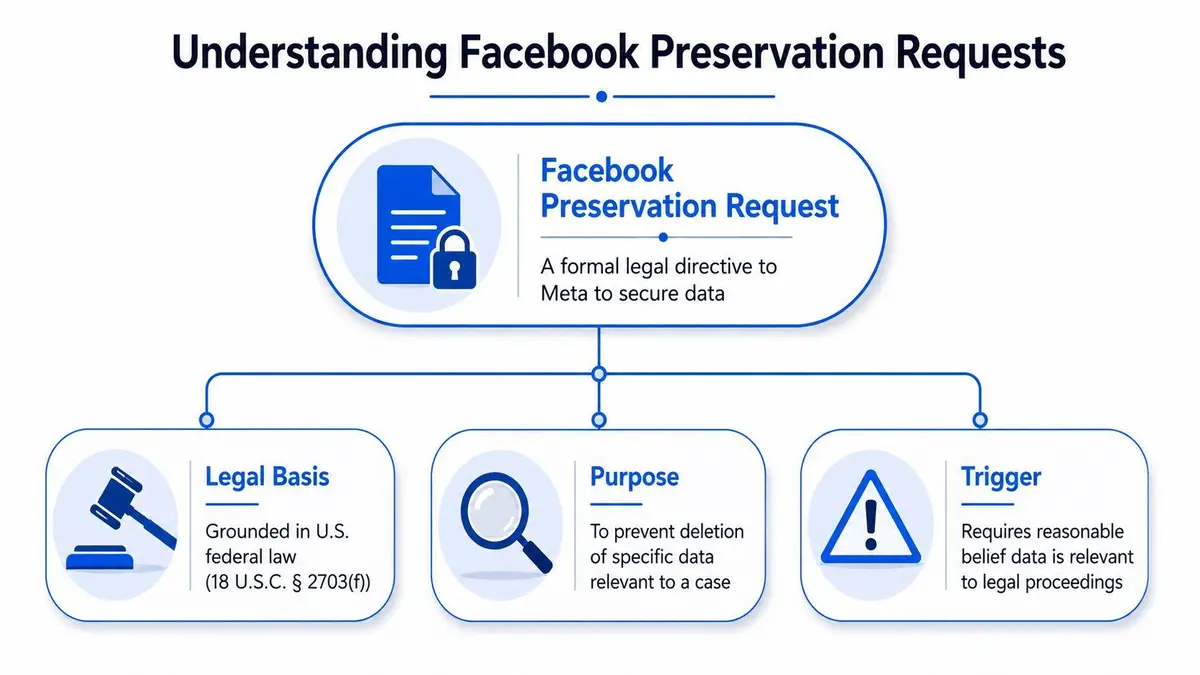
A Facebook preservation request is a formal legal directive to Meta to preserve specific account data. The legal basis is 18 U.S.C. § 2703(f). That statute matters because it draws a hard line between preserving data and producing data. Preservation freezes relevant material. It does not hand the material over.
Preservation is not disclosure
This distinction causes confusion even among experienced clients. After a preservation request is accepted, Meta holds the specified account information so it isn’t deleted in the ordinary course. Your lawyer does not suddenly receive inbox contents, IP logs, photos, or device records. A separate valid legal process, such as a subpoena, court order, or search warrant, is still required to compel disclosure.
That is why preservation should be treated as a defensive lock, not an extraction tool.
A preservation request buys time. It doesn’t end the evidence problem.
The 90-day legal hold
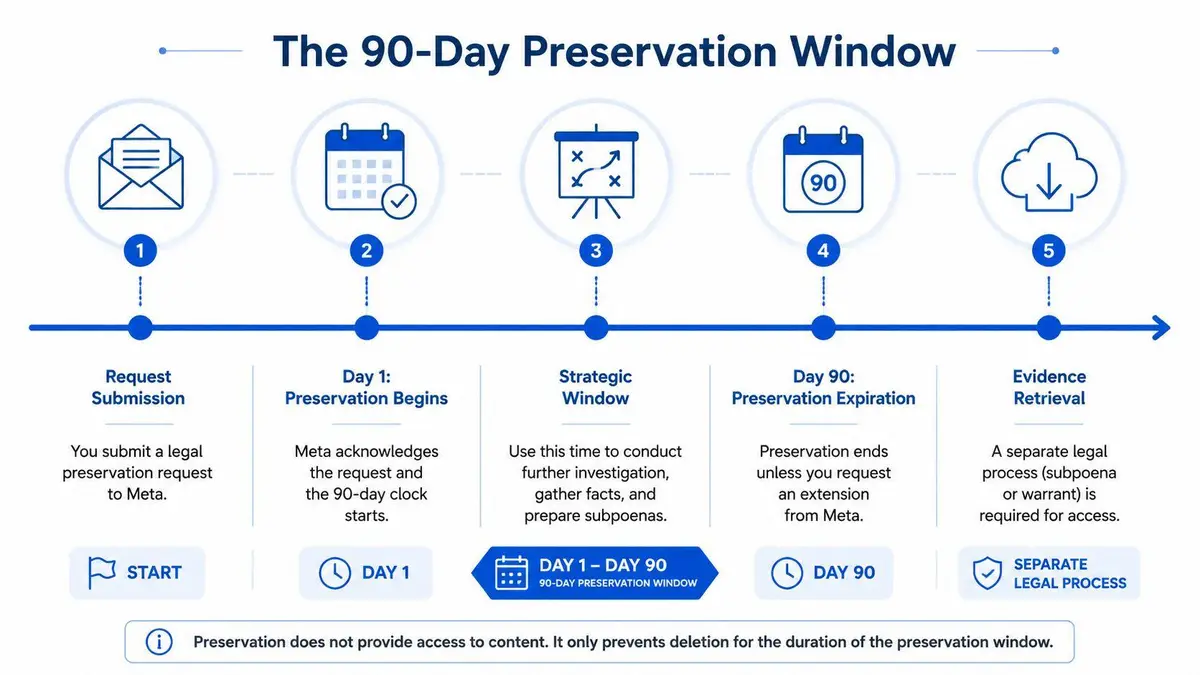
Meta preserves user information for exactly 90 days after receiving a formal preservation request under 18 U.S.C. § 2703(f), after which the data may be deleted unless an extension is granted based on case necessity, as reflected in the Facebook legal process guide archived by EFF. For a client under pressure, that is the central timing rule. It creates a narrow legal runway for the next filing.
A useful way to think about it is this:
| Issue | What preservation does | What it doesn’t do |
|---|---|---|
| Evidence retention | Freezes targeted account data | Doesn’t analyze the data |
| Data access | Protects against loss while legal process is prepared | Doesn’t disclose records to you |
| Litigation value | Preserves options for later subpoenas or warrants | Doesn’t prove the case by itself |
Why privacy governance still matters
Preservation work often sits alongside broader data handling decisions inside a company or family office. When legal, security, and executive teams are moving quickly, sloppy internal handling can create a second problem. A concise model for disciplined data handling is any clear internal framework like your data protection policy, which helps teams define who may collect, store, review, and transmit sensitive material during a live incident.
The legal principle is simple. Preserve externally. Control internally. If you fail at either, the record becomes harder to use and easier to challenge.
How to Submit a Request to Meta
Meta is unforgiving about vague preservation requests. If the account target isn’t identified with precision, or if the sender lacks the right credentials, the request can stall or fail. In an active crisis, that delay is often avoidable.
Where requests go
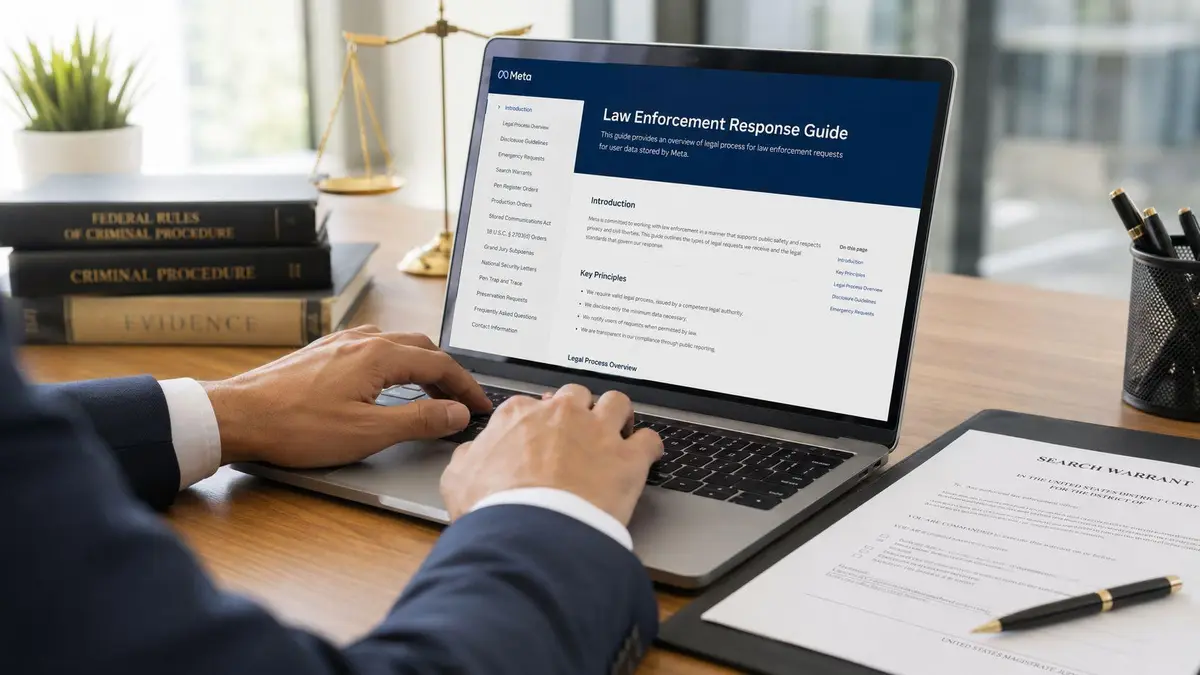
According to Meta’s guidance, requests can be submitted by fax, mail, or email to the law enforcement contact, and emergency matters involving imminent harm to a child or risk of death or serious injury may be submitted through an Emergency Disclosure Form with “Emergency Request” in the subject line. The emergency channel is not a shortcut for ordinary reputational crises. It is reserved for genuine emergency circumstances.
For non-emergency legal work, the practical issue is less about the channel and more about whether the request is drafted with the exact level of specificity Meta requires.
What Meta expects to see
That last point matters more than is commonly understood. A vanity username is not a stable identifier. If an impersonator changes the handle, your screenshot alone may not be enough to anchor the request unless you also recorded the date and account URL.
A clean submission checklist
When I review failed submissions, the defects are usually procedural rather than legal. The request was too broad, the account identifier was imprecise, or the sender assumed the platform would infer what was meant.
Use this standard before anything is sent:
- Identify the account exactly: Use the Facebook user ID or the full profile URL whenever possible. If you’re relying on a username, pair it with the relevant date.
- State legal authority clearly: The request should identify the authority making the request and the basis for preservation.
- Avoid broad categories: “Preserve all information related to this matter” is weak drafting. Target the account and the categories that matter to the dispute.
- Include live contact information: If Meta needs clarification, delay often comes from basic communication failures.
- Coordinate with downstream process: A preservation request should be drafted with the later subpoena or court application in mind.
For legal teams that also work across other platforms, the procedural discipline is similar to the workflow discussed in this guide on how to submit a Google legal request. Different platform, same lesson. Precision beats urgency every time.
Crafting an Effective Preservation Letter
A strong preservation letter does not try to sound dramatic. It gives Meta enough information to act, ties the request to legal authority, and avoids ambiguity that invites rejection. The best letters are restrained, specific, and built for follow-through.
A working draft for counsel
Below is sample language an attorney can adapt:
Re: Request for Preservation of Facebook Account Records Pursuant to 18 U.S.C. § 2703(f)
To Meta Legal Process Team:
Please preserve records and other evidence in Meta’s possession, custody, or control associated with the following Facebook account: [insert exact user ID / full URL / email / username plus relevant date].
This request is made in connection with anticipated legal proceedings involving alleged impersonation, defamation, harassment, privacy violations, unauthorized disclosure of confidential information, or related misconduct. The requested preservation includes account registration information, login and access records, IP logs, associated content, messaging records to the extent preserved by Meta, and other account data reasonably associated with the identified account.
This preservation request is made pursuant to 18 U.S.C. § 2703(f). Please preserve the identified records pending service of appropriate legal process for disclosure.
Kindly confirm receipt and preservation.
Sincerely,
[Name, title, authority, contact information]
Why each clause matters
The opening line identifies the statutory basis and narrows the request to a single account target. That does two things. It shows legal competence, and it reduces the chance that the request will be treated as overbroad.
The middle paragraph frames the dispute without oversharing strategy. You do not need to write a litigation brief to preserve evidence. You need enough context to show that the account is relevant to a real matter and that specific categories of data may later become material.
A useful comparison appears in disputes involving written falsehoods, where the path from publication to platform action can intersect with evidence preservation. This overview of written defamation and the path to content removal captures that overlap well.
Drafting errors that weaken the request
A poor letter usually has one of three defects:
- It identifies the account loosely.
- It requests everything under the sun.
- It asks Meta to both preserve and adjudicate the merits.
Meta is not there to validate your narrative. It is there to preserve data if your request meets the legal and procedural standard. Draft accordingly.
The 90-Day Clock and Evidence Management
Once preservation is in place, the case enters its most misunderstood phase. Many clients think the hard part is over. It isn’t. The preservation period is a countdown that demands organized legal action, internal discipline, and a realistic plan for obtaining disclosure before the hold expires.
What must happen during the hold
The preservation period should be used to prepare the compulsory process that fits the case. In a civil matter, that may mean subpoena practice tied to a filed action or pre-action application where available. In a criminal or emergency context, the route may be through law enforcement and judicial authorization.
The worst approach is passive waiting. Preservation with no downstream order is just deferred loss.
Operational point: Treat day one of preservation as day one of subpoena preparation.
A practical timeline inside the legal timeline
The internal workflow usually looks like this:
| Period | Legal team focus | Risk if delayed |
|---|---|---|
| Early hold | Verify account identifiers, confirm incident scope, map claims | Misidentification of target account |
| Mid hold | Prepare subpoena, court order request, or law enforcement package | Running out of time for service and response |
| Late hold | Follow up, seek extension if justified, maintain chain of evidence | Preserved data lapses before disclosure |
Extension requests and professional handling
If more time is needed, counsel should seek an extension on a properly supported basis. The platform expects case necessity, not casual delay. That means the file should already show active investigative or litigation steps, not inertia.
This stage also places a premium on clear spoken and written communication. In cross-border matters, emergency applications, or hearings where technical facts must be explained quickly, teams often overlook communication as a risk variable. Resources that help lawyers improve communication for legal careers can be more practical than they sound, particularly when precision in oral advocacy affects how fast a court or agency understands the urgency.
From Preservation to Actionable Intelligence
Preserved data becomes valuable only after lawful disclosure and disciplined analysis. Once records arrive, the work shifts from legal hold to intelligence extraction. At this stage, many reputation cases stop being speculative.
What the disclosed record can reveal
A disclosed Facebook record may help establish who created the account, how it was accessed, whether multiple accounts are connected, and whether the same actor appears across a pattern of posts or messages. The forensic value often lies in correlation, not a single dramatic document.
An executive facing anonymous allegations usually wants one answer. Who did this? The legal record often produces a more useful set of answers. Which devices touched the account, what timing patterns appear, what registration data exists, and what other platform or communication evidence should now be subpoenaed?
Turning data into case theory
Forensic review should be tied to the claims you’re advancing. If the matter is defamation, your team needs evidence that supports publication, authorship, falsity, and damages strategy. If it is harassment or impersonation, the account linkage and pattern evidence may be more important than the text of a single post.
Use the disclosed material in layers:
- Attribution layer: Match account access and registration details to likely actors.
- Pattern layer: Compare timing, language, and account behavior with other incidents.
- Corroboration layer: Align Meta records with screenshots, witness accounts, device reviews, or corporate logs.
- Remedy layer: Decide whether the strongest next move is a platform report, injunction, demand letter, law enforcement referral, or filed complaint.
The best evidence package is never just “what Facebook sent back.” It’s the Facebook record integrated with everything else you already know.
What works in real matters
What works is narrowing the question before the data arrives. If counsel asks a forensic consultant to “see what this tells us,” the review often sprawls. If the instruction is “establish likely operator identity, map account timeline, and identify links to known counterparties,” the analysis becomes useful much faster.
What does not work is assuming disclosure alone will solve the matter. Often it points to the next compulsory process, not the final answer.
When Preservation Is Not Enough
A Facebook preservation request secures evidence. It does nothing to remove the harmful post from public view. That limitation matters most when the target is not only preparing for litigation, but trying to stop immediate reputational bleed.
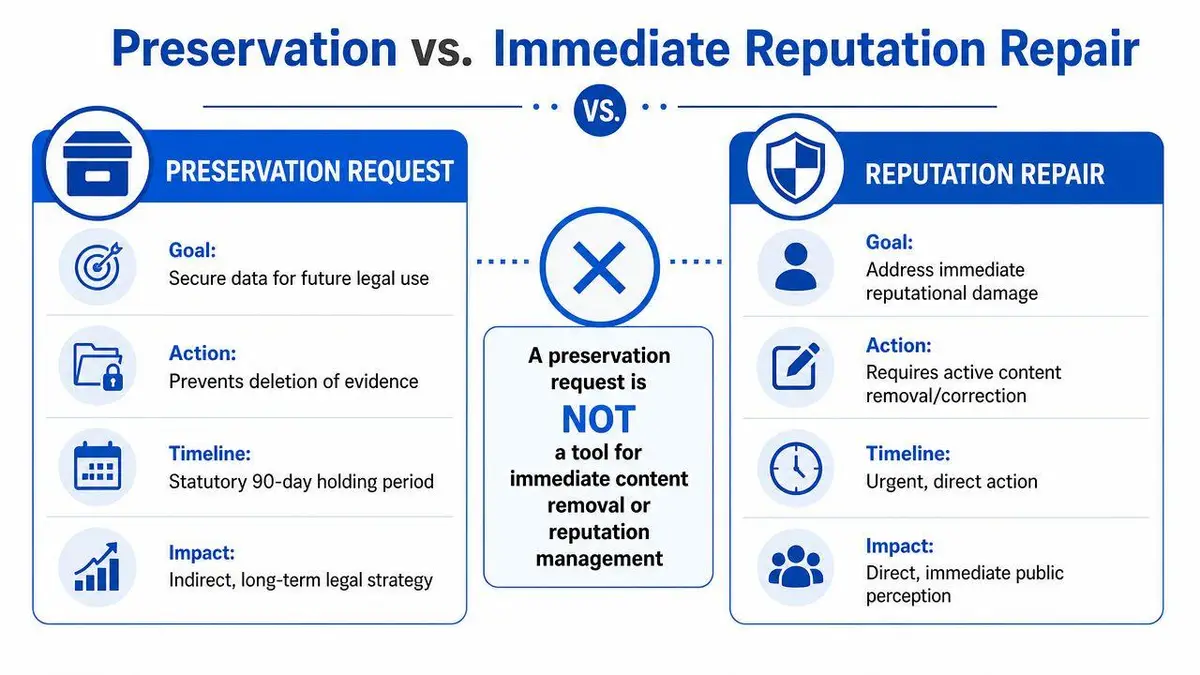
Evidence strategy and removal strategy are different tracks
Facebook and other online service providers remove content for categories such as harassment, privacy violations, impersonation, doxxing, copyright infringement, non-consensual imagery, and terms-of-service abuse, as outlined in this discussion of OSP removal categories and policy thresholds. That system is distinct from preservation. One protects evidence. The other addresses what the public can still see.
Those tracks often need to run together. If you preserve but never pursue removal, the evidence survives while the damage keeps circulating. If you remove without preserving, you may lose your best route to identifying the source and proving responsibility.
The timing problem executives face
The processing timeline for a privacy or personal data removal on major platforms ranges from 2 to 6 weeks, while defamation matters that require both a legal notice and a platform report can extend to 4 to 12 weeks, according to this overview of content removal timelines by claim type. For a public company executive, founder in a financing round, or family office principal in the middle of a sensitive dispute, that can feel far too slow.
That delay changes the strategy. It means the legal file cannot be your only defense. Public-facing mitigation, search monitoring, copycat tracking, and rapid escalation against duplicate uploads have to be treated as live operational tasks, not side issues.
Where specialist intervention changes the outcome
Generic reporting usually fails when the content sits near policy boundaries or when the attack spreads across multiple accounts, reposts, and search results. Specialist intervention matters when the objective is broader than “send a complaint.” The objective is to suppress reach, preserve evidence, reduce replication, and position the case for enforcement.
If you’re dealing with impersonation, harassment, private data exposure, or a coordinated reputational attack, ContentRemoval.com can assess the incident confidentially and coordinate the immediate removal track alongside the legal and evidentiary strategy needed to protect your long-term position.
Frequently asked questions
Does a Facebook preservation request get the post taken down?
No. Preservation secures evidence and does nothing to remove content from public view. Removal runs through Facebook’s separate reporting categories such as harassment, impersonation, privacy violations and non-consensual imagery, and both tracks should run together so evidence survives while the damage is contained.
Who can send a preservation request to Meta?
The request must come from someone with legal authority to make it, typically counsel or law enforcement, and it should state that authority and the basis for preservation. Ordinary user reports through the platform’s public channels do not create a legal hold and should not be relied on to keep a full record.
What happens after the 90-day preservation period ends?
The preserved data may be deleted unless an extension has been granted on a properly supported basis. Counsel should treat day one of preservation as day one of subpoena preparation, so the compulsory process for disclosure is served before the hold lapses.