
Removing posts from Facebook depends on who owns the content. Your own posts are deleted through the Activity Log or in bulk with Manage Posts, and erased 30 days after moving to trash. Posts by others are reported under the Community Standard they breach, appealed through the Support Inbox if rejected, and escalated through a DMCA notice or court order.
Key facts
- Hiding a post removes it from your timeline only; deletion is the only way to erase it.
- Deleted posts sit in trash for 30 days; empty it manually to expedite removal.
- Facebook will not judge a factual dispute; defamation removal almost always needs a court order.
- Google’s Remove Outdated Content tool clears the cached link, often within 24 to 48 hours.
Where ContentRemoval.com comes in. ContentRemoval.com handles the Facebook matters that outgrow the report button: coordinated campaigns across multiple fake accounts and pages, repeated rejections on clear harassment or impersonation, leaked confidential material and stalking, using escalation channels to Meta’s legal and policy teams and following each removal with Google de-indexing and monitoring for re-uploads. Executives and public figures usually reach us through a chief of staff or counsel. A free 15-minute Exposure Scan maps what is removable, and the report is yours to keep. Get a Free, Confidential Exposure Scan or read how our Facebook content removal work is done.
Discovering a harmful or private post on Facebook provokes a singular anxiety: an immediate, high-stakes loss of control over one’s own narrative. The process of removing posts from Facebook ranges from a simple procedural matter to a complex legal engagement, contingent entirely upon the content’s origin and nature. This guide provides the strategic framework for regaining that control.
The Strategic Reality of Removing Unwanted Facebook Content

Excising unwanted content from Facebook is not a technical exercise; it is a strategic one. For executives, public figures, and any individual for whom reputation is a critical asset, a single errant post can ignite a crisis. This may manifest as a past indiscretion, a malicious third-party attack, or the unauthorized disclosure of private information. The resulting damage can be significant and immediate. The core problem is a sudden, public loss of control, demanding a precise and effective solution, not generic advice.
Our approach moves beyond rudimentary deletion tactics. The correct strategy is entirely situational. A post you published years ago presents a different challenge entirely from a defamatory comment posted by a disgruntled former employee.
Understanding the Strategic Layers
Effectively removing posts from Facebook requires a strategy that adapts to the specific threat. The initial action must be swift, but it must also be correct.
The primary scenarios dictate the course of action. First is content you own, which is the most straightforward scenario. You have direct control and can delete posts from your personal profile, a business page you manage, or a group you administer. Second is content owned by others, where the complexity increases. Here, you must navigate Facebook’s reporting system, flagging violations such as harassment, bullying, or impersonation and persuading the platform of your case’s validity. Third is legally actionable content. For serious matters including defamation, copyright infringement, or non-consensual intimate imagery (NCII), the solution often lies outside Facebook’s standard tools and requires formal legal demands.
The most critical distinction to make is between what you can delete yourself and what you must compel another party, or the platform, to remove. Misjudging this wastes valuable time and allows the damaging content to proliferate.
The Limits of Standard Advice
Most publicly available “how-to” guidance is too generic for high-stakes situations and fails to account for the platform’s operational nuances. For instance, Facebook’s automated moderation systems have been observed to mistakenly remove legitimate real estate advertisements due to misapplication of its Fair Housing policies. This demonstrates that even when acting in good faith, the platform’s blunt instruments can be counterproductive.
Conversely, a determined bad actor can often manipulate the system to maintain defamatory content despite numerous reports. A successful removal campaign requires knowing precisely how to frame a complaint, when to escalate it, and which legal pressure points to apply. This guide is structured to provide that expertise, facilitating a resolution and restoring your peace of mind.
Taking Control: Your First Line of Defense
When problematic content appears, the first area of focus must be your own digital assets. Before addressing third-party posts, you must sanitize the properties you directly control: your personal Facebook profile, any Pages you administer, and Groups you manage. This is an essential starting point of digital hygiene.
The most direct method for a single problematic post is to locate it and select “Delete.” For removing a large volume of historical posts, however, a one-by-one approach is not viable. In such cases, Facebook’s own management tools are required.
Digging into Your Activity Log
Your Activity Log serves as a comprehensive chronological record of your entire history on the platform, tracking posts, comments, likes, and shares. This makes it the ideal instrument for conducting a deep, historical content purge.
If, for example, you have concerns about posts made during a specific period, you can navigate to the Activity Log, filter by a date range, select all content from that period, and move it to the trash in a single action. This provides a more organized and deliberate method for purging old content than manually scrolling through your timeline.
A critical distinction: hiding a post is not equivalent to deleting it. Hiding a post removes it from your timeline, but it may remain visible in search results or on the feeds of tagged individuals. Deletion is the only method to ensure the post’s permanent removal from Facebook’s servers.
Bulk Deletion with the Manage Posts Tool
For managing more recent activity, Facebook’s Manage Posts feature offers superior efficiency. It presents a visual grid of your posts, allowing for the rapid selection of dozens at a time.
This tool allows filtering by date, by the author of the post (yourself or another user), and by tagged individuals. It is particularly effective for removing photos you were tagged in without needing to address each one individually. After making your selection, you are presented with two options. “Hide from Profile” renders the posts invisible on your timeline but does not delete them. “Delete Posts” moves the content to your trash folder, where it will be permanently erased after 30 days.
This 30-day grace period acts as a failsafe against accidental deletion. However, if the content poses a genuine reputational threat, you can enter the trash folder and empty it manually to expedite the permanent removal.
Where Self-Service Falls Short
While mastery of these tools is a crucial first step, it is imperative to recognize their limitations. You can only delete content that you own and control. This self-service approach is entirely ineffective against the most common and damaging scenarios, which include when another user has shared or reposted your content; when screenshots of your original post are being circulated as new images; or when defamatory or harassing posts are made by others on their own profiles or in groups you do not control.
Each time your post is shared, a new instance is created that is entirely outside your control. While sanitizing your own profile is a necessary defensive measure, it is rarely sufficient to contain a reputational attack that has already begun to spread. To address content you do not control, including pursuing a full account removal, you must employ different strategies, beginning with Facebook’s reporting system.
Reporting Content on Facebook That Isn’t Yours
When you lack the ability to directly delete a harmful post because it was published by a third party, you are not without recourse. The strategy must shift from direct action to leveraging Facebook’s internal reporting framework. The key to successfully removing posts from facebook in this context is not the volume of reports, but the precision of a single, undeniable claim.
Your report must correspond precisely to a specific rule within Meta’s Community Standards. The initial review is nearly always algorithmic; a vague complaint such as “this is harassing me” will likely be rejected. However, if you can cite the exact policy being violated, you provide the system, and any subsequent human reviewer, a clear and actionable basis for removal.
The first question is always the simplest: do you control the post? If yes, delete it. If no, your only path forward is reporting.
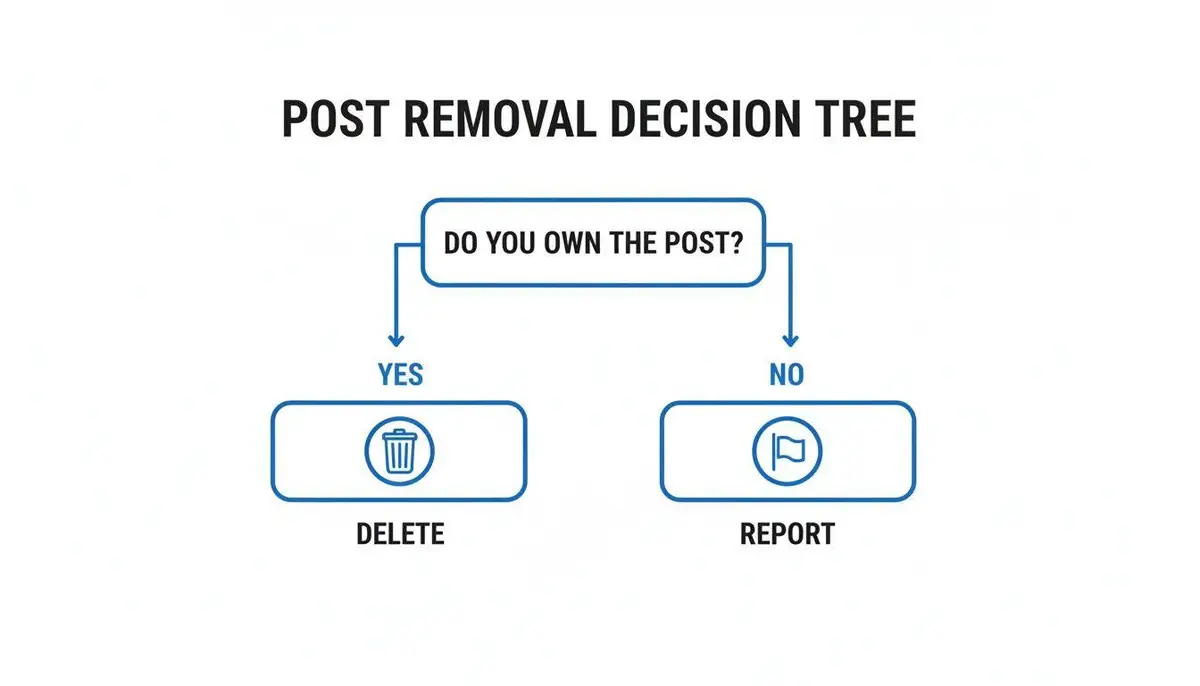
The moment you do not own the content, you enter a domain governed by platform rules and reporting tactics. It is an entirely different strategic environment.
How to Match Your Report to Facebook’s Rules
Given the millions of daily reports, Facebook relies heavily on automation for initial triage. To ensure your report is acted upon, you must frame it in a way the system immediately recognizes as a clear violation.
The most effective violation categories in high-stakes situations are Harassment, for content targeting a private individual with degrading comments or unwanted sexualization, requiring specificity in your report; Impersonation, a straightforward violation if a profile or page is masquerading as you or your business, best reported from your authentic profile for verification; Non-Consensual Intimate Imagery (NCII), which Meta treats with extreme seriousness and prioritizes for rapid review; and Hate Speech, for direct attacks based on protected characteristics, which has a high evidentiary bar and rarely applies to general criticism of public figures unless specific slurs are used.
When drafting your report, resist emotional language. Employ the same clinical, objective terminology found in Facebook’s own Community Standards. The objective is not to win an argument but to match a pattern an algorithm is trained to detect.
The Facebook Violation Reporting Triage
To make the correct reporting choice, one must think like a content moderator seeking a clear link between the content, the cited violation, and the provided evidence. The following table outlines how to triage common situations for the highest probability of success.
| Violation Type | Applicable Standard | Required Evidence/Context | Success Probability |
|---|---|---|---|
| Bullying & Harassment | Bullying and Harassment | Screenshot of the post, URL, and a clear statement like, “This targets me, a private individual, with degrading language.” | Medium to High (for private individuals) |
| Impersonation | Impersonation and Fake Accounts | A link to the fake profile and the real profile. For businesses, a link to your official website or documents. | High (with clear proof of identity) |
| NCII | Adult Nudity & Sexual Activity | A direct statement: “This is a photo/video of me shared without my consent.” No other details needed. | Very High (prioritized by Facebook) |
| Hate Speech | Hate Speech | The content must explicitly attack a person based on a protected characteristic (race, religion, etc.). | Low to Medium (very strict definition) |
Choosing the correct category and providing the right context from the outset is the single most important factor in achieving a swift removal. Misclassifying a report is the fastest path to rejection.
Getting a Human to Review Your Case
A single, perfectly framed report is more effective than ten imprecise ones. However, coordinated reporting from a small number of trusted accounts can signal to Facebook that a violation is particularly severe, potentially escalating it for human review.
This should not be a spam campaign. A more effective tactic is to provide a small, trusted group with a script: “Report this post, select ‘Harassment,’ and use this exact sentence in the description.” This creates a clean, consistent signal that Meta’s systems are more likely to prioritize. The sheer scale of moderation means the system is imperfect. For example, while Facebook removed 1.7 million pieces of bullying and harassment content in Q3 2023, that number fluctuates. For an executive facing a viral smear campaign, the damage can be inflicted long before the system responds. This insight from Statista’s content moderation data highlights the platform’s volatility.
This unpredictability is precisely why the initial report’s accuracy is so critical. You may not get a second chance before the situation escalates.
What to Expect After You Hit “Report”
The initial response will almost certainly be an automated message, often arriving within minutes. Do not be deterred by a rejection stating the post does not violate standards; this is a common initial response.
Persistence is key. If your report is rejected, your Support Inbox should provide an option to “Request a review.” This is your appeal. An appeal has a significantly higher probability of being seen by a human, particularly for sensitive reports like impersonation or NCII.
Throughout this process, document everything. Take screenshots of the post, copy its URL, save the profile link of the publisher, and screenshot all communications with Facebook. This documentation becomes your evidence should you need to escalate the matter, whether through legal counsel or a professional service.
Advanced Takedown Strategies Beyond Standard Reporting

When Facebook’s standard review process fails, as it often does for serious issues, it is necessary to escalate your strategy. For high-stakes threats such as intellectual property theft, coordinated brand attacks, or defamation, waiting in the standard reporting queue is not a viable option.
At this stage, removing posts from Facebook transitions from a request to a demand. These advanced methods apply direct legal and technical pressure, compelling a response when conventional channels have proven insufficient. For executives, families, and public figures, the damage from such content is immediate; the response must be equally swift.
Leveraging the DMCA for Copyright Infringement
The Digital Millennium Copyright Act (DMCA) is the most potent weapon against intellectual property theft on Facebook. If a third party has posted your original photos, videos, written works, or other copyrighted material without authorization, a DMCA takedown notice is the appropriate legal remedy.
This is not a standard report but a formal legal claim. You are asserting, under penalty of perjury, that you are the copyright owner and the use of your material is unauthorized. This process bypasses the subjective “Community Standards” review and carries legal weight that Facebook is obligated to respect to maintain its “safe harbor” status.
A successful DMCA notice requires precision. You must provide proof of ownership, a clear description of your original work and its location; identification of the infringing content with the exact URL(s); and a sworn “Good Faith Belief” statement.
A well-drafted DMCA notice is one of the most effective tools for removing posts from Facebook because it triggers a legal obligation, not a subjective platform review.
Be advised that filing a false or inaccurate DMCA claim can result in liability for damages. This process demands accuracy. Our firm offers a detailed guide on executing a successful copyright infringement removal.
Pursuing Court-Ordered Removals for Defamation
For defamatory content, false statements of fact that damage your reputation, the evidentiary standard is significantly higher. Facebook will not act as the arbiter in a factual dispute and will not remove a post based solely on a defamation claim.
To compel a removal, a court order is almost always required. This entails filing a lawsuit against the publisher of the content. A successful defamation suit requires proving that a false statement of fact was published to a third party, that the publisher was at least negligent, and that your reputation suffered quantifiable damages as a result.
Obtaining a court order is a serious, expensive, and legally complex undertaking. Public figures face an even higher burden, as they must also prove “actual malice”, that the publisher knew the statement was false or acted with reckless disregard for the truth. Once you have a court order, it is presented to Facebook’s legal department, which will then comply with the judicial ruling and remove the post.
The Role of Specialist Firms and Proprietary Channels
In complex situations involving impersonation, relentless harassment, or sophisticated brand attacks, standard processes are inadequate. This is where specialist expertise becomes indispensable.
Over years of managing these exact scenarios, firms like ours develop direct relationships with legal and policy teams inside major platforms. These non-public escalation channels allow us to bypass the frontline automated systems and present a well-documented case directly to individuals with the authority to act. We can articulate the threat with a level of legal and technical precision that a first-level reviewer might miss, often securing removals in days rather than months.
Ensuring Complete Removal Through De-Indexing and Monitoring
Removing a harmful post from Facebook is a critical step, but the task is incomplete. The ghost of that content often persists in Google search results, where a cached version of the page can remain visible. This lingering search result can be as damaging as the original post, undermining the removal effort.
Search engines like Google regularly crawl the web and store cached versions of public pages. Even after a post is deleted from Facebook, this saved snapshot can remain in Google’s index for days or weeks until its crawlers revisit the now-defunct link.
Accelerating Removal from Search Engines
Waiting for Google to organically re-crawl the page is not a tenable strategy when a reputation is at risk. A proactive approach is required.
The most effective method is to directly request the removal of the outdated link using Google’s “Remove Outdated Content” tool. By submitting the URL of the deleted Facebook post, you signal to Google that the content is no longer live, prompting verification and de-indexing from its search results. This procedure can accelerate removal dramatically, often completing within 24 to 48 hours.
Deleting the post is analogous to taking down a billboard. Requesting de-indexing is like instructing all map services to erase the billboard’s location so no one attempts to navigate to it. Both actions are essential.
Omitting this step is a common error that leaves a visible scar on search results long after the immediate threat on Facebook has been neutralized. For a deeper analysis of this process, our firm provides a guide explaining the strategic importance of URL de-indexing.
The Imperative of Proactive Monitoring
Once the post is removed from both Facebook and Google, the objective shifts from removal to prevention. Malicious content can be re-uploaded instantly, and a determined adversary will not cease after a single takedown.
For this reason, one-time fixes are rarely sufficient. Effective reputation management requires continuous, proactive monitoring to ensure the problem remains solved. Manual searches and basic Google Alerts are inadequate for countering persistent threats.
Ongoing monitoring is a non-negotiable component of a comprehensive strategy. It allows you to catch re-uploads instantly, as automated tools can find new instances the moment they appear. It also serves to identify new threats, such as related attacks or new impersonator accounts. Ultimately, it is about maintaining control over your digital narrative and preventing old issues from constantly resurfacing.
For this level of vigilance, Mastering Social Media Mention Monitoring through AI-powered services is invaluable. These tools scan social media, forums, and the broader web 24/7 for specific keywords or images. When a match is found, an immediate alert is triggered, enabling your team to initiate the removal process before the new content gains traction. This transforms a reactive, high-stress engagement into a managed, strategic defense, ensuring your removal efforts provide a permanent solution.
When to Engage Professional Content Removal Services
Self-service deletion and standard reporting can be effective for isolated, low-stakes issues. However, there is a threshold beyond which a DIY approach becomes not merely ineffective but actively detrimental. For executives, public figures, or any individual whose reputation is a primary asset, attempting to manage a complex online attack independently is ill-advised.
It is analogous to representing oneself in court without legal counsel. You lack knowledge of the unwritten rules, key contacts, and procedural errors that can compromise your objective. When a situation escalates beyond a single post, it is time to engage a specialist.
Coordinated Defamatory Campaigns
The clearest indicator that professional assistance is required is a coordinated attack. This is not a single disgruntled individual but a calculated campaign, often involving multiple fake accounts, pages, and platforms propagating the same damaging narrative.
These campaigns are designed to overwhelm. By the time one post is reported, ten more may have appeared. A professional service changes this dynamic. We can identify, document, and report hundreds of content pieces simultaneously, building a comprehensive case that demonstrates a clear pattern of targeted harassment to platform decision-makers.
When facing a multipronged attack, a defensive posture is insufficient. A specialist brings the resources and strategy to dismantle the entire campaign, not merely react to individual posts.
When Platform Reporting Fails Repeatedly
You have followed procedure meticulously. You reported a post that constitutes blatant harassment, impersonation, or hate speech, providing clear evidence. In response, you receive an automated message: “This does not go against our Community Standards.” If this occurs repeatedly, it is a definitive signal that the front-door reporting system will not work.
This is where our direct lines of communication are critical. Reputation management firms do not use the same public-facing reporting tools. We have established relationships and direct escalation channels to legal and policy teams within Meta.
These backchannels accommodate the nuance and context that a standard report form omits. We can articulate the real-world harm, present the full scope of evidence, and place your case before a senior human reviewer with the authority to take decisive action.
High-Stakes Scenarios Demanding Urgency
Certain situations are so critical that the trial-and-error of a DIY approach is untenable. The speed and certainty of a professional takedown are essential when dealing with the leak of confidential information, persistent harassment or stalking, or a direct impact on business operations. In these cases, the cost of inaction far exceeds the cost of a solution.
The objective is to remove the content with speed and discretion before the damage multiplies. It is a strategic investment to contain a crisis, executed with the expertise required to ensure a swift and permanent resolution.
When your reputation, safety, or business is on the line, you need a team with the experience and access to secure results. ContentRemoval.com specializes in handling these complex, high-stakes situations with the discretion and urgency they require. If you are facing a persistent online threat, contact us for a confidential assessment. Learn how we can protect your digital reputation.
Frequently asked questions
Is hiding a Facebook post the same as deleting it?
No. Hiding removes the post from your timeline but it can still show in search results and on the feeds of tagged people. Deleting moves it to trash, where it is permanently erased after 30 days, and you can empty the trash yourself to speed that up.
What happens after I report a post on Facebook?
You will almost always get an automated reply within minutes, and a first rejection is common. Use the Support Inbox to request a review, which is far more likely to reach a human, especially for impersonation or intimate imagery, and screenshot the post, URL, poster profile and every message from Facebook.
Can I make Facebook remove a post that lies about me?
Not through a standard report. Facebook will not arbitrate a factual dispute, so defamatory content usually needs a court order obtained through a lawsuit against the publisher, and public figures must also show actual malice. If the post uses your copyrighted photo or video, a DMCA notice is a faster route.