
To remove negative online reviews, classify the review as genuine dissatisfaction, a policy violation, fabricated activity, or a defamatory statement. Only policy breaches and fakes are platform removal cases: report once with evidence tied to the stated rule, appeal once, then stop. Genuine complaints are resolved offline, defamation goes to counsel, and reviews that stay live are suppressed in search.
Key facts
- Google removes reviews that breach stated policies, not reviews that are unfair or costly.
- Match the reviewer against order records, contracts, CRM notes or appointment history before reporting.
- Google’s Refresh Outdated Content and Results about you tools address search visibility, not deletion.
- Ask a genuine reviewer to update, not delete, and stop after one reasonable follow-up.
Where ContentRemoval.com comes in. ContentRemoval.com works fabricated and defamatory reviews as part of a wider reputation file: classifying the post, preserving the record, filing policy-based reports with evidence, escalating with counsel where the claims are false and damaging, and reducing search visibility for reviews that stay live. Founders, clinic owners and their operations or legal leads usually make contact. A free 15-minute Exposure Scan maps which reviews are removable, and the report is yours to keep. Get a Free, Confidential Exposure Scan or read how our review removal work is done.
You search your company name, your own name, or your flagship location. A one-star review sits near the top of the page. It names people. It makes claims you know are false, distorted, or strategically framed to cause damage. Your communications team wants to respond. Your legal team wants to be careful. Your instinct is to get it off the internet immediately.
That instinct is right, but the method matters. Most executives waste time by treating every negative review as a platform moderation problem. It isn’t. Some reviews are customer service problems. Some are policy violations. Some are extortion attempts in softer language. Some are defamation matters. Some won’t come down at the source, and your only rational move is to reduce their visibility while building a stronger result set around them.
If you want to remove negative online reviews, stop thinking like a customer support manager and start thinking like a risk officer. The right response depends on classification, evidence, timing, and escalation discipline.
The Anatomy of a Review Crisis
The crisis usually starts subtly. A board member forwards a screenshot. A prospective client mentions “something concerning” they found online. A chief of staff notices a drop in inbound confidence during diligence calls. The review itself may be short, even sloppy. That doesn’t make it harmless.
Review platforms sit close to purchase intent. They influence local search behavior, vendor selection, hiring perception, and investor confidence. Consumer behavior data makes the threat plain: 94% of consumers have avoided a business because of negative online reviews, 86% hesitate to buy from a business with negative reviews, 90% read online reviews before visiting a business, and 96% of those readers specifically look for negative reviews, according to Podium’s review statistics summary.
That last point matters most. People don’t merely encounter criticism. They go looking for it.
Why executives misread the threat
Executives often underreact in the first day and overreact in the first week. They underreact because a single review feels manageable. They overreact because they assume forceful outreach, internal PR pressure, or a generic platform report will solve it. Usually, it won’t.
A negative review becomes dangerous when it does one of three things:
- Shapes first impressions: It appears before a buyer, recruit, journalist, or referral partner has any other context.
- Creates a pattern that doesn’t exist: One fabricated complaint can imply operational decay, ethical problems, or personal misconduct.
- Invites repetition: Once one hostile review sticks, copycats, competitors, or disgruntled former insiders may add more.
Practical rule: Treat the first serious negative review as a signal, not an isolated annoyance.
What’s really at stake
The visible star rating is only the surface issue. The larger problem is decision friction. Buyers pause. Referrers hesitate. Internal teams burn time discussing optics rather than fixing the underlying exposure. If the review targets an executive personally, the damage expands further because the line between corporate reputation and personal reputation is thin in high-trust businesses.
The right goal isn’t “reply quickly.” The goal is controlled resolution. That means identifying whether you’re facing a removable policy breach, a resolvable customer grievance, or a legal dispute disguised as public feedback.
When people say they want to remove negative online reviews, what they usually need is a command structure. Without one, they improvise in public. That’s how bad reviews become reputation events.
Initial Triage Assessing the Threat Level
The first move is classification. Do that before you draft a response, contact the reviewer, or ask counsel to send anything.
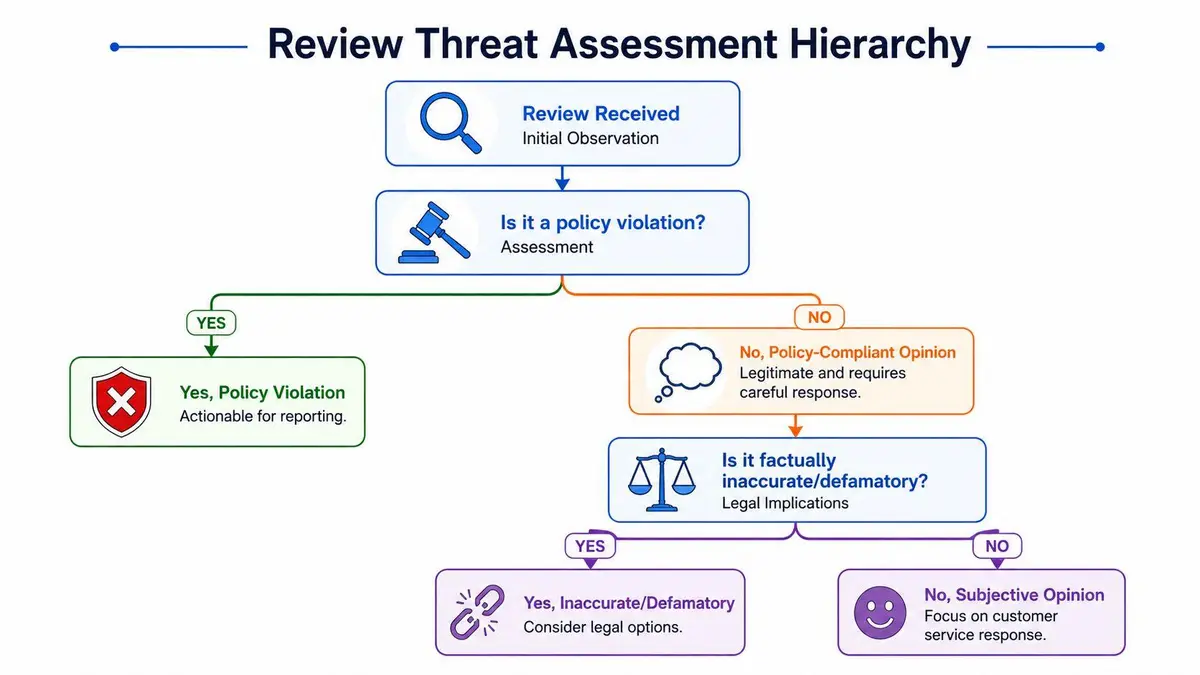
Four categories you need to separate
Most harmful reviews fall into one of four buckets.
- Legitimate dissatisfaction
The reviewer had a real interaction, the facts are broadly true, and the complaint reflects a subjective experience. This is not a removal case. It’s a service recovery case. - Policy-violating content
The review contains spam, hate speech, impersonation, off-topic content, explicit abuse, or other platform-rule issues. This is the cleanest removal path. - Fabricated or malicious review activity
The reviewer may be a competitor, former employee, bot account, or unrelated actor with no genuine transaction or service relationship. These cases can overlap with policy violations and defamation issues. - Defamatory false statements
The review asserts factual claims that are false and damaging. Not “I hated the service.” More like accusations of criminality, fraud, professional misconduct, or specific acts that can be disproved.
Questions that force clarity
Use a disciplined filter. Ask:
- Can you verify the reviewer? Match names, dates, order records, contracts, CRM notes, visitor logs, or appointment history.
- Is the language opinion or assertion? “Terrible experience” is opinion. “They stole funds” is an assertion.
- Does it fit platform policy? Off-topic political attacks, copied text, slurs, and obvious fake engagement should be treated as moderation issues first.
- Is there a legal record risk? If the review alleges illegal behavior, licensing breaches, harassment, or financial wrongdoing, stop informal outreach and preserve evidence.
A review that merely hurts your feelings doesn’t justify escalation. A review that creates provable factual damage does.
Threat assessment matrix
| Review type | Primary response | Secondary response |
|---|---|---|
| Genuine but negative | Public response and private resolution | Ask for update after resolution |
| Clear policy violation | Platform report with evidence | Escalate through appeal path |
| Fake reviewer or competitor | Report for policy breach | Investigate legal options |
| Defamatory factual claim | Preserve evidence and involve counsel | Seek removal, retraction, and suppression |
Preserve screenshots, timestamps, profile details, and any changes to the review text before you do anything else. Reviewers edit. Platforms remove traces. Evidence disappears.
What high-value clients should monitor immediately
Once a harmful review appears, don’t just watch that one URL. Watch the whole pattern around it. Search engines often surface review content in multiple ways, and secondary mentions can spread faster than the original post. Continuous reputation monitoring for executives and brands helps identify whether you’re dealing with a one-off complaint or the opening move in a coordinated campaign.
The common mistake is treating all criticism as removable. It isn’t. The smarter move is to decide, quickly and coldly, which lane the review belongs in. That decision controls everything that follows.
The Platform Playbook Using Reporting Workflows
At 8:15 a.m., your COO forwards a one-star Google review alleging fraud, unsafe conduct, or a violation that never occurred. By 9:00, the instinct is to argue with it, report it three different ways, and hope a moderator sees reason. That is the wrong approach. Platform workflows reward precision, evidence, and policy fit. They do not reward urgency.

Google is the model case
Google matters because it shapes branded search results, local pack visibility, and first-impression trust. Treat its reporting system as a rules engine. Your job is to match the review to a specific policy violation, submit proof, and document every step.
That sounds simple. It is not.
Executives lose time here because they file reports based on business harm rather than platform standards. Google does not remove a review because it is unfair, one-sided, or expensive to leave online. It removes reviews that breach stated policies. The practical sequence and limits are outlined in this Google review removal workflow analysis.
Use the workflow like a case file
Every report should answer one question for the moderator: what rule was broken, and where is the proof?
Use this standard:
- Name the exact violation: Spam, fake engagement, conflict of interest, impersonation, harassment, off-topic content, or a provably false factual claim that fits the platform’s rules.
- Attach evidence that maps to that violation: Internal records showing no transaction, screenshots of duplicate language across profiles, competitor ties, account anomalies, or documents disproving the factual allegation.
- Write for a rushed reviewer: Keep the submission short, specific, and tied to policy language.
- Create an internal log: Record the review URL, account name, screenshots, submission date, case number, and any edits to the review text.
This is an evidence exercise, not a persuasion exercise.
Know what platform tools can and cannot do
Reporting workflows are useful in three situations. First, the review clearly violates a written rule. Second, the reviewer identity or pattern suggests fraud, impersonation, or coordination. Third, you need a documented record before you escalate through legal channels or a formal appeal.
They are weak tools for genuine customer complaints, subjective opinions, or mixed reviews that contain both opinion and one disputed factual point. In those cases, the platform often leaves the post live, even when the commercial damage is obvious.
That limit matters. It tells you when to stop spending executive time on repeat submissions.
Set a hard threshold for DIY efforts
Run one well-built report. If the platform offers an appeal path, use it once with tighter evidence. If the review remains live after that, reassess the case based on risk, not frustration.
A practical rule works well here:
| Situation | Best use of platform reporting |
|---|---|
| Clear fake review or impersonation | Report immediately with supporting records |
| Reviewer has no customer relationship | Report with transaction gap evidence |
| Mixed review with opinion and disputed facts | Report once, then prepare for non-removal |
| Allegation of crime, fraud, abuse, or safety breach | Report, preserve evidence, and prepare escalation track |
That discipline prevents a common executive mistake. Teams keep filing reports long after the platform has effectively made its decision.
If you need a Google-specific framework for deciding what belongs in a report versus a broader response plan, use this Google review removal guide for executives.
Use reporting to build the record
Even when removal is unlikely, a clean reporting record still has value. It shows that you identified the issue promptly, tied your complaint to published platform rules, and gave the platform a fair chance to act. That record becomes useful later if the matter shifts into direct resolution, counsel review, or a broader suppression campaign.
Platform tools have a narrow role. Use them fast, use them correctly, and stop once the evidence shows the platform is not going to solve the problem.
Escalation Pathways Legal and Direct Engagement
When the platform declines removal, the matter doesn’t end. It changes form. At that point, your decision is no longer “report again or not.” It becomes a choice between negotiation, legal pressure, and visibility control.
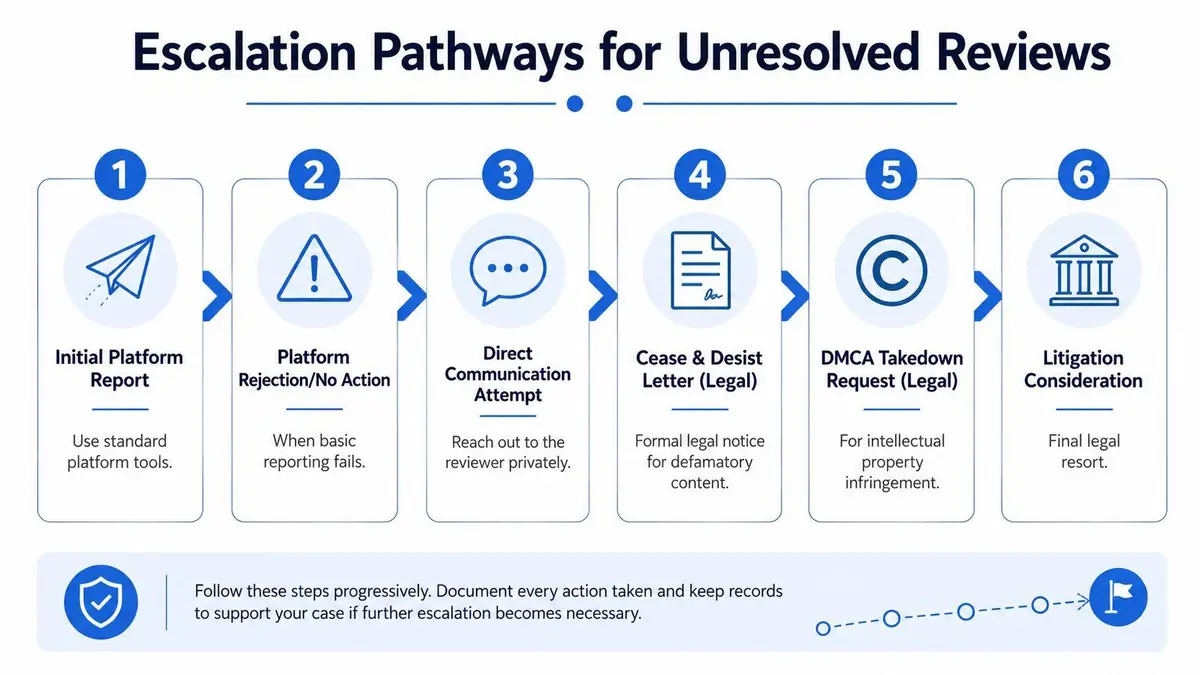
Direct engagement when the reviewer is real
If the reviewer appears to be an actual customer, patient, client, or guest, a controlled outreach attempt can work. But it must be handled like dispute resolution, not emotional rebuttal.
Use a simple sequence:
- Acknowledge the issue privately: Confirm that you’ve reviewed the complaint.
- State the corrective action: Explain what has been fixed, clarified, refunded, replaced, or investigated.
- Invite revision, not demand deletion: Ask whether the reviewer would consider updating the review to reflect the current position.
- Stop after a reasonable follow-up: Repeated pressure looks coercive and can create a second reputational problem.
Here’s the standard I recommend: if the problem was genuine and you solved it cleanly, ask for an update only after resolution is documented. If the reviewer refuses, stop. Don’t litigate the customer experience in public comments.
A good outreach message sounds calm, specific, and reversible. A bad one sounds defensive, legalistic, or desperate.
When the facts cross into defamation
There is a point where soft handling becomes a mistake. If the review makes factual accusations that are false and materially damaging, preserve evidence and involve counsel.
Legal escalation is usually justified when the review alleges things such as:
| Signal | Why it matters |
|---|---|
| False accusation of criminal conduct | High reputational harm and clear falsity question |
| Specific claim of fraud or theft | Can affect clients, investors, and counterparties |
| False licensing or professional misconduct claim | Implicates regulatory and career consequences |
| Repeated publication across platforms | Suggests campaign behavior, not mere opinion |
The legal threshold isn’t “this feels unfair.” The threshold is that the content states false facts, identifies you or your business, causes harm, and isn’t sheltered as obvious opinion.
At that point, options may include a formal retraction demand, cease-and-desist correspondence, platform escalation backed by legal analysis, or litigation if the reviewer can be identified and the harm justifies it. If the matter is heading in that direction, an internet defamation attorney consultation for executives is the right move before your team sends improvised threats.
Source removal versus visibility removal
Most review advice online falls short. Source removal and search visibility removal are different objectives.
A review can remain live on the source platform and still lose meaningful visibility if you use the right tools and suppression strategy. Google itself distinguishes between policy-based review reporting and separate visibility-oriented workflows. Its support materials note that businesses can report policy-violating reviews through the Reviews Management Tool, while separate systems such as Refresh Outdated Content and Results about you address search visibility rather than deletion, as explained in Google’s business review support documentation.
That distinction matters in hard cases:
- If the source won’t delete but the search result is outdated or disconnected from current content, pursue visibility remedies.
- If the review page ranks for branded search, build stronger competing assets around executive bios, press coverage, controlled web properties, and authoritative profile pages.
- If the review contains private information or identity-linked exposure, evaluate whether additional Google removal channels apply.
Know when to stop pushing the wrong lever
A second or third platform appeal rarely fixes a category error. If the content is policy-compliant opinion, more flagging won’t help. If it is defamation, a canned report won’t carry enough weight. If it’s authentic but damaging, legal threats may backfire.
One option in this space is ContentRemoval.com, which states that it handles fabricated review and harmful content removal as part of broader online reputation and privacy protection work. That sort of engagement makes sense when the issue spans multiple platforms, search results, and evidentiary questions rather than a single isolated review.
The executive job here is simple: choose the escalation path that matches the facts. Not the path that feels most satisfying in the moment.
Professional Intervention Thresholds and Timelines
Monday morning, a false review accusing your company of fraud is ranking for your brand name. By Tuesday, your sales team is fielding questions, your general counsel wants screenshots preserved, and someone in marketing is still trying another platform report. That is the point where executive judgment matters more than effort.
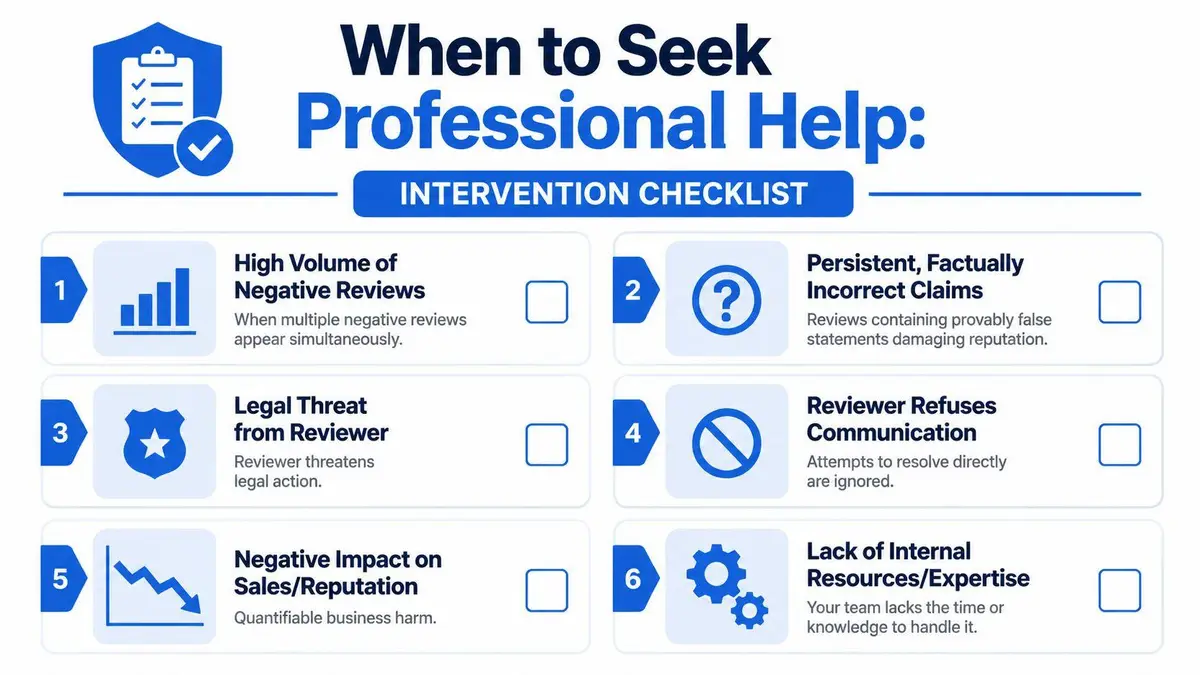
The threshold is earlier than most executives think
Bring in outside specialists when the review stops being a simple customer service issue and starts creating legal, search, or coordination risk.
Use this threshold test:
- One review becomes a pattern: Similar posts appear across Google, Yelp, Reddit, industry forums, or employee sites within a short window.
- The review names private individuals or exposes sensitive details: Family names, personal phone numbers, health information, addresses, or identifying personal facts raise the stakes immediately.
- The post makes factual accusations with legal consequences: Fraud, theft, abuse, discrimination, criminal conduct, licensing violations, or professional misconduct require evidence control and legal review.
- The review affects branded search: Once executives, investors, partners, or customers can find the allegation by searching your name or company, the problem has moved beyond frontline support.
- Your internal teams are split on response: If legal wants silence, PR wants a statement, operations wants outreach, and marketing keeps filing reports, you already have a coordination failure.
Those are intervention points, not warning signs.
What professionals actually change
Experienced reputation counsel and removal specialists shorten the decision cycle. They classify the content correctly, lock down evidence, choose the right escalation path, and stop your team from making avoidable mistakes under pressure.
That matters because poor execution creates permanent problems. A rushed response can alert the reviewer, trigger edits that make the post harder to challenge, produce screenshots that spread on social platforms, or create retaliation claims that complicate legal options. Strong operators control sequence. They preserve the record first, assess removability second, and decide on contact, platform escalation, search suppression, or legal action in the right order.
ContentRemoval.com is one example of the type of provider companies engage when the issue extends beyond a single review and starts touching search visibility, privacy exposure, or multi-platform harm.
Timelines executives should use for planning
Set expectations by case type, not by sales copy.
Clear policy violations can move quickly if the evidence is clean and the platform category is correct. Mixed cases take longer. Reviews that combine opinion, partial truth, and damaging insinuation often stall because they do not fit neatly into a platform rule or an immediate legal remedy. Cases involving counsel review, identity questions, cross-platform reposting, or search visibility work usually become a multi-week campaign.
Some vendors advertise very high success rates and removals within roughly a month for qualifying matters. Treat those claims as provider-specific marketing, not market-wide benchmarks. Use them only as a rough indicator that straightforward cases can resolve faster than contested ones.
A better planning model is simple:
| Case type | Expected pace | Executive posture |
|---|---|---|
| Clear fake, spam, or impersonation review | Fast if documented well | Push for immediate action |
| Legitimate complaint with fixable service issue | Variable | Resolve offline and seek update |
| Defamatory factual accusation | Slower | Involve counsel early |
| Coordinated multi-platform attack | Extended | Treat as active reputation incident |
| Privacy exposure or doxxing risk | Immediate and ongoing | Escalate at once |
A simple decision table
| Situation | Handle internally | Bring in professionals |
|---|---|---|
| Single legitimate complaint | Yes | Usually no |
| Clear spam or fake review with simple evidence | Often | If the first appeal fails or the post spreads |
| Defamatory accusation with business impact | No | Yes |
| Multi-platform attack or search visibility issue | No | Yes |
| Personal privacy exposure | No | Yes |
Use consequence as the deciding factor. If the review can affect revenue, deal flow, recruiting, licensing, litigation posture, or executive reputation, stop treating it as a routine moderation problem. Engage specialists early, set a timeline by threat level, and run a controlled response.
Conclusion Proactive Defense and Suppression Strategy
The best review-removal strategy starts before the next review appears.
A durable defense has three parts. First, build a steady flow of authentic positive feedback so one hostile review doesn’t define the entire public record. Second, monitor aggressively so you catch new posts before they spread through search, screenshots, and secondary commentary. Third, maintain enough controlled digital assets that any review you can’t remove can still be outranked, diluted, or contextually neutralized.
That’s the shift executives need to make. Don’t treat this as occasional cleanup. Treat it as reputation infrastructure.
When a harmful review appears, classify it fast. If it violates policy, report it properly. If it reflects a real service failure, resolve it and seek an update. If it contains false factual claims, escalate with evidence and legal discipline. If the source won’t remove it, attack visibility and search placement instead of wasting time on repeated reports.
Most reputational damage online doesn’t come from one bad post. It comes from weak decision-making in the hours and days after it appears. That part is controllable.
If a negative review is exposing your company, leadership team, or personal brand to real reputational risk, ContentRemoval.com can assess the matter confidentially and help determine whether the right path is platform removal, legal escalation, de-indexing, or suppression. For high-stakes cases, speed and classification matter more than volume of response.
Frequently asked questions
Can I get a negative review removed if it is unfair but true?
Usually not at the source. Platforms remove reviews that breach a written rule such as spam, impersonation, conflict of interest or harassment, not reviews that are one-sided or expensive to leave up. A genuine complaint is a service recovery case: resolve it privately, then ask the reviewer to update.
How many times should I report a review to Google?
Once, done well, with evidence mapped to the specific policy, then one appeal with tighter evidence if the platform offers it. If the review is still live after that, the platform has effectively decided, and repeat submissions waste executive time. Reassess based on risk and consider legal or visibility routes instead.
When does a bad review become defamation?
When it states false facts rather than opinion, identifies you or your business, causes harm and is not obviously opinion. Terrible experience is opinion; they stole funds is an assertion. False accusations of crime, fraud, theft or professional misconduct justify preserving evidence and involving counsel.