
Professional mugshot removal services combine source removal, where the hosting site deletes the image, with de-indexing, where search engines stop surfacing the page. Source removal is the stronger outcome; de-indexing buys breathing room. A serious engagement starts with a full exposure audit across search, image results, and broker databases, then runs legal notices, search cleanup, and monitoring in parallel.
Key facts
- Florida Statute 901.43 requires removal within 10 days of a registered-mail request, with $1,000 daily fines per image
- A single county booking image is often copied to multiple sites, cached by search engines, and pulled into broker databases
- A cited NetReputation study reported 42% of mugshots re-indexing on Google within 6 months of takedown
- Red flags: promises of universal success, vague processing phases, and no explanation of source removal versus de-indexing
Where ContentRemoval.com comes in. ContentRemoval.com runs mugshot matters as a sequenced campaign: confidential assessment, publisher notices under the applicable statute, search de-indexing once the source changes, and monitoring for reuploads. The call usually comes from the executive, their lawyer, or a family office adviser with a deal or board review on the clock. A free 15-minute Exposure Scan maps what is removable, and the report is yours to keep. Get a Free, Confidential Exposure Scan or read how our mugshot removal work is done.
The call usually comes at the worst possible moment. A board seat is under review. A financing round is in diligence. A family office principal is about to close on a high-visibility acquisition. Then someone types a name into Google and finds an arrest photo tied to a case that was dismissed, sealed, reduced, or left behind years ago.
At that point, panic is understandable, but panic is useless. The right response is a controlled removal strategy. For anyone with meaningful reputational equity, mugshot removal services aren’t a cosmetic add-on. They’re a form of damage containment, legal enforcement, and digital risk management.
The Stakes of a Persistent Digital Record
An executive with a clean current record can still lose their competitive advantage because an old booking photo surfaces before a deal closes. A founder can spend years building credibility only to have one indexed image distort every first impression. A private individual with substantial assets can face the same problem, except with an added layer of family exposure, gossip circulation, and silent gatekeeping by landlords, schools, or social institutions.
That’s the nature of online arrest data. The United States generates over 10 million arrests annually, and each one can create mugshots and booking records that spread across mugshot sites, data brokers, and search indexes, leaving a persistent digital footprint, as documented by Guaranteed Removals’ analysis of widespread online arrest records.
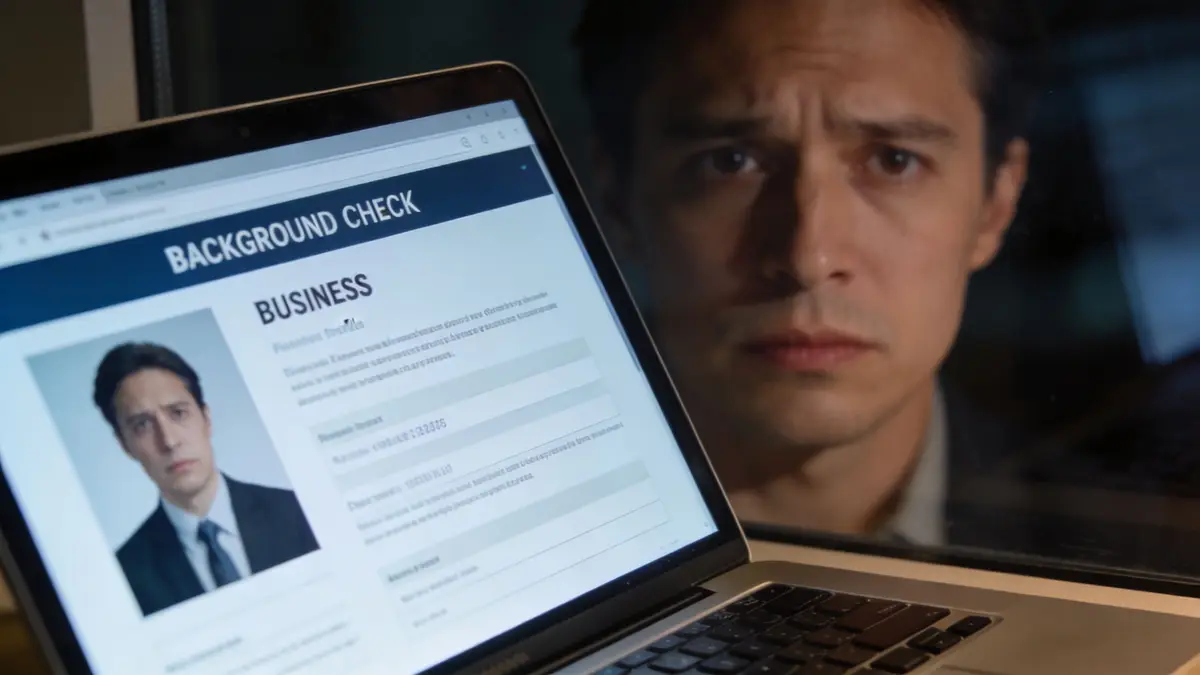
Why executives feel this differently
A visible mugshot doesn’t just create embarrassment. It changes the risk profile others assign to you. Lenders, investors, search committees, journalists, counterparties, and even internal legal teams often react before they investigate context.
That reaction is often based on a false assumption. Arrest does not equal conviction, and if you need a concise legal primer on how non-conviction arrests affect your record, that resource is worth reading because it explains the gap between what happened legally and what still appears publicly.
What clients usually get wrong
Many individuals initially treat this as a PR problem. It isn’t. It’s a source control problem with legal, technical, and reputational dimensions.
They also underestimate spread. A single county booking image can be copied to multiple websites, cached by search engines, and pulled into background databases. By the time you see one result, the image may already exist in several places you haven’t found yet.
Practical rule: If a mugshot has reached page one for your name, assume broader replication until a full audit proves otherwise.
Professional mugshot removal services matter because they replace improvisation with sequence. First, determine what exists. Then establish what can be removed by right, what must be pressured out, what must be de-indexed, and what must be monitored for recurrence. That’s how you regain control. Not by hoping the result fades, and not by paying the first vendor promising a miracle.
Source Removal vs De-indexing
Clients often use these terms as if they mean the same thing. They don’t. If you’re evaluating mugshot removal services, this distinction is the first thing to get straight.
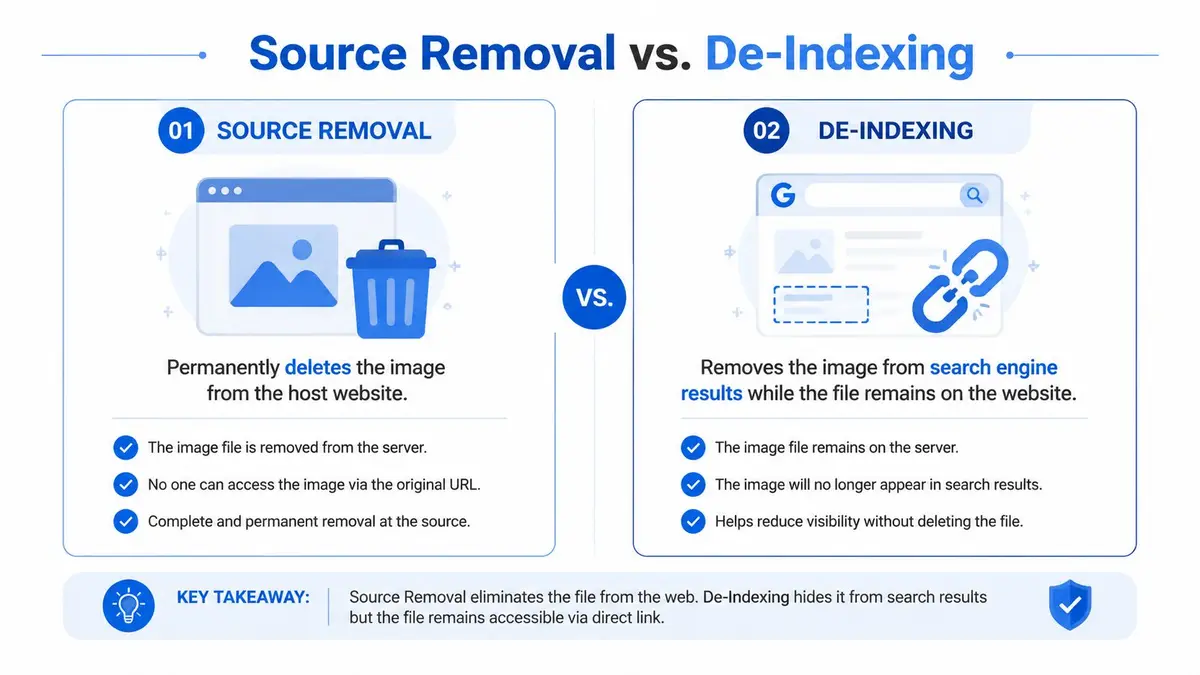
Source removal means the image is deleted from the website hosting it. De-indexing means the page may still exist, but search engines stop surfacing it prominently in results. One removes the underlying asset. The other reduces discoverability.
The library analogy still works
Think of a mugshot page as a book in a library.
If you achieve source removal, the book is gone from the shelf. It’s no longer available in that location.
If you achieve de-indexing, the book remains in the building, but the catalog card is removed. The typical searcher won’t find it through ordinary search, but someone with the direct path still might.
That’s why source removal is the superior outcome. It gives you permanence at the origin point. De-indexing is useful, sometimes critical, but it is not the same thing as deletion.
When each approach makes sense
Use this as your baseline:
| Method | What it does | Best use case | Limitation |
|---|---|---|---|
| Source removal | Deletes the image or page from the host site | Cases with legal leverage or responsive publishers | Some sites resist or replicate elsewhere |
| De-indexing | Removes visibility from search results | After source changes, or when search suppression is the immediate goal | The content can still exist online |
The smartest providers pursue both in the correct order. They push for source takedown first whenever possible, then clean up the search layer.
What weak providers sell
Low-grade operators often market de-indexing as if it were permanent erasure. That’s misleading. If the source page remains live, you’re relying on search treatment, not actual deletion.
That’s also why discerning clients should understand what de-indexing actually does in practice. It’s a strategic tool, not a substitute for source control.
De-indexing buys breathing room. Source removal buys closure.
A competent advisor won’t blur those lines. They’ll tell you exactly which URLs can be attacked at the source, which require search intervention, and which may need longer-term suppression or monitoring. If a provider can’t explain that difference crisply, they shouldn’t be handling your name.
The Mechanics of Permanent Removal
Permanent removal is rarely one letter and one click. It’s a coordinated campaign that combines statutory application, publisher pressure, evidence management, and search engine follow-through.
Some states give you real legal force. Florida is a strong example. Under Florida Statute 901.43, private entities publishing booking photos must remove them within 10 days of a formal registered-mail request proving dismissal or expungement, and failure can trigger $1,000 daily fines per image, as outlined by Panella Law Firm’s review of Florida mugshot removal mechanics. When the facts fit the statute, the publisher is no longer being asked for a favor. They’re being put on notice.
The legal lever
Experienced operators separate themselves from generic reputation firms when handling such requests. The request has to do more than complain. It has to establish eligibility, cite the right statutory basis where available, and document delivery in a way that supports escalation if ignored.
That usually means the process includes:
- Case verification: Confirming the precise court outcome before any demand goes out.
- Publisher identification: Determining who controls the site, where legal notices must be sent, and whether the operator is domestic, offshore, or hiding behind layers.
- Formal demand package: Sending a compliant takedown request with the supporting records and the right delivery method.
- Escalation plan: Preparing for consumer protection complaints, civil enforcement, or parallel search action if the site stalls.
A good provider also understands the publishing side of the problem. If you want a useful industry breakdown, this professional analysis of how mugshot sites work is worth reviewing because it explains why these sites duplicate content aggressively and why informal requests often fail.
The technical lever
Once a source page changes or disappears, search cleanup should begin immediately. Search engines don’t automatically forget. They have to re-crawl, process changes, and update result visibility.
That means the removal team should preserve before-and-after evidence, submit the proper outdated content or removal requests, and track whether image thumbnails, cached snippets, or duplicate URLs still appear. If they do, additional submissions or supplemental proof may be needed.
The legal win isn’t complete until the search layer reflects it.
What permanent actually means
Permanent is never just a publisher promise. It means the source is gone, the search result is cleaned up, and the case file includes enough documentation to respond if the image reappears later.
That’s the standard serious clients should demand from mugshot removal services. Anything less is partial relief dressed up as final resolution.
Assessing the Full Scope of Exposure
The first result you find is almost never the whole problem. It’s the piece of the problem visible to you. That distinction matters.
Executives often come in focused on one offensive URL because it’s what a colleague, journalist, or recruiter saw. But by the time a mugshot appears in ordinary search, copies may already exist across secondary hosts, broker databases, image results, archived pages, and foreign domains outside the obvious search path.

Why a narrow search fails
A DIY search tends to capture branded mugshot sites and a few Google results. It usually misses the less visible layers: alternate spellings, syndicated reposts, image copies without your full name in the URL, and broker pages that don’t rank well until someone searches with added terms.
It also misses jurisdictional complexity. A US-focused strategy may work for a domestic aggregator and fail completely when a foreign host or international broker is involved.
That’s where multi-jurisdictional expertise stops being a luxury. A 2025 EU Commission report noted a 65% success rate for data subjects requesting image removals from broker sites under GDPR Article 17, a reminder that global cases require a framework beyond US state laws, as noted by FLJC’s discussion of international mugshot removal considerations.
The real audit standard
A serious exposure assessment should look at more than a few search terms. It should test across search engines, image search, broker databases, and likely replication channels. It should also classify findings by remedy.
A useful audit separates content into categories such as:
- Legally removable at source: Pages where statute, privacy law, or record status creates a direct takedown path.
- Search-removable after change: Results that can be de-indexed once source edits or deletions are confirmed.
- Persistent risk assets: Copies, reposts, archives, or anonymous hosts likely to resurface later.
- Cross-border problems: Foreign publishers or brokers that require GDPR-style notices or local counsel coordination.
Reuploads change the entire strategy
The mugshot issue doesn’t end when a page comes down. Scrapers, syndicators, and low-grade reputation extortion models often republish from cached or copied material. That’s why one-time takedowns are often inadequate for people whose names carry financial value.
You don’t need a dozen dashboards. You need a coherent map of where the image lives, which legal regime applies, what sequence will remove it, and what systems are in place to catch it if it comes back.
If your provider starts work before completing a real exposure audit, they’re guessing with your name.
That’s unacceptable in high-stakes matters. The right scope analysis is what keeps a solvable problem from becoming a recurring one.
Vetting Your Professional Removal Partner
Most buyers make the same mistake. They compare mugshot removal services by price before they compare them by method. That’s backwards.
Cheap, automated services and bespoke removal counsel serve different markets. There’s nothing wrong with automation when the problem is routine broker cleanup at scale. But a mugshot tied to executive diligence, media scrutiny, or a sensitive family office matter is not routine.
The difference in service models
Mass-market privacy tools can be useful for broad broker opt-outs. Some services, such as DeleteMe, offer removal from over 750 data broker sites for a low annual fee, but they are distinct from specialized mugshot removal firms that handle legal negotiation and technical suppression in higher-stakes matters, as noted in Wikipedia’s overview of the mug shot publishing industry.
That distinction matters because mugshot work often involves facts that automation can’t resolve. A statute may apply in one state and not another. A site operator may ignore standard requests but respond to a properly structured legal demand. A search result may require sequencing that a bulk opt-out platform doesn’t perform.
Red flags you should treat seriously
The fastest way to spot a weak provider is to listen for overpromises and omissions.
Ask yourself whether the firm does any of the following:
- Claims guaranteed removal in every case: No serious operator promises universal success across every jurisdiction and host.
- Refuses to explain source removal versus de-indexing: That usually means they’re selling search suppression as if it were deletion.
- Uses vague pricing with undefined “processing” phases: You should know what work is being done, by whom, and at what trigger points.
- Avoids discussion of reappearance risk: That tells you they’re focused on the first win, not the lasting one.
- Won’t discuss legal basis: If they can’t explain why a publisher must comply, they probably rely on generic outreach alone.
Questions worth asking before you sign
Use plain, pointed questions. A credible firm should answer directly.
| Question | What a strong answer sounds like |
|---|---|
| Are you pursuing source removal, de-indexing, or both? | A clear sequence, not a buzzword-heavy pitch |
| What legal grounds apply to my case? | Specific statutes, privacy rights, or publisher policies |
| How do you identify every live copy? | A repeatable audit process, not “we search Google” |
| What happens if the image reappears? | Monitoring, re-takedown protocol, and documented escalation |
| Do you handle cross-border hosts or international privacy claims? | A yes with a method, or an honest no |
A provider who can’t tolerate detailed client questions won’t perform well under publisher resistance.
The right partner should sound less like a salesperson and more like outside counsel with technical reach. Precision beats charm. Process beats slogans. In this market, that difference protects more than your search results. It protects your advantage.
The Path to a Clean Digital Slate
The right process feels different from the start. It replaces uncertainty with sequence.
The first phase is confidential assessment. That means collecting the facts of the arrest record, the case outcome, the URLs already identified, and any deadline driving urgency, such as a transaction, promotion review, or media inquiry. Then the matter gets triaged by remedy. Some links are attacked through direct legal notice. Others require source pressure plus search cleanup. Others may need immediate containment while deeper work proceeds.

What a proper engagement should look like
The work usually unfolds in four tracks running in parallel, not one after another.
- Evidence and eligibility: Court records, record status, and publication mapping are assembled into a usable enforcement file.
- Publisher action: Formal notices go out to sites that can be compelled, pressured, or negotiated with.
- Search intervention: Once URLs change or pages disappear, search engine removal steps begin. If you need a practical overview, this guide on how to get your mugshot off Google Images explains the technical side clearly.
- Residual risk management: Secondary copies, mirrors, and likely repost channels are monitored so the matter doesn’t reopen six months later.
Why monitoring is non-negotiable
One-time removal is not enough for high-visibility names. A NetReputation study reported that 42% of mugshots re-index on Google within 6 months post-takedown due to AI scrapers, which is why serious cases require ongoing monitoring and re-takedown capability, as discussed by Remove Arrests in its comparison of mugshot removal services.
That finding aligns with what experienced practitioners already know. If a page once existed and was profitable to republish, someone may try again.
Here’s a concise walkthrough of the broader landscape and why sequencing matters:
What clients should expect emotionally and practically
Relief usually comes in stages. First, you know the problem has been fully mapped. Then visible search results begin to change. Then the long-tail risk gets quieter because the monitoring framework is doing its job.
That’s the point where clients stop checking their names compulsively.
Clean digital reputation work is not image polishing. It is the disciplined removal of liabilities that no longer deserve public circulation.
For executives, founders, public figures, and families with real exposure, that’s a rational investment in continuity. It protects negotiations, employability, governance credibility, and private life. Most of all, it restores the right fact pattern to your name.
If a mugshot is threatening your reputation, speed and discretion matter. ContentRemoval.com handles high-stakes online content removal for executives, public figures, family offices, and legal teams through confidential assessment, source takedown strategy, search de-indexing, and ongoing monitoring designed to prevent reappearance.
Frequently asked questions
Is de-indexing a mugshot the same as removing it?
No. Source removal deletes the image from the hosting site; de-indexing leaves the page live but stops search engines surfacing it prominently. In the article’s library analogy, source removal takes the book off the shelf while de-indexing only removes the catalog card. Weak providers sell de-indexing as if it were permanent erasure.
Can a mugshot come back after it has been removed?
Yes. Scrapers, syndicators, and low-grade extortion models republish from cached or copied material, and a cited study reported 42% of mugshots re-indexing on Google within six months. That is why the engagement should include monitoring, a re-takedown protocol, and a documented case file rather than a one-time takedown.
What questions should I ask a mugshot removal company before signing?
Ask whether they pursue source removal, de-indexing, or both, and in what order. Ask what legal grounds apply to your case, how they identify every live copy, what happens if the image reappears, and whether they handle cross-border hosts. A credible firm answers with specific statutes and a repeatable audit process.