
Deindexing a page from Google depends on whether you control the website. On a site you own, use Search Console’s Removals tool for immediate suppression, then a noindex tag or delete the page for a permanent result. On a third-party site, removal runs through platform terms of service, DMCA notices, legal demands or source removal.
Key facts
- Search Console temporary removal is reported to approve in 1 to 24 hours and hide a page for 6 months.
- A noindex tag must be crawled before any robots.txt block, or Google may keep the stale URL.
- The Excluded by noindex tag status appears in Search Console after roughly 21 to 45 days.
- Third-party pages are removed through terms of service, DMCA, legal demand or escalation to hosts and registrars.
Where ContentRemoval.com comes in. ContentRemoval.com handles the third-party side of this problem, where the page sits on a complaint site, forum, mirror or news domain that no Search Console account can touch. General counsel, an executive’s chief of staff or their PR agency usually make contact once a board member or journalist has surfaced the link. A free, confidential 15-minute Exposure Scan maps which pages are removable and by what route, and the report is yours to keep. Get a Free, Confidential Exposure Scan or read how our search result removal work is done.
A damaging page appears in Google under your name, your company, or a family member. You search once, then again, hoping it was a personalization glitch. It is not. The page is indexed, visible, and now tied to your reputation in the one place most investors, journalists, clients, counterparties, and adversaries will check first.
At that point, bad advice becomes dangerous. Generic SEO articles tell you to add a tag, submit a form, or wait for Google to recrawl. That is not a strategy. Under pressure, the only distinction that matters is whether you control the source website or you do not.
If the page sits on a website you own, the path is technical and usually direct. If the page sits on a third-party platform, technical fixes are mostly irrelevant. You need source removal, platform enforcement, legal positioning, or all three. That difference determines whether you solve the problem discreetly or waste time while the page keeps ranking.
Your Guide to Urgent Content Removal from Google
Most clients contact us at the same moment. A board member forwards a search result. A spouse sees a leak. A journalist asks for comment on a page you did not know existed. The panic is understandable. The first instinct is to make Google “take it down.”
That instinct is only partly right.
Google is often the visible symptom, not the source. If a confidential PDF is ranking from your own domain, you can usually contain it quickly. If a complaint site, forum, mirror, or news page is ranking from someone else’s domain, Google is just displaying what another publisher controls. Treating both situations the same is why so many removal attempts fail.
A disciplined response starts with triage. You confirm whether the page is indexed. You determine who controls the domain. You classify the content. Privacy breach, copied material, defamation, impersonation, outdated content, internal staging page, and thin content each require a different move.
The good news is that there is a correct path for each one. The wrong move is improvisation. If you need a practical overview of the wider process beyond deindexing alone, this step-by-step guide to removing unwanted Google results is a useful companion.
Diagnosing the Threat Before You Act
Speed matters. Accuracy matters more.
I have seen internal teams burn valuable time trying to deindex pages that were not indexed, send demands to the wrong host, and alert hostile publishers before the legal position was ready. You avoid that by diagnosing the problem in a strict order.

Confirm whether Google is showing the page
Do not rely on memory or screenshots from someone else. Check the live result.
Use a direct Google search for the exact page title, key text fragments, or the URL itself. Then use a site-restricted query to see whether the page appears under that domain. The goal is simple. Determine whether the URL is currently in Google’s index, whether a cached or alternate version exists, and whether the ranking page is the same document you think it is.
This step matters because strategy changes immediately if the page is already gone from search but still available on the source site. In that scenario, your priority shifts from deindexing to preventing rediscovery, reposting, and backlinks from preserving its visibility elsewhere.
If a page is not indexed, do not file a deindexing request out of habit. Focus on source control, evidence preservation, and monitoring.
Determine who controls the domain
This is the fork in the road.
If the URL is on your own website, a microsite your company owns, a campaign subdomain, a document repository you manage, or a platform account under your control, you have a technical route. You can edit code, remove files, change access, submit Search Console requests, and verify outcomes directly.
If the URL is on a third-party website, you cannot solve it with on-page commands. You cannot add a noindex tag to someone else’s server. You cannot use your Google Search Console account to manage a domain you do not own. Most public advice collapses at this point.
That gap is larger than generally understood. One analysis notes that 40% of negative search results stem from third-party sites, and that recent platform verification changes have made unsupported removal attempts more likely to fail (DevriX on deindexing Google pages). The same source highlights the practical consequence: where you lack control, source removal comes first, and weak ownership claims are now rejected more aggressively.
Classify the content before choosing a tactic
Different content types trigger different remedies. Treat them separately.
- Privacy and data exposure
Think leaked contact details, internal directories, personal addresses, executive IDs, confidential PDFs, or accidental staging pages. These usually justify immediate containment. - Defamation and false allegations
These require evidence, publisher analysis, and often legal drafting. Do not confuse this with a routine SEO issue. - Copyright infringement
If your photo, video, memo, report, or proprietary text was copied without permission, a copyright-based route may be available. - Impersonation or account abuse
Fake profiles, cloned biographies, and deceptive review pages often fall under platform policy enforcement. - Outdated or low-value owned content
This is usually a site hygiene problem, not a legal one. Remove, noindex, or consolidate it.
Keep your first move quiet
Many bad actors watch their traffic and search visibility closely. A clumsy outreach email can warn them that a high-value target has noticed the page. Once alerted, they may copy the material to another domain, edit timestamps, or add inflammatory text to complicate your position.
That is why diagnosis comes before action. You need screenshots, the live URL, indexing confirmation, ownership status, and a content classification before anyone contacts the publisher.
Here is the simplest decision table.
| Situation | What matters first | Primary route |
|---|---|---|
| You own the site | Speed and technical control | Search Console, noindex, deletion, redirects |
| Third-party site | Influence and enforceability | Terms of service, DMCA, legal demand, source removal |
| Unclear ownership | Evidence and attribution | Preserve records before outreach |
| Privacy leak | Immediate containment | Temporary removal plus source fix |
Deindexing Content on Your Owned Digital Assets
When the page is on infrastructure you control, stop overcomplicating it. You need containment first, then permanence.
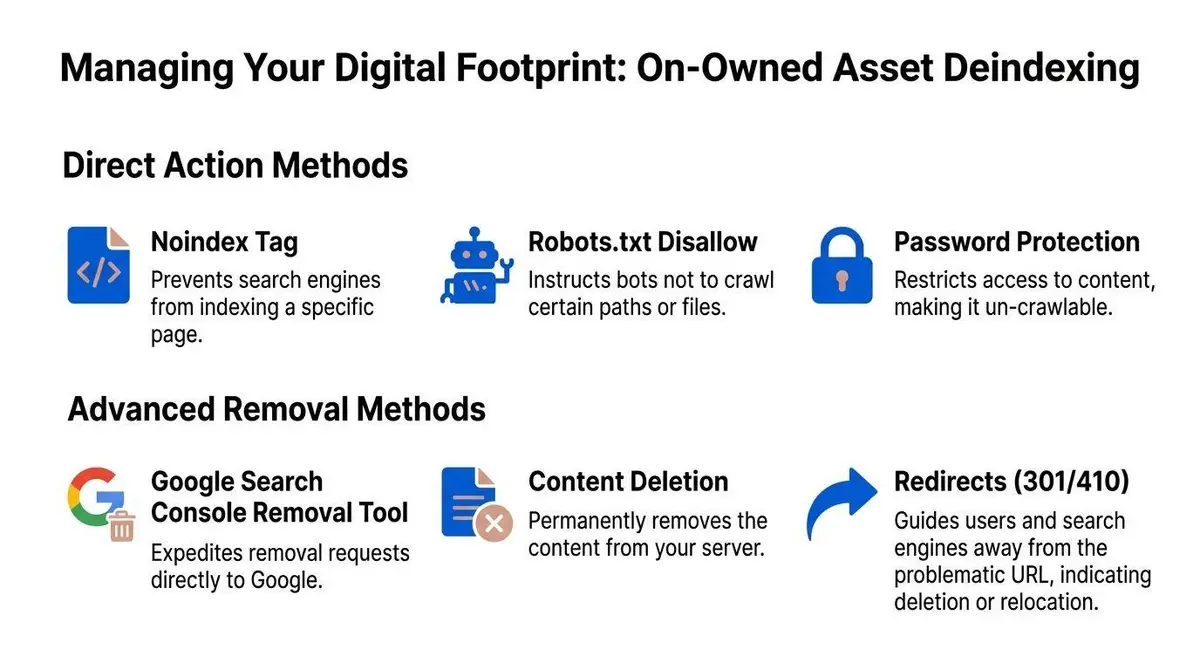
The most effective response is layered. Use Google Search Console Removals for immediate suppression. Then implement a permanent state change on the page itself so the URL does not come back.
Use Google Search Console as the emergency button
For urgent cases on owned properties, the fastest tool is the Removals feature in Google Search Console. According to LeadNicely’s breakdown of deindexing in Google, it is effective within hours for ~90% of requests, with approval typically in 1 to 24 hours, and it hides the page for 6 months.
That is the right move when an executive bio page exposes personal details, an internal file was indexed accidentally, or a thin or duplicate page is causing immediate search damage.
The process is straightforward:
- Verify ownership first
If the site is not verified in Search Console, do that before anything else. - Open Removals
Inside the property, go to the Removals area and create a temporary removal request. - Submit the exact URL
Exact means exact. Protocol and subdomain need to match the live page. - Choose the scope carefully
Remove a single page when possible. Use prefix-based removal only when the problem affects a directory and you know the impact.
The point of this tool is speed, not permanence. It buys you breathing room.
Add noindex for the lasting fix
A temporary hide is not a resolution. It is a shield.
For the page to stay out of Google, add a meta robots noindex tag in the page’s head section. The commonly used form is:
<meta name="robots" content="noindex, follow">
That tells Google not to index the page while still allowing link equity to flow through links on the page. For reputation work on owned assets, that is often the cleanest option when you want the page gone from search without unnecessarily harming internal site structure.
If the content should not exist at all, delete it from the server as well. If a replacement page exists, use an appropriate redirect. If the page should remain accessible only to a controlled audience, password protection may be the better business decision.
Understand the robots.txt trap
Teams make the same error repeatedly. They block the page in robots.txt before Google has seen the noindex signal.
That breaks the process.
LeadNicely notes that 30% of errors come from blocking the URL with robots.txt before Google can crawl the page and detect the noindex instruction. If Google cannot crawl the page, it may keep stale knowledge of the URL longer than you want.
Do not use robots.txt as your first move for an already indexed page you need removed from Google. Let Google see the noindex first.
Choose the right outcome, not the fashionable tactic
Different owned-page problems require different final states.
- Temporary and urgent
Use Search Console removal, then repair the underlying page. - Page should remain live but disappear from search
Add noindex. - Page should never have been public
Remove it and restrict access. - Page was replaced by a better version
Redirect it to the canonical destination. - Whole bad directory or staging area is exposed
Remove from index, then lock down access and review your publishing controls.
A simple command hierarchy
If you are deciding how to deindex a page from google on a site you own, use this order:
| Priority | Action | Why |
|---|---|---|
| First | Search Console temporary removal | Immediate suppression in Google |
| Second | Add noindex or remove the page | Permanent state change |
| Third | Fix access and sitemap issues | Prevent reappearance |
| Fourth | Verify in Search Console | Confirm outcome, not assumptions |
This is one area where internal teams can act quickly if they know what they are doing. If they do not, a hurried implementation creates new exposure, especially when legal, investor, or media scrutiny is already active.
Forcing Removal from Third-Party Websites
Amateur tactics fail in this scenario.
If someone else controls the website, you are not solving a technical indexing issue. You are dealing with a publisher, platform, host, or intermediary that has to be compelled, persuaded, or cornered into action. Noindex tags, robots instructions, and Search Console access are not your tools here.

Start with source removal, not Google
The instinct to file directly with Google is understandable, but incomplete.
Google’s temporary removal mechanisms can help in urgent situations involving exposed personal information or active leaks. As explained in TrueRanker’s guide to deindexing URLs from Google, Search Console works as an emergency button that can process requests within a few hours and hide a page for about 6 months. That speed is useful when immediate containment matters.
But on a third-party domain, temporary suppression is still temporary. If the source remains live, the URL can return. The root problem is not the search result. The root problem is the publisher.
Match the pressure to the content type
Third-party removals work when the argument is precise.
Terms of service enforcement
Platforms remove content every day under their own rules. Harassment, impersonation, doxxing, hate speech, non-consensual material, and deceptive conduct often violate platform terms even when the legal claim is still being developed.
This route works best when your submission is short, documented, and framed in the platform’s own policy language. Not moral outrage. Not a long narrative. Policy violation, evidence, harm, requested remedy.
Copyright takedowns
If the page uses your copyrighted material without authorization, a DMCA notice may be the sharpest tool available. This is often cleaner than arguing fairness or truth. Ownership, copied material, infringing URL, authorized statement, signature.
The strength of this route depends on what was copied and whether you can prove rights cleanly.
Defamation and false allegations
Imprecise language causes damage here. Calling something defamatory does not make it actionable. The analysis depends on falsity, harm, jurisdiction, available defenses, publication context, and whether the target is a private individual or public figure.
That is why serious matters should be routed through counsel or specialist operators. If you send a weak accusation to an antagonistic publisher, you may provoke a response article, social amplification, or evidence destruction.
Third-party removals are won by influence and drafting quality. They are not won by technical tricks.
Know when to escalate beyond the publisher
Some sites are built to monetize conflict. They ignore requests, hide behind offshore entities, or repost content under slightly different URLs. In those cases, the removal path may run through hosts, registrars, payment processors, ad partners, or court-backed demands, depending on the facts.
For people handling a live search crisis, the procedural side of Google can still matter. If legal grounds exist for a formal submission, this guide on how to submit a Google legal request is the right procedural reference.
Why specialist intervention changes the odds
Third-party enforcement is a different discipline from SEO. It combines evidence handling, jurisdiction, platform policy, and sequencing. The order matters. Contact the wrong entity first and you may lose influence. Phrase the claim badly and you may hand the publisher a defense.
Used correctly, specialist services can pursue source removal and suppression in parallel. ContentRemoval.com is one option that handles source removal and Google deindexing workflows for harmful online material. That matters when the goal is not just to hide a link briefly, but to stop reposts and prevent recurrence.
Verifying Removal and Preventing Reoccurrence
A URL disappearing from search results once is not the finish line. It is a checkpoint.
The proper question is not, “Did Google stop showing it today?” The proper question is, “Has the page been removed in a way that will survive recrawls, reposts, and copycat behavior?” That is a different standard.

Verify with Search Console, not guesswork
If the URL was on a property you control, verification should happen inside Google Search Console.
Use the URL Inspection tool to test the current state of the page. Then review the Pages report for the property. For permanent deindexing, the combination of a noindex tag and a robots.txt Disallow directive is reported to achieve 98% long-term success, and confirmation appears when the page is listed as Excluded by noindex tag, which takes an average of 21 to 45 days according to The Gray Company’s deindexing guide.
That status matters because it confirms Google processed the exclusion as intended. Without verification, teams routinely assume a page is gone when only the ranking changed temporarily.
Prevent the relapse that catches people off guard
Removal work fails later when no one handles the reason the page existed.
A private PDF gets uploaded again to a public directory. A deprecated subdomain goes live after a migration rollback. A hostile forum thread is mirrored on another domain. A scraper republishes the same article. The initial response looked successful, but the vulnerability remained.
The Gray Company notes an estimated 15% relapse rate if removed pages are not monitored and root causes are not managed. That is why experts recommend quarterly monitoring after removal.
A useful benchmark for clients asking about timing and expectations is this explanation of how long it takes to remove a Google search result. Timing is only one variable. Durability is the primary issue.
Removal without monitoring is a temporary win. Reputation protection requires verification, recurrence controls, and regular review.
Build a practical monitoring system
You do not need theatrical “brand protection” language. You need a disciplined watchlist.
Use a layered monitoring approach:
- Search checks for exact names and terms
Track your personal name, executive names, company name, product names, and predictable negative modifiers. - Search Console on owned assets
Review coverage changes, excluded pages, and unexpected reindexing. - Alerting for copied or mirrored content
Watch for title matches, text fragments, and unauthorized file republication. - Governance on publishing systems
Staging environments, media libraries, PDFs, and investor materials should have explicit publication controls.
Treat verification and prevention as one process
People separate takedown work into “remove first, monitor later.” That is the wrong mindset.
Verification tells you whether the removal happened. Monitoring tells you whether the underlying risk still exists. Put together, they form a defensive system. Separated, they become a one-off cleanup exercise that has to be repeated under worse conditions later.
When Professional Intervention Is Non-Negotiable
Some removals are operational. Others are strategic risk events.
If an outdated page on your own site should come out of Google, your internal team can often handle it. If the matter involves a hostile publisher, cross-border publication, allegations that affect financing or employment, or private material that can trigger extortion or copycat reposting, the calculation changes. At that point, the cost of a failed first move is often higher than the cost of specialist engagement.
The line between manageable and dangerous
Use this as a hard filter.
You need a specialist if the content is on a third-party domain
Once control leaves your infrastructure, you are no longer executing a technical deindex. You are making a legal and strategic case to someone who may have no incentive to cooperate.
That is particularly true for attack blogs, complaint sites, mirrored leaks, anonymous forums, and high-authority publications. Those environments reward precision. Weak outreach can make the page more durable.
You need a specialist if the issue touches privacy, allegations, or active disputes
Privacy breaches involving executives, family members, home addresses, IDs, or confidential records should move fast and discreetly. So should false allegations tied to litigation, employment actions, M&A, investor diligence, or criminal accusations.
These matters require evidence handling, careful sequencing, and a documented position that can survive scrutiny.
You need a specialist if the publisher is advanced or adversarial
Some publishers know exactly how to frustrate takedown attempts. They rotate domains, republish under new URLs, edit pages after contact, or exploit protections available to media entities and platforms. A routine webmaster email is not a serious response to that kind of operator.
Why internal teams struggle in high-stakes cases
General counsel may understand the legal risk but not the indexing mechanics. Marketing may understand the search result but not the legal posture. IT may remove a page but preserve a public copy elsewhere. PR may want to engage when silence is tactically stronger.
Professional intervention matters because it consolidates the response. One team handles evidence, platform or legal escalation, search suppression where available, and recurrence prevention. That reduces contradictory moves.
The executive standard is certainty, not experimentation
If the issue can affect financing, board confidence, litigation position, family privacy, or public credibility, the objective is not “try a few options.” The objective is controlled resolution.
That means:
- identifying whether the problem is owned or third-party at once
- choosing a route that matches the content type
- moving quickly without alerting the wrong party
- documenting each step
- verifying deindexing or source removal
- preventing reuploads and resurfacing
That is not luxury support. It is risk transfer.
If a damaging page is live in Google and the stakes are real, start with a confidential assessment at ContentRemoval.com. The right first move depends on who controls the source, what the page contains, and how quickly you need it contained without making the situation worse.
Frequently asked questions
Can I deindex a page on a website I do not own?
Not with technical tools. You cannot add a noindex tag to someone else’s server or use your Search Console account on their domain. The route is source removal through platform policy, a DMCA notice where your material was copied, or a legal demand, with Google’s own legal request forms used where grounds exist.
How long does Google take to remove a page after a noindex tag?
The article cites a typical window of 21 to 45 days before Search Console reports the page as Excluded by noindex tag. For faster suppression, file a temporary removal request first, which is reported to take effect within hours, then let the noindex make it permanent.
Why does a removed page come back in Google search results?
Usually because the root cause was never handled: a PDF is re-uploaded, a staging subdomain goes live again, or a hostile page is mirrored on another domain. The article cites an estimated 15% relapse rate without monitoring and recommends quarterly checks after removal.