Removing a Google search result takes anywhere from 48 hours to six months, depending on what the content is and where it lives. Content that violates a clear Google policy (leaked personal data, non-consensual intimate images, doxxing) can be de-indexed in days. Content that must be removed at the source, like a news article or a stubborn data-broker listing, typically takes four to twelve weeks. There is no single honest number, which is exactly why anyone quoting you a flat “guaranteed 24-hour removal” for every case should be treated with caution. This guide gives you the realistic timeline for each content type, explains what accelerates or stalls a case, and shows how emergency situations are handled differently.
Realistic removal timelines by content type
These ranges reflect what professional removal work actually produces, measured from case intake to the content disappearing from a search of your name. Individual cases vary; platforms make their own decisions.
| Content type | Typical timeline | Primary route |
|---|---|---|
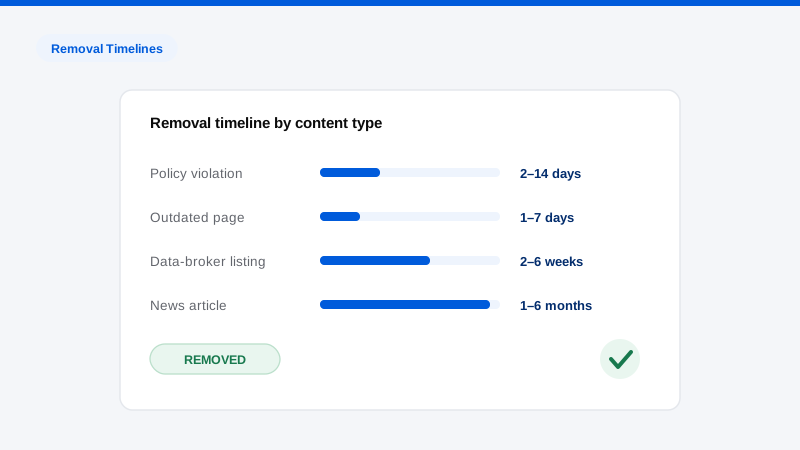
| Google policy violation (doxxing, NCII, leaked data) | 2 to 14 days | Google removal request |
| Outdated page (content already changed or deleted) | 1 to 7 days | Refresh Outdated Content tool |
| Image or video on a cooperative platform | 3 to 21 days | Platform report / DMCA |
| Social media post (Facebook, Reddit, X) | 1 to 4 weeks | Platform policy reporting |
| Negative or fake review | 2 to 8 weeks | Platform flag + escalation |
| Data-broker or people-search listing | 2 to 6 weeks | Opt-out + suppression |
| Mugshot site listing | 2 to 8 weeks | Site removal + de-indexing |
| News article | 1 to 6 months | Publisher outreach / legal / de-indexing |
| Court or public-record PDF | 1 to 4 months | Host takedown + Google tools |
Two things stand out from that table. First, the fastest wins come when Google itself has a policy on your side. Its personal-information and search result removal policies are broader than most people realize. Second, the slowest cases involve a third party who must be persuaded: a news editor, an offshore webmaster, a review platform’s moderation queue. Timelines are driven less by effort than by who holds the delete button.
What actually determines your timeline?
Four variables explain most of the spread in the table above.
Whether a clear policy applies. A search result that plainly violates a written rule (Google’s, or the host platform’s) moves fast because the reviewing employee can approve it without judgment calls. Borderline cases bounce between queues.
Who controls the content. Removing content at the source erases every path to it. But source removal depends on the host: a cooperative US platform responds in days, a news publisher deliberates for weeks, and an offshore shock site may never respond at all, which shifts the strategy to de-indexing and suppression.
Legal leverage. A court order, a valid DMCA claim, or a statutory right (such as state NCII laws or GDPR de-listing for EU-connected clients) compresses timelines dramatically because it converts a request into an obligation.
How the request is built. This is the variable you control. Requests citing the exact policy clause, with evidence attached and the correct URLs enumerated, are approved at far higher rates than free-text complaints. Most first-attempt denials we see from DIY efforts are not wrong cases. They are right cases filed wrongly, and refiling costs weeks. Our process exists to get the filing right the first time.
The removal process, step by step
- Map the exposure (days 0 to 2). Identify every URL, cached copy, image result, and syndicated duplicate. Removing one link while three mirrors survive accomplishes little.
- Choose the route per URL (days 1 to 3). Source removal, platform policy report, legal notice, Google policy request, or de-indexing, usually several in parallel.
- File and escalate (weeks 1 to 4). Submit correctly-framed requests; escalate denials through appeal channels rather than refiling the same argument.
- Clean up search (days after each removal). Once a page is down or changed, Google’s outdated content pathway clears the lingering result and cached snippet, often within 24 to 72 hours.
- Monitor for reappearance (ongoing). Data-broker listings repopulate and content gets re-uploaded. Monitoring turns a removal into a durable outcome.
Get a Free, Confidential Exposure Scan
What speeds a case up, and what slows it down
Accelerators: a documented policy violation; content hosted on a platform with a functioning trust-and-safety team; a copyright claim you genuinely hold; a court order or statutory right; a complete evidence file at intake; and professional escalation contacts that bypass the public queue.
Decelerators: news publishers, who weigh removal against editorial policy and rarely act inside a month; offshore or anonymous hosts with no abuse contact; content that is negative but true and violates no rule (where suppression, not removal, is the honest strategy); incomplete URL mapping that leaves mirrors standing; and prior botched DIY attempts. A denied request creates a record the next reviewer sees.
We are always direct about this with clients: some results cannot be removed, and a firm that promises otherwise is selling you a refund policy, not a removal. When our defamation case study client came to us, part of the work was triaging which URLs were genuinely removable versus which needed a suppression strategy, that triage is what an honest first assessment looks like.
Emergency and expedited handling
Some situations cannot wait for standard queues: intimate images spreading across tube sites, doxxing with an active harassment campaign, a leak the morning of a board meeting. Expedited handling changes the mechanics, simultaneous filing across every venue, use of priority and trusted-flagger channels where they exist, immediate Google policy requests while source removal runs in parallel, and daily monitoring for re-uploads. Our 72-hour emergency removal service is built for exactly these cases. Speed has limits, no one controls Google’s final decision, but the difference between filing everything correctly on day one and dribbling out requests over three weeks is usually the difference between containment and spread.
Frequently asked questions
Can a Google search result be removed in 24 hours?
Sometimes: but only in narrow cases: content that violates an explicit Google policy with clean evidence, or a page that has already been deleted and just needs the stale result cleared through the outdated-content tool. Most legitimate removals take days to weeks. Treat any blanket 24-hour guarantee as a marketing claim, not a timeline.
Why is the result still showing after the page was deleted?
Google’s index updates on its own crawl schedule, so a deleted page can linger in results for days or weeks with its cached snippet intact. Filing a Refresh Outdated Content request tells Google to re-check the URL and typically clears the result within one to three days. This is the single most common “removal” people actually need.
Does removal from Google delete the content from the internet?
No. De-indexing removes the result from Google searches; the page itself still exists and is reachable by direct link or other search engines. That is why professional work prioritizes source removal first and treats de-indexing as either a complement or a fallback when the host will not act.
How long do data-broker and people-search removals take?
Individual opt-outs process in roughly one to six weeks per site, but listings routinely repopulate from fresh data purchases within months. A one-time opt-out sweep decays; ongoing data broker suppression is what keeps the listings down.
What is the slowest type of content to remove?
News articles and court-record PDFs. Publishers deliberate on editorial grounds, and public records carry a presumption of availability, so these cases run one to six months and sometimes resolve through de-indexing or updated coverage rather than deletion. Our pricing guide explains why these cases also sit at the top of the cost range.
Does hiring a professional actually change the timeline?
It changes two things: the approval rate of the first filing and the escalation path after a denial. Professionals do not control platform clocks, but they avoid the refile-and-wait cycles that add weeks to DIY attempts, and they run every route in parallel instead of sequentially.
Every timeline on this page starts from one moment: knowing exactly what is out there and which route applies to each URL. A free, confidential Exposure Scan maps that for you in one pass: what can come down, how long it should realistically take, and what it will cost. If you want to see how the work unfolds from intake to confirmation, our process page walks through it step by step.