
To remove negative search results, decide first between source removal, where the content is deleted from the host site, and de-indexing, where Google is asked to drop the URL from results while the page stays live. Build a threat map of every instance, prioritize by visibility and harm, and suppress with authoritative assets what cannot be removed.
Key facts
- Google de-indexes NCII, doxxing and PII, deepfake pornography, and content on exploitative mugshot or complaint sites.
- A US court order may not bind a foreign publisher, but Google can still de-index for US searchers.
- News outlets rarely delete accurate articles; corrections, anonymization or de-indexing are the realistic asks.
- Suppression campaigns often show initial movement within 60 to 90 days, then need sustained work.
Where ContentRemoval.com comes in. ContentRemoval.com starts every search result matter with the threat map, then pursues source removal where grounds exist, de-indexing where the publisher will not move, and suppression for content that is lawful and permanent, all under one coordinated plan. Executives and public figures usually reach us through a chief of staff, their counsel or a PR agency. A free 15-minute Exposure Scan maps which results are removable and which need suppression, and the report is yours to keep. Get a Free, Confidential Exposure Scan or read how our search result removal work is done.
Finding damaging information about yourself or your business in search results demands immediate, precise action. Your entire strategy will hinge on one of two fundamental approaches: removing the content at its source or de-indexing it from search engines like Google.
Determining the correct path is the most critical decision you will make. It dictates every subsequent action.
An Executive Briefing on Digital Content Removal
For executives, public figures, and high-net-worth individuals, discovering a defamatory article, a fraudulent review, or exposed private information is a crisis. It threatens your reputation, your enterprise, and even your personal security.
The impulse to react forcefully is understandable but often counterproductive. An effective response requires a dispassionate, strategic assessment, which always begins with a choice between two distinct methodologies.
Source Removal vs. Search Engine De-indexing
Source Removal represents the complete eradication of harmful content. This means the material is permanently deleted from the website where it was published. Once removed, it cannot be accessed via direct link, search engine, or any other means. It is the most secure and definitive solution.
Achieving source removal typically involves direct engagement with the website owner, publisher, or their legal counsel. The argument for removal must be grounded in specific, demonstrable claims:
- Factual Inaccuracies: You must present clear, verifiable proof that the information is false.
- Policy Violations: The content violates the hosting platform’s terms of service, such as prohibitions against harassment or hate speech.
- Legal Violations: The material is legally actionable, constituting defamation, copyright infringement, or a clear breach of privacy.
Search Engine De-indexing is the primary strategy when source removal is unattainable. This method does not delete the content from the original website. Instead, it involves a formal request to search engines to remove the page from their search results.
The page remains accessible to anyone with the direct URL but becomes invisible to the vast majority of individuals searching for your name or associated keywords. This is an essential component of any comprehensive brand reputation marketing online strategy.
This flowchart illustrates the critical initial decision point.
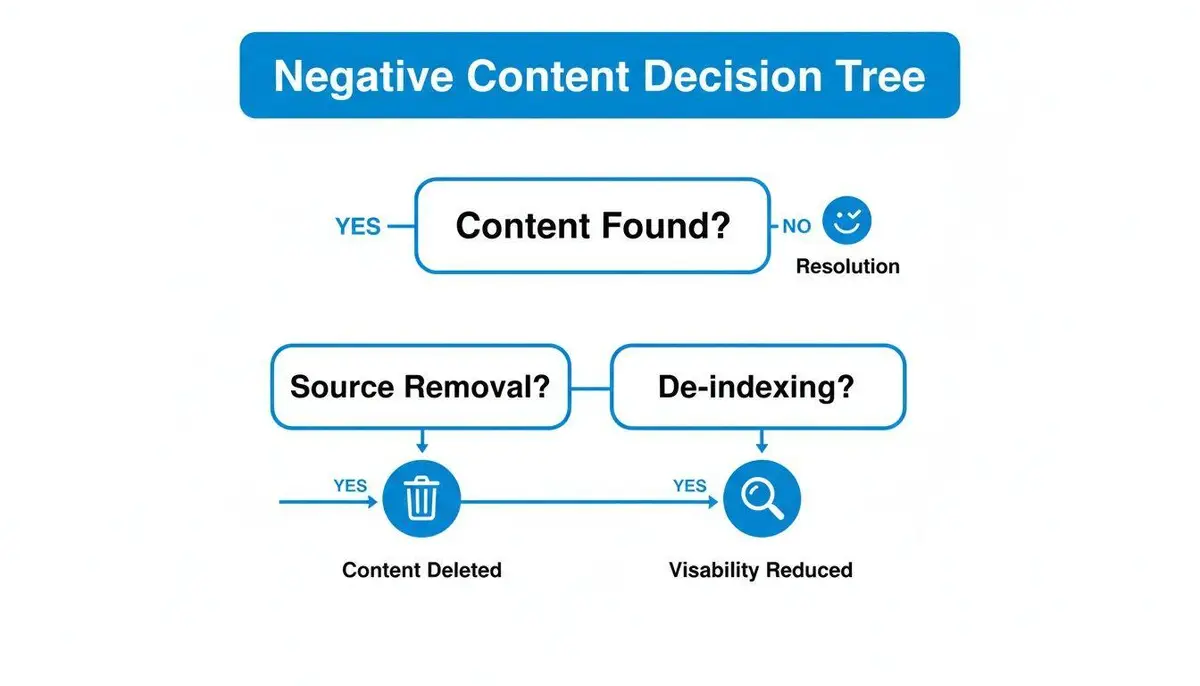
Each situation forces a strategic choice: attack the source directly or render it invisible to public search.
The following table provides a side-by-side comparison to clarify the application of each strategy.
Strategic Approaches to Negative Content
| Method | Mechanism | Best For | Outcome |
|---|---|---|---|
| Source Removal | The content is permanently deleted from the host website. | Factual errors, copyright/privacy violations, or clear breaches of a platform’s terms of service. | The content is gone forever and cannot be accessed by any means. |
| De-indexing | The content is removed from search engine results (like Google) but remains on the original website. | Uncooperative publishers, foreign websites, or content that is opinion-based and not legally actionable. | The content becomes invisible to search engine users, effectively hiding it from public view. |
Selecting the correct path from the outset conserves significant time, capital, and resources.
We have managed countless cases where a client sought source removal against a hostile or anonymous publisher, resulting in an expensive and unwinnable conflict. In those situations, a rapid pivot to a de-indexing strategy is nearly always the more pragmatic and effective action.
Your initial choice depends entirely on the content type, its hosting platform, and the relevant legal jurisdictions. A correct assessment at this stage establishes the foundation for reclaiming control of your digital narrative.
Assessing the Threat and Mapping Your Digital Footprint
When confronting an online crisis, the common instinct is to target the most prominent negative result. This is a tactical error. Acting on impulse without a comprehensive intelligence picture is akin to addressing a structural leak without identifying its origin.
Before any removal action can be contemplated, a deep, methodical investigation is required. This is not a simple search; it is digital forensics. A single negative article is seldom an isolated incident. It is copied, screenshotted, shared on social media, and debated in forums. What begins as one fire can quickly propagate into multiple smaller ones, each capable of escalating without warning.

Building a Comprehensive Threat Map
The first operational step is to construct a Threat Map. This is not a quick task but a comprehensive dossier documenting every instance of negative content. The analysis must extend far beyond the first page of search results. We employ advanced search operators and specialized tools to excavate image and video results, news archives, international search engines, and even sections of the deep web that standard searches do not reach.
Each discovered item is cataloged and scrutinized against several key factors:
- Content Type: Is it defamation, a privacy breach, a copyright issue, a malicious review, or an old news story that is factually accurate but now misleading? Each classification requires a distinct tactical approach.
- Platform: Where is it hosted? A major news outlet operates under different rules and possesses a far greater reach than a personal blog, a social media account, or a public records aggregator. The publisher’s location and policies dictate the entire strategy.
- SERP Visibility: What is the true extent of the damage? A result on the first page of search results for your name is a critical threat. A similar result on page five is a lower-priority issue that requires monitoring but not immediate action.
- Authority and Link Profile: We analyze the website’s authority and whether other sites are linking to the negative piece. This data indicates the content’s “stickiness” and the level of difficulty anticipated for removal or suppression.
This meticulous process ensures we are not merely reacting to symptoms but mapping the entire pathology.
Categorizing and Prioritizing Targets
With a complete Threat Map, we can initiate strategic planning. Each item is sorted into a priority matrix, which is crucial for determining which actions to take. As you analyze the content, you will recognize the importance of being able to evaluate information sources to gauge their real-world impact.
A simplified classification of targets includes:
- Priority 1 (Immediate Action): These are true emergencies posing a direct, imminent threat. This includes doxxing, non-consensual intimate imagery, or blatant libel on a high-traffic website. These targets require immediate intervention.
- Priority 2 (Strategic Removal): This category includes negative news articles, damaging but subjective reviews, or stolen intellectual property. These removals are more nuanced and often require direct negotiation or carefully crafted legal arguments.
- Priority 3 (Suppression & Monitoring): Some content cannot be removed, such as a protected opinion piece or an article on a “bulletproof” offshore site. For these, the strategy shifts from removal to suppression, where positive content is promoted to displace the negative result in search rankings.
I have seen clients waste significant resources attempting to remove an unremovable blog post on page eight while a network of smaller, easily removed items on other sites caused far more cumulative damage. A proper threat assessment prevents such misallocation of effort.
This systematic approach transforms a chaotic, high-stress situation into a structured campaign. It allows you to focus resources with surgical precision, addressing the most damaging content first. Only with this complete, prioritized intelligence can you proceed with a viable plan.
The Legal Framework for Content Takedowns and De-indexing
Requesting the removal of negative content is seldom sufficient. To compel a publisher or search engine to act, you require leverage, and the most effective leverage is a well-constructed legal argument.
This is not a matter of dispatching generic cease-and-desist letters. It is a strategic process of identifying the specific legal vulnerability within a piece of content and presenting a case so compelling that the platform must comply. A vague complaint about “fake news” is easily dismissed. A detailed claim of copyright infringement under the Digital Millennium Copyright Act (DMCA), however, commands immediate attention.

Differentiating Source Removal and De-indexing Demands
Your legal strategy depends on a critical distinction: are you pursuing removal from the website itself (source removal) or from search engine results (de-indexing)? These are two separate objectives, and confusing them can undermine your entire effort.
A source removal demand is a direct confrontation. You argue to the website owner that the hosted content is illegal, whether defamatory, a copyright violation, or a breach of privacy. Success means the content is permanently eliminated from the internet.
A de-indexing request to a search engine like Google often employs a different rationale. You may not argue that the content is illegal but rather that its presence in search results violates a specific law or Google’s own internal policies. Our guide on URL de-indexing provides further strategic context on this powerful but distinct tactic.
Consider this real-world scenario: A publisher in Eastern Europe may be immune to a U.S. court order for defamation. However, Google might still be compelled to de-index that same content for U.S. searchers if it violates local privacy laws or Google’s policies against non-consensual explicit images. This is a critical distinction that experienced professionals exploit.
Core Legal Justifications for Removal
While case details vary, most successful takedowns are built upon a few core legal principles. The skill lies in matching the correct justification to the facts and the specific platform.
- Copyright Infringement (DMCA): The DMCA is an invaluable tool when your original photos, articles, or videos have been stolen. It provides a standardized, legally binding process for demanding takedowns from most U.S.-based platforms, which are obligated to take such claims seriously.
- Trademark Violations: If another site uses your brand name or logo deceptively, such as a fraudulent site impersonating your business, a trademark claim provides a direct path to removal.
- Court-Ordered Removal: A definitive court order declaring content to be false or defamatory provides undeniable authority. With such an order, both hosting companies and search engines will almost always comply to avoid legal exposure.
- Privacy Violations (GDPR & CCPA): Privacy laws like Europe’s GDPR and California’s CCPA grant individuals greater control over their personal data. These can be used to compel the removal of sensitive personal information through “Right to be Forgotten” or “Right to Erasure” requests.
Navigating Platform-Specific Processes
Legal knowledge alone is insufficient. You must also navigate the internal processes of each platform. Google, Facebook, and major news organizations each maintain their own submission portals, evidence requirements, and review teams. A one-size-fits-all approach is ineffective.
A successful demand is a complete package. It requires meticulously organized evidence, a clear citation of the law or policy being violated, and a precise explanation of how the content breaches the rules. This transforms a subjective complaint into an objective, actionable request that a platform’s legal team can process and approve efficiently.
Platforms are becoming more responsive. Government and court-ordered removal requests to Google have more than doubled in three years, exceeding 100,000 in 2023. While Russia accounts for 64% of these requests, the data on these global content removal trends indicate a global shift toward greater digital accountability. This trend creates new opportunities for removing harmful content, provided you can build the right legal case.
Executing Platform-Specific Removal Strategies
Attempting to remove damaging content with a universal approach is a primary and critical mistake. Each platform, from Google and Yelp to major news outlets and social media, is a distinct ecosystem with its own rules, business models, and pressure points.
Submitting a generic complaint is a reliable way to be ignored. The substantive work lies in understanding the specific platform hosting the content. You must analyze their policies and pinpoint the exact violation. Is it defamation, a privacy breach, or intellectual property theft? Identifying this specific justification is what converts a hopeful plea into a non-negotiable demand.
Navigating the Google Maze
For most individuals and businesses, Google is the primary battleground. While Google does not own the content, it controls its visibility. Success hinges on understanding that Google maintains very specific, non-negotiable rules for removing an item from its search results, a process known as de-indexing. Your request must be framed within their precise policy violations.
The most successful removal arguments with Google fall into several key categories:
- Explicit Personal Content: This includes non-consensual intimate imagery (NCII) and similar material posted without consent. Google treats these with the highest priority.
- Doxxing and PII: If a third party has published your home address, private phone number, or financial details, it is a clear violation of Google’s policies against exposing personally identifiable information.
- Content on Sites with Exploitative Removal Practices: Google will de-index content from predatory “mugshot” or complaint websites that attempt to extort money for removal.
- Involuntary Fake Pornography: This covers deepfakes and other digitally manipulated explicit images. It is a serious violation, and Google has a dedicated process to address it.
For each of these categories, you must use a dedicated submission form and build a watertight case. Your request must function as a complete case file, leaving no room for ambiguity or misinterpretation by the reviewer.
Dealing with News Publishers and Media Outlets
Removing a negative news article is one of the most formidable challenges in reputation management. Reputable journalism is protected by principles of free speech, and publishers are inherently resistant to retracting stories. Demanding a takedown is almost certain to fail and may provoke further unwanted attention.
The strategy here requires finesse. Instead of direct confrontation, more productive options exist:
- Request a Correction or Update: If the article contains factual inaccuracies, however minor, you have leverage. Presenting clear, undeniable proof can lead to an editor’s note or an update that significantly reframes the narrative.
- Argue for De-indexing: It is sometimes possible to persuade an editor that an old article is causing disproportionate harm. This is most effective for stories about resolved issues where public interest has waned but the article still ranks prominently.
- Negotiate Anonymization: For particularly sensitive stories, a publisher may agree to remove your name or photo from an older article, severing its connection to your online identity while preserving the original report.
Success with news outlets often depends on the professionalism of the approach. A respectful, well-documented request sent to the appropriate editor or legal department will always prove more effective than an angry, emotional demand.
Fighting Back Against Defamatory and Fake Reviews
For any business, a series of negative reviews on platforms like Google Maps, Yelp, or Glassdoor can be devastating. A review cannot be removed simply for being negative, but you can target reviews that violate platform rules. Most platforms prohibit fake reviews, content from disgruntled ex-employees, hate speech, and off-topic commentary.
Your task is to build a case that the review is not from a genuine customer. This may involve demonstrating that the reviewer was never a client, that their claims are factually impossible, or that their language violates community standards. It is a forensic process: you are not debating their opinion but proving their review is illegitimate under the site’s own terms.
Platforms are increasing their enforcement actions. A recent analysis shows that Google’s review deletion patterns on Search Engine Land are at record levels, with interesting regional variations. In Germany, for example, most deleted reviews are low-rated, likely reflecting the country’s strict defamation laws. This demonstrates the critical importance of grounding your removal request in the specific legal and policy context.
Suppression Strategies When Removal Is Not an Option
What is the recourse when negative content cannot be removed? Certain information becomes a permanent fixture of the internet. A major news organization may publish a story that, while damaging, is factually accurate and protected by journalistic privilege. An influential blogger’s critical opinion piece is often shielded by free speech laws.
In these circumstances, the content cannot be erased. The strategy must pivot from removal to strategic suppression. When the fire cannot be extinguished, you must build a firewall. This is the core principle of suppression: a sophisticated reputation management approach focused on demoting negative content by promoting positive, authoritative assets in search results. It is an offensive, long-term campaign to seize control of your digital narrative.
Constructing a Digital Firewall
The objective is to create and promote a portfolio of high-quality digital properties that you own or influence. These assets are then meticulously optimized to outrank the negative content for your name or brand. The goal is to dominate the first page of Google, pushing the problematic item to page two or beyond, a digital space where it becomes effectively invisible.
This “firewall” is not a single website but a network of interconnected online profiles and content, including:
- A professional personal or corporate website serving as your digital headquarters.
- Fully optimized executive profiles on high-authority platforms like LinkedIn.
- Positive media mentions, interviews, or thought leadership articles secured on reputable third-party sites.
- A corporate or personal blog populated with keyword-rich, substantive content.
Each element is a strategic tool designed not just for appearance, but to actively compete for ranking power against the content you wish to bury.
The Mechanics of SEO-Driven Suppression
At its core, suppression is a high-stakes SEO campaign. It involves creating new, high-quality content and methodically building its authority in Google’s algorithm. This requires both technical skill and a relentless content strategy.
This is the definitive solution for many of our clients facing entrenched negative articles. The practice, as detailed by firms like Reputation Ace who explain how negative content is managed by the team at Reputation Ace when direct removal is impossible, has become highly sophisticated. It involves a mix of creating and optimizing quality articles, social media profiles, and positive press to strategically demote unwanted results.
Success depends on several key elements:
- High-Quality Content Creation: This is the foundation. The content must be well-written, relevant, and provide genuine value. Generic, thin articles are a waste of resources; search engines will ignore them.
- Strategic Keyword Targeting: Every piece of positive content must be optimized for the exact search terms that surface the negative result. You are competing on the same turf.
- Authoritative Backlinking: Securing links from other respected websites to your positive assets is critical. These links act as “votes of confidence,” signaling to Google that your content is credible and important.
Suppression is a campaign of inches, not a single knockout blow. It requires patience and persistence. We often see initial positive movement within 60 to 90 days, but securing and holding those top search positions is a sustained, long-term commitment.
The effort is significant, but the outcome is control. By systematically building and promoting positive content, you create a powerful buffer that insulates your reputation from unremovable content. This method is detailed further in our strategic guide for executives on suppressing negative search results. Ultimately, suppression ensures that what people find when they search for you is the narrative you control.
Your Questions About Removing Negative Content, Answered
When confronting an online reputation crisis, you have urgent, specific questions. Based on years of confidential client consultations, here are the direct answers you require.
How Long Does It Take to Remove Negative Search Results?
The timeline is entirely situational. A universal timeframe does not exist because each case demands a unique strategy.
For a clear-cut policy violation, such as copyright infringement or the posting of non-consensual private images, we can often secure removal within days or weeks. The same applies when we possess a court order; platforms typically act swiftly upon receiving a legal directive.
However, more complex cases require patience. De-indexing a defamatory article hosted by an uncooperative foreign publisher can take several months. For suppression campaigns, a tangible shift in search rankings is often visible within 60-90 days, but maintaining that position is an ongoing commitment, not a one-time fix.
Is It Possible to Permanently Remove a News Article?
This is one of the most difficult challenges. Compelling a major news publisher to delete a factually accurate article is nearly impossible, particularly in jurisdictions with strong free-press protections like the United States. They will not comply unless you can prove a major factual error or present a court order declaring the content defamatory.
The most pragmatic strategy is rarely a direct confrontation with the publisher. A more strategic approach focuses on de-indexing, ensuring the article vanishes from search results, or suppression, which pushes the article so far down in rankings it becomes practically invisible.
These tactics achieve the necessary outcome: the damaging story disappears for anyone searching your name, from the public to investors and potential clients. You neutralize the threat without engaging in a costly, public fight you are unlikely to win.
Why Hire a Professional Service Instead of Handling This Myself?
Any individual can complete a platform’s public removal form. When the stakes are high, however, this is an inadequate approach. A DIY attempt can easily backfire, which is where a specialist firm provides a decisive advantage.
Engaging a professional service provides assets that are nearly impossible to replicate independently:
- We Know the Playbook: We possess deep, operational knowledge of the unwritten rules and hidden escalation paths at major platforms. We know the key contacts and the correct protocols for engagement.
- Technical Firepower: An effective suppression campaign requires more than simple requests. It demands sophisticated SEO expertise to construct a digital “firewall” around your name that demotes negative content and promotes positive assets.
- Speed and Discretion: We operate as your confidential shield. Our team manages the entire process with an urgency and focus that you or an internal team cannot dedicate.
Most importantly, we prevent you from exacerbating the situation. A botched DIY attempt can alert the content’s publisher, entrench their position, or draw more attention to the problem. For executives and public figures, professional assistance is not a luxury. It is essential risk management.
When your reputation is on the line, you need a team that operates with speed, precision, and complete confidentiality. ContentRemoval.com delivers results where traditional PR and legal firms often can’t.
To get a clear picture of your options, schedule a confidential assessment with our specialists today.
Frequently asked questions
What is the difference between removing content and de-indexing it?
Source removal deletes the content from the website where it was published, so it cannot be reached by link or search. De-indexing asks Google or Bing to drop the URL from results while the page stays on the site, reachable only by direct link. De-indexing is the fallback when the publisher is uncooperative or hosted abroad.
Which negative results should I deal with first?
Priority one is anything posing an imminent threat: doxxing, non-consensual intimate imagery or blatant libel on a high-traffic site. Priority two is negative news, damaging reviews and stolen intellectual property that need negotiation or legal argument. Priority three is content that cannot be removed and is handled through suppression and monitoring.
Can I get a fake review removed from Google Maps or Yelp?
Not for being negative, but yes if it breaks the platform’s rules. Build a case that the reviewer was never a customer, that the claims are factually impossible or that the language breaches community standards. You are proving the review is illegitimate under the site’s own terms, not debating the opinion.