
Eviction record removal has three legal routes: vacating the judgment, sealing the record, or expungement, each with a different effect and availability by state. A court order is only the start. Tenant-screening vendors, data brokers and search results copy filings the moment they become public, so disputes with reporting agencies, broker outreach and de-indexing must follow the order.
Key facts
- Sealing is the most common relief because it is reversible; expungement is stronger but less available.
- Vacating a judgment attacks the adverse ruling itself and is often the right first step before sealing.
- Screening companies scrape court records as soon as they appear, so later sealing may not reach private databases.
- Massachusetts’ 2024 law requires reporting agencies to remove sealed cases from tenant reports within 30 days.
Where ContentRemoval.com comes in. ContentRemoval.com handles the part of eviction record removal that survives the court order: people-search and public-record aggregator pages, screening vendor listings and search results that still tie your name to the filing. We coordinate with your counsel so the legal relief and the digital cleanup land together. Executives, their family office or their lawyer usually make contact. A free 15-minute Exposure Scan maps what is removable and the report is yours to keep. Get a Free, Confidential Exposure Scan or read how our court record removal work is done.
A board seat is within reach. The diligence memo is circulating. Someone on the other side runs a standard background sweep and finds an eviction filing tied to your name. It may have been dismissed. It may have been resolved years ago. None of that matters in the first five minutes.
What matters is that a negative housing court record now exists inside the same decision stream as credit review, litigation checks, compliance screening, and reputation analysis. For an executive, founder, investor, or family office principal, an eviction record is rarely read as a narrow landlord-tenant event. It is read as a signal. Fairly or not, people infer instability, conflict, cash-flow stress, or poor judgment.
That is why eviction record removal has to be handled as a reputational containment project, not a clerical court exercise. The legal file is only the beginning. The core work is stopping public visibility, limiting downstream spread, and forcing private databases and search surfaces to catch up with the legal reality.
An Eviction Record Is a Reputation Liability
A compensation committee is reviewing your appointment. A private bank is underwriting a liquidity line. A luxury landlord is deciding whether to approve the lease tied to your relocation. Then an eviction filing appears in the background file.
At that point, the record stops being a housing dispute and starts functioning as a credibility problem. Decision-makers read it fast, and they read it harshly. A dismissed case, a retaliatory filing, or a matter that should never have been brought still creates the same first impression: friction, volatility, and avoidable risk.
That reaction drives policy change. The National Low Income Housing Coalition’s 2024 guide to eviction record sealing and expungement explains that multiple states and the District of Columbia have adopted sealing or expungement measures, and it points to Philadelphia’s heavy filing volume alongside Pennsylvania’s lack of a sealing or expungement path even where the tenant prevailed, the case was withdrawn, or the judgment was satisfied or vacated. The practical message is straightforward. Public eviction data causes lasting harm, and many jurisdictions still offer limited relief after the filing becomes visible.
For affluent clients, that harm reaches further. A screening hit can affect a lease, but a public eviction record can also alter how lenders, boards, counterparties, and family office gatekeepers assess judgment and stability. Thorough reviewers do not limit themselves to one courthouse portal. They compare litigation history, credit signals, media traces, and third-party screening results, then draw conclusions that have nothing to do with the merits of the landlord-tenant dispute.
That spillover is why you should understand credit reporting after a Texas eviction. Housing court exposure can migrate into adjacent review channels and complicate financing, insurance, and diligence conversations long after the case itself is over.
An eviction filing does not need to be fair to cause damage. It only needs to be easy to find.
The common mistake is treating record removal like a clerical errand. File one motion, clean one docket, and assume the problem is solved. That approach fails for executives, founders, investors, and public-facing professionals because the primary threat is downstream replication. Once the filing is captured by screening vendors, data brokers, search tools, or internal compliance files, a narrow DIY fix rarely reaches the places that matter.
Handle this as reputation defense with legal components, not as isolated courthouse paperwork. If your name carries market value, the standard legal aid playbook is too limited. You need a strategy built for visibility control, vendor pressure, and follow-through across every channel where the record can still be used against you.
Verifying the Record and Assessing the Damage
The first question isn’t whether the court still shows the case. The first question is where the record traveled after it appeared.

A basic docket search is inadequate because court visibility and market visibility are not the same thing. The Center for American Progress advocates automating sealing at filing because third-party companies often scrape court records the moment they become public, and Upturn warns that once scraped, later sealing may not remove the record from private databases, making full containment “practically impossible” without immediate action, as described in the Center for American Progress analysis on eviction record expungement.
What a real audit looks like
You need a footprint map, not a docket printout. In practice, that means checking several layers of exposure:
- Court-origin exposure: Confirm the exact case caption, filing date, disposition, and every case number. Precision matters later.
- Tenant-screening exposure: Identify which screening vendors still surface the matter in rental reports or internal landlord workflows.
- Broker and aggregator exposure: Search people-search sites, public-record aggregators, and niche background-reporting pages that may have copied the case.
- Search engine exposure: Determine whether the record, or pages referencing it, appears when your name is searched directly.
- Collateral exposure: Review related credit, collections, or judgment references if they stem from the same dispute.
DIY efforts usually fail because clients search their name once, maybe twice, and stop when they don’t see a result on page one. That tells you almost nothing. Thorough screening doesn’t rely on the same consumer search path you use at home.
The main tactical mistake
People focus on the visible court page and ignore the invisible republication chain. That is backwards. Once the data has been copied, the public docket becomes only one node in a much larger network.
A professional audit also checks for mismatch risk. If your name appears in more than one filing, if there are aliases, if the landlord used a corporate entity, or if multiple actions were filed across time, every identifier has to be reconciled before any removal strategy starts. Otherwise, one stale case survives and keeps poisoning the record.
Operational rule: If you haven’t identified every place the record appears, you don’t yet have a removal strategy. You have a guess.
Why high-stakes clients need a broader lens
Executives and public figures aren’t just trying to rent another apartment. They’re trying to protect optionality. A private bank, investor, board committee, family office gatekeeper, or journalist may encounter the same record through entirely different channels.
That is why the initial assessment has to be run like an intelligence exercise. You need the source. You need the copies. You need the search footprint, and you need to know which exposure points can be removed, which can be suppressed, and which require legal escalation.
Your Legal Pathways for Record Removal
A CFO loses a rental application in under a minute because a screening platform pulls an old eviction case that should never have remained public. That is how these matters work in practice. The court file becomes a credibility problem long before anyone asks for your side of the story.
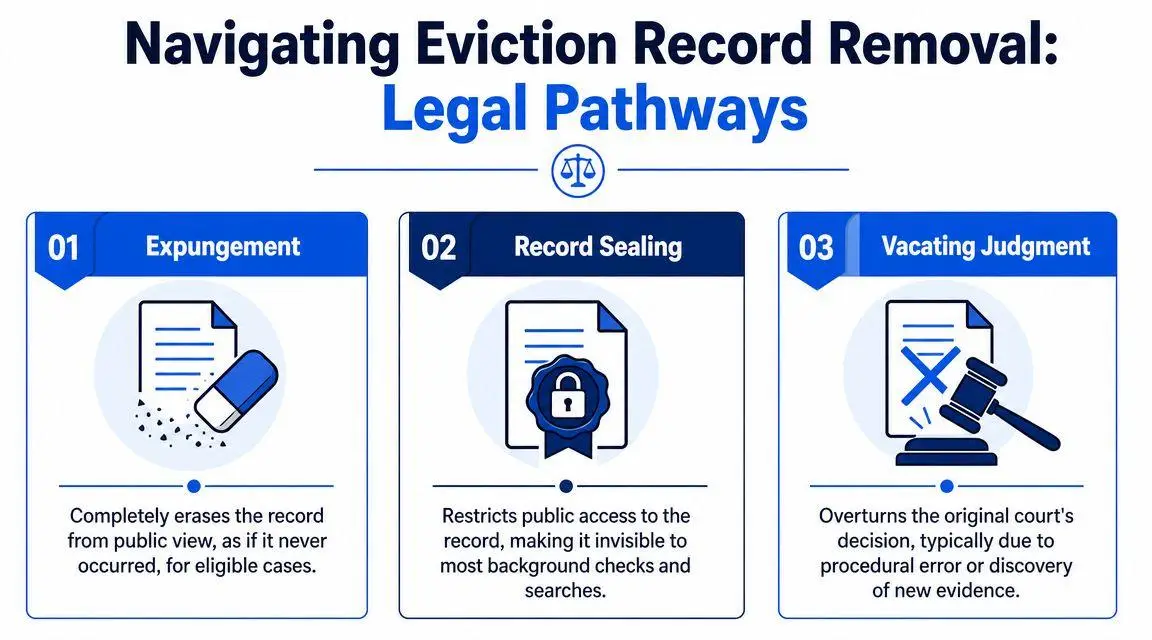
Your options usually fall into three categories: vacating judgment, sealing, and expungement. The labels sound similar. Their legal effect is not.
Comparison of eviction removal remedies
| Remedy | Legal Effect | Common Availability | Ideal Use Case |
|---|---|---|---|
| Vacating judgment | Nullifies the original ruling | More fact-specific and procedure-driven | Cases with procedural defects, settlement-based reversals, or grounds to undo the judgment |
| Record sealing | Restricts public access to the record | Common relative to expungement | Cases where the goal is to stop public visibility and screening access |
| Expungement | Erases the record and treats it as if it never happened | Less common | Jurisdictions and fact patterns that allow full record destruction or equivalent relief |
Start with the remedy your facts can support
Sealing is often the practical first target because it cuts off public visibility and reduces screening exposure. The National Center for State Courts notes that sealing is the most common form of record relief because it is reversible, while expungement is stronger but less available, as explained in the National Center for State Courts guidance on record relief.
For a high-net-worth client, that distinction matters. You are not filing for symbolic relief. You are choosing the remedy most likely to stop tenant-screening vendors, data brokers, and institutional reviewers from seeing a live court record.
Expungement gets more attention than it deserves
Expungement is the cleaner result if your jurisdiction allows it and your facts qualify. It can remove the record more completely and reduce downstream republication risk.
Do not ask for it reflexively. In many states, eligibility is narrow, the standard is stricter, and a weak expungement petition can waste time you should have spent securing a seal or vacatur that the court will grant.
Vacating the judgment can change everything
Vacatur goes at the foundation of the case. If the judgment resulted from defective service, procedural error, settlement terms, or another recognized basis for reopening the matter, vacating it changes the legal posture of the file itself.
That can be the strongest move in the entire strategy. It does more than hide a record. It attacks the adverse result that screening systems and private decision-makers treat as a credibility signal.
In many matters, the right sequence is vacate first, then seal. Sophisticated screening systems do not care which motion sounds more powerful. They care what still appears in the record feed.
Procedure defeats self-help filings
This work breaks down on details. Petitions usually must be filed in the original court, matched exactly to the caption and case number, served correctly, and supported with the right eligibility proof. Some courts require separate filings for each case. Some require proof tied to dismissal, satisfaction, vacatur, or a waiting period, as described in the Indiana Legal Help eviction sealing form guidance.
A filing error here does not just create delay. It can preserve a reportable record during a board appointment, financing event, relocation, divorce, or press cycle.
If your exposure spans multiple filings, counties, aliases, or entity names, counsel should build the filing matrix before anything is submitted. For context on how early procedural timing affects later relief options, understanding California eviction timelines helps frame why missed windows and rushed settlements create long-tail record problems.
For clients dealing with broader online republication risk, this guide on how to remove a public record from the internet is relevant because court relief and internet removal are separate workstreams.
Choose the remedy that changes the record you actually have, not the one that sounds strongest on paper.
Neutralizing the Record Beyond the Courthouse
A sealing or expungement order is not the finish line. It is your authorization to start the next phase.

The residual-risk problem is straightforward. Legal remedies have practical limits. Washington’s Order to Limit Dissemination stops tenant-screening companies from reporting a case, but it doesn’t prevent a landlord from asking about it, and in Massachusetts a sealed case can still be accessed through a court motion, as explained in Washington LawHelp’s discussion of limiting dissemination of eviction records. That gap between legal relief and practical invisibility is where reputational damage survives.
The post-order sequence
Once you have a court order, move on three tracks at once.
First, dispute the record with tenant-screening agencies and consumer reporting entities that still surface the case. If the legal status changed, their reporting should reflect that. Waiting for them to discover the update on their own is naive.
Second, address the original source relationships. In some matters, direct outreach to the landlord or property manager can secure a clarification, satisfaction confirmation, or other corrective document that helps when a stale record keeps resurfacing.
Third, deal with public-facing search exposure. If data brokers, aggregators, or indexed pages still connect your name to the filing, you need a suppression and removal strategy, not more courthouse work.
Search visibility is a separate battlefield
A sealed docket may disappear from a court portal and still leave your name associated with old references elsewhere. Search engines don’t adjudicate fairness. They index availability.
That is why online reputation management sits inside a serious eviction record removal strategy. The task is to remove what can be removed, de-index what qualifies for de-indexing, and suppress what cannot be fully erased. For clients facing broad search exposure, strategic methods to suppress negative content and restore digital authority lays out the core framework. Firms such as ContentRemoval.com also coordinate with platforms, site operators, search engines, and legal teams when public-record material or derivative pages continue to rank after the underlying record has been sealed or otherwise restricted.
A short explainer can help frame the digital side of the problem:
What clients often misunderstand
They think a judge’s order compels the internet to forget. It doesn’t. It compels certain legal outcomes in certain systems. Everything else depends on follow-through.
Use this practical sequence:
- Get the certified order: You’ll need exact proof of the relief granted.
- Notify reporting entities: Send disputes and supporting documents to agencies still reporting the matter.
- Check search results by name: Not just the case number. Your name.
- Monitor derivative pages: Broker pages, cached snippets, and copied summaries can survive after source removal.
- Document every correction request: If the issue resurfaces, your paper trail matters.
A court order changes your legal position. It does not automatically clean your digital footprint.
Timelines, Costs, and When to Engage Counsel
A CEO applies for a luxury lease before a relocation, expects a routine approval, and gets flagged because an old eviction filing still appears in a screening database and on a public-record aggregator. The court issue may be fixable. The reputational hit lands first, and it can disrupt housing, financing, board optics, and private diligence in the same week.

Treat timing as two separate projects. First, getting legal relief. Second, forcing the market to stop circulating the record after the legal status changes. Clients who budget for only the filing fee usually end up paying twice.
Court timing depends on the forum, the quality of the filing, service requirements, opposition from the landlord, and the judge’s calendar. Straightforward matters can move efficiently. Messy matters do not. One drafting mistake, one missing exhibit, or one avoidable objection can add weeks and create a worse record.
What success actually looks like
Success usually means restricted public access, corrected reporting, and a cleaner screening profile. It does not mean every copy disappears everywhere.
That distinction affects disclosure strategy. As noted earlier, the legal effect of sealing, expungement, or vacatur differs by state, and that difference can control whether you may lawfully answer “no” to prior-eviction questions. Get that answer wrong on a lease application, compliance form, or background questionnaire and you create a new problem that is harder to defend than the original filing.
Budget for verification. Someone has to confirm the docket changed, tenant screening vendors updated their files, and search results stopped surfacing stale copies. If you need a practical benchmark for post-order cleanup, this guide on how long search-result removal typically takes after legal relief sets realistic expectations.
When counsel is necessary
Hire counsel at the start if any of these conditions apply:
- Your name has market value: executive leadership, board membership, public profile, investment activity, major philanthropy, or regulated licensing.
- The record is factually or procedurally messy: multiple filings, defaults, settlements, aliases, inherited data errors, or more than one court system.
- You need a defensible disclosure position: the wrong answer on an application can trigger rescission, denial, or credibility damage.
- You need discretion and speed: high-visibility clients cannot afford failed pro se filings, unnecessary hearings, or careless outreach to data brokers.
The cost issue is simple. Counsel is cheaper than partial relief.
A do-it-yourself approach may work for a low-stakes tenant matter with no digital spread and no reputational sensitivity. It is the wrong approach for executives, founders, investors, and public-facing families. Standard legal aid models focus on courtroom access. They do not usually cover screening vendor correction, search suppression, broker outreach, or the private-market consequences of a record that keeps resurfacing during diligence.
The realistic view
An eviction record can often be contained. The actual deadline is not the hearing date. It is the next screening pull, the next relocation review, the next underwriter question, or the next search by someone deciding whether to trust your name with an asset.
Adopting a Proactive Reputation Defense
Reactive removal is necessary. It is not sufficient.
The critical issue is speed. Massachusetts’ 2024 law allows administrative sealing for cases dismissed or decided for the tenant, and once sealed, consumer reporting agencies must remove the information from tenant reports within 30 days, yet Upturn’s position remains the sharper strategic point. Once records become public and are copied, it is “practically impossible” to fully contain dissemination. The Boston Bar Association’s discussion captures the core question well in its focus on how fast sealing can contain the damage.
That is why high-value clients need permanent monitoring after the immediate cleanup. Data brokers republish. Search results shift. Old pages reappear under new domains. A record that seemed contained can re-enter the market through one lazy aggregator or one stale vendor database.
The durable approach
Treat eviction record removal as one component of a broader reputation defense system:
- Monitor your name continuously: especially across search, people-search databases, and public-record aggregators.
- Preserve your legal documents: sealing orders, satisfaction records, vacatur orders, and correspondence should be ready for immediate use.
- Escalate quickly when republication appears: delay gives copied data more time to spread.
- Separate legal relief from digital mitigation: both are required if public perception matters.
High-stakes reputation work is about shrinking the exposure window, then keeping it closed.
Executives, founders, family offices, and public figures should think the same way they think about cybersecurity. One clean-up is not a strategy. Ongoing detection, rapid response, and controlled escalation are the strategy.
If your name is an asset, protect it like one.
If an eviction filing is affecting housing, financing, diligence, or search visibility, ContentRemoval.com can assess the record’s public footprint, coordinate with counsel and platforms, and build a discreet plan for removal, de-indexing, suppression, and ongoing monitoring.
Frequently asked questions
Does sealing an eviction record remove it from the internet?
No. Sealing restricts public access at the court, but copies already scraped by tenant-screening companies, data brokers and aggregators can remain. After the order you need to dispute the record with reporting agencies, contact brokers with the certified order, and address any pages still ranking for your name.
Can an eviction that was dismissed still show up on a background check?
Yes. A dismissed or withdrawn case is still a public filing in many states, and some jurisdictions such as Pennsylvania offer no sealing or expungement path even where the tenant prevailed. Reviewers often read a filing as a signal regardless of outcome, which is why removal has to reach beyond the courthouse.
Should I vacate the judgment or seal the eviction record first?
Where the facts support it, vacate first, then seal. Vacatur nullifies the adverse ruling that screening systems treat as a credibility signal, while sealing then cuts off public visibility. Petitions must match the exact caption and case number in the original court, so counsel should build the filing matrix before anything is submitted.