
Mugshots are presumptively public records in most U.S. jurisdictions, and at least 11 major states, including Florida, New York, Ohio and Texas, treat booking photos as open to public inspection. Public status explains where a mugshot originates, not why it persists online. Removal depends on the source agency, the republishing site and search indexing, each governed by different rules.
Key facts
- Alabama, Florida, Maryland, New York, Ohio, Texas and Wyoming classify booking photographs as public inspection records.
- North Carolina’s 2026 Senate Bill 660 would move mugshot release toward discretionary disclosure with media affidavits.
- Illinois consumer fraud rules for publish-for-pay mugshot sites do not apply to news media.
- Paying one aggregator removes one URL and leaves copies on county sites, news archives and scrapers.
Where ContentRemoval.com comes in. ContentRemoval.com handles mugshot cases where a booking photo has spread from an agency source into aggregators, news archives and Google image results, working source removal, de-indexing and monitoring together. Executives, their general counsel or a family office usually make contact after a search before a financing round, board appointment or media appearance surfaces the image. A free 15-minute Exposure Scan maps what is removable, and the report is yours to keep. Get a Free, Confidential Exposure Scan or read how our mugshot removal work is done.
In most U.S. jurisdictions, mugshots are presumptively public records. As of 2026, at least 11 major states explicitly classify booking photographs as public inspection documents, but getting a mugshot off the internet is a separate problem that quickly turns into a reputation crisis.
If you’re searching this right now, you’re probably not doing it out of curiosity. A board member found a booking photo in search results. A journalist is asking questions. An investor relations team flagged a result that shouldn’t be there. Or your family office did a routine audit and discovered an old arrest image still circulating years after the underlying matter stopped being relevant.
The legal answer to are mugshots public is often straightforward. The business answer isn’t. For an executive, founder, public figure, or high-net-worth individual, a mugshot online isn’t just embarrassing. It becomes a persistent digital liability that search engines, news archives, and third-party sites can keep surfacing long after the underlying event has lost any legitimate public value.
Panic usually makes this worse. People email the wrong publisher, threaten the wrong target, or pay a site that has no control over the broader ecosystem. That approach wastes time and creates a record of desperation.
A disciplined response works better. You need to identify the source, map the republication chain, determine what legal recourse exists in the relevant jurisdiction, and then suppress what can’t be removed immediately. That is the difference between reacting emotionally and managing risk like an operator.
The Initial Shock and the Legal Reality
The first call usually sounds the same. An executive says they searched their name before a financing round, a keynote appearance, or a leadership announcement and found a mugshot sitting on page one. Sometimes it came from a local sheriff archive. Sometimes from a news site. Sometimes from a mugshot aggregator that copied the image years ago and never let go.
The emotional reaction is predictable. The legal implications are less obvious. People assume that if the photo is damaging, it must be illegal to publish. In many cases, it isn’t. That’s the part that catches knowledgeable people off guard.
Why this hits executives harder
A mugshot doesn’t stay confined to the incident that produced it. Search engines flatten context. Recruiters, investors, donors, counterparties, and journalists don’t see nuance first. They see the image, the word “arrest,” and a result that suggests present relevance.
That creates an asymmetry. You may know the matter was dismissed, resolved, sealed, outdated, or non-representative. The market doesn’t know that. It sees a high-salience visual artifact attached to your name.
Practical rule: Treat a visible mugshot the same way you’d treat leaked financial information or a defamatory article. It’s not a private embarrassment. It’s a reputation event with commercial consequences.
The right first conclusion
So, are mugshots public? In much of the United States, yes. But that doesn’t mean every use, republication, indexing pattern, or downstream display is equally defensible or equally difficult to challenge.
That distinction matters. A public record at the source can still become removable, suppressible, or de-indexable once it moves through other channels. An official booking database is one problem. A republished image on a monetized third-party site is another. A local news archive is a third.
Executives who solve this well don’t obsess over the abstract privacy question. They ask better questions:
- Where did the image originate: Was it posted by a sheriff, police department, court-adjacent database, or a secondary scraper?
- Who amplified it: Did a newsroom, blogger, aggregator, or social account republish it?
- What appears in search: Is the problem the source URL, image indexing, a knowledge panel association, or broad name-query contamination?
That is the legal reality. The image may be public. The exposure is still manageable if the response is strategic.
The Legal Framework Why Mugshots Are Presumptively Public
For executives, the first legal mistake is treating a mugshot as a privacy dispute. It is a public-records problem first, and a reputation problem immediately after. In many U.S. jurisdictions, booking photos are released because open-records laws favor public oversight of police activity over the subject’s interest in avoiding exposure.
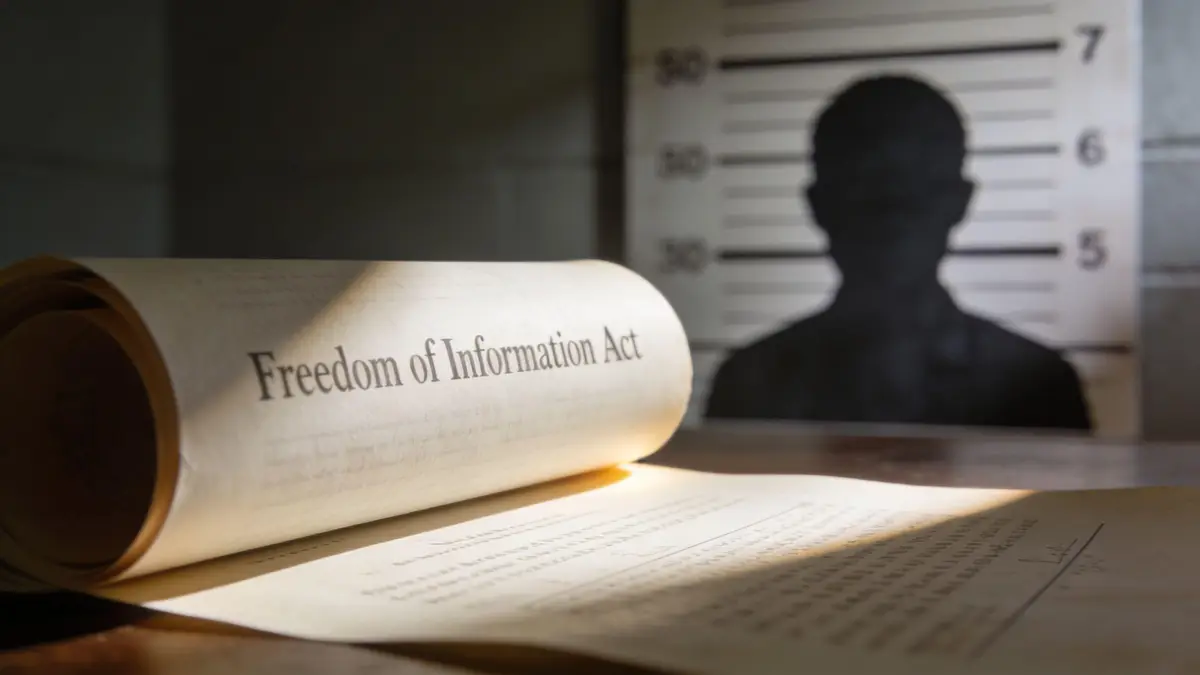
As of 2026, access still turns largely on state law, and many states continue to treat mugshots as presumptively public under their FOIA or public-records rules. The Reporters Committee for Freedom of the Press summary on mugshot access explains that several major states, including Alabama, Florida, Maryland, New York, Ohio, Texas, and Wyoming, classify booking photographs as records available for public inspection rather than records shielded by privacy exemptions.
Public does not mean uniform
General counsel and in-house communications teams often oversimplify this issue. They hear “public record” and assume the answer is settled everywhere. It is not.
North Carolina’s 2026 legislative session introduced Senate Bill 660, a proposal that would move mugshots away from automatic disclosure and toward discretionary release tied to sworn media affidavits. That kind of change matters because it shows the legal situation is shifting state by state, often in ways that create opportunity for a targeted response.
The harder problem is republication. Once a record leaves the agency source, different rules, incentives, and defenses come into play. This analysis of the evolving regulatory environment for mugshot sites in 2026 is useful because it frames the issue correctly for risk counsel. The core question is not just whether an agency could release the image. Rather, the question is which downstream publisher can still justify keeping it online, indexing it, and monetizing it.
The same public-shaming issue appears in law-enforcement social posting. For a legal critique of that practice, see these criminal defense insights on police shaming.
The real legal tension
Three legal interests collide here.
| Legal interest | What it protects | Why it matters here |
|---|---|---|
| Government transparency | Public oversight of arrests and law enforcement activity | Agencies often release booking information by default |
| Privacy and rehabilitation | Limiting unnecessary long-term harm from arrest records | Search visibility can keep an old booking photo commercially damaging for years |
| Media freedom | News reporting and archive rights | Republishing entities often claim editorial or archival protection |
Public disclosure at the source does not settle every downstream question. Search engines, aggregators, and archive sites changed the actual effect of release. A booking photo that once sat in a county file can now attach itself to investor diligence, board selection, counterpart risk reviews, and high-intent branded search queries.
That is the exposure executives need to understand. You are not dealing with one rule set. You are dealing with overlapping state record laws, publication defenses, platform policies, and removal standards across multiple jurisdictions. That is why a serious response requires legal analysis, search analysis, and jurisdiction-specific execution, not a generic takedown request.
The Digital Ecosystem Where Mugshots Proliferate
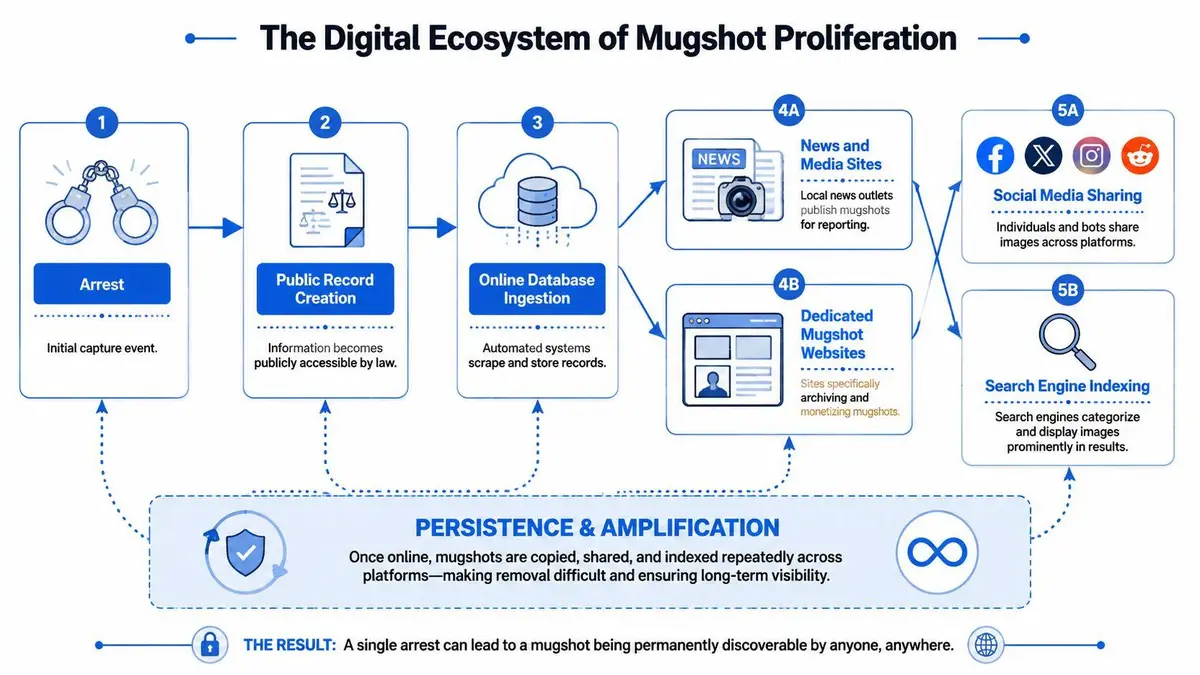
A mugshot rarely stays where it started. Once an arrest record enters the public stream, multiple systems ingest it, copy it, classify it, and republish it. That is why executives who remove one result often see five more appear.
California shows how the source layer works. Under the state’s public records framework, arrest records are broadly accessible public documents, and most California residents can search recent arrest logs through sheriff and police department websites at no cost, according to the California arrest records overview. That kind of open access creates the raw material for a much larger digital distribution chain.
The three publishers that matter
Most clients think they have a single website problem. They usually have three.
- Official law enforcement sources
These are sheriff portals, police logs, jail rosters, and agency databases. They are often the original publication point. If the jurisdiction makes arrest information broadly accessible, other sites can pull from them quickly. - Commercial mugshot aggregators
These operators scrape public records, normalize names and charges, and build searchable profiles around them. Some monetize attention directly. Others exist to capture search traffic and syndicate the content elsewhere. If you want a technical breakdown of that model, this professional analysis of how mugshot sites work is a useful primer. - News archives and local media
Local publishers often treat booking photos as routine crime coverage. Once archived, the content can rank for years. That’s one reason debates about police department “photo shaming” matter. These criminal defense insights on police shaming are worth reading because they capture the practical concern. Public safety messaging easily becomes reputational punishment.
Why this spreads so fast
The spread isn’t mysterious. It’s mechanical.
- Automated ingestion: Bots and scrapers monitor agency pages and public logs.
- Structured data reuse: Names, charges, dates, and images get reformatted into searchable pages.
- Search engine reinforcement: Once multiple sites carry the same image and text, search engines treat the record as highly relevant for branded queries.
A mugshot online is rarely a single publication. It’s a distributed content event.
That is why are mugshots public is the wrong endpoint for analysis. Public status explains the origin. It does not explain the persistence. Persistence comes from indexing, republication, and archive behavior across separate actors with separate incentives.
Why Simple Removal Fails The Challenge of Republication
Most self-help efforts fail for one reason. They target the visible result, not the ecosystem behind it.
A client finds a mugshot on one site and assumes that removing that page will solve the problem. It usually won’t. Even if that page disappears, the same image may still live on a county site, a local news article, a scraper database, an image index, and a cache layer you haven’t identified yet.
Law enforcement, media, and commercial actors play by different rules
Illinois provides a clean example of why this gets messy. Public Act 100-0927 restricts some law enforcement posting practices for minor offenses, but the Illinois Press Association discussion of the statute states there is “no prohibition in providing the mugshots to members of the news media”. It also says consumer fraud protections aimed at publish-for-pay mugshot sites “DO NOT APPLY TO THE NEWS MEDIA”.
That means a single image can sit under three distinct legal umbrellas at once:
| Publisher type | Typical leverage | Typical obstacle |
|---|---|---|
| Agency source | Public records law, sealing, expungement, policy requests | Agency may still classify the image as disclosable |
| News publisher | Editorial negotiation, accuracy arguments, archive policies | First Amendment and archive retention concerns |
| Commercial republisher | Consumer fraud statutes, platform policies, direct legal pressure | They may copy from multiple sources and reupload |
Why paying one site is often a mistake
Executives under pressure sometimes pay the first commercial site they find. That may remove one URL. It doesn’t solve the search environment.
A site that accepts payment may not control image copies on other domains. It may not control the news result ranking above it. It may not stop search engines from surfacing cached or alternate URLs, and if the source record remains public, new pages can appear later.
That is the whack-a-mole problem. You are not buying resolution. You are buying a temporary adjustment on one node in a network.
If the source remains accessible and republication channels remain active, isolated removal is just delay disguised as progress.
Search creates a second layer of harm
Even when the underlying page is weak, search engines can make it powerful. Image tabs, name associations, and autosuggest behavior can keep an old arrest artifact commercially toxic. That is why legal removal and search suppression have to be coordinated. One without the other leaves value on the table.
The hard truth is this. There is no universal “remove my mugshot” button. There are only separate legal and technical pressure points, and they need to be used in the right order.
A Strategic Framework for Mugshot Suppression and Removal
The right response is coordinated, multi-jurisdictional, and evidence-driven. Anything less leaves openings.
Start with source control. Then attack republication. Then stabilize search. If you reverse that order, you end up suppressing content that later resurfaces because the original publication path remained open.

Pillar one involves source-level action
If the original booking photo sits on an agency site or in an accessible public database, that source needs immediate review. The precise strategy depends on the jurisdiction, the status of the underlying case, and whether sealing, expungement, dismissal-related relief, or administrative correction is available.
This part is legal work, not public relations. You need the exact publication point, the governing records regime, and a clear theory for why the record should be withdrawn, restricted, corrected, or treated differently. Generic demand letters don’t move serious custodians.
A professional guide on how to get a mugshot removed for free is useful for understanding the basic routes people try. But executives should be realistic. Free methods can help in narrow cases. They don’t replace a coordinated strategy when reputation exposure is active.
Pillar two requires direct publisher negotiation
News organizations, aggregators, and archive operators each need different treatment. Some respond to demonstrated inaccuracies. Some will review changed case status. Some care about outdatedness. Others only respond when you understand their risk model and escalation path.
Weak outreach backfires. Aggressive but uninformed requests often entrench the publisher. Better practice is controlled engagement backed by documentation, jurisdictional analysis, and a clear ask.
For clients managing broader digital vulnerability, adjacent privacy tools can matter too. Resources on identity compartmentalization and alternative contact methods, such as this review of Strawberry.me Alternatives, can be relevant when you’re reducing discoverability around personal data trails that amplify search harm.
A number of firms operate in this space. ContentRemoval.com handles source removal, de-indexing, and ongoing monitoring in cases where a mugshot has spread across search engines, websites, and social platforms. That kind of integrated model is usually what this problem requires because legal action alone doesn’t control search behavior.
A short explanation of the operational side helps:
Pillar three is search suppression and continuity control
Even after successful removals, remnants can linger. Search results may still display old snippets. Image associations can persist. Secondary sites may republish from prior captures or archives.
So the final layer is technical. That means de-indexing where available, suppression campaigns for branded search terms, and continuous monitoring so new copies don’t gain traction unnoticed.
- Search remediation: Reduce the visibility of harmful pages and image results tied to your name.
- Monitoring: Track reuploads, new domains, and resurfacing in branded queries.
- Continuity control: Make sure a resolved issue doesn’t return during diligence, media scrutiny, or litigation.
This is not optional for senior operators. If your reputation matters to enterprise value, your response has to match the complexity of the threat.
Next Steps Protecting Your Executive Reputation
The question “are mugshots public” is legally interesting. It is not the decision that matters most to you now. The actual issue is whether a public record has become a durable search liability attached to your name, your company, and your commercial credibility.
That is manageable. But it requires speed, discretion, and a strategy built around the actual publishing chain.
What decisive clients do next
They stop guessing. They stop sending emotional emails. They stop assuming one takedown will solve a distributed problem. Instead, they assess the exposure in four parts: source publication, republication network, search visibility, and legal authority by jurisdiction.
That same mindset applies to broader privacy risk. If you’re tightening your overall exposure, practical resources on safeguarding your digital footprint can help your team reduce the personal-data signals that make reputational attacks easier to scale.
The fastest path to resolution is clarity. Identify every live asset, rank them by business risk, and act in the order that prevents recurrence.
The standard to hold your advisors to
If an advisor can’t explain the difference between source removal, republication control, and search suppression, they are not equipped for this problem. If they promise instant deletion everywhere, they are selling fantasy. If they ignore jurisdictional differences, they will waste your time.
You need an operator’s response. Quiet intake. Fast mapping. Credible legal analysis. Publisher outreach that doesn’t inflame the situation. Search control that protects the result after initial takedowns.
That is how this gets solved. Not perfectly in every instance, but decisively enough to protect a leadership profile, preserve optionality, and keep an old incident from dictating present value.
A confidential assessment with ContentRemoval.com is the practical next move if a mugshot, arrest image, or related search result is creating executive-level risk. The goal isn’t noise. It’s a clear action plan that identifies the source, maps republication, prioritizes legal and technical strategies, and moves quickly to reduce visibility with discretion.
Frequently asked questions
Can a mugshot be removed if it is a public record?
Often yes, at least from the places that matter. Public status at the agency source does not settle whether an aggregator, news archive or search engine must keep showing the image, and each of those has its own removal or de-indexing path. The article recommends working source control first, then republication, then search.
Why does my mugshot keep reappearing after I got one site to take it down?
Because a mugshot online is a distributed content event. Scrapers ingest agency pages, reformat names and charges into searchable profiles, and copy from each other, so removing one node leaves the rest of the network live and can let new pages appear later.
Which states treat mugshots as public records in 2026?
The Reporters Committee for Freedom of the Press summary cited in the article lists Alabama, Florida, Maryland, New York, Ohio, Texas and Wyoming among states that classify booking photographs as available for public inspection. Rules continue to shift state by state, as the North Carolina proposal shows.