
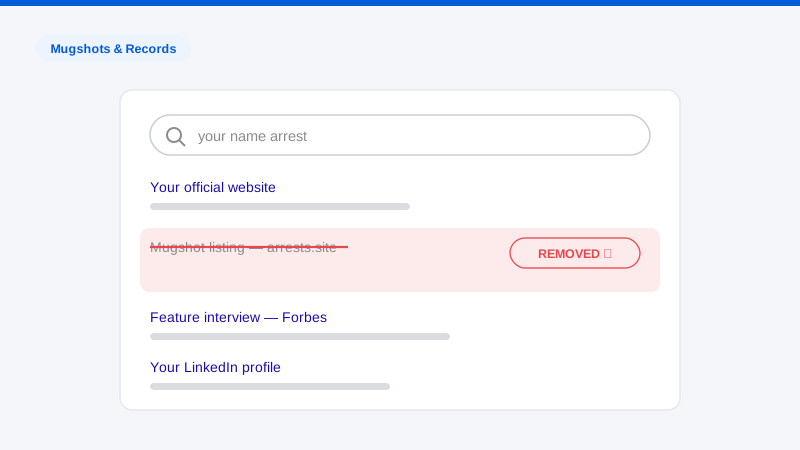
It is a strange thing to write as a company that removes mugshots for a living, but here it is: the suspicion behind the phrase “mugshot removal services scam” is well earned. This industry grew up in the shadow of the mugshot publishing business, and for years the two were, in too many cases, the same business wearing two hats, one hand posting booking photos, the other hand charging to take them down. If you have typed that search, you are asking exactly the right question before spending money, and you deserve a straight answer from inside the industry.
The straight answer is: no, mugshot removal services are not inherently a scam, legitimate firms remove content through legal grounds, platform policies, and documented process, and they get real, verifiable results. But yes, scams and extortion-adjacent operators are genuinely present in this market, they advertise aggressively, and they are hard to distinguish from legitimate firms if you do not know what to look for.
This guide is that field manual. We will explain how the exploitative side of the industry actually operates, what a legitimate removal practice does differently, and give you a concrete vetting checklist, including the questions that make a bad operator squirm.
Where the mugshot removal services scam reputation comes from
The original sin: publish-and-charge
The commercial mugshot industry was built on a simple loop: scrape booking photos and arrest data in bulk from sheriff and police websites, publish them on ad-supported pages optimized to rank for people’s names, and then charge the humiliated subjects a fee to “unpublish.” When one site’s fee was paid, the photo would often surface on an affiliated or copycat domain, and the meter started again. Whether or not any individual operator met the legal definition of extortion, the business model was functionally indistinguishable from it: manufacture the harm, sell the relief.
The backlash was real. A significant number of states passed laws prohibiting sites from charging removal fees or requiring free removal of expunged and non-conviction records. Google introduced policies allowing de-indexing of sites with exploitative removal practices, and payment processors squeezed the pay-to-remove model. The industry did not disappear. It adapted, moved some operations offshore, and got subtler.
The gray middle: removal services with undisclosed ties
The second-generation problem is the removal service that is quietly connected to the publishing network, or that simply pays the sites’ fees on your behalf and marks them up. From the outside it looks like a miracle: instant, guaranteed removal from specific sites. From the inside, your money is flowing to the ecosystem that published you, your name may be flagged as a payer, and nothing prevents reappearance. This is the specific trap the word “scam” should make you think of, because it is far more common than outright theft.
The merely bad: overpromisers and abandoners
The third category is not corrupt, just poor: operators who charge large upfront retainers, send one templated email per site, and go quiet when anything resists. They technically performed “services.” You technically got nothing. In a field where clients are embarrassed and rarely want to litigate or leave reviews under their own names, low-effort operators survive longer than they would in any other market. The vetting checklist later in this guide is designed to filter out this tier just as much as the outright frauds, because from the client’s chair, paying for nothing and being defrauded feel identical.
What legitimate mugshot removal actually looks like
Against that backdrop, here is what the honest version of this work involves, and it is the standard you should hold any provider to, including us.
Removal through grounds, not payments. A legitimate firm compels removal using leverage that exists independent of the mugshot site’s goodwill: state statutes requiring removal of expunged, sealed, or non-conviction records; platform and search engine policies (including Google’s exploitative-practices policy, which lets qualifying sites be de-indexed precisely because they charge for removal); hosting provider and registrar terms of service; and documented negotiation for targets like news archives. Money flows to the practitioner for their work, never to the publisher for the takedown. Our approach is laid out step by step on our process page.
Performance-based pricing. The clean structural answer to this industry’s trust problem is pay-after-removal: fees contingent on results, itemized per target, with nothing owed for failures. A firm confident in its methods can carry that risk. A firm that cannot is telling you something. This is how our mugshot removal engagements are priced, and we consider it the minimum standard for the field.
Honest triage. Real practitioners decline targets. A news article about a recent, serious conviction is unlikely to come down, and an honest firm says so before taking your money, then talks about what is achievable instead, such as statutory removals from aggregators, search de-indexing where policies apply, and suppression for what remains. The willingness to say “this one probably stays up” is one of the most reliable legitimacy signals in this industry.
Verifiable results. Removals are checkable facts. The photo is on the site or it is not; the result is in Google or it is not. A legitimate firm reports target-by-target status you can confirm yourself in an incognito window, and stands behind reappearance with monitoring or re-removal terms, the logic behind ongoing protection plans.
How to vet a mugshot removal service: the checklist
Run any provider through these filters before signing:
- Corporate reality. A named legal entity, verifiable address, real people, and operating history. Scam operators in this niche are habitually anonymous and disposable.
- Pricing structure. Itemized, per-target, and performance-based or refund-backed. Walk away from large non-refundable upfront retainers and from any price quoted before anyone has audited your actual exposure.
- Method transparency. They should be able to explain, in plain language, on what grounds each target will be removed. “We have relationships” and “proprietary methods” with no further detail are non-answers.
- No payments to publishers. Ask directly whether any part of your fee goes to the sites hosting the photo, in any form. The only acceptable answer is no.
- Willingness to lose. Ask which of your targets they expect to fail on. Honest firms have an answer; scams insist everything is easy.
- No fake legal authority. Removal firms are not law firms unless they actually are one. A provider that offers legal conclusions about your record, rather than telling you to consult an attorney about expungement or sealing, is practicing outside its lane, and that recklessness will show up elsewhere in the engagement.
- Realistic timelines. Days-to-weeks per target depending on grounds, not “everything gone in 24 hours.”
Questions that make a bad operator squirm
Use these verbatim in your first call:
- “Do you pay removal fees to any mugshot site, directly or through an intermediary?”
- “For each site on my list, what specific legal ground or platform policy will you rely on?”
- “What do I owe you for a site you fail to remove?”
- “Which of my targets do you expect not to come down, and why?”
- “If the photo reappears on a new domain in six months, what happens and what does it cost?”
- “Can you point me to the state statutes or Google policies you’d be using, so I can read them myself?”
A legitimate practitioner answers all six comfortably, these are our normal working vocabulary. Evasion, hedging, or irritation at any of them is your signal to leave. Pay particular attention to question four: it is the cheapest diligence test in this industry, because a firm that has actually run hundreds of campaigns has losses to describe, and a firm that claims a perfect record is either brand new or lying about its history.
Step by step: what to do if you suspect you’re dealing with a scam
If you are mid-engagement and something feels wrong, or a site itself is demanding payment, here is the sequence:
- Stop payments. Do not send more money to a site charging for removal or a service that cannot document its work. If a site is charging a removal fee, note that several states prohibit exactly that practice; an attorney can tell you what applies in your jurisdiction.
- Preserve evidence. Screenshot the pages, the fee demands, the correspondence, and any promises made. Documented pay-to-remove demands are useful. They are the basis of search engine de-indexing requests under exploitative-practices policies.
- Verify claimed removals yourself. Incognito window, your name, web and image search. Anything a service claims to have removed should be independently checkable.
- Reclaim the free pathways. Expungement-based statutory demands, Google’s removal request forms, and outdated-content refresh requests cost nothing and remain available to you regardless of what a bad vendor did or did not do. Our guide to removing yourself from Google covers what individuals can file directly.
- Report where it matters. State attorney general consumer-protection offices and the FTC take complaints about pay-to-remove practices and fraudulent reputation services. Reports build the record that has driven this industry’s legal squeeze.
- Re-scope with a legitimate provider, or DIY. Get a fresh, itemized, performance-based assessment of what remains. Simple exposures with strong grounds are genuinely doable yourself; scale and resistance are where professionals earn fees.
The strategic view for executives
If you hold a leadership role, the calculus has an extra layer: the cost of engaging a bad vendor is not just wasted money but compounding exposure. Paying a publishing network flags a high-value target. A botched campaign can leave the record more visible mid-search than before, and a vendor breach or disclosure adds a second reputational story to the first. Treat removal vendor selection like any other sensitive procurement: verify the entity, demand method transparency and performance pricing, involve counsel where legal instruments (expungement, sealing, court orders) are in play, and insist on reporting you can independently verify. The mugshot itself is usually a solvable problem; the vendor risk is only a problem if you skip diligence.
Frequently asked questions
Are all mugshot removal services a scam?
No. Legitimate firms remove mugshots through statutory demands, platform and search engine policies, hosting escalation, and negotiation, with verifiable, checkable results and performance-based pricing. But exploitative operators are genuinely present in this market, including services with undisclosed ties to the publishing networks. The distinction is method and pricing structure, which is why vetting matters more here than in most industries.
How do I know if a removal service is connected to the mugshot sites?
You usually cannot prove it from the outside, so test for it structurally. Ask directly whether any fee flows to publishers, be suspicious of instant guaranteed removal from specific named sites, and note whether the provider’s methods rely on grounds you can verify (statutes, policies) or on unexplained “relationships.” Instant success on exactly the sites that charge removal fees is the classic tell.
Is it illegal for mugshot websites to charge removal fees?
In a number of states, yes, statutes prohibit charging for removal or mandate free removal of expunged and non-conviction records, and pay-to-remove practices have drawn regulatory action. Whether a specific site’s demand violates the law of your state is a question for an attorney. Practically, a documented fee demand is also evidence supporting search engine de-indexing under exploitative-practices policies.
What results can a legitimate service honestly promise?
Honest framing: removals with clear-cut grounds (expunged or sealed records under state statutes, sites violating platform policies, exploitative pay-to-remove sites) succeed at high rates. Editorial and news content is harder and outcome-uncertain. A legitimate firm promises its process, its effort, and its pricing terms; it does not promise unconditional outcomes on content controlled by third parties, and anyone who does is your red flag.
If you want a second opinion before hiring anyone, including us, start with facts instead of promises. Our free exposure scan maps every copy of the record we can find, identifies the removal grounds for each target, and gives you an itemized, performance-based assessment. You pay when content comes down, and you can verify every result yourself.