
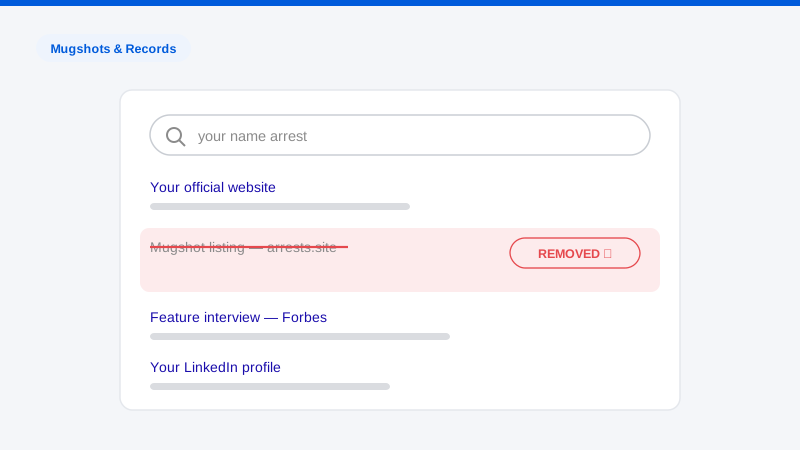
Search for “guaranteed mugshot removal” and you will find dozens of companies promising to make an arrest photo vanish: completely, permanently, sometimes “within 48 hours.” As a firm that files mugshot takedowns every working day, we can tell you that some of those promises are legitimate and enforceable, and others are marketing language stretched past its breaking point. The difference matters, because you are about to pay someone real money based on which kind of promise they are making.
Here is the honest version up front: no one on earth can guarantee that every third-party website will comply with every removal request. What a professional firm can guarantee is its pricing structure, specifically, that you pay only when a removal actually happens. That model, called performance-based or pay-after-removal pricing, is the industry’s honest answer to the word “guaranteed,” and it is the standard you should hold any provider to.
This guide explains how guaranteed mugshot removal works when it is done properly, which guarantees are real, which are red flags, and how to evaluate an offer before you sign anything.
What “guaranteed mugshot removal” actually means
When a legitimate firm uses the word “guaranteed,” it is describing one of three specific commitments:
- A pricing guarantee. You are charged per successful removal, or your fee is refunded for any site where removal fails. The risk sits with the firm, not with you.
- A rights-based guarantee. In certain situations, most commonly when a record has been expunged or sealed, many states give you enforceable legal grounds to demand removal, and a firm can commit to pursuing those grounds to completion. Roughly twenty states have passed laws restricting commercial mugshot publication or requiring removal after expungement, and where those statutes apply, outcomes are highly predictable.
- An effort and process guarantee. The firm commits to a defined workflow: identifying every copy of the image, submitting removal demands on proper grounds, escalating to hosting providers and search engines, and reporting results.
What “guaranteed” can never honestly mean is absolute control over websites the firm does not own. Mugshot sites, data brokers, and search engines are independent entities. A professional can compel or persuade them using legal grounds, platform policies, and persistence (and with mugshots specifically, success rates on clear-cut grounds are genuinely high) but the mechanism is leverage, not magic. Any company that claims it can delete anything from anywhere, no exceptions, is describing a power it does not have.
If you want to understand how we structure this work, our mugshot removal service is built entirely around the performance model described below.
How performance-based pricing works
Performance-based deletion is the honest implementation of guaranteed mugshot removal. The structure is simple: the fee is tied to the outcome, not the attempt.
Pay-after-removal
Under a pure pay-after-removal arrangement, the firm audits your exposure, quotes a price per site or per record, does the work, and invoices you only for the removals it actually completes. If a site refuses and the firm cannot force the issue, you owe nothing for that site. This aligns incentives perfectly: the firm only takes on cases it believes it can win, and it tells you honestly when a target is unlikely to come down.
Flat fee with a removal-or-refund clause
Some engagements are priced as a flat project fee with a contractual clause refunding the portion attributable to any failed removal. This is functionally similar to pay-after-removal, but read the refund terms carefully: the refund should be automatic and defined per site, not discretionary.
What the quote should be based on
A serious firm quotes after an audit, not before. The price of a mugshot removal campaign depends on how many sites republished the record, whether the underlying arrest was dismissed or expunged, which states’ laws apply, and whether the image has spread into search results, image search, and data broker profiles. A company that quotes a single flat price before it has seen your search results is guessing, and guessing is not a foundation for a guarantee. Our process starts with a full exposure audit for exactly this reason.
What can genuinely be guaranteed
Expungement-based removal rights
This is the strongest guarantee in the entire field. If your record has been expunged, sealed, or the charges were dismissed, many states require commercial mugshot websites to remove the photo on request. Some within a defined statutory window, some with penalties for non-compliance. When those laws apply, a removal demand is not a favor being asked; it is a legal obligation being enforced. Firms that handle these cases daily can commit to outcomes with real confidence, because the site’s alternative is legal exposure.
We are not attorneys and this is not legal advice, whether your record qualifies for expungement, and what your state’s statute requires, are questions for a licensed attorney in your jurisdiction. But once an expungement exists, using it as removal leverage is process work, and it is the closest thing to a sure outcome this industry has. Where court documents or legal orders are involved, our legal content removal practice coordinates directly with your counsel.
Policy-violation removals
Many mugshot postings violate the stated policies of the platforms hosting or indexing them. Search engines have specific pathways for content like this: for example, Google’s policy allows removal requests for images on sites that charge for takedown, an exploitative-removal-practices policy aimed squarely at the mugshot industry. When a target clearly violates a written policy, removal is a matter of documenting the violation correctly and filing through the right channel. Experienced filers can guarantee the filing will be done properly and pursued to a decision; the decision itself belongs to the platform, but clear-cut violations succeed at high rates.
The firm’s own conduct
A legitimate provider guarantees its own behavior without hesitation: a defined scope, itemized targets, regular reporting, no charge for failed removals, and no long-term contract you cannot exit. If a company will not put those terms in writing, that tells you what its “guarantee” is worth.
What no one can guarantee, and why that is fine
Being honest about limits is not a weakness; it is how you identify a firm that will still be answering your emails in month three.
- Editorial and news content. A newspaper’s arrest report is not a mugshot site. News organizations have editorial discretion and legal protections, and removal or updating is a negotiation, not a demand. Success is possible, especially for dismissed charges under updated-content policies, but it cannot be promised in advance.
- Permanent non-republication. A removed mugshot can theoretically be scraped and reposted by a new site later. Professionals mitigate this with monitoring, but no one controls future publication by parties that do not exist yet. Ask how the firm handles reappearance, ongoing protection plans exist for precisely this reason.
- Instant timelines. Statutory windows, platform review queues, and site response times are real. “Guaranteed removal in 24 hours” across all sites is not a promise anyone can keep; typical campaigns resolve over days to weeks per target, and a firm should tell you that.
Red flags: how to spot a hollow guarantee
After years in this field, these are the warning signs we tell every prospective client to watch for:
- 100% guarantees with no conditions. “We remove anything from anywhere, guaranteed” is the single most reliable indicator of a company that either overpromises or operates on the shady side of the industry.
- Full payment up front with no performance terms. If the entire fee is due before any work happens and the contract contains no refund-per-failure clause, the “guarantee” is a slogan.
- No audit before the quote. Real pricing follows discovery. A one-size price quoted in the first phone call means the company has not looked at your actual exposure.
- Suspicious ties to the mugshot sites themselves. Parts of this industry have historically involved removal services connected to the very networks publishing the photos. If a company can get a specific site to remove your photo instantly for a fee, ask yourself how that relationship works. (We cover this dynamic in depth in our guide to evaluating whether mugshot removal services are a scam.)
- Pressure tactics and countdown clocks. Your mugshot has been online for months; a legitimate firm does not need you to decide in the next ten minutes.
- Guaranteed Google deletion. Google removes results under its policies or upon source removal. A firm can achieve de-indexing through proper channels, but “we control Google” is not a claim any honest practitioner makes.
Step by step: how to evaluate a guaranteed mugshot removal offer
Before you engage any provider, including us, walk through this checklist:
- Map your own exposure first. Search your name in a private browser window, check image results, and note every site displaying the mugshot. You cannot evaluate a quote without knowing the target list.
- Confirm your legal posture. Was the charge dismissed? Is the record eligible for expungement or sealing? Consult an attorney if you are unsure. An expungement can convert a persuasion campaign into an enforcement campaign, which changes both cost and certainty.
- Demand an itemized, per-site quote. Each target site should have a price and a status. Lump-sum quotes hide which removals are actually achievable.
- Ask exactly what “guaranteed” means in the contract. Get the answer in writing: Is payment contingent on removal? Is there a per-site refund? What happens if a site refuses?
- Ask about the hard targets. Say: “Which of these sites do you expect not to come down, and why?” An honest firm has an answer. A dishonest one insists everything is easy.
- Ask about reappearance. What happens if the image resurfaces in six months? Monitoring, re-removal terms, and cost should be defined now, not later.
- Check independent reputation. Look for a real business entity, a physical presence, verifiable reviews, and tenure. Fly-by-night operators dominate this niche’s advertising.
Why expungement changes the guarantee math
It is worth dwelling on this, because it is the most under-used lever in mugshot removal. An arrest photo’s persistence online usually outlives the legal case by years. Yet in many states, once a record is expunged or sealed, commercial mugshot sites lose their footing entirely: statutes in a substantial number of states either prohibit charging for removal, require removal of expunged records on request, or both.
Practically, that means the sequence matters. If you are eligible for expungement, pursuing it first (through an attorney) and then running the removal campaign produces dramatically more certain results than attacking the websites cold. The removal demand letter that cites a sealing order and a state statute gets a different reception than one that appeals to decency. This is where “guaranteed” stops being a marketing word and starts being a description of legal reality, and it is why our intake always asks about case disposition before anything else.
Frequently asked questions
Is guaranteed mugshot removal actually possible?
Yes, in the specific sense that matters: a firm can guarantee you pay only for successful removals, and where expungement statutes or platform policies apply, outcomes are highly predictable. What is not possible is an unconditional guarantee covering every website in existence. Judge providers by whether their guarantee is contractual and performance-based, not by how absolute the marketing sounds.
How long does guaranteed mugshot removal take?
It varies by target. Sites subject to state removal statutes often comply within the statutory window once properly noticed. Platform-policy removals (such as search engine de-indexing of exploitative sites) typically resolve in days to a few weeks. Negotiated removals from news or editorial sources can take longer. A campaign covering multiple sites usually resolves in phases rather than all at once.
Should I just pay the mugshot website’s own removal fee?
We strongly advise against it. Paying one site in a network frequently signals that you are willing to pay, and the photo can then surface on affiliated sites. Several states have also made charging for mugshot removal unlawful. Professional removal works through legal grounds and platform policies rather than feeding the ecosystem that published the photo.
What if my charges were never expunged?
You still have options. Many removals succeed on platform-policy grounds, publication-practice violations, or negotiation, expungement is the strongest lever, not the only one. It is also worth asking an attorney whether you are eligible for expungement or sealing now; eligibility rules have loosened in many states in recent years.
If a mugshot is affecting your career, relationships, or peace of mind, the first step costs nothing: find out exactly where the image appears and what grounds exist to remove it. Request a free exposure scan and we will map every copy of the record we can find, tell you honestly which ones we can remove, and quote on a performance basis. You pay when it comes down.