
Filing a slander lawsuit requires proving four elements: a false statement of fact, communication to at least one third party, the required level of fault, and resulting harm. Public figures must also prove actual malice. Before filing, preserve evidence, build a damages file and consider a pre-suit demand, since a public complaint can amplify the accusation.
Key facts
- Publication can be satisfied by a statement made to a single third party such as a client or board member.
- Public figures must prove actual malice: knowledge of falsity or reckless disregard for the truth.
- Florida Statute 770.01 requires five days’ written notice to media defendants before filing.
- Common defenses are truth, opinion, privilege and no provable harm.
Where ContentRemoval.com comes in. ContentRemoval.com works alongside litigation counsel, or instead of a filing, when the priority is to stop a false accusation spreading online rather than to win a judgment a year from now: source removal, de-indexing and suppression of the posts, clips and threads where the claim is being repeated. General counsel or the executive’s own lawyer usually makes contact. A free, confidential 15-minute Exposure Scan maps what is removable, and the report is yours to keep. Get a Free, Confidential Exposure Scan or read how our defamation removal work is done.
A false accusation rarely arrives at a convenient moment. It lands while you’re running a company, negotiating a transaction, managing investors, protecting a family name, or trying to keep a controversy from metastasizing online. Someone says you committed fraud, abused a client, stole money, lied to a board, or engaged in criminal conduct. The statement starts as speech, then gets repeated in texts, meetings, social posts, and whisper networks.
At that point, the question usually isn’t moral. It’s strategic. You want to know whether you can sue, whether you should sue, how exposed the other side really is, and whether litigation will fix the problem or make it louder.
Knowing how to file a slander lawsuit matters. Knowing when not to file matters more. Slander cases can work, but only when the facts, evidence, forum, and timing align. Otherwise, you spend heavily to publicize the accusation in a court file, invite procedural attacks, and still struggle to remove the underlying harm.
Determining if You Have a Viable Slander Case
The first pass is cold, not emotional. Being offended, humiliated, or privately certain the speaker lied doesn’t create a legal claim by itself. A slander case survives only if it can be pleaded and proved with precision.

Under the legal standards summarized here, a plaintiff must establish four mandatory elements. The statement must be false, it must have been communicated to at least one third party, the speaker must have acted with the required level of fault, and the statement must have caused harm. If you’re a public figure, or the dispute touches a public matter, the burden rises to actual malice, meaning you must prove the defendant knew the statement was false or acted with reckless disregard for the truth.
Fact versus opinion
Most failed slander claims collapse here. Courts don’t punish every nasty remark. They look for a false statement of fact, not rhetorical abuse, loose opinion, or vague insult.
If someone says, “I think he’s unethical,” that’s usually not enough. If someone says, “He stole client escrow funds last year,” that’s different. One is evaluative. The other is verifiable.
A practical screening test helps:
- Can the statement be proved true or false: If yes, you’re closer to actionable territory.
- Was it specific: The more concrete the accusation, the stronger the claim.
- Did context signal opinion or reporting of fact: Courts examine the setting, wording, and whether an audience would understand the statement as factual.
For related issues involving written accusations, this guide to written defamation and content removal is useful because many real disputes involve both spoken and written repetition.
Practical rule: If the accusation sounds like something a forensic accountant, HR investigator, or prosecutor could verify, treat it as potentially actionable. If it sounds like pure commentary, don’t build your strategy around outrage.
Publication fault and harm
Slander requires publication, but that doesn’t mean a mass audience. Communication to a single third party can satisfy the element. A false accusation whispered to a board member, a prospective employer, a lender, a spouse, or a key client can be enough.
Fault is where knowledgeable plaintiffs often underestimate the challenge. Private individuals may proceed on negligence. Public figures face the actual malice standard, and that’s a steep climb. You need evidence of what the speaker knew, ignored, or deliberately avoided when making the statement.
Harm must also be grounded in reality. If the accusation cost you a contract, triggered termination, caused clients to leave, or damaged a financing process, the case strengthens. If the damage is real but difficult to quantify, that doesn’t kill the claim, but it affects bargaining power, settlement posture, and whether the economics of litigation make sense.
A viable case isn’t the same as a satisfying case. It means the claim can survive scrutiny on paper, under oath, and under attack.
Preserving Evidence Before It Vanishes
Slander cases are won or lost before the complaint is filed. Spoken defamation is fleeting. The words disappear. Memories shift. Witnesses become cautious. Digital traces get deleted. The side that preserves evidence first controls the early terrain.
According to this discussion of internet defamation evidence and filing requirements, plaintiffs need dated copies of statements, witness testimony, and proof of falsity. The same source warns that a common failure point is not preserving online content before it disappears, and notes that in Florida, Statute § 770.01 requires five days’ written notice to media defendants before filing.
What to capture immediately
If you’re dealing with spoken accusations, don’t wait for a tidy legal plan. Build a record at once.
- Memorialize the statement precisely. Write down the exact words as best you can, who said them, where, when, and who heard them. Precision matters more than outrage.
- Identify every witness early. Get names, roles, and contact details while memories are fresh. Don’t coach them. Don’t draft their testimony for them. Just preserve who heard what.
- Document falsity with hard records. Contracts, compliance files, bank records, HR records, travel logs, board materials, audit findings, and internal communications often matter more than emotional testimony.
What sophisticated plaintiffs often do wrong
The worst mistake is warning the speaker too early without first locking down proof. Once accused parties realize exposure is coming, they delete posts, scrub accounts, “clarify” what they supposedly meant, and contact witnesses.
Preserve first. Confront later.
Another mistake is keeping evidence in a casual folder without chain-of-events logic. Courts and opposing counsel look for chronology. Your legal team needs a timeline showing statement, publication, falsity, fallout, and subsequent repetition.
Use a working evidence matrix like this:
| Evidence type | What to save | Why it matters |
|---|---|---|
| Spoken statement record | Date, time, location, exact words, audience | Anchors the claim |
| Digital captures | Screenshots, recordings, URLs, message exports | Preserves publication |
| Falsity proof | Business records, contracts, emails, internal reports | Rebutts truth defense |
| Harm record | Lost deals, cancellations, termination records, medical documentation where applicable | Supports damages |
Build the damages file now
High-value plaintiffs often focus on principle and neglect damages until much later. That’s backwards. Start a dedicated file for client losses, canceled appearances, withdrawn offers, financing complications, internal remediation costs, and professional fallout.
If the accusation spread online, preserve the pages you don’t control first. Those are the ones most likely to vanish. Your own site, inbox, and devices can be revisited. Third-party content may be gone tomorrow.
The Pre-Suit Demand and Strategic Alternatives
Your general counsel gets a call at 7:30 a.m. A competitor has been telling clients you falsified numbers, and one of those clients now wants “clarification” before renewing. Filing suit that afternoon may feel decisive. In many cases, it is the slower, louder, and more expensive move.
A pre-suit demand is often the better first tool because it tests whether the matter can be contained before you hand the accusation a public docket number.

The broader civil system resolves most disputes short of trial. The U.S. Courts overview of civil cases explains that parties often end cases through settlement, dismissal, or other pretrial resolution. In defamation work, that matters because a well-built demand can get a retraction, secure preservation, and stop repetition without inviting the cost and exposure that come with a filed complaint. It can also satisfy notice requirements that apply in some jurisdictions and for some defendants.
What a serious demand letter is designed to accomplish
A strong demand letter is a pressure document, not a performance piece. It gives the recipient and their counsel a clear choice. Correct the record now under controlled conditions, or defend a claim with a documented history of notice, continued publication, and potential malice.
That letter should do four jobs at once:
- Pin down the statement: Quote or describe the words with enough precision that the recipient cannot pretend the complaint is vague.
- Show why the statement is false: Attach or reference the records that matter, but do not dump your full file if doing so gives away unnecessary advantages.
- Demand concrete action: Retraction, correction, deletion where possible, non-repetition, and preservation of relevant evidence.
- Create a record: If the defendant repeats the allegation after notice, that fact can matter later on fault, damages, and injunctive strategy where available.
The trade-off is real. The more detail you provide, the more credible the demand becomes. You also educate the other side about your case. Good pre-suit letters are usually selective. They disclose enough to force a serious response and hold back enough to preserve an advantage.
When sending a demand is a mistake
Some defendants should not be warned.
If the speaker is anonymous, impulsive, ideologically motivated, or likely to post your letter online for attention, a demand can trigger fresh publication. I have seen private disputes become wider reputation events because the target’s first move gave the speaker a new story to sell. The legal claim may still be strong. The business result gets worse.
That problem appears often when spoken accusations spill into posts, clips, comments, or coordinated harassment. In that setting, legal action is only one part of the response. A strategic response guide for slander on social media is useful because the fastest path to reducing harm may involve platform reporting, targeted removal work, and controlled communications rather than an immediate complaint.
A short visual explainer can help clarify the decision path before litigation escalates:
> Some clients want a judgment. Others want the statement to stop circulating by the end of the week. Those objectives point to different tactics.The strategic alternatives high-value plaintiffs should weigh first
For founders, executives, physicians, investors, and public figures, the right question is usually narrower than “Do I have a case?” The better question is “Which option reduces reputational harm fastest at an acceptable cost and risk?”
Litigation is the nuclear option. It creates process, subpoena power, and settlement pressure. It also creates visibility. Complaints are public. Hearings are public. Discovery can pull in emails, text messages, board communications, and personal records that discerning plaintiffs would rather keep out of the fight. Even a win can keep the accusation alive for a year or more.
That is why I often assess pre-suit options on a business timeline, not just a legal one. A discreet demand may solve the problem. A targeted removal or suppression campaign may reduce search visibility and audience reach faster than a court can hear a motion. A carefully drafted rebuttal, delivered to the right counterparties and no one else, may stop deal fallout without broadening the audience.
Use the remedy that fits the objective. If the priority is money damages, deterrence, or compelled discovery, suit may be justified. If the priority is speed, privacy, and containment, a demand backed by non-litigation reputation work often makes more sense.
Executing the Lawsuit Filing and Initial Motions
Once pre-suit efforts fail, the case turns technical. Filing a slander action isn’t about telling your story compellingly. It’s about pleading facts with enough specificity that the court doesn’t dismiss the complaint before discovery begins.
The procedural risk of self-representation is severe. Data summarized here on self-represented litigants shows that pro se civil litigants lose 90 to 95 percent of their cases. In defamation matters, the same source states that only 2% of pro se defamation claims survive summary judgment, compared with 25% for litigants with counsel.
Drafting the complaint correctly
A slander complaint has to do more than accuse the defendant of lying. It should identify, with as much precision as possible, the actual words spoken, the date or approximate date, the audience, why the statement was false, the level of fault, and the harm that followed.
That sounds straightforward until you draft it. Plaintiffs often know the gist but not the wording. They know business suffered but haven’t connected the dots tightly enough. They know the statement was malicious but have no pleaded facts showing knowledge or recklessness.
A competent complaint usually includes:
- The statement itself: As close to verbatim as possible.
- Publication details: Who heard it, where it happened, how it spread.
- Falsity allegations: Not conclusions, but facts.
- Damage allegations: Economic, professional, and reputational consequences tied to the statement.
Courts dismiss defamation claims that sound plausible in conversation but are pleaded vaguely on paper.
Choosing forum and serving the defendant
Jurisdiction and venue are not housekeeping issues. They influence timing, motion practice, and strategic advantage. If the statement crossed state lines, was repeated online, or involved a media defendant, the forum analysis gets more complicated quickly.
Then comes service. If the defendant is obvious and local, service is usually routine. If the defendant used burner accounts, pseudonyms, third-party platforms, or intermediaries, you may need subpoenas and early motion practice just to identify who you’re suing.
For readers evaluating whether to retain specialized counsel before filing, this strategic guide to an internet defamation attorney consultation addresses the threshold questions that should be answered before a complaint goes out the door.
Expect an early attack
Defendants in slander suits rarely answer meekly and move on. They attack the complaint. They challenge falsity, argue opinion, deny damages, contest jurisdiction, and test whether your pleading is specific enough to survive.
That means the opening filing has to be built for combat, not optimism. A weak complaint doesn’t buy you time. It invites dismissal, emboldens the defendant, and weakens settlement advantage before the main case even begins.
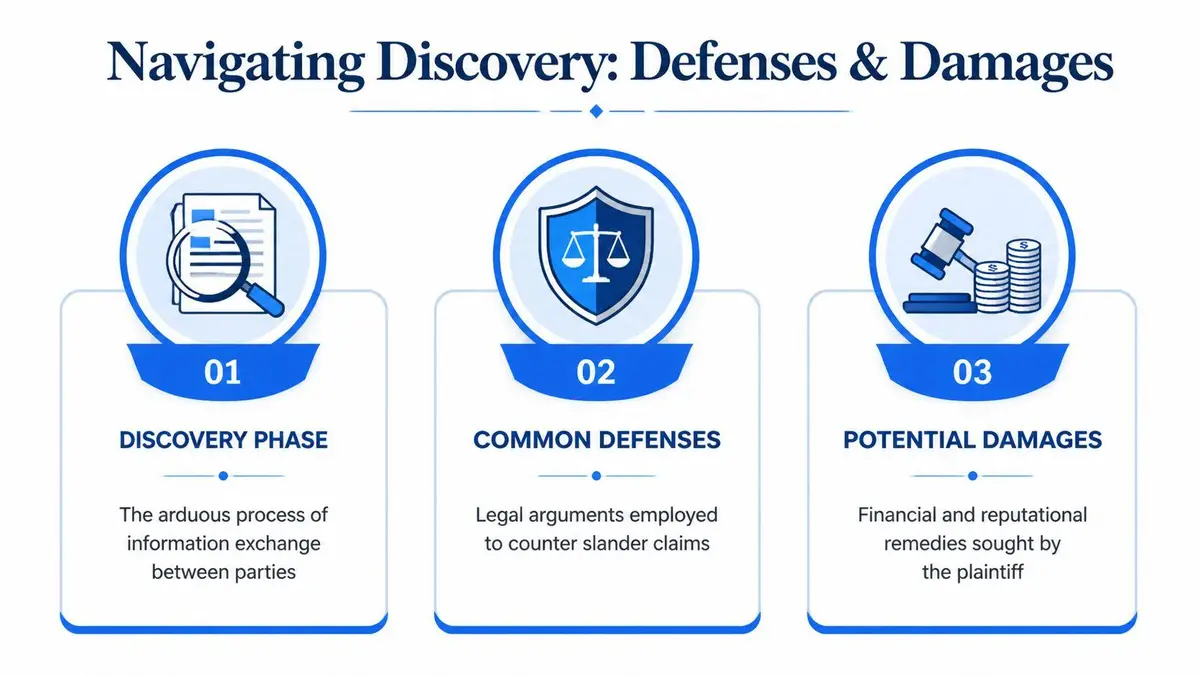
Navigating Discovery Defenses and Damages
Most clients think filing the lawsuit is the hard part. It isn’t. Filing is the entry ticket. Discovery is where cost, exposure, and endurance start to matter.
Once the complaint survives, both sides demand documents, communications, notes, recordings, calendars, phone records, and business files. Witnesses sit for depositions. Executives get asked what they knew, when they knew it, and how the accusation affected their work, relationships, and finances. If your reputation is central to the claim, your reputation becomes a subject of inquiry.
What discovery actually looks like
The process is not elegant. It is repetitive, intrusive, and expensive. Your side asks for everything supporting truth, source materials, communications with third parties, and evidence showing the defendant knew the statement was false or didn’t care whether it was true. The defense asks for your damages support, internal discussions, prior reputation issues, business losses, and any document that could weaken causation.
A simple way to view it:
| Discovery tool | What it targets | Why it matters |
|---|---|---|
| Document requests | Emails, texts, notes, contracts, recordings | Tests truth, falsity, and damages |
| Interrogatories | Written factual explanations | Locks parties into positions |
| Depositions | Testimony under oath | Exposes inconsistencies and credibility gaps |
The defenses that matter most
Most defendants don’t argue, “Yes, I lied.” They choose from a narrower set of defenses that often work if the plaintiff’s case wasn’t built carefully from the start.
- Truth: If the substance of the accusation is true, the case usually collapses.
- Opinion: Defendants recast factual accusations as impression, commentary, or interpretation.
- Privilege: Certain contexts protect speakers more than clients expect.
- No provable harm: The defense argues the statement changed nothing measurable.
Each defense changes what your legal team has to prove. Truth turns the case into a factual investigation. Opinion turns it into a context fight. Privilege creates a threshold legal shield. Weak damages reduce settlement value even when liability is arguable.
A slander plaintiff doesn’t just prove falsity. The plaintiff must also survive the defendant’s reframing of the statement into something legally protected or practically harmless.
Anonymous speakers cross-border problems and AI contamination
Modern defamation cases are harder than the classic model of one speaker, one audience, one forum. This discussion of slander litigation challenges reports that “John Doe” suits face a 65% dismissal rate pre-discovery, that cross-border claims have risen by 40%, and that AI-generated slander surged 300% in 2025. The same source states that faster non-litigious takedown solutions succeed in over 85% of cases.
Those figures reflect what practitioners already see on the ground. Anonymous online speakers force plaintiffs into preliminary identification battles before merits discovery even begins. Cross-border publication creates service problems, jurisdiction disputes, and inconsistent platform behavior. AI-generated voice, image, and text content complicates fault because you may know the content is false without yet knowing who created or amplified it.
In those cases, the classic slander lawsuit can become a poor fit for the immediate objective. You may eventually litigate, but first you need attribution, preservation, and containment.
What a win really looks like
Clients often picture a clean courtroom vindication. Real outcomes are messier. Relief may come through settlement, retraction, monetary payment, non-disparagement terms, and quiet exit provisions. If the case reaches judgment, damages still depend on proof, credibility, and collectability.
Even when liability is strong, the remedy may not erase the digital footprint. Court success and reputation repair are related, but they are not identical. That’s why experienced counsel measures every major move against the client’s actual end state: less visibility, fewer repetitions, credible correction, monetary recovery, or all four.
The Final Calculation Risks Costs and Alternatives
At 8:30 a.m., your assistant forwards a false accusation that just hit a client group chat. By noon, a lawsuit sounds satisfying. By the end of the week, if you file without a clear objective, you may have converted a reputational problem into a public court record with higher legal fees, wider circulation of the allegation, and no fast path to removal.
That is the final calculation. A slander case should serve a business objective, not an emotional one.
The cost question is usually straightforward even when the legal analysis is not. Defamation litigation gets expensive fast, especially once the defendant contests fault, truth, damages, or identity. Early motions, subpoenas, forensic work, and depositions can consume significant budget before the case reaches a meaningful settlement posture. The American Bar Association’s litigation resources and practice guidance provide a useful baseline for how quickly civil cases become cost-intensive once motion practice and discovery begin.
For many high-profile clients, the better question is not “Can we sue?” It is “What result are we buying, how long will it take, and what new exposure does filing create?”
Here is the comparison that matters:
| Factor | Slander Lawsuit | Professional Content Removal |
|---|---|---|
| Speed | Usually slow, with pleading fights, discovery disputes, and court calendars | Often faster and more discreet |
| Visibility | Public filings can give the accusation a second life | Focuses on reducing exposure |
| Proof burden | High, especially for public figures and disputed damages | Often centered on publisher, platform, and search removal channels |
| Cost profile | Can rise sharply through motions, experts, and depositions | Usually targeted to the immediate reputational problem |
| End result | Judgment, settlement, retraction, or some mix of the three | Source removal, de-indexing, suppression, and containment where available |
Public filing creates its own risk. Reporters can pull the complaint. Competitors can circulate it. Searchers who never saw the original statement may find the lawsuit instead. I have seen strong claims lose strategic value the moment they were filed because the client needed quiet containment, not a docket number.
That does not mean litigation is the wrong choice. It means litigation is the right choice only when the likely payoff justifies the cost, delay, and publicity. If the speaker is identifiable, the statement is serious, damages are provable, and the defendant has assets or insurance, filing may be the most efficient way to force resolution. If the primary objective is fast suppression, reduced visibility, and a lower profile response, court is often the slower and more expensive route.
The disciplined approach is to rank the outcomes in order. Stop the spread. Remove what can be removed. Preserve optionality for suit. File only when the legal remedy is likely to outperform the practical alternatives.
If you’re dealing with slander, impersonation, false accusations, or damaging online content, ContentRemoval.com offers confidential assessments for executives, public figures, family offices, and legal teams that need a fast, discreet response. The firm focuses on practical outcomes, including source removal, de-indexing, and reputation protection strategies designed to reduce visibility and stop further spread without turning every matter into a public lawsuit.
Frequently asked questions
Can I sue someone for slander if only one person heard it?
Yes. Publication does not require a mass audience, and a false accusation made to a single third party such as a lender, prospective employer or key client can satisfy that element. You still need to prove falsity, fault and harm.
Should I send a cease and desist before filing a slander lawsuit?
Often, but not always. A precise demand letter can secure a retraction, preservation of evidence and non-repetition without a public docket. The article warns against warning anonymous, impulsive or attention-seeking speakers, who may publish the letter and widen the audience.
How do slander lawsuits usually end?
Most civil cases resolve short of trial through settlement, retraction, payment or non-disparagement terms. Even a judgment does not erase the online footprint of the accusation, which is why the article suggests ranking objectives: stop the spread, remove what can be removed, and file only when litigation outperforms the alternatives.