
You can sue someone for defamation if a false statement of fact was published, caused measurable harm, and, for public figures, was made with actual malice. Whether you should depends on cost, time and exposure: a case that settles early can run $21,000 to $55,000 in fees, contested cases exceed $100,000, and litigation takes one to three years.
Key facts
- Public figures must prove actual malice under New York Times v. Sullivan: knowing falsity or reckless disregard.
- The statute of limitations is often one to three years from first publication under the single publication rule.
- Preserve evidence with full-page captures showing URL and timestamp, plus Wayback Machine or Archive.today snapshots.
- Well over 90% of defamation cases settle before trial.
Where ContentRemoval.com comes in. ContentRemoval.com is the alternative or complement to litigation when the priority is getting the false content off the web and out of search quietly, without discovery, a public docket or the Streisand effect. Executives and their litigators usually get in touch while weighing whether to file, or after a cease and desist has been ignored. A free 15-minute Exposure Scan maps what is removable, and the report is theirs to keep. Get a Free, Confidential Exposure Scan or read how our defamation removal work is done.
You can sue for defamation. The more critical question is whether you should. This decision cannot be made from a place of anger or distress. A lawsuit is a significant commitment of capital, time, and emotional reserves. It is essential to understand precisely what this path entails.
The Strategic Calculus of a Defamation Lawsuit
When your reputation is under attack, the instinct is to mount an aggressive counter-offensive. For the executives and public figures we advise, a false accusation feels personal and requires an immediate response. The legal system, however, is neither personal nor immediate. It is slow, public, and exceptionally expensive.
The financial reality is the first barrier. Filing a defamation suit is a costly endeavor that halts many considerations before they begin. A “straightforward” case that settles before trial can still incur $21,000 to $55,000 in legal fees. Should the case involve complex discovery, such as unmasking an anonymous online actor or proceeding to trial, costs can easily exceed $100,000.
For a high-profile individual, litigation introduces a second front in the reputation war. The very act of suing can amplify the original defamatory statement through the Streisand effect, bringing unwanted attention and scrutiny.
Hidden Costs Beyond Legal Retainers
The financial burden extends far beyond counsel’s invoices. A lawsuit carries numerous ancillary expenses that are often unanticipated. These include court filing fees, costs for transcribing depositions, fees for expert witnesses required to substantiate financial damages, and the immense personal cost in your own time and focus.
Then there is discovery. This legal phase grants the opposing party the right to scrutinize your life (your emails, business dealings, and personal history) for any information that can be leveraged against you. It is invasive by design. You must be prepared for your own character and credibility to be assailed in open court. This is a war of attrition; possessing the emotional and financial stamina to endure is as critical as the facts of your case.
The High Bar for Proving Tangible Harm
For public figures, the legal standard is exceptionally high. You must prove more than a simple falsehood. You are required to demonstrate that the false statement caused concrete, measurable damage. This demands a focus on quantifiable metrics, not emotional injury.
You will need to produce compelling evidence of:
- Quantifiable Business Losses: Can you draw a direct causal link from the defamatory post to a lost client, a canceled contract, or a measurable decline in sales? You must prove this connection.
- Career Damage: Did you lose a job offer, a board seat, or a promotion as a direct result of the statement? You must show the statement was the proximate cause.
- The “Actual Malice” Standard: In many jurisdictions, this is the most formidable obstacle. You must prove the defamer knew the statement was false or acted with a complete and reckless disregard for the truth.
This high standard means that even in cases of genuine reputational harm, a lawsuit may not be a viable strategy. When you are a victim of online defamation, you face a strategic choice: Is a protracted, expensive, and public court battle the optimal method for clearing your name? For our clients, the answer is often no.
Litigation vs. Professional Takedown Services
Before committing to the arduous path of litigation, you must compare it against a more direct approach. A lawsuit’s primary objective is to secure damages and, potentially, a court order for removal. A professional takedown service bypasses the judicial system to focus exclusively on one outcome: removing the harmful content quickly and discreetly.
Here is how the two strategies compare.
Defamation Suit Cost vs. Professional Content Removal
| Factor | Defamation Lawsuit | ContentRemoval.com Service |
|---|---|---|
| Primary Goal | Win financial damages; court-ordered removal | Fast, discreet, and permanent content removal |
| Upfront Cost | $5,000 to $25,000+ retainer | $500 to $5,000 one-time fee per project |
| Total Cost | $21,000 to $100,000+ | Fixed fee agreed upon upfront; no hidden costs |
| Timeline | 1-3+ years | 24 hours-2 weeks on average |
| Publicity | High (public court records, media attention) | Low (private, discreet communication) |
| Success Rate | Uncertain; depends on judge, jury, and evidence | 80-95% success rate for eligible content |
| Emotional Toll | Very high; invasive discovery, public scrutiny | Low; we handle the entire process for you |
As the table illustrates, the investment of time, capital, and emotional energy differs dramatically. While litigation has its place, it is frequently not the most efficient tool for reputation repair. A swift, targeted removal can neutralize the threat before it metastasizes, achieving the primary goal, restoring your good name, without the collateral damage of a lawsuit.
How to Gather Evidence for a Defamation Lawsuit

When you decide to sue someone for defamation, your feelings are irrelevant in a courtroom. A judge is not swayed by anger or distress; they are persuaded by cold, hard proof. Your entire case hinges on the quality of evidence you collect. From the moment you identify a defamatory attack, your primary role is to become a meticulous archivist.
Time is your adversary. Online content is ephemeral. A defamatory comment can be deleted, a website edited, or a social media profile can vanish instantly. You must act immediately to capture everything.
Preserving the Digital Evidence
Your first action is to create a clear, time-stamped record of the defamatory material exactly as it was published. Too many cases are weakened by relying on a simple, cropped screenshot from a smartphone. This is insufficient for surviving legal scrutiny. You must build an evidentiary file that is virtually unassailable.
Here is how we guide our clients:
- Capture the Full Context. Use a browser extension or dedicated service that captures the entire webpage, including the URL in the address bar and the date and time of the capture. This metadata transforms a mere image into credible evidence.
- Utilize Public Archiving Tools. Do not rely solely on local storage. Submit the offending URL to services like the Wayback Machine or Archive.today. This creates an independent, third-party snapshot of the page, making it exceedingly difficult for the opposing party to claim the content never existed.
- Record Dynamic Content. For defamation within a video, social media story, or interactive format, a screenshot is inadequate. Use screen recording software to capture the content. While recording, scroll slowly to display the entire context: the account name, date, other comments, and the full video itself.
Opposing counsel’s objective is to create doubt about your evidence. They will argue it is doctored, taken out of context, or incomplete. Your objective is to make that argument untenable by creating an airtight record from the outset.
Do not neglect the surrounding context. Capture the number of likes, shares, and the complete comment thread. This information helps establish the “publication” element of defamation and demonstrates the extent of the statement’s dissemination.
Connecting Defamation to Quantifiable Damages
Proving a false statement was made is only half the battle. To prevail in a defamation suit, you must demonstrate that the statement caused you tangible harm. This is a common point of failure. A vague claim of “damage to my reputation” is insufficient; you must translate that harm into a specific monetary figure.
This process is an accounting exercise, not an emotional one. You must draw a direct line from the defamatory post to a quantifiable financial loss. For a precise understanding of the legal thresholds, our guide on what constitutes online defamation provides a firm legal foundation.
Documenting Financial Losses
Immediately establish a dedicated “damages” file. This file will form the financial backbone of your legal claim.
Begin collecting the following now:
- Evidence of Lost Revenue: Assemble profit and loss statements that show a clear decline in revenue coinciding with the publication of the defamatory content.
- Records of Failed Transactions: Did a promising deal collapse? Locate the relevant emails, contracts, or correspondence. If a counterparty withdrew from a negotiation citing “concerns” they saw online, preserve that communication.
- Proof of Professional Setbacks: Collect all documentation related to lost opportunities. This may include a rescinded job offer, a canceled speaking engagement, or a withdrawn invitation to join a corporate board.
- Costs of Mitigation: Retain every receipt for expenses incurred while attempting to rectify the damage. This includes invoices from a public relations firm, reputation management services, or the cost of a marketing campaign designed to counter the negative content.
This preparatory work is non-negotiable. When you sue someone for defamation, you are engaging in a conflict where the party with superior documentation almost always prevails. Without it, you are proceeding unarmed.
Navigating the Public Figure Doctrine
If you are an executive, a public official, or a prominent figure in your field, the strategy for combating defamation is fundamentally different. The law imposes a much higher burden of proof on you than it does on a private citizen. This is the central strategic challenge you will face. This elevated standard is known as the “public figure doctrine,” and it reshapes what is required to win a defamation case.
For a private individual, success often depends on proving the defendant was merely negligent. For you, the standard is far more rigorous.
Understanding the Actual Malice Standard
As a public figure, you must prove “actual malice.” This legal term has a very specific meaning, derived from the landmark Supreme Court case, New York Times Co. v. Sullivan. It is unrelated to personal animosity or ill will.
To prove actual malice, you must show the publisher of the false statement acted with one of two states of mind:
- Knowledge of Falsity: They published a statement they knew was an outright lie.
- Reckless Disregard for the Truth: They entertained serious doubts about the statement’s truthfulness but chose to publish it regardless.
This is an exceptionally difficult standard to meet. It essentially requires proving the defendant’s state of mind at the moment of publication. Simply demonstrating that a statement was false, damaging, and even carelessly reported is not sufficient to win.
The core of the actual malice standard is this: The First Amendment protects even harsh, critical, and factually incorrect statements about public figures. The only exception is when the speech is a known or highly probable lie. The law grants commentators wide latitude, operating on the assumption that public figures have superior access to the media to correct the record and have, in some sense, accepted public scrutiny.
Distinguishing Public Figure Types
Courts further classify “public figure” status, and your classification will shape legal strategy.
- All-Purpose Public Figures: These are individuals with such pervasive fame (major celebrities, nationally recognized CEOs, top politicians) that they are considered public figures in all contexts.
- Limited-Purpose Public Figures: This is a more common classification. It includes individuals who voluntarily enter the public sphere regarding a specific public controversy. For instance, an executive leading a high-profile campaign on a contentious issue becomes a public figure for commentary related to that specific topic.
Regardless of your classification, the “actual malice” standard applies. A primary objective for your legal team will be to argue, if possible, that you are a private citizen, as this dramatically lowers the burden of proof. For a closer look at the unique challenges these individuals face, you can find more resources on celebrities and public figures.
Evidence Required to Prove Actual Malice
Building a case for actual malice requires deep investigation. You need evidence that extends beyond the defamatory statement itself and delves into the publisher’s internal processes and state of mind. This typically involves a lengthy and costly discovery phase.
Your counsel will seek evidence such as:
- Internal Communications: Emails, text messages, or Slack DMs where the publisher, editor, or their sources express doubt about the story’s veracity.
- Contradictory Sources: Proof that the publisher was provided with credible information that contradicted their false allegation but chose to ignore it.
- Outright Fabrication: Hard evidence that the publisher invented quotes, sources, or entire events.
- A Pattern of Poor Journalism: A consistent failure to adhere to basic journalistic standards can be used to build a case for a reckless disregard for the truth.
From CEOs to celebrities, public figures can sue for defamation, but they face a far greater challenge than private citizens. That standard, set by the US Supreme Court’s 1964 New York Times v. Sullivan decision, requires bulletproof evidence that goes far beyond what private plaintiffs need. This reality is reflected in both court rulings and the sheer cost of litigation.
For our high-net-worth clients, this often means that a traditional lawsuit is a long, expensive, and uncertain road. It is why services like those offered by ContentRemoval.com (which focus on discreet, direct takedowns) are often a more practical and effective first move.
Calculating the True Cost of Reputational Damage
When you sue for defamation, you are not merely seeking an apology; you are pursuing a financial judgment. That final dollar amount is not arbitrary. It is a specific calculation based on the demonstrable harm you have suffered. Understanding how courts categorize this harm is critical for managing expectations and determining if a lawsuit is a worthwhile endeavor.
The financial outcome is determined by three categories of damages. To succeed, you must provide a detailed, documented accounting of the fallout from the defamatory statement.
Special Damages: The Provable Financial Loss
Special damages represent the direct, quantifiable financial losses you can prove with receipts and financial statements. If you cannot point to it on a spreadsheet or a bank statement, it does not qualify as a special damage.
To make a successful claim, your legal team must establish an undeniable causal link from the defamatory statement to your financial detriment. This includes:
- A sudden drop in business revenue that began immediately after the article was published.
- An investment deal that collapsed after the investor cited “reputational concerns.”
- The direct cost of hiring a public relations firm for damage control.
- The loss of a specific job, a promotion you were in line for, or a board appointment.
This requires meticulous record-keeping. Without solid proof connecting their words to your bottom line, a court will not award special damages.
General Damages: The Price of a Tarnished Reputation
General damages compensate for harms that are not accompanied by an invoice. These include damage to your standing in the community, loss of professional credibility, public humiliation, and the significant emotional distress resulting from a public attack.
Because this type of harm is subjective, it is often the subject of the most intense legal battles. Courts recognize that certain accusations (such as claims of criminal activity, professional malpractice, or having a “loathsome disease”) are so inherently damaging that harm is presumed. The reach of the lie is also a critical factor. A defamatory post seen by 1.2 million people will cause exponentially more damage than a comment made in a private email, and the potential award will reflect that disparity.
Verdicts range from a few thousand dollars to multimillion-dollar judgments. The outcome depends on the severity of the lie, the evidence of harm, and the plaintiff’s public status. Special damages for direct financial losses often fall in the $10,000 to $50,000 range, while general damages for reputational harm can be anywhere from $20,000 to over $100,000. Punitive damages can skyrocket from $50,000 to over $1,000,000 in egregious cases.
Punitive Damages: Punishing Malicious Conduct
Finally, punitive damages are not intended to compensate you. Their sole purpose is to punish the defamer for outrageous behavior and to deter similar conduct in the future.
Punitive damages are not awarded for simple errors. They are reserved for cases where you can prove the defendant acted with actual malice: they either knew the statement was a lie or demonstrated a reckless and blatant disregard for the truth.
Because they are punitive, these awards can be substantial, sometimes dwarfing all other damages. They are also the most difficult to obtain, particularly for public figures who already face the challenge of proving actual malice. Winning punitive damages requires showing the defendant’s conduct was not just wrong, but intentionally and maliciously cruel.
You can take a deeper dive into the numbers and what they mean for your strategy in our article covering the financial realities of online reputation management.
Executing Your Legal Strategy
Once the decision is made to pursue legal action, the focus shifts from if you should fight back to how. A defamation claim is a disciplined campaign that does not always begin with a lawsuit. The most effective strategies start with pre-litigation actions designed to achieve a swift resolution, escalating to a court battle only when absolutely necessary.
This decision tree can help visualize the initial crossroads you’ll face when deciding whether to sue.
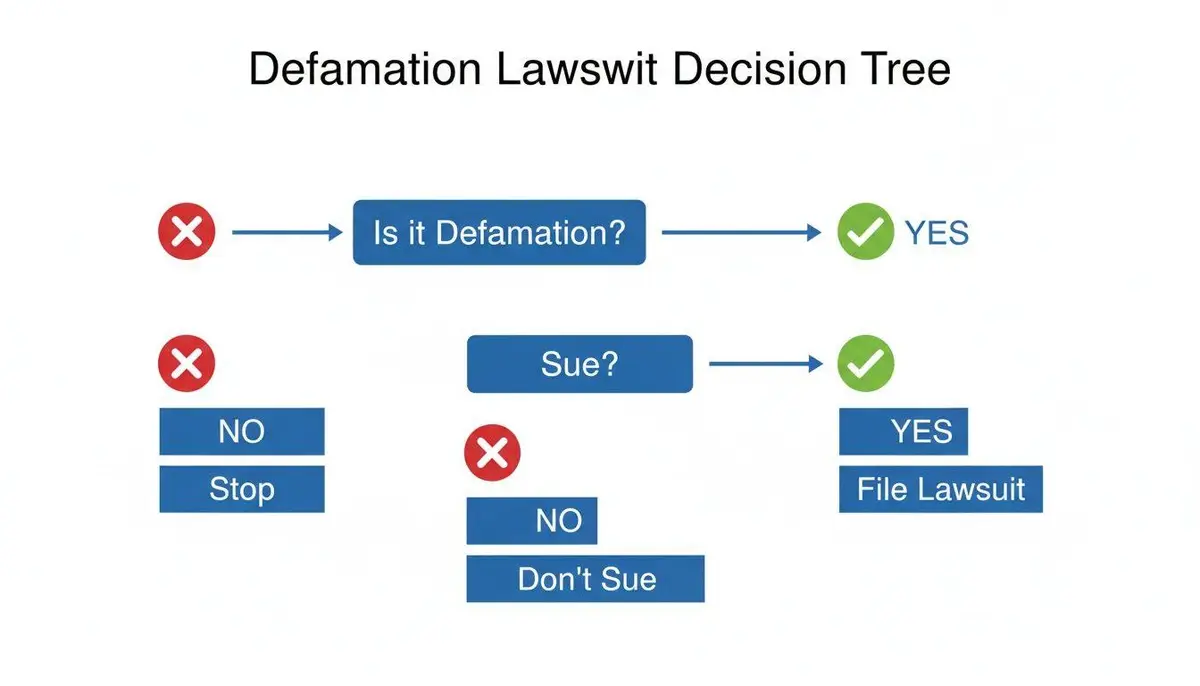
Consider this a simplified map for that complex initial assessment, guiding you from the moment you identify the false statement to the critical choice of whether to engage counsel for a lawsuit.
The Cease and Desist Letter: Your First Strategic Action
Your first offensive measure is almost always a Cease and Desist letter. This is not merely a strongly worded email; it is a formal demand drafted by your attorney that serves several critical functions. It places the defamer on formal notice that you are aware their statements are false, that they are causing demonstrable harm, and that you are prepared to pursue legal action.
A professionally drafted letter does more than request a takedown. It creates a paper trail proving the defamer was informed their statements were false. If they refuse to comply, that letter becomes a key piece of evidence. It can help establish actual malice or, at a minimum, a reckless disregard for the truth.
The language must be precise and firm. The following is an example of language that yields results:
“Your statements of [Date], published on [Platform], falsely asserting that our client [Client’s Name] engaged in [Specific False Allegation], are categorically untrue and constitute defamation per se. These allegations have caused immediate and substantial harm. We demand the immediate and permanent removal of these statements by [Date and Time] and the publication of a full retraction. Failure to comply will leave our client with no alternative but to pursue all available legal remedies, including a lawsuit seeking compensatory and punitive damages.”
Note its directness and the hard deadline. It establishes a clear boundary and shifts the dynamic, converting an online diatribe into a serious legal liability for the author.
Filing the Lawsuit: When Demands Are Insufficient
If the letter is ignored and the content remains online, it is time to file the lawsuit. This stage requires tactical precision, beginning with two critical details: the statute of limitations and the court’s jurisdiction.
The statute of limitations for defamation is unforgivingly short, often just one to three years from the date of first publication. The “single publication rule” in most jurisdictions dictates that this clock starts the moment the content goes live, not each time it is viewed. If you miss this window, your case is terminated before it begins. Contacting counsel immediately is therefore imperative.
Choosing the proper jurisdiction, the court where you file, is another crucial strategic decision. You might file where the defendant resides, where your company is headquartered, or where your reputation suffered the most significant damage. Each court system has its own procedural nuances, and experienced counsel will select the venue that offers your claim the greatest advantage.
Filing the suit involves preparing a formal complaint. This document presents your case to the court, outlining the defamatory statements, identifying the publisher, explaining when and where they were published, and proving their falsity. It also details the damages you have suffered and the relief you seek. Once filed with the court and served to the defendant, the litigation has officially commenced.
Surviving the Litigation Gauntlet
Upon filing, you enter the discovery phase. This is where both sides are compelled to exchange information, a process that can feel deeply invasive. Your legal team will seek emails, internal messages, and other documents from the defendant that can help prove knowledge of falsity, a key element for establishing malice.
Simultaneously, prepare to be deposed. A deposition is a formal, sworn testimony where the opposing attorney questions you for hours. Your counsel will prepare you thoroughly for this critical event, where a misstatement could jeopardize your case.
Throughout this period, anticipate a series of pre-trial motions. The defendant will almost certainly file a motion to dismiss your case, arguing it lacks legal merit. This is a standard tactic. Your attorney will file a response, defending the strength of your complaint to ensure you have your day in court.
The reality is that the vast majority of defamation cases, well over 90%, never reach a trial. They conclude in a settlement. Negotiations can occur at any stage. A favorable settlement can achieve all your objectives: financial compensation, a public retraction, and permanent content removal, all without the risk, expense, and public spectacle of a trial. Your attorney’s role is to advise you on when to accept a settlement and when to continue fighting for your reputation.
Common Questions We Hear About Defamation Lawsuits
When your reputation is under attack, the legal path forward can seem opaque and fraught with uncertainty. For the executives and public figures we work with, navigating these complexities is often the most difficult part. Here are direct answers to the high-stakes questions we address daily.
Can I Sue an Anonymous Person for Online Defamation?
Yes, it is possible to pursue an anonymous defamer through a “John Doe” lawsuit. This is not a simple matter of filing a complaint against an unknown party.
The process begins with your attorney petitioning the court for permission to issue a subpoena. This subpoena is not directed at the anonymous individual but at the platform where the defamatory content was published: the social media company, blog host, or internet service provider (ISP). The objective is to legally compel the platform to disclose any identifying information it possesses, such as an IP address, email, or a name associated with the account.
Anticipate resistance. Technology companies often oppose these subpoenas, and the anonymous user may retain their own counsel to quash the subpoena, asserting a First Amendment right to anonymous speech. To prevail in this initial contest, you must present a strong prima facie case for defamation. It is a critical first hurdle.
What Is the Difference Between Libel and Slander?
This distinction is a core concept in defamation law. Libel is written defamation: it exists in a fixed, tangible form. For our clients, this almost invariably means false blog posts, malicious online reviews, defamatory social media comments, or deceptively edited photos and videos. Slander is spoken defamation.
This distinction is important for two primary reasons. First, libel is recorded. It possesses a permanence and potential for viral dissemination that spoken words lack. A single defamatory tweet can be seen by millions, and a false article can persist in search results for years, causing recurring damage.
Second, due to this permanence and reach, courts often presume that the harm from libel is more significant. This can translate to much higher damage awards compared to a typical slander case. If you are an executive or public figure being attacked online, the harm is almost certainly libel, a fact that strengthens your case for substantial damages.
An anonymous, false comment on a major news site is libel. A false accusation whispered at a private dinner party is slander. The former has the potential to inflict far greater and more lasting reputational damage, and the law treats it accordingly.
How Long Do I Have to Sue for Defamation?
This is a critical point where many potential claims fail. The window to file a defamation lawsuit, known as the statute of limitations, is exceptionally short and strict. Depending on your jurisdiction, you often have just one to three years from the date the defamatory material was first published.
For online defamation, most states adhere to the “single publication rule.” This is crucial: the clock starts ticking the moment the content is first posted, not each time a new person views or shares it. If you discover a defamatory article from two years ago, your time to act may already be expiring.
Missing this deadline will almost certainly result in the dismissal of your case, regardless of its merits. You cannot afford to wait. The moment you become aware of a defamatory attack, the clock is running. You must consult with experienced counsel immediately to preserve your legal rights.
What if the Defamatory Statement Is an Opinion?
“It was just my opinion” is a classic defense and one of the most litigated issues in defamation law. While pure opinion is protected by the First Amendment, prefixing a false statement with “I think” or “in my opinion” does not grant it legal immunity.
A court will analyze whether the statement implies a provably false fact. For instance, “In my opinion, this CEO is terrible at their job” is likely a protected opinion. However, “In my opinion, this CEO is terrible because he defrauded investors” crosses a legal line. The assertion of defrauding investors is not an opinion; it is an allegation of fact that can be proven true or false.
Judges examine the entire context, the specific language used, and how a reasonable person would interpret the statement. Your opponent will almost invariably attempt to shield themselves with the opinion defense. Defeating it requires a legal team skilled at demonstrating that the statement, regardless of its phrasing, was intended as a factual attack.
When facing a complex reputational attack, navigating these legal questions alone is a significant risk. At ContentRemoval.com, we provide the strategic expertise to assess your situation and execute a plan tailored to restore your good name, whether that involves discreet content removal or preparing for litigation. Protect your reputation with a team that understands the stakes. Learn more about our services at ContentRemoval.com.
Frequently asked questions
How much does it cost to sue for defamation?
The article puts a straightforward case that settles before trial at $21,000 to $55,000 in legal fees, with retainers of $5,000 to $25,000 or more. Cases involving unmasking an anonymous poster or going to trial can exceed $100,000, before filing fees, deposition transcripts and expert witnesses.
What evidence do I need to sue someone for defamation online?
A full-page capture of the content with URL and timestamp, independent archive snapshots, screen recordings for video or stories, and the surrounding context such as shares and comments. You also need a damages file: lost revenue, failed transactions, rescinded offers and receipts for mitigation costs.
Can a public figure win a defamation lawsuit?
Yes, but the bar is high. You must prove the publisher knew the statement was false or seriously doubted it, which usually means finding internal communications, ignored contradictory sources or fabricated quotes during discovery. Many executives find a direct takedown a more practical first move.