
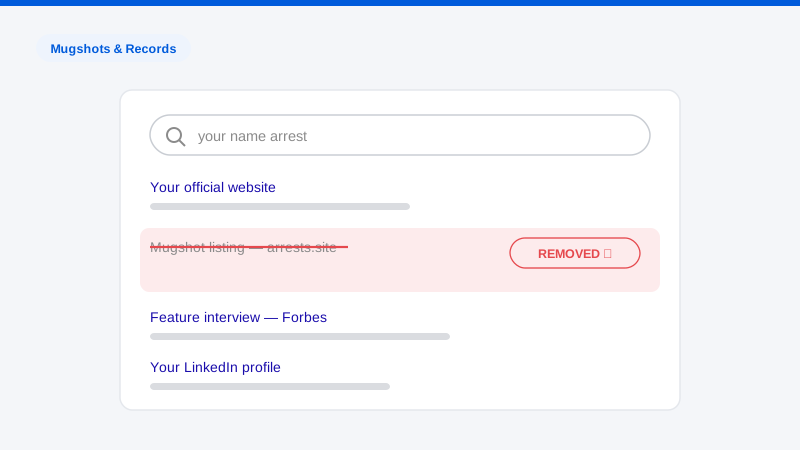
The honest answer to “what is the cost to remove a mugshot” is: it depends on how many sites are holding it, what legal grounds you have, and whether you make the single most expensive mistake in this field, paying the mugshot sites themselves. As practitioners who scope and run these campaigns daily, we can tell you the cost to remove a mugshot ranges from nothing (a handful of removals are free if you have the right grounds and the patience to file them yourself) to several thousand dollars for a multi-site professional campaign with search engine cleanup.
What we can also tell you is that anyone quoting a single universal price without looking at your actual exposure is not quoting. They are fishing. Mugshot removal is priced per target, and the target list varies enormously from one person to the next. One client’s photo lives on two aggregator sites; another’s has been scraped across a dozen domains, indexed into Google Images, and folded into data broker profiles.
This guide breaks down what actually drives the price in 2026, what the pricing models look like, where the traps are, and how to spend the least money for the most complete result.
The factors that drive the cost to remove a mugshot
How many sites republished the record
This is the dominant variable. Mugshot aggregators scrape county sheriff and police booking data in bulk, and the same booking photo frequently propagates across multiple affiliated or copycat domains. Every additional domain is an additional removal target with its own process, response behavior, and price. A two-site problem and a twelve-site problem are different projects, which is why any serious engagement begins with a full audit, ours is described on our process page, before a number is put on paper.
Your legal posture: dismissed, expunged, or standing
The second-biggest cost driver is the status of the underlying case:
- Expunged or sealed records are the cheapest to remove per site, because in many states the law requires commercial mugshot sites to take them down on request. The removal is enforcement, not persuasion.
- Dismissed charges or non-convictions carry strong policy arguments and, in some states, statutory support. Removal rates are high, effort is moderate.
- Standing convictions are the hardest and therefore most labor-intensive tier. Removals still succeed regularly (through platform policies, publication-practice violations, and negotiation) but each one takes more work, and the price reflects it.
If you may be eligible for expungement, talk to an attorney before spending heavily on removal. We are not a law firm and cannot advise you on eligibility, but from a pure cost standpoint, an expungement often pays for itself by converting expensive persuasion targets into inexpensive enforcement targets.
How far the image has spread beyond the mugshot sites
A booking photo rarely stays on booking sites. It surfaces in Google Images, gets attached to people-search and data broker profiles, and occasionally appears in blog or forum posts. Cleaning the source sites without cleaning search results and image indexes leaves the most visible copies untouched, and full-scope campaigns cost more than source-only ones. Scope is a legitimate cost lever: some clients need everything gone; others only need the first page of Google fixed.
Whether you need ongoing monitoring
Removed content can reappear when a new scraper site launches. One-time projects cost less; engagements with monitoring and re-removal coverage cost more but protect the result. Which one you need depends on your risk tolerance and public profile.
What the pricing models look like in 2026
Do-it-yourself: free, but not costless
You can file removal requests yourself. Where you have an expungement, many state statutes let you demand removal directly. Google accepts removal requests for mugshots on sites with exploitative removal practices under its published policies. Some aggregators honor documented dismissal paperwork. The dollar cost is zero; the real cost is your time (expect many hours across weeks), the learning curve on which grounds apply where, and the emotional toll of repeatedly engaging with the content. DIY works best for people with one or two targets and clean legal grounds.
Per-site professional pricing
Most legitimate firms price per site or per record, typically in the low-to-mid hundreds of dollars per straightforward target, scaling with difficulty. Hard targets (sites that ignore first demands, offshore hosts, editorial content) cost more because they consume escalation work: hosting-provider complaints, registrar pressure, search engine filings, and sometimes coordination with your attorney through channels like our legal content removal practice.
Flat-fee campaign pricing
For multi-site exposures, firms often quote a single project fee covering the full audited target list, generally landing in the four figures for comprehensive campaigns. This is convenient, but insist on seeing the itemized list behind the number so you know what is included and what happens if a target fails.
Performance-based pricing: the model to insist on
Whatever the structure, the term that matters most is when you pay. Under performance-based (pay-after-removal) pricing, fees are contingent on successful removal. A failed target costs you nothing. This is the pricing model we use for mugshot removal, and we consider it the honest standard for the industry: it forces the firm to quote only what it believes it can deliver, and it makes the quote itself a truthful signal. Be wary of large non-refundable retainers in this niche; they transfer all the risk to you.
The trap: why paying the mugshot site’s own “removal fee” backfires
Many mugshot sites offer, or historically offered, their own paid removal, sometimes framed as an “unpublishing fee” or routed through a conveniently affiliated “reputation” service. Do not pay it. Three reasons:
- It can signal the network. Portions of the mugshot ecosystem have operated as networks of related or copycat domains. Paying one site identifies you as someone who pays. Practitioners in this field have long observed photos resurfacing on affiliated domains after a direct payment. You can end up paying serially for the same photo.
- It may be unlawful for them to charge you. A significant number of states have enacted laws prohibiting websites from charging fees to remove arrest photos, or requiring free removal for expunged and non-conviction records. Paying a fee that a statute prohibits the site from charging is paying for something you may be entitled to for free. An attorney can tell you what applies in your state.
- It rewards the business model. The entire commercial mugshot industry runs on the gap between embarrassment and payment. Every direct payment finances more scraping. Professional removal works through legal grounds, hosting and platform policies, and search engine channels precisely so that the sites are compelled rather than compensated.
This dynamic is also why Google’s exploitative-removal policy exists: sites that charge for removal can be de-indexed from search on that basis alone. Ironically, a site demanding payment often hands you the strongest free removal argument you have.
Hidden and follow-on costs to budget for
- Search engine cleanup. Source removal does not instantly clear Google’s cache and image index; refresh and removal requests are follow-up work.
- Data broker replication. People-search sites often attach arrest data to their profiles of you. Clearing those is a separate workstream, see our data broker removal service, and worth bundling, since a clean mugshot result means little if the arrest line survives on twenty broker profiles.
- Reappearance. New scraper domains appear periodically. Budget either for monitoring or for the possibility of a second, smaller engagement later.
- Doing nothing. The most overlooked cost. A mugshot on page one of your name search operates continuously, on hiring managers, lenders, landlords, dates, and clients. Whatever a campaign costs, it is a one-time number set against an ongoing loss.
Step by step: how to scope your cost before talking to anyone
You can estimate your own project size in under an hour:
- Search your full name in a private/incognito window: regular results and the Images tab. Note every domain displaying the photo or the arrest record.
- Search name + city and name + “arrest” or “mugshot.” Aggregators often rank for these modifiers even when they miss your plain-name search.
- Check the major people-search sites for your name and note which ones show criminal-record sections.
- Write down your case disposition: convicted, dismissed, pending, expunged, sealed. This single fact moves your quote more than anything else.
- Count targets by type: mugshot aggregators, data brokers, news articles, forum/blog reposts, and search results. Each type has a different removal path and cost profile.
- Ask an attorney about expungement eligibility if your case qualifies. Sequence matters: expunge first, remove second is often the cheapest total path.
- Get an itemized quote from any firm you consider: per-site pricing, payment terms, and what happens on failure, in writing.
If you would rather not do the mapping yourself, this is literally what our free exposure scan does: we run the audit and hand you the target list with honest per-item assessments, whether or not you hire us.
What a fair quote looks like, and what an unfair one looks like
A fair quote in 2026 is itemized, follows an actual audit, distinguishes easy targets from hard ones, and ties payment to results. It also says “no” sometimes: an honest firm will tell you a standing news article about a serious recent conviction is unlikely to come down, rather than charging you to fail quietly.
An unfair quote is a round number produced in the first five minutes, a demand for full payment up front with no performance terms, a guarantee with no conditions, or a price that mysteriously matches the mugshot site’s own removal fee, and at the other extreme, be equally cautious of prices that seem too low, bottom-dollar operators often file one templated email per site and abandon anything that resists. When comparing two quotes, compare the terms before the totals: a slightly higher price with pay-after-removal terms and reappearance coverage is almost always the cheaper engagement in practice, because it is the one where failure costs the firm rather than you.
Frequently asked questions
What is the typical cost to remove a mugshot from one website?
For a straightforward target (an aggregator site, with dismissal or expungement paperwork in hand) expect pricing in the low hundreds of dollars per site from a legitimate performance-based firm, and less if you do it yourself with strong statutory grounds. Difficult targets that require escalation cost more. Multi-site campaigns are usually quoted as a package after an audit.
Is it ever free to remove a mugshot?
Sometimes, yes. If your record is expunged or sealed, statutes in many states require removal without charge on request. Google’s policies allow free de-indexing requests for mugshots on sites that charge for removal. Some sites voluntarily honor dismissal documentation. Free paths cost time and persistence rather than money, and they cover some targets but rarely all of them.
Why shouldn’t I just pay the mugshot site directly? It’s cheaper.
Because it frequently is not cheaper in the end. Direct payment can flag you to affiliated sites where the photo reappears, may involve paying a fee the site is legally barred from charging in your state, and funds the industry that published you. It also does nothing about search caches, image results, or data broker copies.
Does removing the mugshot also fix my Google results?
Not automatically. After source removal, search engines need to recrawl or be prompted to refresh; images can persist in Google Images; and the arrest may live on independently in data broker profiles. A complete campaign treats Google cleanup and broker removal as part of the scope, not an afterthought.
Before you spend anything, find out what you are actually dealing with. Our free exposure scan maps every copy of the mugshot and record we can locate, tells you which targets have strong removal grounds, and produces an itemized, performance-based quote. You pay for removals when they happen, not for promises.