
A cyber security background check is a risk transfer decision, not an HR formality. Scope it to the role’s access and coercion risk, combine criminal, civil, employment and education records with a digital footprint review of code hygiene, forum conduct and credential exposure, follow consent and jurisdiction rules, and interpret findings by role relevance rather than pass or fail.
Key facts
- Routine nationwide criminal searches can miss up to 75% of convictions because of fragmented jurisdictions.
- Clearance roles use a fingerprint-based search and at least 10 years of history through Standard Form 86.
- Under the FCRA, roles paying under $75,000 limit reporting of non-conviction arrests and civil items to seven years.
- Criminal checks typically return in 24 to 72 hours; employment and education verifications in 1 to 3 business days.
Where ContentRemoval.com comes in. For the person being screened, ContentRemoval.com handles the other side of this process: false, outdated or misleading search results, scraped arrest references and copied forum posts that could distort someone else’s risk judgment, removed or de-indexed before formal vetting begins. Candidates, their counsel and the hiring company’s general counsel all make contact. A free 15-minute Exposure Scan maps what a screener will find and what can be removed, and the report is yours to keep. Get a Free, Confidential Exposure Scan or read how our content removal work is done.
You’re probably in one of two situations.
Either you’re about to approve a cyber hire who will get privileged access to production systems, customer data, financial controls, or internal investigations, and you know a standard HR screen won’t tell you what you need to know. Or you’re the person being screened, and one unresolved digital artifact, an old forum alias, a scraped court record, a misleading search result, or a badly framed social post could distort someone else’s risk judgment about you.
That pressure is justified. A cyber security background check isn’t an administrative formality. It’s a risk transfer decision. You are deciding whether to trust a person with access that can bypass policy, expose secrets, and create a crisis long before anyone notices.
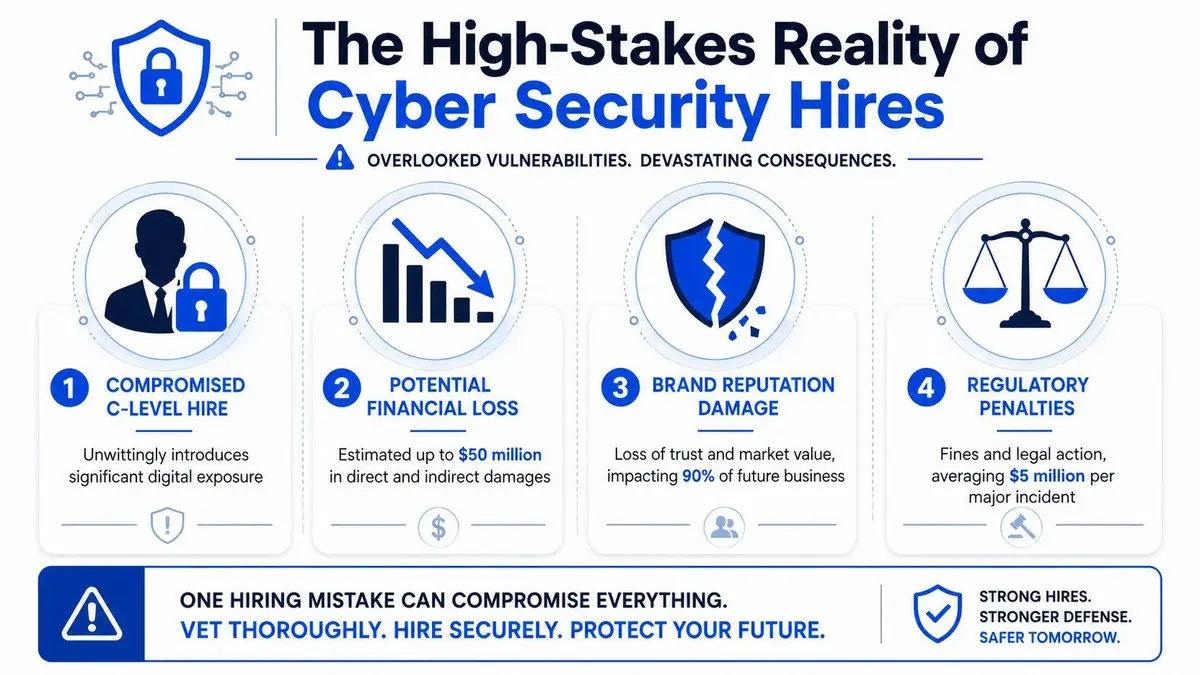
The High-Stakes Reality of a Cyber Security Hire
A weak cyber hire rarely looks weak on paper.
The résumé is polished. The references are cooperative. The interviews are sharp. The candidate speaks fluently about zero trust, incident response, identity architecture, GitHub workflows, and cloud hardening. Then six months later, the company is dealing with a credential-driven intrusion, a regulator’s questions, an anxious board, and a forensic review that keeps uncovering preventable failures.
The most dangerous version of this problem isn’t the obvious bad actor. It’s the executive or senior technical hire with a hidden vulnerability. Maybe they reused credentials. Maybe they left a trail of reckless public code practices. Maybe they carried undisclosed financial pressure, prior deception, or online associations that made them easier to coerce or easier to impersonate. By the time that pattern becomes visible, the damage isn’t theoretical.
A data breach is already expensive before you account for litigation, management distraction, customer churn, or personal reputational fallout for the leaders who approved the hire. SentinelOne notes that the global average cost of a data breach is projected to reach $4.88 million in 2026, up from $4.35 million in 2022, and that breaches involving compromised credentials take 328 days to identify and contain, compared with 277 days for all breaches (SentinelOne cybersecurity statistics). If your screening process doesn’t account for credential risk, insider exploitation, and digital exposure, you’re absorbing that risk blindly.
Why generic screening fails
Most hiring systems were built to answer a narrow question. Was there a reportable criminal issue, a résumé lie, or a sanction that blocks employment?
That’s not enough for cyber roles. A security leader, IAM architect, DevSecOps engineer, security analyst, or developer with access to production secrets can create enterprise risk without triggering a simplistic pass or fail result. The wrong person can be technically skilled, legally employable, and still present material exposure.
Practical rule: If a role can touch credentials, keys, sensitive logs, regulated data, or executive communications, treat the screening decision as part of enterprise risk management, not HR administration.
What executives need to understand
The question isn’t whether someone “passes” a check. It’s whether their documented history, digital conduct, and pressure profile align with the level of trust the role requires.
That requires a different framework. You need a scoped investigation, legally defensible process controls, a method for interpreting nuanced findings, and a response plan if adverse information appears. Without that, you’re hiring on intuition in a domain where intuition routinely fails.
Defining the Scope of Your Investigation
A one-size-fits-all cyber security background check is malpractice.
The investigation should track the role’s actual power. A junior analyst with limited access doesn’t create the same exposure as a CISO, an identity engineer, or a developer who can reach production keys. If your company uses the same screening depth for all of them, you’re signaling that convenience matters more than risk.
Build tiers around access and leverage
Start with authority, not job title. Ask four questions.
- What can this person access directly? Administrative consoles, customer environments, source code, security tooling, financial systems, legal files, executive communications.
- What can they influence indirectly? Vendor approvals, incident narratives, access grants, policy exceptions, or third-party trust decisions.
- What could they exfiltrate? Credentials, tokenized data, internal playbooks, investigation records, M&A material.
- What kind of coercion risk exists? Financial stress, concealed history, ideological volatility, digital recklessness, or susceptibility to manipulation.
A CISO or deputy CISO belongs in the highest tier because the role combines access, authority, and narrative control. An IAM lead can alter identity boundaries. A developer with production secret access can create hidden persistence points. A security analyst may not control strategy, but if they can view alerting systems and incident data, they still warrant more than a shallow screen.
Use the clearance model as the benchmark
If you want a gold standard for high-risk roles, look at how the U.S. government handles security clearance positions. For cyber roles requiring clearance, employers must run a fingerprint-based background search and collect at least 10 years of personal information, including residence, employment, education, and police records, through Standard Form 86 (USAJOBS security clearance guidance).
That doesn’t mean every private company should mirror the federal process. It means serious organizations should understand the principle. High-trust roles require broad historical visibility because short snapshots miss the patterns that matter.
Define the purpose before you collect data
The right scope starts with explicit risk objectives. Don’t tell your screening provider to “see what comes up.” That’s amateur hour. Tell them what risks you’re screening for.
Use a framework like this:
- Integrity risk evaluates dishonesty, credential inflation, and omission patterns.
- Security discipline risk looks at public code behavior, operational security habits, and reckless online conduct.
- Coercion risk examines financial strain, concealed disputes, and pressure points.
- Reputational spillover risk tests whether public associations or digital history could damage trust in the business.
- Access abuse risk focuses on roles where a single person can override controls or conceal misuse.
For executive appointments, online reputation due diligence should run in parallel with formal screening. A useful benchmark is this guide to executive online reputation due diligence, especially when the hire will be customer-facing, investor-facing, or involved in regulated decisions.
A cyber hire should be screened for the risks they can create, not the title they happen to hold.
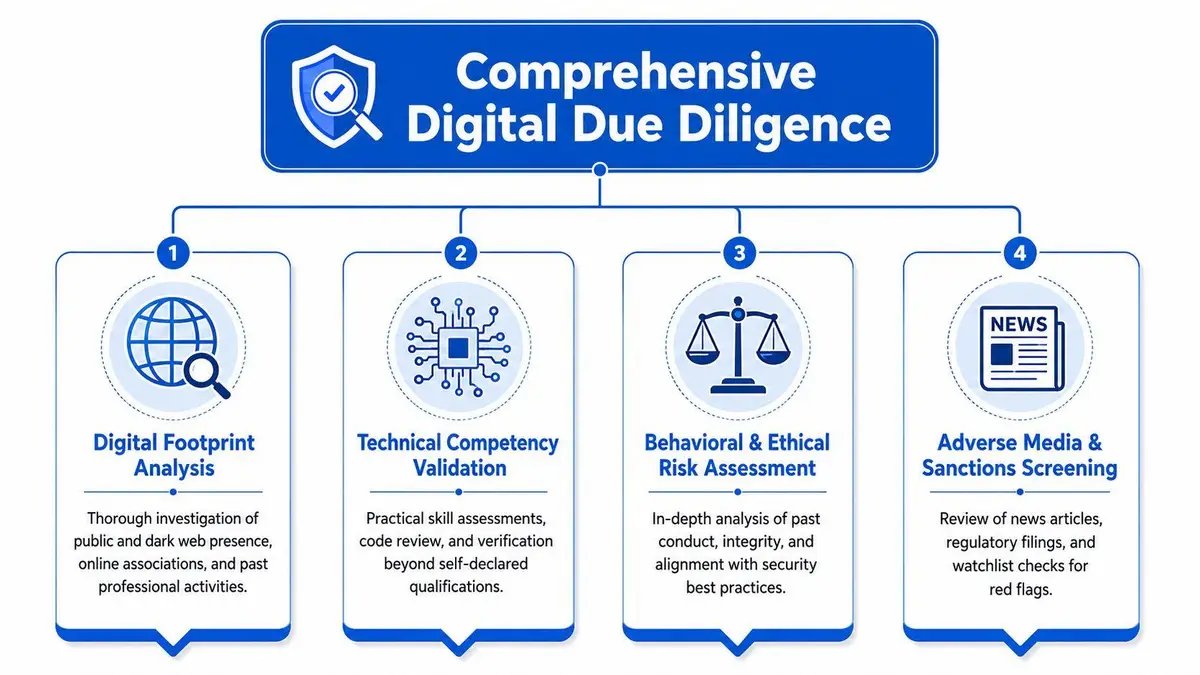
Anatomy of a Comprehensive Digital Due Diligence
Most failed cyber screening programs rely on bad inputs.
The classic example is the routine “nationwide” criminal search that gives boards and hiring managers false comfort. That shortcut is widely used because it’s fast, cheap, and easy to operationalize. It’s also inadequate for serious cyber hiring.
According to PIN’s analysis of recruiter background check tools, routine “nationwide” criminal searches can miss up to 75% of all criminal convictions because of fragmented jurisdictions and incomplete aggregation. The same analysis argues for a tiered methodology, especially for senior or finance-adjacent roles, and notes that a bad hire can cost 50% to 200% of annual salary (PIN background check tools for recruiters).
Start with records that can be verified
A proper investigation begins with structured records, not social media gossip.
You need direct criminal, civil, and financial checks that match the candidate’s jurisdictions and the role’s risk level. For senior hires and roles adjacent to financial controls, that should include employment verification, education confirmation, credit history review where lawful and relevant, and sex offender registry cross-checking, because the point is to match the inquiry to the exposure.
Often, internal teams fall short. They buy a vendor package, get a thin report, and assume it’s complete. It isn’t. A meaningful process tests the candidate’s timeline for gaps, contradictions, unexplained moves, and omitted employers.
Then investigate the digital footprint
A cyber security background check that ignores the digital footprint is structurally broken.
Cyber candidates often leave behind a richer trail than professionals in other fields. That can be a strength or a liability. Review public social accounts, forum identities, pseudonymous handles, public breach chatter, code repositories, archived bios, conference appearances, and technical communities. Where lawful and appropriate, include dark web monitoring for exposed credentials, reused usernames, and associations with compromised data.
Look for indicators, not theatrics:
- Public code hygiene. Hardcoded secrets, weak operational discipline, careless disclosure of internal methods, or unserious treatment of security basics on GitHub or similar repositories.
- Anonymous forum behavior. Harassment, extremist rhetoric, glorification of criminal intrusion, or sustained participation in communities that normalize abuse.
- Identity inconsistency. Multiple personas aren’t automatically a problem. Concealed personas tied to deception or misconduct usually are.
- Credential exposure signals. Reused email patterns, leaked credentials, and visible account compromise history deserve scrutiny because they point to personal security habits.
If your team wants to understand what the market expects from specialist investigators, review current postings like Find Certik Background Investigator jobs. The value isn’t the job opening itself. It’s the fact pattern. Serious organizations increasingly expect investigators to combine records work, technical context, and online exposure analysis.
Validate capability, not just biography
Cyber hiring has a specific weakness. Companies overvalue self-description.
A candidate can sound excellent and still lack operational maturity. Technical competency validation matters because inflated capability becomes a risk event once the person controls sensitive systems. Ask for code samples where appropriate, review public contributions, verify claimed certifications and employers, and test whether the candidate’s stated expertise aligns with what they’ve done in practice.
Examine pre-clearance reputation risk
For some hires, the issue isn’t misconduct. It’s visibility.
Old posts, inflammatory commentary, scraped records, and distorted search results can become friction points during vetting or after onboarding, especially when the hire moves into a cleared, regulated, or public-trust environment. This is why a candidate should review their own digital history before formal scrutiny begins. A practical starting point is social media preparation for security clearance vetting.
The strongest due diligence file doesn’t just collect facts. It explains why each fact matters to the role’s access profile.
Navigating Global Legal and Privacy Compliance
Executives often treat compliance as a brake on hiring speed. That’s backwards.
A compliant cyber security background check is what makes the process defensible when a candidate challenges it, a regulator examines it, or an audit asks how you applied standards across jurisdictions. If you don’t define the legal perimeter at the start, you won’t move faster. You’ll create rework, exposure, and credibility problems.
U.S. rules are not a global template
One of the most common mistakes in global hiring is assuming the U.S. model applies everywhere. It doesn’t.
Secureframe’s guidance on audit compliance draws a line many companies miss. Background checks are required only for U.S.-based employees, while a resume upload is sufficient for non-U.S. staff under that framework (Secureframe background check scope). That distinction matters if your cyber team spans multiple countries, which many do.
If you impose U.S.-style screening on non-U.S. candidates without proper legal analysis, you can trigger labor law, privacy, and proportionality issues. If you fail to collect what a U.S. audit framework expects from domestic staff, you can create a separate compliance failure. The right answer is not “apply one policy everywhere.” The right answer is “build one governance model with jurisdiction-specific execution.”
Later in the decision process, sector-specific statutes may also matter. Companies operating essential services or sensitive infrastructure should understand local obligations such as Australian critical infrastructure legislation when assessing screening, access governance, and insider risk controls.
Consent and timing are operational controls
A lawful process needs written consent before screening begins. It also needs consistency. Mitratech’s guidance is blunt on this point. A successful screening program requires a standardized policy, written consent obtained prior to screening, adherence to FTC guidelines, and operational integration with ATS workflows. It also notes that criminal record checks often return in 24 to 72 hours, employment and education verifications in 1 to 3 business days, and that waiting until after salary negotiation to trigger checks can add 3 to 5 days to hiring cycles (Mitratech on common background screening mistakes).
That isn’t just an HR process note. It’s a control. Delayed screening creates vulnerable points, inconsistent treatment, and avoidable hiring failure.
Here is the video I’d have legal, HR, and security operations review together before finalizing any multinational screening policy.
Build a defensible operating model
A durable program usually has these characteristics:
- Written jurisdiction rules that specify what can be collected, by whom, and for which roles.
- Role-based screening tiers so the company can justify proportionality.
- Centralized adverse-action handling to avoid improvised decisions by hiring managers.
- Data minimization and retention discipline so sensitive reports aren’t casually shared or stored.
Compliance done properly doesn’t weaken your hand. It gives you a disciplined basis to make difficult decisions and defend them.
Interpreting Findings and Calibrating Risk
Raw findings are not decisions.
A cyber security background check becomes useful only when someone competent interprets context, timing, severity, and role relevance. Too many companies default to a crude binary. Clear or disqualify. That’s not rigorous, and it’s not safe. It produces both false comfort and avoidable rejection.
Stop using pass or fail logic
An old civil dispute doesn’t carry the same weight as recent deception. A pseudonymous privacy-focused profile isn’t the same as active participation in malicious communities. A corrected résumé discrepancy may reflect sloppiness. A concealed termination linked to privileged access abuse is a different matter entirely.
Legal limits also shape what should appear and how much weight it should carry. Under the FCRA, if a cybersecurity role pays less than $75,000 annually, employers are restricted from reporting arrest records that did not lead to convictions, Chapter 13 bankruptcies, collection accounts, civil judgments, tax liens, and civil lawsuits to no more than seven years (iProspectCheck cybersecurity background check overview). Executives who don’t understand that threshold often misread an incomplete report as a clean one, or overreact to information that should be handled with more care.
If a finding doesn’t connect to access, coercion, trustworthiness, or reputational exposure, it may be noise. If it does, evaluate it against the role, not your instincts.
Use a structured decision table
A practical way to avoid overreaction is to map each finding to a business risk and a mitigation option.
| Finding Category | Example | Potential Risk | Action / Mitigation |
|---|---|---|---|
| Identity inconsistency | Undisclosed alias tied to technical forums | Concealment, reputational spillover, questions about candor | Interview the candidate directly, verify ownership and context, document whether omission was material |
| Financial pressure | Recent debt distress or unresolved collections where lawfully reviewable | Susceptibility to coercion or fraud pressure | Narrow privileged access initially, increase approval controls, reassess after explanation |
| Public code negligence | Exposed secrets or careless security practices in public repositories | Poor operational discipline, preventable internal security failures | Require technical review, remedial training, and role-specific restrictions if hired |
| Hostile online conduct | Harassing, extremist, or violent rhetoric under a linked account | Reputational damage, insider threat concerns, culture risk | Escalate to legal and security leadership, assess recency and pattern before decision |
| Résumé or certification inflation | Claimed employer, degree, or certification cannot be verified | Integrity risk, competence gap | Treat deliberate inflation as a major trust issue unless quickly resolved with evidence |
| Prior litigation or regulatory issue | Civil action involving misuse of confidential information | IP leakage risk, legal exposure | Review pleadings and resolution carefully, consider exclusion from sensitive projects |
| Personal opsec weakness | Reused handles, leaked credentials, visible account compromise history | Credential compromise risk, impersonation vulnerability | Require account hygiene remediation and stronger identity controls before onboarding |
Distinguish pattern from artifact
One ugly post from years ago may matter less than a recent cluster of hostile behavior. One scraped result may be misleading. A sealed, expunged, or resolved matter may require legal review before anyone treats it as meaningful.
There’s a real information gap here. Public discussion regularly shows cyber professionals worrying that expunged records will adversely affect candidacy for IAM or cybersecurity roles, even when the actual treatment may depend on process, law, and case-by-case review. That’s precisely why your decision model should privilege verified context over rumor.
Ask better follow-up questions
When adverse information surfaces, the interview should not sound accusatory. It should test judgment.
Ask what happened, what the person disclosed earlier, what they’d provide to clarify the record, and what controls would be appropriate if they were hired. Candor under scrutiny tells you as much as the finding itself.
Remediation Mitigation and Responding to Findings
An adverse finding isn’t the end of the process. It’s the point where discipline matters most.
For employers, that means two tracks running at the same time. First, follow the required adverse-action process when a consumer report informs the decision. Second, decide whether the issue is disqualifying, manageable with controls, or misunderstood.

Employers should mitigate before they reject
Some risks can be reduced instead of treated as automatic disqualifiers.
Consider limited-access onboarding, enhanced monitoring, separation of duties, stronger approval chains, or delayed access to crown-jewel systems while a concern is resolved. That approach is often smarter than a reflexive no, especially when the issue is peripheral to the role or the candidate offers credible clarification.
Federal suitability reviews provide a useful reminder that risk levels should drive process depth. Yale Law School’s overview notes that Low-Risk positions may trigger a National Agency Check with Inquiries that takes at least two to three months, while High-Risk positions require a full Background Investigation reviewing the prior five years of employment, residential, and educational history, sometimes with in-person interviews (Yale guide to government background checks). Private employers should take the same lesson. Match response intensity to actual exposure.
Individuals should act before someone else defines the narrative
If you’re the candidate, executive, or founder under review, don’t wait for a bad result to discover what’s online about you. False allegations, outdated search results, scraped arrest references, copied forum posts, and decontextualized articles can all distort a screening file.
That’s why a pre-screen digital audit matters. If harmful or misleading material is already indexed, a strategic removal and suppression plan should start before formal vetting. This guide on removing negative search results before a background check is a practical starting point for anyone who needs to address visible search liabilities before they become someone else’s conclusion.
Strong remediation does two things at once. It corrects the record where possible, and it narrows the chance that old or false material will be mistaken for present risk.
If a cyber security background check has exposed damaging, false, outdated, or strategically misleading content about you or one of your executives, ContentRemoval.com should be your next call. The firm works with high-net-worth individuals, founders, legal teams, and senior leadership to remove harmful search results, suppress reputational liabilities, monitor the open and dark web, and build a defensible digital profile before screening, litigation, transactions, or public scrutiny escalate the damage. Start with a confidential assessment and get a clear action plan.
Frequently asked questions
What should a background check for a cybersecurity role include?
Criminal, civil and financial checks matched to the candidate’s jurisdictions and the role’s risk, employment and education verification, and a digital footprint review of public code hygiene, forum conduct, identity consistency and credential exposure. Senior hires warrant the deepest tier.
Can an expunged record affect a cybersecurity job application?
A sealed, expunged or resolved matter may require legal review before anyone treats it as meaningful, and the FCRA limits what can be reported for lower-paid roles. The decision model should privilege verified context over rumor, and candidates should check what is still visible online before vetting.
Should an adverse finding automatically disqualify a cyber candidate?
No. Map each finding to a business risk and a mitigation such as limited-access onboarding, enhanced monitoring or separation of duties. Deliberate certification inflation or concealed access abuse are serious; an old civil dispute or a pseudonymous privacy profile usually is not.