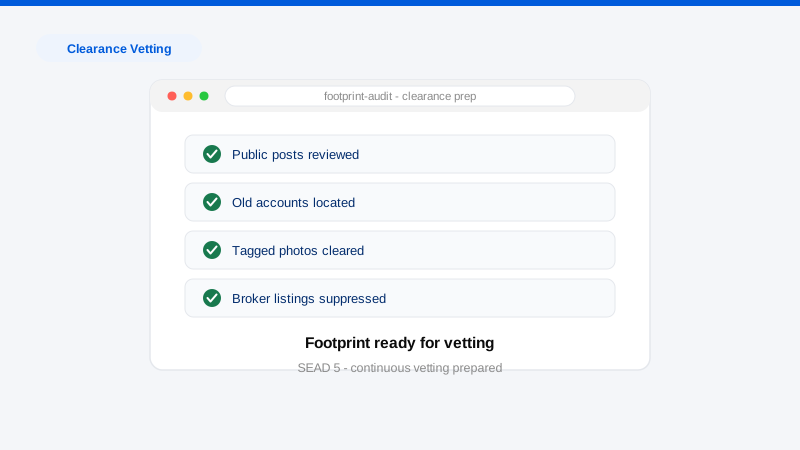
Preparing your social media for security clearance vetting comes down to three tasks: know what investigators can see, remove or correct what you control, and be ready to explain what you can’t remove. Since Security Executive Agent Directive 5 (SEAD 5) authorized the collection of publicly available social media information, clearance investigations can lawfully review any public post, photo, comment, or profile tied to you, and under Continuous Vetting, that review doesn’t end when the clearance is granted. The good news: vetting rewards honesty and mitigation far more than it punishes an imperfect history, and a deliberate cleanup done now is entirely legitimate.
One clarification up front, because it matters: cleaning up your public footprint before applying is not “hiding” anything. You are still obligated to answer the SF-86 and investigator questions truthfully. What cleanup does is remove ambiguity (the out-of-context photo, the years-old joke, the account you forgot existed) so your record reflects who you actually are.
What do clearance investigators actually check on social media?
Under SEAD 5, investigators and automated screening tools may review publicly available social media. They cannot compel your passwords, log into private accounts, or require you to friend an investigator. In practice, review focuses on the adjudicative guidelines used for every clearance decision. The ones social media most often touches:
- Foreign influence and foreign preference: regular engagement with foreign nationals in sensitive contexts, undisclosed foreign contacts your posts reveal, or content suggesting loyalty conflicts.
- Drug involvement: posts, photos, or group memberships indicating illegal drug use, including marijuana, which remains federally disqualifying regardless of state law.
- Criminal conduct: content depicting or bragging about illegal activity, even jokingly.
- Alcohol misuse: a pattern of excessive-drinking content, not a single champagne photo.
- Financial irresponsibility: visible gambling problems, get-rich-quick promotion, or posts contradicting your reported financial situation.
- Personal conduct: the catch-all: dishonesty, harassment, threats, extremist affiliation, mishandling of sensitive information, or anything showing poor judgment and unreliability.
- Inconsistencies with your SF-86: the quiet killer. A public timeline that contradicts your stated employment history, residences, or foreign travel invites exactly the scrutiny you don’t want.
Sexual content, strong political opinions, and general online cringe are not, by themselves, disqualifying. Patterns of behavior implicating the guidelines are. This is a sibling topic to what military recruiters look for on social media, vetting simply goes deeper and lasts longer.
The pre-vetting cleanup: a step-by-step protocol
- Inventory every account, including dead ones. Search your name, usernames, and old email addresses across Google, Bing, and the platforms themselves. Abandoned MySpace-era accounts, old gaming forums, and secondary Instagram accounts all count as publicly available information. Our digital footprint cleanup service exists because this inventory step is where most people miss things.
- Audit as an outsider. Log out and view each profile as the public sees it. What’s visible on your timeline, tagged photos, likes, follows, comments on other people’s posts, and group memberships?
- Delete deliberately. Remove content implicating the guidelines above: drug references, criminal humor, harassment, extremist-adjacent shares, and anything materially inconsistent with your paperwork. Delete the posts, not the accounts, where the account itself is benign, a long-lived, normal account is itself evidence of stability.
- Untag and request takedowns. Content posted by others about you is still publicly available information. Untag yourself, ask friends to remove problem photos, and use platform reporting for content that violates policies. Where others refuse, professional removal channels handle the escalation.
- Lock down what remains. Set personal accounts to private, prune followers you don’t know, disable public tagging, and turn off search-engine indexing of profiles where platforms offer it. Private accounts are outside SEAD 5’s reach, but assume screenshots exist for anything you’ve ever posted.
- Clean the search layer. Google your name the way an investigator’s tools would. Old posts, people-search profiles, and cached pages persist after deletion. De-indexing outdated content and removing personal data from broker sites closes the gap between “deleted” and “gone,” and data broker removal also reduces the identity-theft exposure that itself concerns adjudicators.
- Document, don’t fabricate. Keep notes on what you removed and why. If an investigator asks about past conduct, answer truthfully, the cleanup governs what’s visible, never what you say.
Get a Free, Confidential Exposure Scan
Honest timelines and expectations
Start 60 to 90 days before you expect to submit the SF-86. Platform deletions are immediate, but search engines take days to weeks to drop deleted pages, people-search opt-outs run one to six weeks per broker and recur as listings republish, and content controlled by other people can take longer to resolve. Under Continuous Vetting, this isn’t a one-time scrub: automated checks run throughout the life of your clearance, so the habits and privacy settings matter as much as the initial cleanup.
Be realistic about what cleanup cannot do. It cannot remove news coverage, court records, or archived material held by third parties on any guaranteed timeline, and it cannot substitute for honest disclosure, the fastest way to lose a clearance is not an old post, it’s the appearance of concealment. Whole-person adjudication means time, maturity, and candor mitigate almost everything; deception mitigates nothing.
Frequently asked questions
Can investigators see my private accounts?
No. SEAD 5 limits collection to publicly available social media. Investigators may not demand passwords, compel you to accept follow requests, or use fake profiles to get inside private accounts. But content from a private account becomes fair game the moment it’s screenshotted and reposted publicly, so privacy settings reduce exposure without erasing history.
Should I delete my social media accounts entirely before applying?
Usually not. A normal, long-standing social presence reads as ordinary life; a footprint that vanished the month before your SF-86 can read as concealment and gives adjudicators nothing favorable to weigh. Delete problematic content, keep the benign accounts, and set them private.
Do old posts from years ago really matter?
Age is genuine mitigation: adjudication weighs recency, frequency, and maturity at the time. A college post from a decade ago carries far less weight than the same content from last year. The risk with old content is less the conduct itself than inconsistency with your current disclosures, which is why the inventory step matters.
What about posts other people made about me?
Publicly available information about you counts regardless of who posted it. Untag, request removal from the poster, use platform reporting where policies apply, and escalate through professional channels for content that won’t come down informally. This is a large share of the pre-vetting work we handle inside digital footprint cleanup.
Does this apply after I get the clearance?
Yes. Continuous Vetting replaced the old periodic-reinvestigation model with ongoing automated checks, and agencies may review public social media throughout your cleared career. Treat your public footprint as permanently in scope, which argues for monitoring, not just a one-time cleanup.
If a clearance application is on your horizon, find out what’s actually visible before an investigator does. Start with a free, confidential Exposure Scan (we’ll map every account, listing, and search result tied to your name) and see how our process works for the cleanup itself.