
Digital privacy for wealthy individuals is a coordinated system rather than a set of tools. It covers separated devices and networks, hardware-key authentication, encrypted communication, written rules for family and staff, contractual controls on advisors, continuous monitoring of search, leaks and impersonation, and a remediation workflow for when exposure slips through. The threat is built from ordinary fragments.
Key facts
- Attackers assemble targeting files from property filings, event programs, school links, staff texts and family posts.
- Use a separate secure device for banking, legal and family office work, plus a hardened travel device.
- Household rules: no real-time posting, no wealth signaling, no sensitive matters on unapproved apps.
- Complete online invisibility can itself read as a credibility red flag, so aim for controlled disclosure.
Where ContentRemoval.com comes in. When a leak, impersonation profile, doxxing post or damaging search result has already surfaced, ContentRemoval.com handles the remediation layer for high-net-worth families: evidence preservation, source removal, de-indexing, impersonation takedowns and monitoring for reuploads, coordinated with counsel and security. A chief of staff, family office principal or security adviser usually makes contact. A free 15-minute Exposure Scan maps what is removable, and the report is yours to keep. Get a Free, Confidential Exposure Scan or read how our personal data removal work is done.
A client usually reaches us after the boundary has already failed. A spouse’s Instagram story reveals the family’s location. A child’s school event appears in a tagged photo. A journalist, activist, extortionist, or fraudster connects that thread to a home address, a travel pattern, a board seat, or a private transaction. Then the pressure starts. Sometimes it arrives as a phishing attempt that looks credible enough to fool a chief of staff. Sometimes it arrives as a leak, an impersonation profile, or a search result you can’t afford to leave online.
If you have substantial assets, digital privacy for wealthy individuals isn’t a lifestyle preference. It’s part of asset protection, family security, and reputation control. You don’t solve it with one app, one assistant, or one IT vendor. You solve it with a coordinated system that covers devices, networks, family behavior, public exposure, and legal-grade remediation when something slips through.
Your Privacy Is Now an Attack Vector
A plausible breach rarely starts with a dramatic hack. It starts with ordinary convenience.
Your pilot receives a calendar update. Your household manager texts a vendor from a personal phone. Your teenager posts a harmless photo with a location clue in the background. Your name appears in a property filing, a company disclosure, or an event program. None of those details seem catastrophic on their own. Combined, they create a targeting file.
That’s the point most wealthy people miss. An adversary doesn’t need full access at the start. They need enough fragments to build confidence, mimic familiarity, and place pressure where your life is most exposed: travel, children, residences, staff, and liquidity events.
For high-net-worth families, privacy failure isn’t limited to embarrassment. It becomes an operational weakness. Once someone can map your routines, they can craft believable fraud attempts, invade negotiations, weaponize a family dispute, or trigger reputational damage at exactly the wrong time. If your current approach is scattered across passwords, a few NDAs, and a private assistant trying to keep up, you don’t have a privacy strategy. You have luck.
Practical rule: If a stranger can infer where you live, when you travel, who your children know, or how your money moves, you’re already disclosing too much.
Most clients need the same reset. Stop treating privacy as an afterthought managed by convenience tools. Start treating it as a risk discipline, the same way you treat tax exposure or litigation risk. That means hardening systems, reducing visible signals, controlling what search engines surface, and preparing a response before a live incident forces your hand. If your baseline is weak, start with a proper view of your data security risk exposure.
Mapping Your Digital Threat Landscape
The first mistake affluent clients make is assuming the threat is “hackers.” It isn’t. Instead, the threat is a mix of motivated actors using publicly available information, social signals, and predictable human behavior.
According to reporting on ultra-high-net-worth family privacy, individuals with assets exceeding $30 million face targeted cyber attacks at rates 300% higher than the general population, and above that threshold privacy shifts from convenience to strategic necessity because public wealth visibility increases exposure, as noted by Social Life Magazine’s coverage of UHNW privacy risks.

Who is actually targeting you
Some attackers want money. Some want control. Some want access to your company through you. Others want notoriety, revenge, or ideological impact. Wealth attracts all of them.
The categories usually look like this:
| Threat actor | What they want | How they start |
|---|---|---|
| Financial criminals | Wire fraud, account access, extortion | Email spoofing, fake assistant requests, credential theft |
| Reputation attackers | Public humiliation, negotiation leverage | Leaks, impersonation, selective publication |
| Corporate intelligence operators | Business advantage, deal insight | Staff targeting, advisor compromise, metadata collection |
| Obsessed individuals | Access, proximity, personal intrusion | Social monitoring, family tracking, public record mining |
Each group studies different parts of your life. The criminal watches transaction patterns. The activist watches your public affiliations. The obsessed individual watches family routines. The common denominator is access through context.
What your life reveals without your consent
Most affluent households leak information passively. Not through press interviews, but through infrastructure.
Property filings, business registrations, litigation records, donation lists, event programs, school affiliations, club memberships, old domain registrations, executive biographies, and archived press releases all create a composite identity. Add luxury assets, connected homes, travel services, and the digital habits of relatives, and the profile becomes far more precise.
A determined actor doesn’t need a data breach to start. They can buy, scrape, aggregate, and correlate. If you haven’t reviewed how data brokers expose executive and family information, you’re likely underestimating how quickly your personal map can be assembled.
Attackers rarely begin by breaking down the door. They begin by studying which door your staff forgets to lock.
The threat vectors wealthy people underestimate
The obvious exposure is financial logins. The more dangerous exposures are adjacent systems and people.
Consider the following attack paths:
- Travel metadata: Charter activity, hospitality bookings, itineraries, and staff coordination reveal absence from home and real-time movement.
- Home technology: Smart entry systems, cameras, guest Wi-Fi, and vendor apps turn a residence into a sensor network that can be abused if poorly segmented.
- Family social behavior: A child’s photo, a spouse’s fitness post, or a school fundraiser page can reveal patterns no adversary should have.
- Advisor channels: Lawyers, wealth managers, assistants, and consultants often exchange highly sensitive material through ordinary tools because they prioritize speed.
- Search visibility: Old news coverage, cached pages, leaked PDFs, and directory profiles create a public dossier that keeps resurfacing.
This is why digital privacy for wealthy individuals has to be treated as a full threat environment, not a cybersecurity procurement exercise. The battlefield includes your name, your relatives, your vendors, your properties, your schedule, your archives, and every search result that helps someone connect them.
Building Your Technical Fortress
Most “private” setups aren’t private. They’re convenient. Convenience is what creates openings.
A proper technical posture separates identities, limits blast radius, and assumes that one device, one account, or one vendor will eventually fail. Your objective isn’t perfection. It’s containment.

Separate your digital lives
If your banking, family communications, deal activity, travel logistics, and public-facing accounts all run through the same laptop and smartphone, your structure is weak. Segregation matters because one compromise shouldn’t expose everything else.
Start with device separation:
- Primary secure device: Reserve one phone and one computer for banking, legal, family office, and critical communication only.
- General personal device: Use a separate device for routine messaging, browsing, consumer apps, and lower-risk activity.
- Travel device: Carry a hardened travel setup with minimal data, especially for border crossings, conferences, and jurisdictions you don’t fully trust.
This isn’t paranoia. It’s compartmentalization. The less your systems overlap, the harder it is for an attacker to pivot from one part of your life into another.
Lock down account access
Password reuse, SMS-based authentication, and shared credentials between spouses, assistants, or advisors are still common in wealthy households. They’re indefensible.
Use a reputable password manager. Generate unique credentials for every account. For your most sensitive systems, use hardware security keys. They reduce the risk of phishing-based account takeover because a stolen password alone won’t open the account.
Your priority list should include email, cloud storage, banking access, legal document systems, encrypted messaging apps, and any account that can reset other accounts. If your email falls, the rest often follows.
A practical benchmark is simple. If an assistant can “just log in” to something critical using a saved password in a browser, the setup needs to be rebuilt.
Harden the network, not just the devices
A luxury residence often has the weakest network discipline of any high-value environment. That’s because the house is optimized for usability. Guests need access. Staff need flexibility. Vendors need remote entry. Children need streaming and gaming. Every convenience increases exposure.
Divide the network by function. Home automation should not sit beside family laptops. Guest access should not touch anything operational. Vendor access should be restricted, time-limited, and reviewed. A smart home contractor should never have broad, persistent access because installation was easier that way.
If you need a strategic framework for this layer, our overview of internet privacy protection services for executives addresses the broader operational model.
Here’s a useful baseline explainer for the non-technical reader:
Secure communication by default
Do not discuss sensitive family, legal, medical, or transaction matters over ordinary channels because “it’s faster.” If speed matters, build secure speed.
Use encrypted messaging for private coordination. Use secure document-sharing platforms instead of loose attachments. Keep private calendars private. Limit who can see attendee lists, locations, and travel notes. Review whether your team is forwarding emails into less secure personal inboxes for convenience.
The fastest way to lose privacy is to let urgency overrule process.
Reduce telemetry and location leakage
Modern affluent life generates location data constantly. Your phone, vehicle apps, travel tools, wearables, home systems, and asset platforms all produce traces. Many households never audit them.
Review what every device broadcasts. Disable unnecessary location sharing. Remove app permissions that don’t need persistent access. Avoid posting in real time. Delay public sharing until you’ve left a venue or returned home. If an app’s business model depends on collecting movement and behavior, assume that data will be exposed somewhere you can’t fully control.
Audit access every quarter
Technical security degrades because people accumulate access faster than they remove it. Former staff retain old permissions. Advisors keep shared folders they no longer need. Household vendors stay connected long after the work is done.
Review this on a fixed cadence:
- Who has access now: family members, staff, advisors, contractors.
- What systems they can reach: email, storage, messaging, home controls, travel platforms.
- Whether that access is still justified: if not, revoke it immediately.
Digital privacy for wealthy individuals depends less on clever tools than on disciplined architecture. Separate, restrict, review. That’s how the fortress holds.
Fortifying The Human Firewall
Most privacy failures aren’t technical. They’re social.
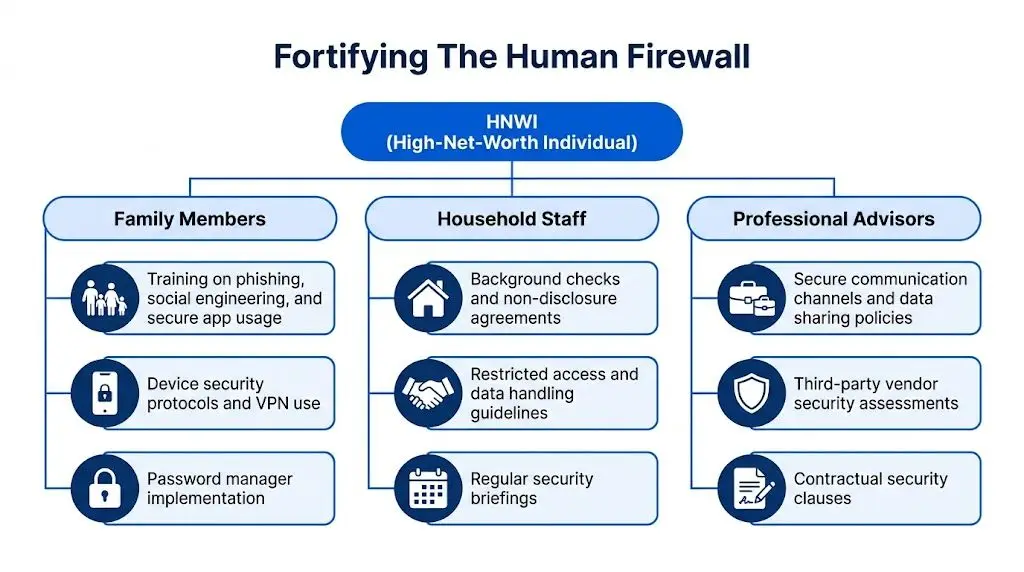
Someone talks too freely. Someone trusts a familiar voice. Someone forwards a file to a personal email because they’re rushing. Someone’s child posts a photo that confirms a location, a school, or a pattern. The best technical stack in the world won’t save a family that treats discretion as optional.
The families at highest risk are often the ones who’ve only recently become conspicuous. Reporting on this problem notes that over 25% of ultra-high-net-worth families have been targeted in cyberattacks, with a 15% rise in attacks aimed at less-protected spouses or children as a path into core assets, according to BlackCloak’s analysis of newfound wealth family exposure.
Family discipline is not optional
Children, spouses, former spouses, and extended relatives often disclose more than the principal ever would. They don’t need bad intentions to create risk. They just need normal habits in an abnormal threat environment.
Set household rules that are explicit, written, and enforced. Not vague requests to “be careful online.” Real rules.
- No real-time posting: Family members should never post current location, travel status, or identifiable routines while they’re happening.
- No wealth signaling: Avoid images or captions that reveal residences, aircraft tails, vessel names, school insignia, collections, security arrangements, or staffing patterns.
- No unsanctioned app use for sensitive matters: If family logistics matter, they belong on approved channels.
Many principals hesitate on this matter because they don’t want to police family life. That hesitation is expensive. If your family is part of your threat surface, their behavior must be managed.
Staff need protocol, not trust alone
Wealthy households often rely on deep personal trust with assistants, estate managers, drivers, nannies, household managers, and private security personnel. Trust is necessary. It is not a control.
Staff should be trained to verify unusual requests, especially requests involving money movement, guest access, schedules, identity documents, or private contact details. They should understand phishing, impersonation, and pretexting. They should know that “the principal asked for this urgently” is exactly how many attacks begin.
A useful operating model is tiered access:
| Group | Access standard | Common mistake |
|---|---|---|
| Household staff | Only what they need for their role | Shared passwords and broad calendar visibility |
| Executive assistants | Controlled access with approval workflows | Acting on urgency without secondary verification |
| Outside vendors | Temporary, narrow, logged access | Leaving persistent access in place after work ends |
| Advisors | Secure channels for defined matters | Using familiar but weak communication methods |
If a person can access your information because they’re helpful, rather than because they need it, your controls are too loose.
Advisors can become your blind spot
The principal may be disciplined. The family office may be disciplined. The weak point may still be the periphery: concierge medicine, personal legal matters, a boutique consultant, a travel planner, an art registrar, or a property vendor.
Every outside professional who handles your information should be assessed for how they store, share, and transmit it. Generic confidentiality language isn’t enough. Their contracts should address digital handling, retention, onward sharing, and breach response. If they resist, treat that resistance as a warning.
For sensitive relationships, require secure communications and defined escalation procedures. If a vendor receives a request changing an account, transfer instruction, travel detail, or delivery arrangement, they should have a mandatory verification path.
New wealth is especially exposed
Families who have recently sold a company, gone public, received a major liquidity event, or inherited significant assets often make the same mistake. They assume wealth changes their options, but not their threat model.
In reality, they’re visible before they’re prepared. Their addresses, affiliations, and family details surface quickly. Their relatives haven’t adjusted. Their staff structures are immature. Their advisors may be skilled financially and careless digitally.
That’s why onboarding matters. The first phase should include device reviews, account clean-up, social media restrictions, staff briefing, document access controls, and a direct conversation with every family member about what changes now. If you skip that conversation because it feels awkward, the adversary will have it for you.
Implementing Active Defense and Remediation
Defensive posture matters. Active management matters more.
The households that contain damage fastest are not the ones with the most software. They’re the ones that monitor continuously, escalate quickly, and know exactly who handles removals, impersonation claims, de-indexing requests, and source-site pressure. Privacy is dynamic. New exposures appear even when your internal controls are strong.
Monitoring has to be continuous
You need visibility across several layers at once: search results, public mentions, leaked personal information, impersonation accounts, reposted imagery, and criminal marketplaces where exposed data circulates. One tool won’t do that thoroughly. One assistant checking Google won’t do it at all.
A passive approach fails because harmful material spreads before the principal even knows it exists. Cached pages, copied posts, scraped profiles, and reposted allegations create persistence. If you discover a problem late, you’re no longer preventing visibility. You’re chasing it.

Why hybrid response beats tech-only response
Often, affluent clients waste time. They install software, subscribe to alerts, and assume that detection equals control. It doesn’t. Alerts without expert handling only tell you that you have a problem.
According to ReputationDefender’s HNWI digital protection guidance, a hybrid methodology combining technology with human expertise achieves 92% threat detection pre-exploitation versus 65% for tech-only solutions, with 98% remediation success via rapid takedown and reupload prevention.
That tracks with what we see in practice. Detection is one discipline. Remediation is another. You need both.
What a proper remediation workflow looks like
When harmful or private content appears, the sequence matters more than emotion.
- Preserve evidence first. Capture screenshots, URLs, timestamps, account handles, and any signs of impersonation or distribution.
- Assess the legal and platform angle. Privacy breach, impersonation, defamation, copyright misuse, terms-of-service violation, or security issue. Each path requires a different approach.
- Push for source removal where possible. De-indexing helps. Source-site action is often better when it’s available.
- Monitor reuploads and mirrors. Removal without monitoring invites recurrence.
- Coordinate with counsel and security. A content issue may also be an access issue, an insider issue, or a stalking issue.
Specialist remediation firms are essential to the strategy. For example, ContentRemoval.com handles de-indexing, source removal, impersonation takedowns, and ongoing monitoring in cases where exposure has already become operational or reputational risk.
A privacy response fails when legal, technical, and reputation teams work separately. The adversary benefits from your fragmentation.
The right posture is simple. Monitor continuously. Escalate early. Remove aggressively. Then watch for recurrence.
The Invisibility Paradox Controlling Your Narrative
Many wealthy people still believe the safest profile is no profile at all. That used to work better than it does now.
A complete vacuum online can signal evasion, not discretion. It raises questions for journalists, counterparties, investors, institutions, and even ordinary members of the public trying to verify who they’re dealing with. According to a Transmission Private survey on how invisibility affects wealthy reputations, 41% of people would feel more negatively about wealthy individuals if no information about them appears online, seeing digital invisibility as a credibility red flag.
That doesn’t mean you should become public. It means you should become deliberate.
Build a controlled public record
Your goal is not visibility. Your goal is legitimacy without unnecessary exposure.
That usually means a minimal but credible public footprint:
- A professional biography: concise, factual, current.
- A controlled profile presence: enough to establish role, sector, and legitimate affiliations.
- Selective philanthropic or institutional visibility: only where public association serves a clear purpose.
No family details. No residence clues. No travel habits. No lifestyle broadcasting. No personal trivia that helps a stranger build rapport.
Decide what must be findable
If someone searches your name, what should they learn in the first minute? The answer should be designed, not accidental.
A sound profile usually confirms identity, business relevance, and one or two legitimate points of public contribution. It should also reduce the chance that a hostile article, leaked document, or misleading third-party profile becomes the only narrative available.
This discipline belongs alongside your legal documentation. The same care you apply to corporate governance should apply to how your name appears online. If you need a model for how formal disclosures are framed and limited, a well-drafted privacy policy is a useful reference point because it shows how information boundaries can be defined clearly without volunteering unnecessary detail.
The answer to oversharing isn’t disappearance. It’s controlled disclosure.
What to avoid
Do not build a vanity presence. Do not produce content just to fill search results. Do not let a marketing team turn your personal profile into a brand campaign unless you’re prepared to accept the added scrutiny.
Digital privacy for wealthy individuals works best when visibility is narrow, factual, and intentional. The right profile gives people enough to trust what they’re seeing, while denying adversaries the detail they need to exploit it.
Your Incident Response Checklist
When a privacy breach goes live, speed matters. So does discipline. Panic creates secondary damage.
Keep this checklist in a secure place and make sure your assistant, counsel, and relevant family office personnel know where it is.
First actions in the first hours
- Contain the exposure. Lock compromised accounts, revoke suspect sessions, change credentials, and isolate affected devices from routine use.
- Freeze unnecessary communication. Stop discussing the incident across casual channels. Use approved secure channels only.
- Preserve evidence. Save screenshots, links, timestamps, usernames, emails, call records, and platform IDs before content changes or disappears.
- Activate your core team. Bring in legal counsel, cybersecurity support, and reputation remediation immediately.
- Do not contact the adversary directly. That often worsens extortion, confirms active monitoring, or creates evidence problems.
- Identify the exposure class. Determine whether this is a leak, impersonation, account compromise, defamation issue, stalking pattern, or insider problem.
- Start takedown and monitoring procedures. Removal and recurrence tracking should begin at once.
- Brief family and staff with a short script. Tell them what happened, what not to say, and where all questions now go.
What not to do
- Don’t improvise publicly. A rushed denial, angry post, or sloppy explanation can lock in reputational damage.
- Don’t assume one platform means one copy. Harmful material often spreads beyond the original post.
- Don’t treat it as only technical. Privacy incidents often carry legal, personal security, and search visibility consequences at the same time.
A strong response is calm, centralized, and documented. If you wait until an incident to decide who owns what, you’re already behind.
If your family, office, or advisors are operating without a unified privacy and remediation plan, fix that before the next exposure forces the issue. ContentRemoval.com works with high-net-worth individuals, executives, and family offices on confidential assessments, active monitoring, de-indexing, source removals, impersonation takedowns, and long-term reputation protection. The right time to build the system is before you need it under pressure.
Frequently asked questions
What are the biggest digital privacy risks for high net worth families?
The article points to travel metadata, poorly segmented smart home systems, family social media behavior, advisor and vendor communication channels, and persistent search visibility from old coverage, cached pages and directory profiles. Attackers correlate those fragments rather than breaking in directly, and spouses and children are increasingly the entry point.
Should wealthy people have no online presence at all?
No. A complete vacuum can signal evasion to journalists, counterparties and institutions. The article recommends a minimal, deliberate footprint: a concise professional biography, a controlled profile presence and selective institutional visibility, with no family details, residence clues, travel habits or lifestyle content.
What should a family office do first when private information leaks online?
Contain compromised accounts and devices, freeze casual communication, preserve screenshots and URLs with timestamps, activate counsel, cybersecurity and reputation remediation, and identify whether it is a leak, impersonation, defamation, stalking or insider issue. Do not contact the adversary directly and do not improvise a public response.