
You can remove a Yelp review only by proving, with evidence, that it violates Yelp’s Content Guidelines, not by arguing it is unfair. Actionable grounds include conflicts of interest such as ex-employees or competitors, harassment, privacy breaches and false statements of fact. Reports should cite one rule, quote the offending text, attach proof, and be appealed if declined.
Key facts
- Yelp’s own data shows about 9 percent of reviews are removed for policy violations and 24 percent are filtered.
- Not Recommended reviews sit behind a link and do not affect the star rating.
- In 2025 Yelp announced removal of roughly 500,000 reviews suspected of being AI-generated.
- Coordinated attacks are documented as a pattern in a log of profiles, timestamps, text and red flags.
Where ContentRemoval.com comes in. ContentRemoval.com takes on Yelp cases where standard reporting has failed: pseudonymous fabricated stories, clusters of one-star reviews from new accounts, and insinuating reviews built to slip past moderation. Executives, professional services firms and their counsel usually make contact once the review is affecting client intake, and the firm handles all communication with the platform. A free 15-minute Exposure Scan maps what is removable, and the report is yours to keep. Get a Free, Confidential Exposure Scan or read how our review removal work is done.
The question is not whether you can remove a Yelp review. The question is whether you can build a case that compels Yelp to act. Success in this area is not achieved through negotiation or emotional appeals. It is a procedural exercise in which a review is proven, with evidence, to violate Yelp’s own Content Guidelines. This is a matter of strategy, not sentiment.
Understanding Yelp’s Content Moderation Framework

When a false or defamatory review appears, the immediate reaction is often one of acute anxiety, particularly for professionals whose reputation is a primary asset. However, an emotional or reactive response is counterproductive.
To initiate a removal, one must operate within Yelp’s framework. The platform’s objective is not to arbitrate disputes but to maintain the perceived integrity of its user-generated content. Therefore, your only viable path is to demonstrate that a specific review contravenes a specific rule within their Content Guidelines. An argument that a review is merely “unfair” or “untrue” will be summarily dismissed by Yelp’s moderation team.
The Lifecycle of a Yelp Review: Recommended, Filtered, or Removed
An effective removal strategy requires a precise understanding of how Yelp classifies content. Every review is assigned one of three statuses, each with distinct implications for your reputation and potential for removal.
First, there are Recommended Reviews. These are prominently displayed and directly impact your aggregate star rating. Yelp’s algorithm has determined these reviews meet its criteria for trustworthiness.
Second are the reviews designated as “Not Recommended.” Yelp’s software has flagged these as potentially unreliable. They are sequestered behind a link at the bottom of a business profile and, critically, do not influence the star rating. While accessible to a determined party, their reputational impact is significantly diminished.
Finally, there are Removed Reviews. This is the objective. A review is permanently deleted from the platform by Yelp’s human moderators following a successful report demonstrating a terms of service violation.
Yelp Review Status and Potential Outcomes
| Review Status | Platform Action | Removal Likelihood |
|---|---|---|
| Recommended | Published prominently on the profile; factors into the star rating. | Low, unless a clear policy violation can be proven. |
| Not Recommended | Hidden behind a link; does not factor into the star rating. | Very Low; Yelp already considers it filtered. |
| Removed | Permanently deleted from the platform by moderators. | N/A (This is the successful outcome). |
Yelp’s system is part of an aggressive, platform-wide effort to combat fraudulent content. The platform manages a repository of over 308 million reviews, and its algorithm and human moderators work in tandem to enforce its policies. According to Yelp’s own data, 9% of reviews are removed for policy violations, while another 24% are filtered into the “not recommended” category. Your task is to build a case so compelling that the problematic review is relegated to that 9%.
The operative question is not “Is the review negative?” but “Does the review violate Yelp’s policies?” Your capacity to prove the latter with objective evidence determines the possibility of removal.
Strategic Implications
Achieving a removal demands precision. A generic report is insufficient. You must identify the exact violation (be it a conflict of interest, harassment, disclosure of private information, or defamatory language) and present your evidence with clarity.
This meticulous, evidence-based process is a core component of any serious online reputation management engagement. For executives and other high-profile individuals facing targeted reputational attacks, we have detailed the construction of a robust defense in our guide on the strategic approach to online review removal services.
The process is methodical and requires expert guidance, but it is far from impossible when approached with a clear understanding of the rules of engagement.
Executing a Successful Report within Yelp’s System
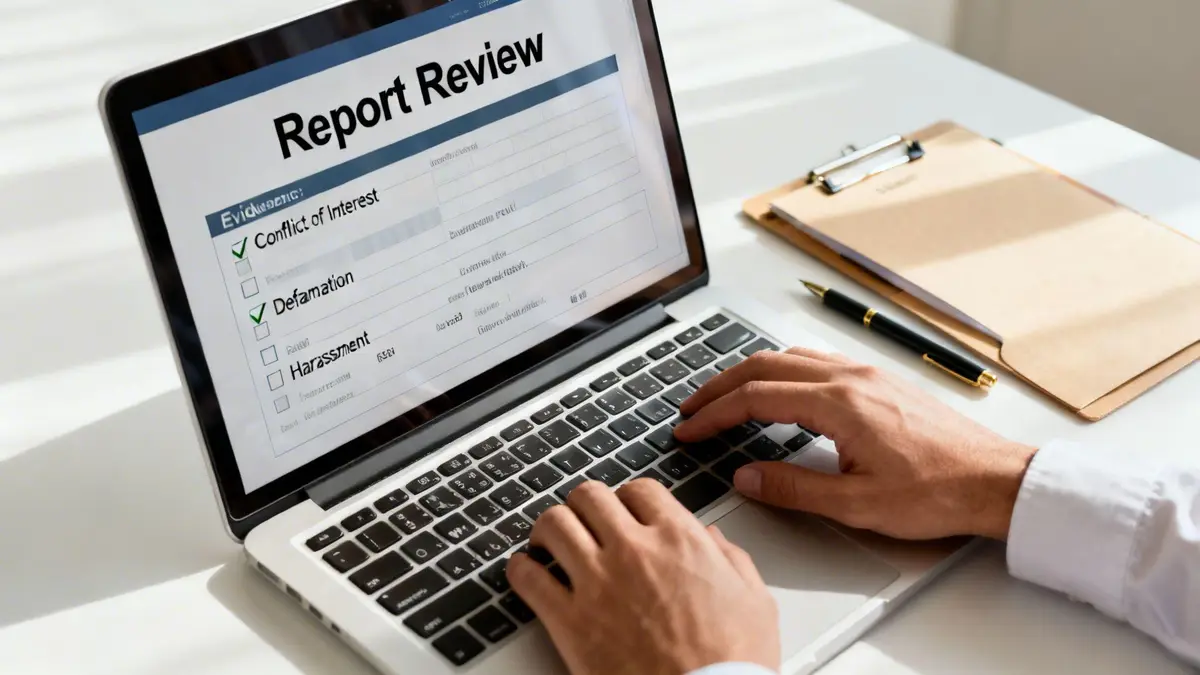
The initial tactical step for addressing a damaging Yelp review is to utilize the platform’s designated reporting tool. Success, however, is not a matter of simply clicking “report.” It requires the construction of a case that leaves Yelp’s moderators no room for subjective interpretation.
The critical mind-shift is from “This is unfair” to “Which specific rule does this review break?” Each report must function as a precise, evidence-backed argument that directly cites a violation of Yelp’s Content Guidelines. Vague or emotional complaints are systematically ignored.
Isolating the Specific Violation
Before initiating a report, you must possess a working knowledge of Yelp’s rulebook. The objective is not to debate service quality but to identify an undeniable breach of their terms.
The task is to connect the reviewer’s language directly to Yelp’s policy. For instance, a negative review from a disgruntled ex-employee constitutes a clear conflict of interest. A review that fabricates a factual claim, such as alleging a professional services firm mishandled client funds, enters the territory of defamation.
Common and actionable violations include conflicts of interest (reviews from employees, competitors, or paid parties), harassment or hate speech, privacy breaches (posting full names or private contact information), and irrelevant content that does not pertain to a consumer experience.
When composing the report, present a legalistic argument, not a narrative. State the violation (e.g., “This review represents a conflict of interest”) and then provide the exact quotation from the review that serves as evidence. The submission must be concise and direct.
Assembling Corroborating Evidence
Once the violation is identified, the next step is to gather documentation. Yelp’s moderators, both algorithmic and human, respond to objective proof, not emotional pleas. The report must be dispassionate and irrefutable.
Consider a review that falsely accuses your business of illegal activity. This is not a mere opinion; it is a defamatory statement of fact, and Yelp treats such allegations with greater seriousness. For these high-stakes scenarios, structuring the claim is paramount. We have previously outlined this framework in our detailed guide on how to report a defamatory website.
If the review originates from a terminated employee, the evidence-gathering protocol is straightforward. First, you must identify the reviewer through profile details or internal knowledge. Second, you gather internal records, such as employment dates and termination paperwork, to confirm the conflict of interest. Finally, you submit the report, stating simply: “This review was posted by a terminated employee, violating Yelp’s policy on conflicts of interest.”
Bypassing Automated Gatekeepers
The initial report will almost certainly be reviewed by Yelp’s AI. These automated systems are programmed to detect keywords and patterns corresponding to policy violations. A report that is unfocused, emotional, or fails to cite a specific rule will likely be rejected before human review.
To bypass this filter, the initial report must focus on the single most egregious violation. Should the automated system deny the request, an appeal to a human moderator is often possible. This is the stage to present the more detailed documentation you have prepared. When escalating to a human, the strategy remains the same: connect the review directly to a specific rule and present objective proof. This methodical, evidence-first approach is the only reliable method for removing a fraudulent or malicious Yelp review.
Investigating Fraudulent Reviews and Coordinated Attacks
When reporting a single review proves insufficient, a more sophisticated analysis is required. This occurs when dealing with coordinated attacks or fabricated reviews designed to manipulate a business’s rating.
In these circumstances, you must transition from a passive reporter to an active investigator. The objective is to gather definitive proof that the reviews are not from legitimate consumers, thereby building a case so compelling that Yelp’s moderators are obligated to conduct a deeper investigation.
Identifying Indicators of Inauthentic Reviews
Experienced business leaders develop an instinct for reviews that lack authenticity. Fraudulent reviews almost invariably leave a trail of digital indicators. While a single anomaly may be coincidental, a confluence of red flags strongly suggests a manufactured campaign.
Analysis must extend beyond the star rating to the content and context of the review. Key indicators include vague, superlative language lacking specific details of a consumer experience. Real customers provide particulars; fakes rely on hyperbole like “worst company ever” without substantiating the claim.
Another powerful indicator is a suspicious reviewer profile. A new account with a generic name, no profile picture, and a history consisting of one or two uniformly negative reviews is a classic sign of an account created for malicious purposes. Legitimate Yelp users typically exhibit a more diverse review history.
Finally, review timing and velocity are critical. A sudden influx of negative reviews on a profile that previously had a steady, organic pace is a primary sign of a coordinated attack, not a random surge of customer dissatisfaction.
Documenting a Pattern of Abuse for Yelp
Upon identifying these patterns, comprehensive documentation is essential. You are not reporting a single review; you are building a case that demonstrates a pattern of platform manipulation. This evidence is your primary tool for removal and is also critical should the matter escalate to a legal footing.
Maintain a spreadsheet or secure document to log each suspicious review. For each entry, capture the reviewer’s name and a direct link to their Yelp profile, the date and time of the post, the complete text of the review verbatim, and a brief analysis of why it is suspect (e.g., “Vague language, no specifics,” “New profile, 1 review history,” or “Part of 5-review negative spike on 10/26”).
The goal is to present Yelp with a clear pattern of manipulation. One suspicious review is easily dismissed. Evidence of five new accounts created on the same day, all posting similar, unsubstantiated one-star reviews, tells a story of platform abuse that compels investigation.
The Challenge of AI-Generated Content
Artificial intelligence has introduced a new layer of complexity to identifying fake reviews. AI can generate grammatically perfect, plausible-sounding reviews, making them more difficult to detect than their manually created predecessors.
However, even sophisticated AI reviews have a flaw: they lack the nuance of a genuine human experience. They may be polished, but they are often sterile and devoid of the specific, sensory details that authenticate a personal account.
Yelp is actively combating this trend. In 2025, the company announced the removal of approximately 500,000 reviews suspected of being AI-generated. This is in addition to the 24% of all submissions already blocked by its automated filters. More data is available regarding Yelp’s ongoing efforts to ensure review integrity.
When you suspect an AI-generated fake, articulate this in your documentation. Note how the review, despite its polished prose, is hollow and lacks the specific anecdotes a real person would include. This analysis provides Yelp with concrete evidence that aligns with its own mandate to fight fraudulent content.
Advanced Mitigation Strategies and Legal Recourse
When standard reporting fails, advanced strategies are required. The decision to respond publicly, engage privately, or explore legal options carries significant reputational and financial consequences. A misstep can escalate a contained problem into a public crisis.
The common impulse to post a public reply is often a strategic error. For a prominent brand or executive, a public response frequently amplifies the negative review and validates the complaint. A public comment is advisable only in rare instances where a calm, factual correction can definitively neutralize the claim without appearing defensive.
The Calculated Risk of Public and Private Engagement
Directly contacting a reviewer can be a viable, albeit risky, option. A private message, handled with absolute professionalism, may resolve the issue. The communication must be framed as a customer service inquiry, not a confrontation. The objective is to understand the experience and, where appropriate, offer a resolution.
This approach requires extreme caution. A poorly phrased message can be publicly disseminated, creating a secondary reputational problem. All outreach must be concise, non-accusatory, and focused on de-escalation. For high-profile individuals, we advise that a neutral third party, such as legal counsel or a specialized firm, handle such communications to maintain professional distance.
Before responding, it is critical to determine if you are dealing with a legitimate customer or a fraudulent actor. This decision tree can help identify the red flags.
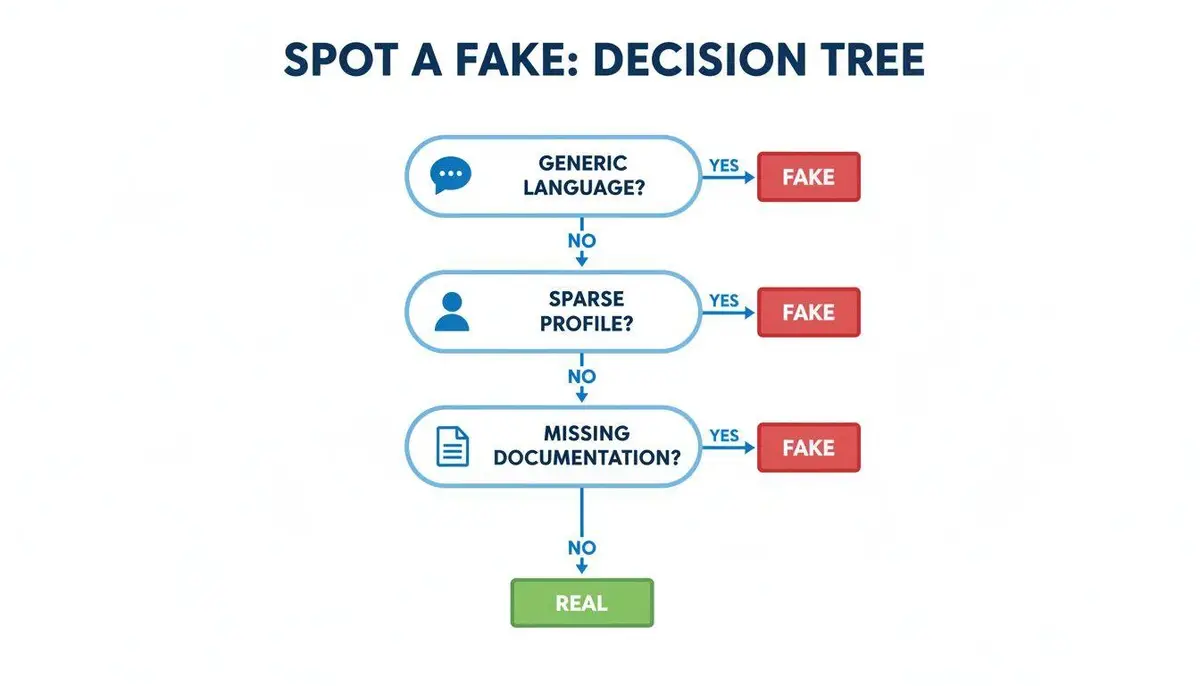
The strategy for engaging a legitimate but unhappy customer is entirely different from the strategy for countering a malicious or fabricated attack.
Defining the Threshold for Legal Action
When outreach fails or is too risky, legal action becomes the final and most powerful option. This is reserved for severe cases where a review causes tangible harm.
The legal case will depend on the doctrine of defamation. The core issue is whether the review contains a false statement of fact that damages your reputation. A review stating, “The service was poor,” is a protected opinion. A review stating, “The company engages in fraudulent billing,” is a statement of fact. If false, it constitutes defamatory libel.
The legal standard for proving defamation is exceptionally high. You must prove the statement is false and that it caused measurable damages, such as documented lost revenue or quantifiable harm to your professional standing.
Prior to litigation, the standard procedure is to issue a cease and desist letter from legal counsel. This formal notice demands the removal of the defamatory content and signals your intent to pursue legal remedies, often resolving the matter without court proceedings. For a strategic analysis of this process, our guide on evaluating online defamation of character lawsuits for executives offers further detail.
Assembling Evidence for Legal Intervention
Should you proceed with legal action, the case will be determined by the quality of your evidence. Immediate and methodical documentation is paramount.
First, preserve the review with clear, timestamped screenshots of the post, the reviewer’s profile, and all associated commentary. Second, gather documentation that directly contradicts the reviewer’s claims, such as business records, security logs, witness statements, receipts, or internal communications. Third, demonstrate harm by connecting the review to actual damages, including financial statements showing a revenue decline or correspondence from clients citing the review as a reason for terminating a relationship.
You are building a case that the statement was both false and damaging. Yelp’s own data indicates that 9% of reviews are permanently removed by its moderators. By meticulously documenting a review’s falsity, you align your efforts with Yelp’s stated interest in platform integrity.
Ultimately, removing a single review is one component of a broader reputational defense. A robust long-term strategy involves proactive online presence management to build a bulwark of positive content, as detailed in these 8 Simple Online Reputation Management Tips.
Engaging a Specialist Content Removal Firm
When you have exhausted all standard protocols (reporting the review, attempting contact, and considering legal correspondence) and the damaging content remains, it is time to engage a specialist.
This is a distinct discipline from public relations or traditional legal services. PR firms manage public perception; law firms operate within the protracted and unpredictable legal system. A specialist content removal firm is exclusively focused on one outcome: securing the removal of the targeted content. We intervene to solve the problem directly, employing proprietary methods and established relationships that are not accessible through public channels.
The Specialist Engagement Protocol
The process begins with a confidential, detailed assessment of your specific situation. We analyze the review, the profile of the poster, and the context of the incident to determine if it is an isolated event, a coordinated campaign, or a more complex threat.
This initial analysis allows us to develop a bespoke strategy that circumvents the limitations of Yelp’s standard moderation system. We identify the most effective angles of attack and determine the optimal sequence of actions to expedite removal.
Once engaged, our team manages the entire process discreetly. You will have no further interaction with Yelp or the reviewer; we handle all communications behind the scenes.
Our value proposition is speed and certainty. A business owner can lose weeks navigating Yelp’s automated system and appeals. We can often escalate a case to the appropriate decision-makers within 24-48 hours, collapsing the timeline for resolution.
Navigating Complex and Ambiguous Cases
The expertise of a specialist firm is most evident in complex situations where a review does not violate a clear-cut policy. These are the cases where standard approaches fail.
Consider these common scenarios:
An individual using a pseudonymous profile posts a fabricated and reputationally devastating story. Litigating against an anonymous party is a costly and often futile exercise. We employ investigative techniques and back-channel communications to address the content at a higher level.
A sudden wave of one-star reviews appears from new profiles with no other activity. This is a clear indicator of a coordinated attack, but reporting each review individually is an ineffective strategy. We consolidate the evidence, prove the pattern of platform abuse, and present a single, comprehensive case for mass removal.
A review masterfully uses insinuation, mixing negative opinion with subtle falsehoods to imply misconduct. This content is specifically designed to evade Yelp’s standard moderation. Our experts perform a linguistic and contextual analysis to build a case based on implied violations that a typical user cannot effectively argue.
In these situations, our long-standing relationships with platforms like Yelp are critical. We are not another user submitting a report; we are a known entity that brings credible, well-documented cases. This allows us to bypass front-line moderation and present the issue directly to senior personnel with the authority to render a final decision.
At this level, the question evolves from “can you remove a Yelp review” to how quickly and discreetly the problem can be resolved. For our clients, that is the only metric that matters.
Frequently Asked Questions About Yelp Review Removal
When your reputation is at stake, you require direct answers, not speculation. Here are concise responses to the most critical questions from our clients.
How Long Does It Take to Remove a Yelp Review?
The timeline for removal is highly variable and depends entirely on the chosen strategy.
Utilizing Yelp’s standard reporting function places you on their timeline, which can range from days to weeks. A denial from their automated system, a common occurrence, necessitates an appeal to a human moderator, further extending the process while the damaging content remains public. Attempting to argue complex legal issues like defamation without a court order can prolong the process indefinitely.
Engaging a specialist is designed to circumvent these delays. Our process leverages established channels to escalate cases beyond front-line moderation.
We can typically bring a case before the necessary decision-makers within 24 to 48 hours. While no outcome can be guaranteed, this approach condenses a process that takes most individuals weeks into a matter of days.
Can I Sue Someone for a Negative Yelp Review?
Yes, you can initiate a lawsuit over a Yelp review. The more important question is should you?
Litigation is public, expensive, and carries a high burden of proof. The legal system protects freedom of speech, which includes the right to express a negative or even unfair opinion.
To succeed in court, you must prove defamation. This requires demonstrating that the review contains a false statement of fact that caused you tangible, measurable harm.
Consider two examples:
- Opinion (Not Defamatory): “The CEO is arrogant, and the company’s service is terrible.” This is subjective opinion and is not actionable.
- False Statement of Fact (Potentially Defamatory): “The CEO was convicted of fraud in 2022.” If this statement is untrue, it crosses the line from opinion to a specific, damaging, and false assertion of fact.
The burden of proof rests entirely on you. You must provide dispositive evidence that the statement is false and directly caused financial loss or professional harm. For public figures, the standard is even higher, requiring proof of “actual malice”, that the reviewer knew the statement was false or acted with reckless disregard for the truth.
A lawsuit is the final option, not the initial strategy.
Does Responding to a Review Help or Hurt My Case?
Publicly responding to a negative review is a high-risk, low-reward maneuver that can easily exacerbate the situation.
In our experience, a public response generally causes more harm than good. It increases the visibility of the negative review by elevating it in the activity feed. It also signals to the reviewer that they have impacted you, potentially provoking further engagement. A defensive or emotional reply can be screenshotted and used against you, creating a new, self-inflicted reputational problem.
The only circumstance in which a public response may be warranted is if the review contains a clear factual error that can be disproven calmly and concisely. The tone must be impeccably professional, unemotional, and directed at correcting the record for other readers, not at engaging the original reviewer.
As a rule, the most prudent initial response is strategic silence. Never reply in the heat of the moment. If a response is deemed absolutely necessary, it should be drafted by a neutral third party, such as legal counsel or a reputation specialist, to eliminate all emotion.
In high-stakes scenarios, the objective is not to win a public debate. It is to make the problem disappear quietly and completely.
When Yelp’s internal processes are insufficient to protect your reputation, a different course of action is required. ContentRemoval.com provides a confidential, direct path to resolving these critical issues. If you are facing a serious reputational threat on Yelp or any other platform, contact our team for a confidential assessment.