
Reputation management for wellness founders is the work of controlling what appears when a buyer, journalist, retailer or investor searches the founder’s name, and removing the press stories, screenshots and accusations that sit there. In wellness the founder is the product. Damage to the person is damage to the company, immediately and measurably.
Most wellness businesses are built on one person’s story. The recovery, the diagnosis, the career change, the protocol that worked. That story is why people buy, and it is also why a single article about the founder’s past, a business dispute, or a former client’s public complaint does more commercial damage here than in almost any other category. There is no corporate brand to hide behind. There is a face, a name and a search results page.
This guide sets out what actually attacks a wellness founder’s name, which routes reach each type of content, what the sequence looks like, and what to do when a story has already been syndicated across four markets before you have finished reading it.
What is reputation management for wellness founders?
Reputation management for a wellness founder is the combination of removal, de-indexing and monitoring applied to a named individual whose personal credibility is the company’s main asset. It differs from brand-level work in three ways.
The first is that the target is a person. Personal privacy and data protection routes apply to a founder in ways they do not apply to a company, and in several jurisdictions those routes are the strongest tool available against an old article. The second is that the content is emotional rather than transactional. A one star product review is a commercial problem. An article about a founder’s divorce, bankruptcy, past conviction or falling out with a business partner is a character problem, and readers treat it as disqualifying rather than disappointing. The third is speed of spread. Wellness audiences screenshot. A paragraph from a tabloid lifestyle desk becomes an Instagram story, then a repost account, then a Reddit thread, then a “the truth about” video, inside a week.
The practical objective is therefore not to publish more positive content. It is to remove the source items where a route exists, break the syndication chain before it hardens, and reduce the search visibility of what survives.
What content actually damages a wellness founder?
National press stories about the founder’s past. A business collapse from a decade ago, a court matter, a family dispute, a former career the founder has moved on from. These pieces are written once and then rank for the founder’s name indefinitely, because nothing else about the founder carries a national publication’s domain authority.
Television network websites and tabloid lifestyle desks. Wellness sits in the lifestyle section, which is the fastest moving and least corrected part of any newsroom. A piece written in an afternoon can outrank a decade of work, and the desk that wrote it often has no memory of it a month later.
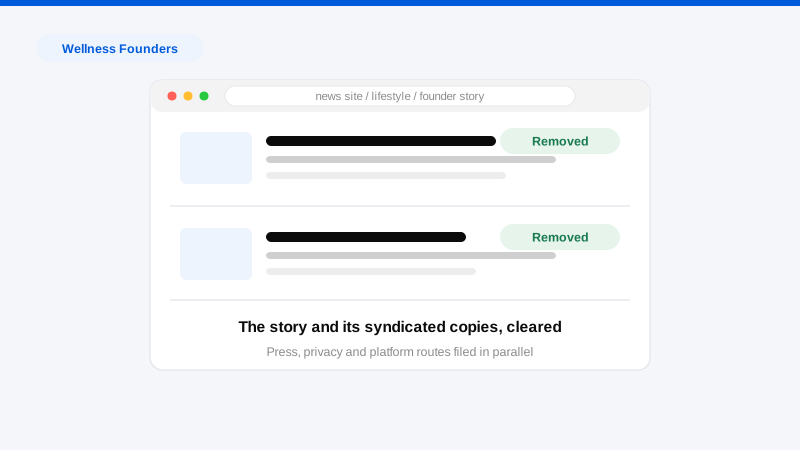
Syndicated copies. This is the part founders underestimate. One story appears in a parent title, then in three sister titles, then in aggregators, content farms and translated versions. Handling the original alone leaves the copies ranking. Our page on removing news articles covers how the original and its copies are treated as separate matters, and there is a dedicated page for the Australian ecosystem at removing a news.com.au article, where syndication across a network is the norm rather than the exception.
Instagram screenshots and repost accounts. Screenshots strip context by design. A caption written for an audience that knows you reads very differently when a gossip account crops it and adds a line. These accounts are usually anonymous, frequently in breach of platform policy on harassment and impersonation, and often reachable.
“Scam” accusations against programmes and protocols. Once a founder sells a programme, the accusation shifts from “this did not work for me” to “this is a scam”. The claim tends to arrive in clusters: a Reddit thread, a review site page, a video, and an affiliate blog that exists only to rank for your name plus that word. The mechanics are identical to what we describe in reputation management for supplement brands, and the same removal-first sequence applies.
Ex-client reviews and dispute posts. Coaching relationships end badly sometimes. Where the account is honest, it usually stands. Where it contains false statements of fact, private information, or was posted by someone who was never a client, there are routes.
Which removal route reaches which problem?
Every item has to be assessed on its own facts, and the honest answer for a national newspaper article is different from the honest answer for a repost account or an affiliate page built to rank for your name plus one word. Which of them is reachable, and on what basis, is exactly what the Exposure Scan establishes. Timelines depend on the item, the publisher and the platform, and they are set out in writing after the scan rather than promised on a call.
What we will say in general terms is that a founder is a person rather than a company, and personal privacy and data protection rights are the strongest single advantage a founder has against old coverage. Platforms and publishers still decide their own cases. Any firm that tells you otherwise is selling you something it does not control.
Get a Free, Confidential Exposure Scan
How does a founder engagement actually run?
It starts with the scan. We map everything attached to the founder’s name and the business name: press, syndicated copies, social screenshots, review pages, video and the answers AI assistants are giving about you. You get the findings on a 15-minute call and the written report is yours to keep whether or not you engage.
From there we tell you which items are genuinely reachable, which will only ever be a search problem, and which are better left alone, because filing against honest opinion wastes credibility that the items that matter will need. Then we work every ground that applies, at the source and in the search results, at the same time rather than one at a time. Results are verified, evidenced to you and monitored afterwards, because reuploads, fresh screenshots and refreshed affiliate pages are normal in this sector and the next one should be caught in hours rather than discovered by a retailer six months later.
Who normally makes first contact?
Sometimes the founder, usually late at night, on the day something publishes. Often it is someone acting for them: a chief of staff, an operations lead, a PR agency that has already tried the editor, or a lawyer who wants the search results handled while the legal position is being decided. All of those are normal starting points here, and we are used to working as one part of a team rather than the lead adviser.
We work alongside counsel, PR and security teams routinely. Confidentiality agreements are standard, we do not disclose client names, and nothing about an engagement is ever made public. There is an anonymised wellness founder case study that shows the shape of this kind of matter without identifying anyone.
Why does publishing more content not fix this?
Because the buyer is not reading sequentially. She is searching your name, or your name plus a word she has already been given, and reading what ranks for that exact query. Your new podcast appearance does not compete with a national title’s article for that query, and it never will.
There are three further reasons the content-first approach fails wellness founders specifically. Screenshots survive de-ranking entirely, since they live in DMs and stories rather than in search. AI assistants read the whole web rather than the top of it, so a hostile page that has been pushed to position eleven still feeds the answer someone gets when they ask about you, and retail buyers, gym chains, brand partners and investors do not stop at page one. They search deliberately, and they are looking for exactly the thing you hoped to bury.
Removal at the source is the only outcome that cleans search, screenshots and AI answers at the same time.
What about the business, not just the founder?
They separate less than founders expect. The company’s search results carry the founder’s press, and the founder’s name carries the company’s reviews. In practice we run both together, which is why this work overlaps heavily with what we describe in reputation management for fitness brands and, where a founder also coaches, reputation management for personal trainers.
Frequently asked questions
Can a national newspaper article about me actually be removed?
Sometimes, and more often than people assume. Accuracy complaints, privacy and data protection routes and right to be forgotten applications all reach published articles, and the outcome depends on the publisher, the jurisdiction, the age of the piece and whether there is a factual error to work with. What is far more often achievable is removing the piece from search results for your name, which removes most of the commercial damage even when the article itself stands. We assess the specific article before saying anything about its chances.
The same story ran in five publications. Do we have to fight them all?
They are handled as separate matters, but they are not equally difficult. Syndicated copies are frequently easier than the original, because the licensing outlet has less invested in the piece and often no editorial stake in it at all. We normally work the copies first, both because they move faster and because a shrinking footprint changes the conversation with the primary publisher.
An anonymous Instagram account is posting screenshots of my captions with commentary. Can that come down?
Often, yes. Anonymous repost and gossip accounts routinely breach platform rules on harassment, impersonation and private information, and where the images are yours there is a copyright route as well. The account itself is a legitimate target, not just the individual posts, because taking down posts one at a time on an account that posts daily is maintenance rather than a solution.
A former client is posting about a dispute we had. What can be done?
It depends entirely on what they are saying. An honest account of their own experience generally stands, and we will tell you that plainly rather than take money to file something that fails. Where the post contains false statements of fact, private information, confidential material or content posted under a false identity, there are routes. The assessment is the first thing we do, and it is part of the free scan.
How discreet is this, and can someone else handle it for me?
Completely discreet, and yes. Confidentiality agreements are standard, we never disclose client names, and a large share of our work is briefed by a chief of staff, an agency or a lawyer rather than by the person the content concerns. The engaging party does not have to be the individual named in the content.
What does it cost?
You get a written quote after the free Exposure Scan, once we have seen the actual links and know which routes apply to each one. Nothing is quoted before that, because a single syndicated story and a five year campaign across forums and video are not the same piece of work. The structure is explained on the 15-minute call and confirmed in writing.
If your name is currently attached to something you would rather buyers, partners and journalists did not find, the first step is knowing exactly what is out there and which parts of it are reachable. Book a free, confidential Exposure Scan. A specialist walks you through the live findings on a 15-minute call, the report is yours to keep either way, and if you decide to go ahead our process is set out in full before anything is filed.