Removing a news.com.au article means persuading News Corp Australia to unpublish, correct or anonymize it, or removing the article from the search results for the name. Deletion is the least common outcome. Correction, name removal, de-indexing and suppression settle most Australian press matters we are asked to look at.
Key facts
- news.com.au is the free national digital masthead of News Corp Australia, which also publishes The Daily Telegraph, the Herald Sun, The Courier Mail, The Advertiser and The Australian.
- Copy moves constantly across that network, so a story from a metropolitan masthead is often rewritten for news.com.au, where it reaches a larger audience and frequently outranks the original.
- Participating Australian publishers are subject to the Australian Press Council’s Standards of Practice on accuracy, fairness, balance and privacy, and the Council can uphold a complaint and require publication of its adjudication.
- The Press Council’s remedies are corrective rather than deletive, so an upheld complaint changes what the page says rather than removing it.
- Australia’s uniform defamation scheme, as amended from 2021, includes a serious harm element and makes a concerns notice a formal prerequisite to commencing proceedings.
- The limitation period for defamation in Australia is generally one year from publication, extendable by a court in defined circumstances.
- Australia has no general right to erasure of the kind that exists in the United Kingdom and Europe, so search level work in Australia stands on different ground and is harder than clients expect.
- The eSafety Commissioner administers statutory schemes under the Online Safety Act covering seriously harmful online material, which sit outside press regulation entirely.
Who publishes news.com.au?
news.com.au is the free national digital masthead of News Corp Australia, the country’s largest newspaper group. The same company publishes The Daily Telegraph in Sydney, the Herald Sun in Melbourne, The Courier Mail in Brisbane, The Advertiser in Adelaide and The Australian, and copy moves between them constantly.
This is the single most important operational fact about the site. A story that begins on a metropolitan masthead is frequently rewritten for news.com.au, where it reaches a much larger audience and often outranks the original. Fixing one URL and leaving the others live is the most common failure in Australian press work, which is why our Courier Mail and Sydney Daily Telegraph pages exist alongside this one.
What does removal actually mean here?
It means one of five outcomes. Unpublication takes the URL down. Amendment leaves the piece live and changes the text, the headline or both, usually to reflect an outcome the original never reported. Anonymization removes the name while keeping the journalism. De-indexing removes the page from search results for the name while the article stays online. Suppression leaves the article untouched and changes what a searcher sees first.
Australian mastheads treat their archives as a record of what was reported at the time. That makes amendment and name removal far more available than deletion, and it makes the search layer more important than it is in some other markets.
What is the complaints route for an Australian title?
The masthead’s own corrections and readers’ channels come first, and a documented, specific approach to the right desk is far more effective than a demand letter. Beyond the newsroom, print and digital publishers in Australia participate in self regulation through the Australian Press Council, which administers Standards of Practice covering accuracy, fairness, balance and privacy, and can uphold a complaint and require publication of its adjudication.
The Council’s remedies are corrective. It is not a mechanism for having an article deleted, and it has its own expectations about timeliness. So there is a route, and it is a narrower one than most people assume, which is why it is rarely the whole answer on an Australian matter.
What does Australian defamation law give you?
Australia has a uniform defamation scheme enacted state by state, and the amendments that began taking effect in 2021 introduced a serious harm element, so a claim must show the publication has caused or is likely to cause serious harm to reputation. The reforms also made a concerns notice a formal prerequisite to commencing proceedings, and the limitation period is generally one year from publication, extendable by a court in defined circumstances.
Australia does not have a general right to erasure of the kind that exists in the United Kingdom and Europe, so search level work here stands on different and narrower ground. That is worth knowing before anyone promises you a clean first page. We are not a law firm, and where a concerns notice is the right step we work alongside your Australian solicitors rather than in front of them.
Which route fits which article?
That is the judgment the engagement buys you, and it turns on facts specific to your article and to how far the copy has already travelled. Timelines depend on the route and on the masthead, and they are set out in writing after the free Exposure Scan.
Get a Free, Confidential Exposure Scan
How an engagement runs
We establish exactly what exists across the network, which is almost always more than the URL you sent. We tell you which of the five outcomes your facts genuinely support before you commit, including when the honest answer is that the source will not move. Then we pursue every ground that applies, at the source and in the search results, at the same time rather than one after another. Nothing goes to an Australian newsroom until you have approved it, because these mastheads will report on an attempt to suppress coverage. What comes back is verified, evidenced to you and monitored.
We have handled Australian founder and wellness sector matters of this shape, and one of them is written up as an anonymised case study on our wellness founder page. Broader country context sits on our content removal Australia page.
What we need from you to start
Australian newsrooms move on documents, not on tone. We ask first for the news.com.au URL, the publication date, and the URLs of every version you have already found on the group’s other mastheads, because the national rewrite and the metropolitan original are often worded differently and dated differently.
Then we ask for the record. If the article reported an allegation and the allegation went nowhere, the paperwork proving that is the single most useful thing you can send us. Where the concern is privacy rather than accuracy we ask what was published that was never public, and whether children are identifiable.
We also want everything already sent to the publisher, including anything the principal sent personally. Finally we need written authority to act for the named individual, normally signed by a chief of staff, in house counsel or an agency principal under a confidentiality agreement, so the individual never has to correspond with News Corp Australia directly.
Timelines and what usually happens first
The first few days are assessment rather than correspondence, and you see the recommendation before anything leaves. After that, timelines depend on the route and on the masthead, and you get ranges in writing item by item rather than a single date. Suppression is different in kind, because it is continuous rather than finished. The decision belongs to editors and platforms, and no adviser controls their calendar.
Common mistakes that make it harder
- Going after one URL. Leaving the metropolitan original or the national rewrite live is the most common failure in Australian press work, and the copy left standing is often the one ranking.
- Sending a concerns notice as an opening move. It is a formal step with legal consequences, it should be a decision of your Australian solicitors, and sent without serious harm behind it, it hardens the publisher and can generate fresh coverage.
- Talking publicly about the coverage. Australian mastheads report on attempts to suppress reporting, and a public complaint is itself a story.
- Contacting the journalist. The reporter does not set archive policy and cannot rewrite a headline.
- Deleting your own posts and profiles. It destroys context, removes evidence and takes down pages that were ranking usefully for the name.
- Paying anyone who offers to make it disappear. Nothing is delivered and the payment becomes a fact that can be published.
How this works alongside your lawyer, PR team or security team
Australian defamation is a specialist field and it belongs with Australian solicitors. Where a concerns notice is genuinely the right step, they lead it, and we run the editorial, syndication and search work around it so that the network copies and the search results are not forgotten while a formal process runs. Where the serious harm element plainly cannot be met, or the limitation period has run, we say so at assessment rather than letting the question stay open.
With PR advisers the division is straightforward. They handle what is said publicly and to whom. We handle what is filed, to which desk, on which ground, and what the search results look like afterwards. Coordinating those matters more in Australia than in most markets, because the media outlets are concentrated and a placed story in one masthead is read by the others.
With security teams, addresses, schools, vehicles, routines and images of a residence are treated as their own priority list. Those specific details are frequently removable even from articles that are staying online, and they are pursued first.
Who normally makes contact?
A chief of staff, a family office manager, a founder’s lawyer or the agency handling the account. The 15-minute call is a working conversation. We look at the article and its copies, say which of the five outcomes the facts support, and tell you plainly when the answer is that nothing useful can be done at the source. Confidentiality and an NDA are standard, our involvement stays invisible unless strategy dictates otherwise, and we work alongside counsel, PR and security teams. The report is yours to keep whether or not you engage us.
We do not promise outcomes. Some news.com.au articles stay up. The realistic question is whether the story still defines the first page of results in six months.
Frequently asked questions
Can a news.com.au article be deleted?
Occasionally, where it is materially wrong, where the subject was later cleared, or where the piece breaches the publisher’s own standards. It is the least likely outcome of the five and we will tell you at assessment if we think it is out of reach for your article.
Does the Australian Press Council order removals?
Its remedies are corrective rather than deletive. An upheld complaint typically results in a correction or the publication of an adjudication, which can be valuable in its own right because it changes what the page and the search snippet say.
The story was republished by the Herald Sun and The Courier Mail. Is that a separate job?
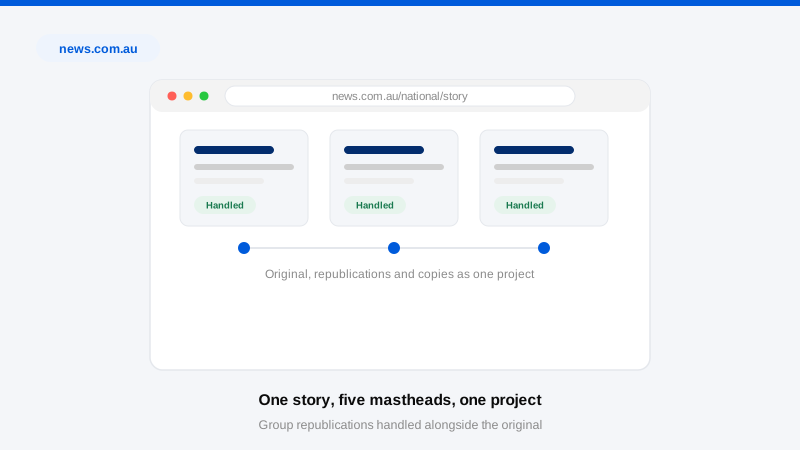
It is part of the same job. Group republications are handled together with the original, because a searcher does not care which masthead they land on.
Is a concerns notice a good idea?
Sometimes, and it is a decision for your Australian lawyers rather than for us. A notice sent without serious harm behind it can harden the publisher’s position and generate fresh coverage, so the sequencing matters as much as the content.
Can you get it out of Google if the publisher refuses?
Sometimes. Australia has no general right to erasure, so search level work rests on Google’s own policies and on locally recognised legal grounds. Where those apply, delisting for name searches often resolves the practical harm even though the article stays online.
Is news.com.au the same as The Australian or the Herald Sun?
They are separate mastheads under the same owner, News Corp Australia, with separate editorial teams and separate archives. Copy is shared and rewritten between them constantly, which is why a result on one does not carry across automatically and why the whole network goes on the map before anything is filed.
Can the eSafety Commissioner do anything about a news article?
Its statutory schemes are aimed at seriously harmful online material rather than at journalism, so it is not a route to a news article. Where the real damage is the pile on that follows publication rather than the piece itself, the picture changes, and that is one of the things the scan sorts out.
What happens to the comments and the social posts quoting the story?
They are treated as part of the same project. In a fast moving Australian story the material around the article frequently does more damage than the article, so it goes on the map at the Exposure Scan rather than being left running afterwards.
Start with a free, confidential Exposure Scan. It maps the article, its group republications and the search results around the name, and the written report is yours to keep. Our process sets out what happens next.