
Reputation management for telecom companies is the practice of controlling what customers, enterprise buyers, regulators, investors, and journalists find when they research a carrier, an internet service provider, or the executives who run one, and removing the damaging content that would otherwise define the brand before anyone speaks to a sales rep or reads an earnings release. Telecom operates under a handicap almost no other industry faces: the public is predisposed to believe the worst. A single viral billing complaint, a screenshot of a customer-service chat gone wrong, or a Reddit thread cataloging an outage does not need to be accurate, representative, or even recent to become the first thing a prospective customer sees. For an industry that sells long-term contracts, enterprise connectivity, and trust in critical infrastructure, what ranks in search results is not a marketing concern. It is a revenue and regulatory concern, and it compounds every quarter it goes unaddressed.
Most telecom executives already know their Net Promoter Scores trail nearly every other consumer category. What fewer appreciate is how that ambient resentment changes the mechanics of online reputation. Content attacking a telecom brand spreads faster, ranks longer, and attracts more pile-on engagement than equivalent content about almost any other business, because the audience wants it to be true. That asymmetry is exactly why generic reputation tactics fail in this sector, and why the carriers that protect their search results treat removal, not response, as the first line of defense.
Why telecom companies are targeted
Telecom brands sit at the intersection of universal usage, recurring billing, and infrastructure that occasionally fails in public. Every one of those characteristics generates hostile content at scale, and each type behaves differently once it is online.
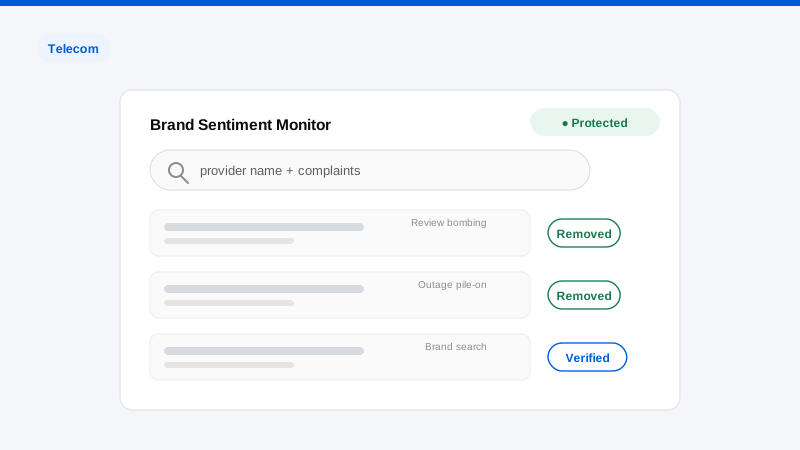
Billing complaints go viral because they are perfectly shaped for outrage. A screenshot of a disputed charge, an early-termination fee, or a promotional rate that expired is short, visual, and instantly relatable to millions of people who suspect they are being overcharged too. These posts routinely escape the customer’s own feed and land on aggregator communities, consumer-advocacy sites, and news roundups. Once a billing horror story is indexed under the brand’s name, it becomes permanent sales collateral, for competitors.
Outages trigger pile-ons that outlive the outage. When service drops, thousands of customers converge on the same hashtags, outage-tracker comment sections, and community forums within minutes. The service is usually restored in hours. The threads are not. Months later, a search for the brand plus a city name can still surface angry outage threads that read, to a prospective enterprise buyer evaluating reliability, like a pattern rather than an incident.
Review bombing punishes decisions customers dislike. Price increases, plan restructuring, merger announcements, and policy changes reliably produce coordinated waves of one-star reviews across Google Business Profiles for retail stores, app stores, and consumer-review platforms. Many of these reviews come from non-customers or duplicate accounts, but they blend into legitimate feedback and drag ratings down across an entire retail footprint at once.
Customer-service horror threads become evergreen search assets. Long-form posts describing a nightmarish support experience (hours on hold, contradictory answers, a cancellation that took months) perform extraordinarily well on forums and discussion platforms because they invite hundreds of “same thing happened to me” replies. That engagement signals value to search engines, which is why a five-year-old support thread can outrank a carrier’s own product pages for high-intent queries.
Executives are targeted personally. Telecom CEOs and regional leaders are named in complaint posts, tagged in outage rants, and profiled on gripe sites. During labor disputes, rate cases, or merger reviews, executive names attract activist attention, doxxing attempts, and attack content that follows the individual across every future board seat and speaking engagement.
Scammers exploit the brand’s name. Fake support numbers, phishing pages dressed as billing portals, and impersonation accounts promising “outage compensation” prey on the carrier’s own customers. When victims complain, they complain about the brand, adding another layer of hostile content the company did not create but must answer for.
What damaging content actually costs a telecom company
The cost of hostile search results in telecom is rarely a single dramatic loss. It is a continuous tax applied across every part of the business that depends on trust.
Enterprise and government procurement is where it bites hardest. Consumer churn is priced into the business, but B2B connectivity, managed services, and public-sector contracts are won through diligence processes in which procurement teams research the vendor, and its leadership, before a shortlist is ever drawn. A first page dominated by outage threads, billing scandals, and employee complaints gives a risk-averse evaluator an easy reason to score the bid down. No one tells the carrier why it lost; the search results already voted.
Regulators read the same internet everyone else does. Public utility commissions, telecom regulators, and attorneys general monitor complaint volume and press coverage when weighing rate cases, license renewals, merger approvals, and consumer-protection inquiries. A persistent cloud of visible, indexed complaints, accurate or not, shapes the narrative environment in which those decisions get made, and it arms interveners who oppose the company’s filings.
Churn and acquisition costs move with search results. Switching a carrier is a researched decision. Prospective customers search the brand plus “reviews,” “outages,” and “complaints” before committing, and hostile content at the top of those results converts undecided shoppers into a competitor’s customers. In a subscription business, a small shift in gross-add conversion or churn driven by search-visible negativity compounds into material revenue impact over a contract lifetime.
Talent and investor confidence erode quietly. Engineers evaluating offers read employer-review platforms and news coverage; analysts and institutional investors factor reputational risk into how they model regulatory outcomes and brand equity. Neither group announces that hostile content influenced them. It simply does.
The local layer multiplies everything. A national carrier is really hundreds of local reputations: every retail store, every regional market, every service territory has its own review profile and its own outage history. Damage at the local layer is where purchase decisions actually happen, and it is where centralized corporate communications teams have the least visibility.
Why generic PR and SEO approaches fail in telecom
The standard playbook (publish positive content, buy ads, respond to reviews, wait for the news cycle to move on) underperforms in telecom for structural reasons.
First, suppression is a losing arms race against engagement. Traditional SEO-based reputation work tries to push negative results down by ranking positive assets above them. But telecom complaint content earns continuous fresh engagement (new replies, new upvotes, new outages reviving old threads) which is precisely the signal search engines reward. A corporate blog post does not accumulate engagement the way a grievance thread does. The negative content keeps climbing back.
Second, responding often amplifies. Public replies to viral complaints add fresh activity to the thread, extend its life in feeds, and occasionally generate second-wave coverage about the response itself. Communications teams are trained to engage; in many of these situations, engagement is exactly what the content needs to keep ranking.
Third, the volume problem defeats manual effort. A national carrier can face thousands of new reviews, posts, and threads per week. In-house teams triage the loudest items and miss the quiet ones (the defamatory forum post, the fake support number, the executive gripe page) that sit undisturbed and rank for years.
Fourth, none of this addresses removability. A meaningful share of hostile telecom content violates platform rules, review policies, or the law: fabricated reviews from non-customers, coordinated brigading, impersonation, doxxing, defamation, scam pages using the brand’s trademarks. PR firms are not built to identify those violations or execute takedowns. That is a different discipline entirely, and it is the one that actually makes damaging content disappear rather than merely competing with it.
What removal-first protection looks like
Removal-first reputation management starts from a different premise: content that is gone cannot rank, cannot be screenshotted into a procurement memo, and cannot resurface during the next merger review. Content Removal approaches telecom engagements in four phases.
Assessment. The first step is a comprehensive audit of what actually exists, branded search results across national and key local markets, review profiles across the retail footprint, forum and community threads, complaint-site listings, impersonation and scam infrastructure, and the personal search results of named executives. Each item is classified by severity, visibility, and removability: does it violate a platform policy, a review-platform guideline, a law, or the rights of the company or an individual? A free, confidential Exposure Scan is how most telecom clients begin, because it converts a vague sense of “our search results are bad” into a prioritized inventory.
Removal. Removable content is pursued at the source through the correct channel for each item, platform policy enforcement against fake and brigaded reviews, terms-of-service action against impersonation accounts and scam pages, legal process where content is defamatory or publishes private information about employees or executives, and direct engagement with site operators where appropriate. This is specialist work: each platform has its own standards, evidence requirements, and escalation paths, and success depends on building the right case the first time.
De-indexing. Some content cannot be removed at the source, a hosting provider that ignores complaints, a complaint site designed to resist takedowns. Where content violates search-engine policies or applicable law, the next lever is removing it from search results themselves, so it stops appearing for the queries that matter. Content that exists but cannot be found has lost most of its power.
Monitoring. Telecom generates new hostile content continuously, so protection is not a one-time cleanup. Ongoing monitoring watches branded search results, review velocity across the retail footprint, executive names, and known attack vectors: catching review-bombing waves, new scam infrastructure, and emerging threads early, when removal is fastest and before rankings consolidate. Continuous coverage of this kind is what our Protection Plans are built for.
Removal-first does not mean removal-only. Suppression and positive-content strategies still have a role for accurate negative coverage that cannot legitimately be removed. But sequencing matters: remove what can be removed first, then compete with whatever genuinely remains. Most firms run that sequence backwards, and their clients pay to suppress content that could simply have been taken down.
Protecting telecom executives as individuals
The company’s reputation and the leadership team’s reputations are separate battlefields, and the second is more personal. A CEO, CFO, or regional president of a major carrier will be searched by name, by journalists during a rate case, by board-search firms, by activists during a labor dispute, by neighbors and their children’s schools.
Executive-targeted content in telecom follows predictable patterns: complaint posts that name the executive as the face of a billing policy, gripe pages and petition campaigns built around an individual, home addresses and family details published by data brokers and scraped-record sites, and hostile commentary that spikes around layoffs, price increases, and merger announcements. During contentious periods, this can escalate to doxxing and harassment that raises genuine physical-security concerns.
Protecting leaders requires a dedicated program: auditing each executive’s personal search results, removing exposed personal data from broker networks and people-search sites, taking down doxxing and harassment content, addressing defamatory attacks through the appropriate legal and platform channels, and monitoring executive names continuously so new threats surface within hours rather than after a journalist calls. This is the core of our digital executive protection practice, and for telecom leadership teams it is not a perk. It is a control against a threat model the sector reliably generates.
The reputational interests also compound each other. Hostile content about an executive weakens the company in regulatory and media contexts; hostile content about the company attaches permanently to the executive’s name. Protecting them together is more effective than protecting either alone.
The strategic case for acting before the next incident
Every telecom company will have another outage, another rate adjustment, another contentious quarter. The question is what the search landscape looks like when it happens. A company that enters an incident with a clean, monitored search profile absorbs the wave and recovers; a company that enters with years of accumulated hostile content watches the new incident merge with the old into a single, career-spanning narrative of failure.
The economics favor early action for a simpler reason too: content is easiest to remove before it ranks, before it is quoted, and before it spawns copies. A complaint thread addressed in its first week is one takedown. The same thread two years later may be an entrenched search result cited by a dozen other pages.
If you lead communications, legal, or the executive team at a carrier or ISP, the practical first step is knowing exactly what is out there. A free, confidential Exposure Scan maps the hostile content attached to your brand and your leadership, identifies what is removable, and gives you a factual basis for deciding what to do next, before the next pile-on decides for you.
Frequently asked questions
Can negative reviews of a telecom company actually be removed?
Reviews that violate platform policies frequently can be, including reviews from non-customers, coordinated review-bombing campaigns, duplicate or fake accounts, and reviews containing prohibited content. Legitimate reviews from real customers generally cannot and should not be targeted. The work is separating one category from the other and building policy-compliant removal cases, which is a specialist discipline rather than a form-filling exercise.
Our outage threads are months old. Do they still matter?
Yes, because search engines reward the engagement those threads accumulated, and enterprise buyers, journalists, and regulators searching your brand today will still find them. Old threads also get revived every time a new incident occurs, adding fresh activity that keeps them ranking. An assessment can determine which threads are removable, which can be de-indexed, and which need a different strategy.
Should our support team publicly respond to viral complaints?
Sometimes: but every public response adds engagement that can extend a post’s visibility and lifespan, so the decision should be case-by-case rather than reflexive. For content that violates platform rules or the law, quiet removal is usually the better outcome than a well-crafted reply. A specialist can help triage which posts warrant response, which warrant removal, and which warrant nothing.
How is this different from hiring a PR agency?
PR agencies shape narratives and place positive coverage; they are not built to investigate removability, execute platform takedowns, pursue de-indexing, or remove executives’ personal data from broker networks. Removal-first firms do that work, and the two functions complement each other. The failure mode is paying a PR retainer to talk over content that could have been removed outright.
What does protection look like for our executives specifically?
It typically includes a personal search audit for each named leader, removal of exposed home addresses and family data from people-search and broker sites, takedown of doxxing or harassment content, action against defamatory attacks, and continuous monitoring of each executive’s name. For telecom leaders (who become lightning rods during outages, price changes, and labor disputes) this is standard risk management, not vanity.