
Reputation management for politicians and public officials is the practice of removing unlawful and fabricated content (defamation, deepfakes, impersonation accounts, and doxxing) from the online record of people whose names are searched more intensely than almost anyone else’s. It is emphatically not the business of hiding legitimate scrutiny. Public officials answer to the public; journalism, criticism, opposition research grounded in fact, and uncomfortable coverage of their official conduct are the price and proof of a functioning democracy. What no official owes the public is submission to fabrication: invented quotes, synthetic videos, fake accounts speaking in their name, and the publication of their children’s schools and home addresses.
That distinction, between accountability and fabrication, defines this entire field, and it is being tested harder every cycle. Generative tools have collapsed the cost of producing convincing fake audio and video of any public figure. Impersonation accounts appear faster than platforms police them. Doxxing has migrated from fringe forums into routine political combat, and it reaches spouses, children, and staff who never ran for anything. The officials most exposed are often the least equipped: local and state officeholders, school-board members, and election administrators with no communications staff and no playbook.
This guide defines the actual threat landscape for politicians and public officials, what is at stake for them and for the offices they hold, and what professional, removal-first protection looks like, including the ethical boundary that any legitimate firm in this space must enforce against its own clients.
What reputation management for politicians covers, and what it must never cover
Reputation management for politicians and public officials, done legitimately, is confined to four categories of content:
- Defamation: false statements of fact: invented crimes, fabricated quotes, doctored documents presented as real. Not opinion, not harsh characterization, not accurate reporting of real conduct. Defamation removal is evidence work: documenting falsity and pursuing each platform’s removal pathway until the content comes down or is delisted.
- Deepfakes and synthetic media: AI-generated audio and video depicting an official saying or doing things they never said or did, including synthetic sexual imagery, fabricated “hot mic” recordings, and fake endorsements. Platform policies on manipulated media, and a growing body of law, provide removal grounds.
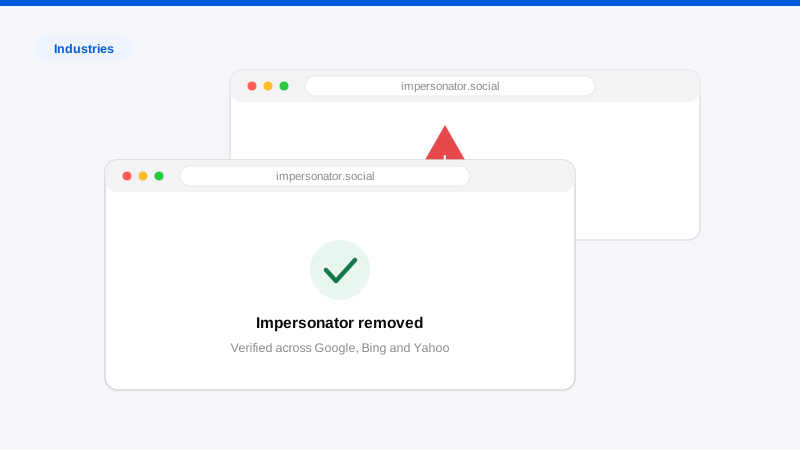
- Impersonation: accounts, pages, websites, and fundraising operations posing as the official or their campaign: issuing fake statements, soliciting donations, or manufacturing scandals in the official’s own voice.
- Doxxing and targeted harassment: publication of home addresses, family members’ identities, children’s schools, and personal contact details in threatening contexts, the category where reputation work becomes safety work, handled under cyber abuse removal.
Now the boundary, stated as plainly as it can be stated: we do not remove, suppress, or bury truthful reporting about a public official’s conduct, not investigative journalism, not accurate coverage of votes, statements, finances, or failures, not legitimate criticism however harsh. We decline that work when asked, and public officials do ask. That refusal is not a marketing line; it is the operating standard that makes the rest of the practice function, because platforms and search engines take filings seriously only from firms that never cry wolf. An official who wants embarrassing truths hidden needs a different strategy and a different vendor, and should know that suppression attempts against truthful reporting routinely backfire into bigger stories than the originals.
Why politicians and public officials are targeted
Public officials sit at the intersection of every force that generates fabricated content.
The incentive to fabricate is structural. Elections are adversarial by design, and while most political combat stays within lawful bounds, the payoff for a well-timed fabrication (a fake quote seeded days before a vote, a synthetic video released the weekend before an election) is enormous, and the accountability is nearly zero. Attribution is hard, timing is deliberate, and corrections never travel as far as the fake.
Synthetic media has democratized the attack. Producing a convincing fake video of a public figure once required resources; it now requires minutes. Officials are uniquely vulnerable because abundant public footage of their face and voice is exactly the training material synthesis tools need. Every speech, hearing, and interview an official gives expands the raw material for the next deepfake.
Impersonation pays twice. A fake account in an official’s name can manufacture a scandal (the official “said” something inflammatory) and harvest money (fake fundraising) simultaneously. Local officials are hit hardest: their constituents have no verified reference point, and platforms respond slowest to names they don’t recognize.
Doxxing has become political punishment. Election administrators, school-board members, public-health officials, judges, and municipal officeholders have all seen home addresses and family details published as retaliation for official acts. The intent is not speech but intimidation, driving people out of public service through fear that reaches their families.
Exposure outruns protection down-ballot. A member of Congress has staff, counsel, and platform contacts. A county clerk, a state legislator, or a school-board member has none of that, and faces the same deepfakes, the same impersonation, the same doxxing, with a search footprint small enough that a single fabrication can dominate their name for years.
Key takeaway: Public officials are targeted because fabrication is cheap, timing is decisive, and the subjects are maximally searchable. The attacks that matter are not criticism. They are counterfeits of the official’s own words, face, and identity.
See what's out there before it becomes the story.Free confidential Exposure Scan: live results on a 15-minute call, yours to keep either way.
Book Your Free ScanWhat’s at stake
The stakes run through distinct mechanisms: personal, institutional, and civic.
Elections turn on late-breaking fabrications. A deepfake or fabricated claim released in the final days of a race can reach the electorate faster than any correction, and voters who see the fake may never see the debunk. The mechanism is asymmetry of speed: fabrication propagates on outrage; correction crawls behind on diligence. For the candidate, there is no re-run. Removal speed, hours versus weeks, is therefore not a service metric; it is the whole game.
Careers carry the residue. Search results are a public official’s permanent record. Fabricated content that is never removed continues to surface in every future context: appointment vetting, board candidacies, private-sector transitions, and the ordinary searches of constituents and journalists. Officials leaving public life discover that the fake scandal follows them into it; the same personal-name discipline we apply to executives applies to former officials building second careers.
Families absorb the worst of it. Doxxing converts political disagreement into household fear: strangers with a home address, children identifiable by school, spouses harassed at work. Officials describe this (not criticism, not coverage) as what makes them consider leaving public life. The stakes are safety, and the response clock is measured in hours.
Fundraising and trust drain through impersonation. Fake fundraising operations divert donations and leave angry donors blaming the real campaign. Fake statements force the official to spend credibility denying words they never said, and every public denial teaches some listeners to doubt the real accounts too.
AI systems launder fabrications into answers. Voters increasingly ask AI assistants about candidates, and those systems synthesize whatever the open web contains. A defamatory post or debunked fake that still ranks can resurface, laundered of context, as a neutral-sounding AI answer about the official. Auditing and correcting what AI systems say about a public figure is now a core component of protection, alongside conventional search result work.
The civic stake is real, and it cuts both ways. When fabricated content drives officials from office or deters candidates from running, the public loses, and when officials abuse removal tools to hide real accountability, the public loses more. Both harms are answered by the same discipline: remove the counterfeit, never the record.
Key takeaway: For a public official, fabricated content is not a public-relations problem. It is an attack on elections, family safety, and the public’s ability to know what its officials actually said and did. The remedy is removal of fakes, never suppression of facts.
What professional reputation management for politicians looks like
Professional protection for politicians and public officials is removal-first, evidence-bound, and built for speed.
1. Baseline exposure audit. A complete map before anything is filed: branded search results for the official and immediate family, social platforms, video platforms, fundraising sites, and AI-generated answers about the official. The audit inventories existing impersonation accounts, circulating manipulated media, doxxing exposure (how findable is the home address, the children’s school?), and defamatory content already ranking. Candidates ideally run this before announcing, the fakes tend to arrive with the filing papers.
2. Classification against the boundary. Every item is sorted: fabricated versus factual, unlawful versus merely unwelcome. Defamation, synthetic media, impersonation, and doxxing go into the casework queue. Accurate reporting and legitimate criticism are identified as out of scope: explicitly, in writing, so the client knows exactly where the line sits. This classification discipline is what separates a professional firm from a suppression shop.
3. Rapid removal execution. For each qualifying item, the strongest available case is built and filed through the venue that adjudicates it: manipulated-media and impersonation reports with the evidence platforms’ policies actually require, defamation cases documented to the standard each venue credits, doxxing reports through the emergency channels platforms maintain for safety threats, host- and registrar-level escalation for fake fundraising sites, and search delisting where policies provide it. Venue fluency (knowing each platform’s standards, formats, escalation paths, and real-world response tendencies) is the difference between a takedown in hours and a form response in weeks. We are not a law firm; where legal action is the right tool, we work alongside campaign or personal counsel and say so plainly.
4. Family and staff coverage. Spouses, children, and senior staff are mapped and protected (data-broker exposure reduced, doxxing response pre-arranged) because attackers who cannot reach the official reach the household.
5. Continuous monitoring at political speed. Reputation monitoring across search, platforms, video sites, and AI outputs, tuned for the artifacts of fabrication: new lookalike accounts, sudden video uploads, coordinated posting patterns. In a campaign cycle, detection within hours is the goal, because content found early is content removed before it peaks. Standing coverage under a protection plan means the response team already holds the exposure map when the fake drops, no cold start at the worst possible moment.
6. Documentation throughout. Every fabricated item is preserved to evidence grade before removal, because campaigns, counsel, and in some cases law enforcement need the record even after the content is gone.
Why specialists beat DIY
Campaigns and officials routinely try to handle this in-house, and the failure modes are consistent.
Platform process rewards fluency, and elections don’t wait. Every platform maintains distinct standards for manipulated media, impersonation, defamation, and doxxing: different forms, different evidence, different escalation paths, all changing constantly. Specialists file across them daily and know which channel moves in hours versus weeks. A campaign staffer learning the process during the final stretch of a race is spending the one resource a campaign cannot recover: time.
Poorly built filings entrench the content. Venues triage requests; vague or overreaching first filings get templated denials and harden the platform’s position on the item. Worse, campaigns that reflexively report unfavorable-but-accurate content train platforms to discount everything they file, so when the genuine deepfake arrives, the campaign’s reports carry no weight. Filing credibility is cumulative, and it is precisely what a disciplined firm brings.
Public denial amplifies what quiet removal ends. The instinct to hold a press conference about a fake often does the attacker’s distribution for them. The professional sequence is removal first, and only then a public answer if one is still needed, a judgment call that depends on knowing how fast the removal pathway will actually move.
The official’s attention is the campaign’s scarcest asset. Every hour a candidate or senior staff spends fighting takedown queues is an hour off the trail. Specialist handling is not a luxury; it is division of labor under a deadline.
See what's out there before it becomes the story.Free confidential Exposure Scan: live results on a 15-minute call, yours to keep either way.
Book Your Free ScanWhy politicians and public officials choose Content Removal
Content Removal LLC is a removal-first firm with a bright ethical line, and in this sector the line is the value. We remove defamation, synthetic media, impersonation, and doxxing. We decline, categorically, work aimed at suppressing truthful reporting of an official’s conduct, and we put that boundary in writing at engagement. Officials choose us because of that line, not despite it: our filings are taken seriously by platforms and search engines precisely because we only file cases that belong in the queue, and in fabrication response, filing credibility converts directly into speed.
We work for officials across the spectrum, under strict confidentiality, with senior practitioners rather than ticket queues. Our assessments are blunt: we tell you which items are removable fabrications, which are delisting candidates, which require your counsel, and which are legitimate scrutiny we will not touch, before any commitment. We never promise outcomes; no honest practitioner can, and anyone promising a clean search page to a public figure is selling something else. What we commit to is the strongest available case on every qualifying item, filed through the fastest correct channel, pursued to conclusion, and documented to evidence grade. Our case studies show the discipline; our reputation management programs show how it runs as standing protection rather than crisis-only response.
For public officials specifically: candidate-baseline audits, deepfake and impersonation rapid response, doxxing and family protection, fake-fundraising takedowns, AI-answer auditing, and monitoring tuned to the speed of a news cycle.
Frequently asked questions
Can a politician get a deepfake video removed?
Manipulated-media policies at the major platforms, impersonation rules, and a growing body of law addressing synthetic depictions of real people all provide genuine removal grounds, and synthetic sexual imagery has the strongest pathways of all. Speed and case quality decide outcomes: the fake must be documented, the synthesis evidenced, and the filing made through the channel each platform actually staffs. Removal from primary platforms is realistic and often fast; complete eradication from every corner of the internet is not a promise anyone honest will make, which is why monitoring for re-uploads is part of the work.
What can be done when an official’s family is doxxed?
Doxxing sits in the safety category, and platforms maintain emergency channels for it that move faster than ordinary reports, publication of home addresses and family details in threatening contexts violates policy nearly everywhere, and often law. Professional response runs in parallel: emergency platform filings, host-level escalation for sites that ignore reports, data-broker suppression to cut off republication at the source, and evidence preservation for law enforcement where threats are involved. This is also the category where advance work matters most, reducing the household’s findable footprint before anyone comes looking.
Will a removal firm help bury negative news coverage about my record?
No: not this firm, and you should be wary of any firm that says yes. Accurate reporting about a public official’s conduct is legitimate scrutiny; attempting to suppress it is both wrong and, practically, a trap, suppression attempts against journalism have a long history of becoming bigger stories than the coverage itself. What we will do is remove what is actually false or unlawful around your name (fabricated quotes, synthetic media, impersonation, doxxing) which, for most officials, is a larger and more damaging category than they realized before the audit.
When should a candidate start, after an attack or before announcing?
Before announcing, for mechanical reasons: the baseline audit catches existing exposure (data-broker listings, dormant impersonation risks, old defamatory content) while there is time to address it quietly; monitoring is live from day one of the campaign, when fabrications tend to start; and the response team already holds your exposure map when the first fake drops. Fabrication response is a speed problem, and preparation is how speed is bought.
If you hold or seek public office, your name is being searched today, by voters, journalists, and the AI systems voters now ask directly. A free, confidential Exposure Scan shows you what they’re finding: live results on a 15-minute call, covering fabricated content, impersonation, and doxxing exposure for you and your family, yours to keep either way. Book it before the campaign calendar decides the timing for you.