
Reputation management for pharmaceutical companies is the practice of controlling what physicians, payers, investors, regulators, patients, and journalists find when they research a drugmaker, its products, or its leadership, and removing the damaging content that would otherwise define the company for audiences already primed to distrust it. Pharma operates with a structural handicap no other industry shares: it sells products people need but resent needing, at prices they see as evidence of bad faith, through a scientific process most of the public does not understand. Every search about a pharmaceutical company happens against that backdrop. The content that ranks does not merely inform the searcher’s skepticism. It confirms it.
This is why the industry’s reputation problem cannot be solved by communications alone. A pharmaceutical company can run flawless corporate messaging and still find its search results dominated by a pricing controversy from five years ago, a resurfaced FDA warning letter, conspiracy content that treats the company as a villain in a larger story, and coverage of a trial failure that reads, to a lay audience, as evidence of concealment rather than the normal operation of science. The visible record accumulates one-sidedly, because in pharma the negative is always news and the routine never is.
This guide is written for chief communications officers, general counsel, corporate affairs leads, and investor relations teams at pharmaceutical companies, and for the executives whose personal names increasingly absorb the public’s anger at the industry. It describes how hostile content actually accumulates around drugmakers, what it costs through mechanisms that rarely get attributed to search results, why the standard PR playbook underperforms against this threat profile, and what removal-first protection looks like when it is built for this sector.
Why pharmaceutical companies are targeted
Pharma’s threat landscape is broader than almost any other industry’s because the company is simultaneously a corporate actor, a scientific actor, a political symbol, and, in the conspiracy ecosystem, a character in other people’s stories.
Anti-pharma sentiment supplies a permanent, motivated audience. No other industry has a prefix. “Big Pharma” functions as shorthand for corporate malice across the political spectrum, which means hostile content about any drugmaker finds an audience that arrives already convinced. Content that would die quietly if written about a logistics company gets engagement, shares, and durable search placement when written about a pharmaceutical company, and engagement is what search algorithms reward.
Drug pricing narratives attach to the company name indefinitely. A single pricing decision (a launch price, an increase, a formulary dispute) generates coverage, advocacy-group campaigns, and social pile-ons engineered to rank for the company’s name. The narrative survives the underlying facts: prices come down, patient-assistance programs expand, and the “greed” framing remains the top result, resurfacing every time the company appears in the news for anything.
Trial failures and safety signals read as scandal to lay audiences. Clinical development fails constantly by design, but coverage of a halted trial, a missed endpoint, or an adverse-event signal is written and read as revelation. The scientific context, that this is how evidence works, never ranks. What ranks is the headline, and the headline follows the drug, the program, and the executives who fronted it for years.
Conspiracy content casts the company in stories it never joined. Vaccine conspiracies, suppressed-cure narratives, and depopulation fantasies name real companies and real executives. This content lives on video platforms, alternative social networks, and forums; it is prolific, coordinated, and increasingly sophisticated, and it leaks into mainstream surfaces, including the AI-generated answers that now summarize a company for casual searchers.
Regulatory artifacts resurface stripped of context. FDA warning letters, Form 483 observations, and consent decrees are public documents, and hostile actors excerpt them into evergreen content: “the FDA cited this company for…” An observation that was remediated a decade ago circulates as if current, because the remediation was never news and the citation permanently is.
Executives are targeted as the faces of the industry. Pharma CEOs absorb the public’s anger at drug prices personally. They are doxxed, impersonated, meme-ified, and named in conspiracy content; their compensation becomes an annual hostile-coverage event; their home addresses and family details circulate through data brokers into communities that regard them as legitimate targets. The industry’s political salience converts online hostility into genuine physical-security concern faster than in almost any other sector.
What damaging content costs a pharmaceutical company
The costs land through mechanisms that are concrete, traceable, and almost never traced.
Prescriber and payer perception shapes commercial performance. Physicians research companies and products; so do pharmacy and therapeutics committees, payer medical directors, and the consultants who advise them. A search page dominated by safety controversy, pricing anger, or manufacturing citations creates friction in every market-access conversation, friction no rep ever hears articulated, because “we saw the coverage” is never given as the reason.
Investor diligence prices the visible record. Biopharma investors run adverse-media screens as standard practice, and sell-side coverage incorporates controversy risk. Resurfaced regulatory content and unresolved hostile narratives widen the discount on everything the company says about its own pipeline. For an industry whose valuations rest on trust in management’s representations, search-page damage is a cost-of-capital problem.
Partnership and licensing diligence reads the same pages. Business development at potential partners screens reputation alongside science. A licensing counterparty weighing two comparable assets will feel the difference between a clean search page and one carrying fraud allegations or conspiracy contamination, and the company that loses the deal will never learn that was the margin.
Talent flight and recruiting friction compound quietly. The scientists and commercial leaders pharma needs have options, including options outside the industry. Candidates research; their families research; and a company whose search presence is an anthology of controversy pays a persistent premium in offers declined and searches extended.
Litigation and regulatory exposure feed on the record. Plaintiffs’ firms build mass-tort recruitment campaigns around indexed negative coverage, and their advertising then becomes part of the company’s search results, a self-reinforcing loop in which litigation content generates litigants. Regulators, legislators, and hearing staff prepare from the same visible record everyone else sees.
AI assistants now deliver the skeptics’ version as a summary. Ask an AI assistant about a pharmaceutical company and it synthesizes the indexed record (pricing anger, trial-failure headlines, conspiracy-adjacent framing included) into a confident answer. Patients ask before starting a therapy. Physicians ask. Journalists ask. The company is being summarized thousands of times a day by systems reading a record it has never audited.
Why generic PR and SEO approaches fail in pharma
Pharmaceutical companies are not under-resourced in communications. They are mis-resourced against this specific problem.
Suppression fails against emotionally-charged content. The standard SEO play, publish positive content until the negative sinks, assumes the negative has ordinary engagement. Anti-pharma content does not: it is shared, linked, and revisited by a motivated audience, which search algorithms read as enduring relevance. Corporate content about patient outcomes cannot out-engage outrage, and pretending otherwise burns budgets for years.
Corporate rebuttal amplifies conspiracy content. Responding to conspiracy narratives through official channels elevates them. It creates news coverage of the conspiracy, which creates more indexed content, which strengthens the association. The correct treatment for most conspiracy content is removal and de-indexing under platform policies, executed quietly, without the company’s fingerprints on the effort.
Regulated-industry caution slows response past the point of usefulness. Every external statement from a pharmaceutical company passes through legal, regulatory, and medical review, as it must. But hostile content compounds in hours, and a response cycle measured in weeks means the company always arrives after the content has hardened into permanence. Removal work through a specialist proceeds on the platform’s clock, not the company’s review calendar.
No internal function owns the whole surface. Corporate affairs owns press, legal owns defamation, security owns threats, IT owns impersonation, HR owns review platforms, and conspiracy videos, data-broker exposure, resurfaced 483s, and AI-answer drift fall between all of them. Removal-first reputation management treats the entire hostile-content surface as a single accountable problem.
What removal-first protection looks like
Removal-first protection starts from a simple premise: a damaging item that no longer exists, or no longer appears in search, outperforms any volume of positive content published on top of it.
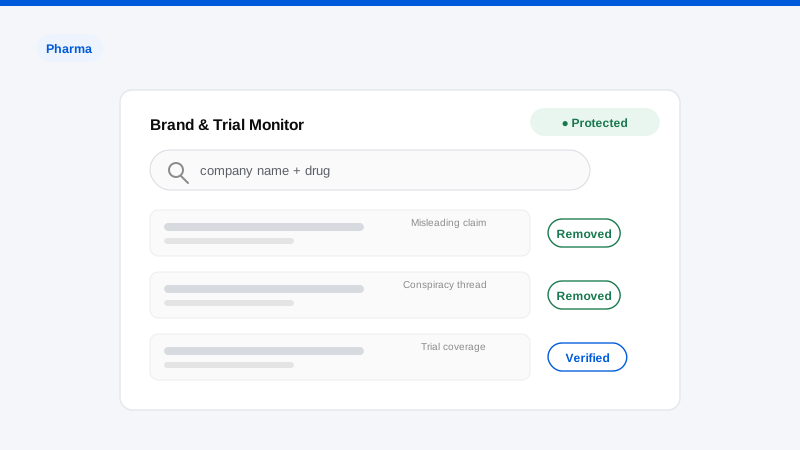
Assessment. The engagement begins with a full exposure audit across the company’s names, brand and product names, pipeline programs, and leadership: search results, news surfaces, video platforms, forums and social networks, review platforms, data brokers, and the AI-generated answers that now summarize the company to casual researchers. Each damaging item is classified by the path it is actually eligible for (removal at the source, de-indexing, correction, or containment) so effort goes where it will produce results. Most pharmaceutical clients begin with a free, confidential Exposure Scan, and the audit routinely surfaces exposure the internal teams did not know existed, particularly around executives and conspiracy-ecosystem content.
Removal at the source. A substantial share of the hostile content around pharmaceutical companies violates the policies of the platforms hosting it: defamatory posts, fabricated claims presented as fact, impersonation accounts, doxxed executive information, fake reviews, and coordinated inauthentic campaigns. Each category has a removal path, argued in the platform’s own terms, by specialists who have run the process at volume across thousands of matters. The honest caveat, stated up front: removal decisions belong to platforms and publishers, and no credible firm guarantees a specific item will come down. What specialists change is the probability, the speed, and how much of the target set falls.
De-indexing. Content that cannot be removed from its host can often be removed from search results: the layer where prescribers, payers, investors, and journalists actually encounter it. Search engines maintain de-indexing policies covering exposed personal information, doxxing, and other categories that apply frequently to content targeting pharma executives, and outdated-content pathways can address cached artifacts that misrepresent the current record. De-indexing closes the discovery path even when the underlying page persists.
Monitoring. Pharma’s hostile-content surface regenerates around catalysts: approvals, pricing announcements, earnings, safety communications, political news cycles. Continuous monitoring across search, social, video, forums, data brokers, and AI answers catches new items while they are one post rather than a narrative, and standing Protection Plans pair that monitoring with reserved removal capacity so response begins within hours. In a sector where content hardens into “what everyone knows” within days, speed is most of the outcome.
Protecting named executives as individuals
In pharma, the company’s controversies become the executive’s personal search results, and the executive’s exposure becomes a security problem in a way few industries match.
A pharmaceutical CEO’s name returns pricing-anger coverage, compensation stories framed as provocation, conspiracy content naming them personally, and, through data brokers, home addresses, family members, and travel patterns available to anyone sufficiently motivated. The industry has already seen public anger at healthcare economics converted into targeted violence, and every corporate security team in the sector now treats digital exposure as the leading edge of physical risk. The threat model is not hypothetical; it is the baseline.
Executive protection in the digital layer means treating each named leader as a distinct protected asset: systematic removal of personal data from broker networks before it can be weaponized, takedown of impersonation accounts and fabricated content, de-indexing of doxxed information, remediation of legacy items that predate the current role, and continuous monitoring of each name, including in AI-generated answers, where a model’s confident summary of an executive now functions as their public reference file. This is the core of our digital executive protection practice, and in pharma it properly extends beyond the CEO to the officer group, board members, chief medical officers who front safety communications, and in elevated-risk cases, executives’ families.
Companies that handle this well fund it through corporate security rather than communications, because it is a security function, and because the digital layer is where targeting begins.
Frequently asked questions
Can conspiracy content naming our company actually be removed?
Often, yes, more often than internal teams assume. Conspiracy content frequently violates host-platform policies on medical misinformation, harassment, impersonation, or fabricated claims, which creates removal paths that do not require engaging with the content publicly or identifying its authors. What cannot be removed can often be de-indexed or contained at the search layer. The assessment stage determines, item by item, which path each piece is eligible for before any effort is spent.
An old FDA warning letter keeps resurfacing in our search results. What can be done?
The letter itself is a public record and stays public, no legitimate firm will tell you otherwise. What is addressable is the ecosystem around it: hostile articles that misrepresent its current status, scraped copies on low-quality aggregators, outdated cached versions, and the ranking dominance of decade-old content over the current record. The realistic goal is that a researcher encountering the company today finds the accurate present, not a frozen version of its worst week.
Is negative coverage of a failed trial removable?
Accurate reporting on genuine clinical events is generally not removable, and we say so in the first conversation. What is achievable: removing defamatory distortions and pile-on content that goes beyond the facts, de-indexing eligible items, eliminating scraped duplicates that multiply the story’s footprint, and containing the coverage so it becomes one aging result rather than the defining answer for the program and its leaders. Assessment separates the removable from the containable before you spend anything.
Our CEO is being doxxed and threatened after a pricing announcement. How fast can removal work move?
Faster than most internal processes, because platform takedown paths for doxxing and threats do not wait on corporate review cycles. Exposed personal information, threatening content, and impersonation accounts are among the most tractable removal categories, and data-broker removal can strip the address-and-family layer that converts online anger into physical risk. Standing clients get response within hours of detection; that speed differential is most of the reason companies engage before a crisis rather than during one.
How do we start without committing to anything?
With a free, confidential Exposure Scan, a full map of the damaging content attached to your company, products, and leadership, reviewed live on a call, with the findings yours to keep either way. Most pharmaceutical clients are surprised by at least one category of exposure they did not know existed, and the scan is the fastest way to see what a removal-first program would actually target.
Every prescriber, payer, investor, and patient who researches your company this year will read a record you did not curate, and increasingly, an AI summary of that record you have never seen. Book a free, confidential Exposure Scan and find out what the skeptical market finds before it decides.