
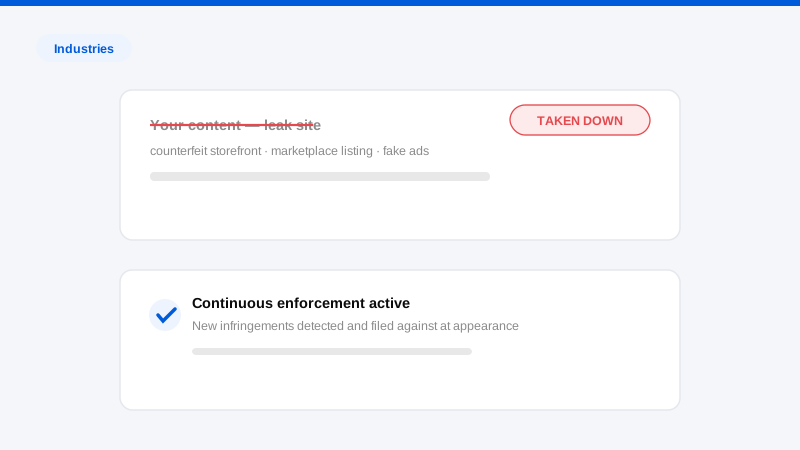
Reputation management for OnlyFans creators is the work of removing leaked content from the sites that traffic in it, breaking the links between a creator’s work identity and their legal identity, and shutting down the impersonation accounts that scam subscribers in a creator’s name. For most OnlyFans creators, this is not about vanity or brand polish. It is about privacy, safety, and income, keeping paid content off free sites, keeping a stage name from being connected to a real name, and keeping the creator’s family, employer, and community from being pulled into a part of their life they chose to keep separate.
If you’re reading this because your content has been leaked or your identity has been exposed, one thing is worth saying plainly first: what happened to you is a violation, it is distressingly common across the industry, and it is not a reflection of carelessness on your part. Leak sites and identity-exposure forums exist because stealing creators’ content and privacy is profitable, and they are built to make individual creators feel powerless against them. You are not. There are real removal pathways for almost every category of this harm. They are simply procedural, numerous, and exhausting to run alone, which is exactly why professional help exists.
This guide explains why OnlyFans creators are targeted so systematically, what is actually at stake beyond the obvious, and what removal-first professional protection looks like, so you can decide, with clear information, how you want to respond.
What reputation management for OnlyFans creators covers
Effective reputation management for OnlyFans creators runs on four tracks at once, because the harms arrive on four tracks at once.
Leaked content removal: getting stolen paid material off the aggregator sites, forums, and channels that republish it, and keeping it off through monitored re-enforcement rather than one-time sweeps.
Identity protection: removing content that links your stage name to your legal name, and breaking that link in search results so the two halves of your life stay separate.
Impersonation shutdown: dismantling the fake accounts that use your name and photos to scam the very subscribers your income depends on.
Continuous monitoring: watching your content, stage name, and real name across platforms and search so each new incident is caught in its first hours, when every removal pathway is at its strongest.
The rest of this guide walks through why each track is necessary and what professional execution looks like.
Why OnlyFans creators are targeted
The threats facing OnlyFans creators are industrialized in a way that most people outside the industry don’t appreciate.
Leak sites run on stolen subscriptions
Content leaks are not primarily the work of individual bad-actor subscribers acting on impulse. They are the supply chain of an ecosystem: aggregator sites, forum threads, and Telegram channels that systematically collect paid content and republish it for free, monetizing through ads, premium memberships, and traffic resale. New creator content is harvested continuously, sometimes within hours of posting, because the ecosystem’s business depends on freshness. This matters for how you respond: a leak is rarely a single site, and removing one copy without addressing the network is why so many creators feel takedowns “don’t work.”
Identity linking is treated as sport
A parallel category of harm targets not your content but your name. Forums and threads exist where users collaborate to connect creators’ stage identities to their legal ones, matching tattoos and backgrounds across photos, cross-referencing old social accounts, scraping data breaches, and publishing the results: real names, hometowns, workplaces, family members’ profiles. For creators who keep their work separate from their daily life, which is most creators, this is the single most feared scenario, because it converts a contained professional choice into an uncontrolled personal exposure.
Discovery risk extends to the people around you
The consequence of identity linking is that other people find out on someone else’s terms: a family member sent a link, an employer receiving an anonymous email, a creator’s content circulated in a hometown Facebook group or a school parent chat. Some of this is incidental; some is deliberate, targeted harassment: an ex-partner, a hostile acquaintance, or a forum user who treats outing creators as entertainment. Content used this way frequently crosses into nonconsensual-distribution territory, which carries some of the strongest removal pathways that exist, when they are invoked correctly and fast.
Impersonators monetize your subscribers
The same market forces that drive leaks drive impersonation: fake accounts using your photos and name on Instagram, TikTok, X, and dating apps, running “exclusive content” scams, fake subscription pages, and DM fraud against your actual and prospective subscribers. Every victim blames you, every scam page siphons revenue, and clusters of fakes crowd genuine search results for your name, a direct tax on the trust your business runs on.
Find out where your content actually is.The free, fully confidential Exposure Scan maps leaked content, identity exposure, and fake accounts, reviewed privately with a specialist in 15 minutes.
Book Your Free ScanWhat’s at stake
The harms here operate on two tracks at once, economic and personal, and they compound each other.
Income erodes as paid content goes free. Your subscription business depends on scarcity: content available only behind your paywall. Every leak site hosting your material is a free competitor to your own page, and the erosion is ongoing rather than one-time, as long as the content stays up, it keeps answering the question “why subscribe?” for people who would otherwise pay.
Search results for your real name become a permanent risk surface. Identity-linking content is dangerous specifically because it’s indexed. Once a real name is connected to creator content in search results, every future employer background check, landlord search, custody dispute, and curious acquaintance can surface it. This is the harm with the longest tail, and the one where early removal, before broad indexing, matters most.
Safety risks are real, not theoretical. Exposure of identity and location details brings stalking and harassment risk into physical space. Threads that publish a creator’s workplace, neighborhood, or family members’ identities are a category of abuse with urgent, expedited handling on major platforms and search engines, but only when someone reports them through the right mechanism with the right documentation.
The psychological weight is its own damage. Creators dealing with leaks and exposure describe the same experience: compulsively checking leak sites, dreading messages from family, unable to focus on the work that pays their bills. That toll is worth taking seriously in its own right, and it is also a practical argument for delegation, because the person being violated should not have to spend hours a day reading the sites violating them.
Silence around you is not protection. Many creators cope by not looking. The difficulty is that leaks and identity threads grow while unwatched, and the strongest removal pathways, particularly for nonconsensual distribution and privacy violations, work best early. Knowing what’s out there, through a scan you don’t have to conduct yourself, is materially safer than not knowing.
Key takeaway: Leaked content and identity exposure both worsen with time, spread compounds and indexing hardens. Every strong removal pathway available to creators works best early, which makes finding out what’s out there the single highest-value first step.
What professional protection looks like
Professional, removal-first protection for OnlyFans creators is a systematic operation across four fronts, run with the discretion this category demands.
Confidential exposure mapping. The work starts with a complete, quiet inventory: which leak sites and threads host your content, whether and where your identity has been linked, what surfaces in search for both your stage name and your real name, and what impersonation accounts exist across platforms. Creators are often braced for the worst here; sometimes the reality is smaller than feared, sometimes larger, either way, decisions get made from facts rather than dread.
Content removal at network scale. Leaked content is pursued through the mechanisms that fit each host: copyright enforcement against leak sites and forums, expedited nonconsensual-content pathways where they apply (most major platforms and search engines maintain dedicated, prioritized processes for intimate content shared without consent) and host- and registrar-level escalation for sites that ignore frontline requests. Because leak ecosystems re-upload, professional image and video removal is run as a monitored campaign with refiling, not a one-time sweep.
Identity de-linking. Content connecting your stage identity to your legal identity is attacked on its own track: privacy and doxxing pathways on platforms and forums including Reddit, search engine removal for exposed personal information (search providers accept removal requests for certain categories of personal data and nonconsensual content, which can sever the practical link even when a stubborn page survives) and escalation against the dedicated exposure threads. The goal is concrete: someone searching your real name should not find your work, and someone finding your work should not reach your real name.
Impersonation shutdown. Fake accounts are filed through identity-verification pathways across every platform where they appear, handled as networks rather than individually, with monitoring for the regeneration that scam operations attempt.
Standing protection. Because leaks, exposure attempts, and impersonation recur as long as a creator is active, the durable arrangement is a Protection Plan: continuous monitoring of your content, stage name, and real name, with removals executed on detection. For working creators this is the difference between a permanent low-level defense and a cycle of periodic crises.
Key takeaway: Nonconsensual-content and privacy pathways are among the strongest removal mechanisms on the internet, but they are strongest in expert hands, filed early, through the correct channel, with the documentation each one requires. This is a domain where professional execution changes outcomes.
Why DIY reputation management for OnlyFans creators is so hard
Most creators attempt DIY takedowns first, and most stop within weeks, not from lack of will, but because the deck is stacked against individuals.
The volume is designed to exhaust you. Leak ecosystems distribute content across many sites precisely because whack-a-mole defeats individuals. Effective enforcement requires coverage, tooling, and persistence that must outlast the re-uploaders, an operational capability, not an evening task.
Filing requires exposure to the material. Every DIY takedown means personally locating, viewing, and documenting your own violated content, over and over. Creators consistently describe this as the worst part. Delegating it to professionals is not weakness; it is the reason this profession exists.
Wrong-pathway filings waste the strongest tools. The expedited nonconsensual-content and privacy channels expect specific evidence and framing. Requests filed in the wrong category, or incompletely, get denied, and repeated denials complicate the properly framed request that should have gone first. Meanwhile, some leak sites weaponize the process itself, ignoring requests or demanding identity documents from the very creators they’re violating; knowing which sites require host-level pressure instead of direct contact is learned, practical knowledge.
Anonymity makes self-advocacy risky. For creators protecting a real identity, DIY enforcement carries a cruel catch: takedown processes typically require the filer’s real information. Doing it yourself can mean handing your legal name to the operators of the sites exposing you. A professional intermediary files on your behalf, keeping your identity out of the exchange.
You should not have to monitor leak sites yourself.Book a free, discreet Exposure Scan, a specialist maps your exposure and walks you through it privately on a 15-minute call. The findings are yours either way.
Book Your Free ScanWhy OnlyFans creators choose Content Removal
Content Removal is a removal-first firm, and our OnlyFans creator practice is one of the deepest parts of what we do. We work inside the takedown mechanisms this niche actually depends on, copyright enforcement against leak networks, the expedited nonconsensual-content pathways on major platforms and search engines, privacy and doxxing channels, host and registrar escalation against resistant sites, and impersonation shutdown across social platforms. We file on your behalf, which means your legal identity stays out of correspondence with the sites and forums that violated it.
Two commitments define how we work with creators in this niche. The first is discretion without judgment: your work is legal work, our job is protecting it and you, and every engagement is confidential from first call to last report. The second is honesty about outcomes: we are not a law firm, no firm can truthfully guarantee that every copy of a leak disappears forever, and we will tell you clearly which items are removable, which will need ongoing suppression and monitoring, and what each track realistically involves. Our broader creator protection work follows the same principle (durable protection comes from monitoring plus rapid removal, not from one dramatic cleanup) and our Protection Plans are built accordingly.
Frequently asked questions
My content is on leak sites. Can it really be removed?
In many cases, yes, leaked paid content is removable through copyright enforcement, and intimate content distributed without consent qualifies for dedicated, prioritized removal processes on major platforms and search engines. The honest caveat is persistence: leak ecosystems re-upload, so lasting results come from monitored, repeated enforcement rather than a single pass. What no honest firm will promise is that every copy vanishes permanently; what professional work delivers is content that stays down where it matters most and gets caught quickly when it resurfaces.
Someone connected my OnlyFans to my real name. What can be done?
This is treated as its own removal track, and it’s often more tractable than creators fear. Doxxing and personal-information content is pursued through platform privacy pathways, forum and host escalation, and search engine personal-information removal, the practical goal being that your real name and your work no longer reach each other in search. Speed matters more here than anywhere else, because indexing hardens the link; if this has just happened, it is worth acting immediately.
Will filing takedowns expose my real identity?
This is a legitimate concern with DIY filing, since takedown processes generally require the filer’s information, and some bad-faith sites exploit that. When a firm files on your behalf, our details stand in the correspondence, not yours. Protecting the separation between your work identity and your legal identity is a design requirement of how we run these campaigns, not an afterthought.
Fake accounts are scamming my subscribers. Is that part of this?
Yes: impersonation is a core front of creator protection, not a side issue. Fake accounts are removed through identity-verification pathways on each platform, pursued as networks because scam operations run clusters, and monitored for regeneration. Shutting them down protects your revenue and, just as importantly, the subscriber trust every future sale depends on.
Whatever brought you here (a leak you just discovered, a name-link you’re afraid of, or a background worry you’ve been carrying for months) the first step is simply knowing where you stand. Book a free, confidential Exposure Scan: in one private 15-minute call, a specialist maps your content, identity, and impersonation exposure, explains what can be removed and how, and the findings are yours to keep whether or not you go further.