
Reputation management for luxury brands is the practice of protecting the single asset a luxury house cannot manufacture: the perception of rarity, integrity, and desirability that justifies its prices. A luxury brand does not sell goods; it sells meaning built over decades, and that meaning now lives in search results, social feeds, resale listings, and AI-generated answers that the house does not control. When counterfeit ecosystems, viral pile-ons, or resale fraud contaminate those surfaces, the damage is not a marketing problem. It is an attack on the balance sheet’s most valuable line.
The paradox of luxury is that the qualities that create value (scarcity, price, status, visibility) are precisely the qualities that attract predators. The more desirable the brand, the larger the counterfeit economy built on it, the more attractive its clients are to fraudsters, and the faster any controversy travels. A mass-market brand can absorb a bad news cycle; a luxury brand’s entire proposition rests on flawlessness, which means each stain shows more.
This guide defines the threat landscape as it actually exists for luxury houses today, explains what is at stake in terms sophisticated operators will recognize, and describes what professional, removal-first protection looks like, and why the houses that take this seriously retain a specialist firm rather than leaving it to communications teams built for a different job.
Why luxury brands are targeted
Luxury brands are targeted because they concentrate more extractable value per square inch of brand equity than any other business category. Every threat actor in the ecosystem (counterfeiters, scammers, extortionists, opportunistic content farms) is monetizing the same thing: the gap between what the brand’s name signals and what it costs to fake that signal.
Counterfeit ecosystems are the oldest and largest threat. For a luxury house, counterfeiting is not a scattering of fake handbags; it is an industrialized parallel economy, replica sites ranked in search, “superfake” communities on social platforms, wholesale networks feeding marketplace listings, and paid ads built from the house’s own campaign photography. The ecosystem grows in proportion to desirability, which means the most successful houses carry the largest shadow inventories of goods they never made.
Viral outrage mechanics work against luxury in a way they do not work against ordinary brands. Exclusivity reads, in the wrong frame, as arrogance, and social platforms reward the wrong frame. A single clienteling misstep, a decontextualized clip of a boutique interaction, or a manufactured controversy can generate a wave of content that outranks decades of brand-building in the search results of the exact affluent, research-driven buyers the house depends on.
VIP client exposure is a threat category unique to the top of the market. Luxury clients include public figures, executives, and families for whom discretion is part of the product. Leaked client information, paparazzi-adjacent content tying clients to purchases, or fraud rings targeting known collectors all convert the house’s client relationships into liabilities. A house that cannot protect its clients’ discretion loses the clients for whom discretion matters most, which is to say, its best ones.
Resale-market fraud is the newest structural threat. The secondary market is now a permanent feature of luxury, and it is where counterfeits are laundered into apparent legitimacy. Fake pieces sold as authenticated resale, fraudulent listings using stolen imagery of genuine items, and scam “consignment” operations all erode the confidence that makes the primary market’s prices defensible. When buyers stop trusting the secondary market, the investment case for the primary purchase weakens with it.
Key takeaway: Luxury is targeted not despite its strength but because of it. Counterfeit volume, scam sophistication, and outrage velocity all scale with desirability, which means the threat grows automatically as the brand succeeds.
What’s at stake
What’s at stake for a luxury brand is the pricing architecture itself. Luxury margins rest on a perception structure (rarity, provenance, impeccability) and every threat in the landscape attacks a load-bearing element of that structure.
Dilution destroys scarcity value. When search results, social feeds, and marketplaces are saturated with convincing replicas, the visual signal of ownership loses its meaning. The buyer of a genuine piece is paying, in part, for what the piece communicates; a counterfeit ecosystem devalues that communication for every authentic owner. This is why counterfeiting harms the clients who never buy a fake: it degrades the asset they already own.
Search contamination reroutes the customer journey. High-value purchases are researched purchases. A prospective client searching the house’s name, a product line, or “brand + authenticity” before a five-figure purchase is at the most fragile moment in the journey. If that search surfaces replica sites, scam complaints from fake-store victims, or defamatory content, the purchase quietly dies, and the house never learns why. Persistent defamatory content in search results does its damage invisibly, one abandoned consideration at a time.
AI answers are becoming the concierge. Affluent buyers increasingly ask AI assistants what to buy, whether a resale listing is trustworthy, and what a brand’s reputation is. Those answers are synthesized from the open web, including every counterfeit complaint, scam report, and viral controversy left standing. A house that has not audited what AI systems say about its brand has an unmonitored salesperson speaking to its best prospects.
Client trust, once broken, migrates. The top of the market is small and connected. VIP clients who are scammed by an impersonation of the house, or whose discretion is compromised, do not complain publicly. They simply move their spending, and their circles follow. The most expensive reputational damage in luxury is the kind that never generates a headline.
See what your clients see before they buy.Free confidential Exposure Scan: live results on a 15-minute call, yours to keep either way.
Book Your Free ScanWhat professional reputation management for luxury brands looks like
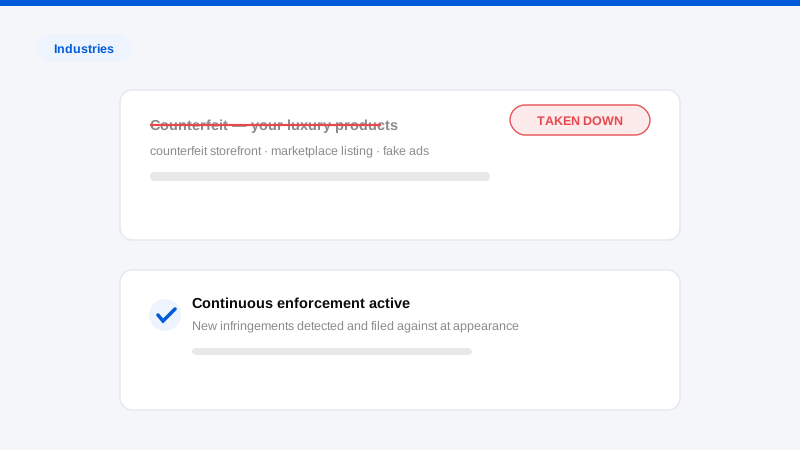
Professional reputation management for luxury brands is removal-first: the objective is to make hostile and infringing content cease to exist at its source, not to argue with it, bury it under press releases, or “manage the narrative” around it. For a category built on impeccability, the only fully satisfactory outcome is absence, and the professional discipline is sequenced to achieve exactly that.
Remove at the source. Counterfeit listings and replica storefronts are dismantled at the platform, host, registrar, and payment-processor level, intellectual property enforcement executed with the documentation standards and abuse-team relationships that volume work requires. Stolen campaign imagery, the raw material of every convincing fake, is pursued through copyright infringement removal across marketplaces, ad networks, and social platforms. Defamatory and fraudulent content is removed through the policy and legal-adjacent pathways each platform provides. Source removal is the standard because it is the only outcome that protects every surface at once: search, social, resale, and AI.
De-index what resists. Some hostile content sits on platforms that are slow to act. While source removal is pursued, de-indexing from search engines severs the content from discovery, the replica site that no longer appears when a client searches the house’s name has lost most of its economic reason to exist.
Build authoritative press assets. Removal clears the ground; authority holds it. Earned press placements in publications a luxury clientele actually respects give the house ranked, credible assets that occupy its search landscape, so the research journey of a high-intent buyer is shaped by vetted coverage rather than by whatever content drifts in to fill a vacuum.
Monitor continuously, discreetly. Counterfeit networks relaunch; outrage cycles recur; new resale fraud appears weekly. Serious houses maintain continuous monitoring across search, marketplaces, ad libraries, domain registrations, and social platforms, with escalation protocols that catch threats in days rather than quarters. This is the logic of an ongoing Protection Plan: luxury reputation is not a project with an end date, it is a perimeter that must be held.
Key takeaway: For luxury, “responding well” is already a defeat. The professional standard is removal at the source, de-indexing where removal is slow, authoritative press holding the cleared ground, and continuous monitoring so threats die young, quietly, and without a public fight that would itself become content.
Why generic PR fails at reputation management for luxury brands
The instinct of most luxury organizations is to route reputation threats to communications. It is an understandable instinct and a structural mistake. A communications team’s toolkit is publishing: statements, placements, relationships with editors. Publishing cannot remove a replica network, cannot take down a scam ad targeting VIP clients, and cannot delete the defamatory post sitting third in the brand’s search results. Worse, in outrage dynamics, official statements frequently feed the cycle they are meant to calm: the response becomes the story’s second act.
In-house legal has the opposite limitation. Counsel can win against an identifiable infringer, but industrial counterfeiting is anonymous, jurisdictionally scattered, and faster to relaunch than any docket moves. Litigation is a scalpel; the threat is a swarm.
The work in between (high-volume, cross-platform removal executed with discretion) is a specialist operational discipline. It requires standing relationships with platform abuse teams, fluency in each venue’s evidentiary requirements, and the judgment to know which lever moves which threat. It also requires something luxury houses value above almost everything: the ability to solve the problem without creating a spectacle. A public enforcement campaign that advertises the existence of a counterfeit ecosystem can do more damage to perception than the counterfeits themselves. The right firm works quietly.
Your brand's search results are your most-visited boutique.Book a free confidential Exposure Scan and walk through the live findings with a specialist on a 15-minute call. The results are yours regardless.
Book Your Free ScanWhy luxury brands choose Content Removal
Luxury brands choose Content Removal because removal at the source is the firm’s founding discipline, executed with the discretion the category demands, not a service line inside a PR agency or a legal practice billing by the hour.
The track record is concrete and verifiable. Content Removal dismantled the counterfeit operations trading on Saski Collection, the label founded by Tammy Hembrow: replica listings, cloned storefronts, and the stolen-imagery infrastructure behind them (see the Saski case study). For Sweat, the firm stopped a fraud operation on track to divert an estimated $10 million from the brand’s customers. Client work spans consumer and enterprise names including Danone; the record is documented in our case studies.
For luxury houses specifically, three characteristics of the engagement matter most. Discretion is structural, not promised: engagements are confidential, enforcement is conducted without publicity, and the house’s name never becomes part of the story. The work is removal-first: outcomes are measured in content that no longer exists (listings down, storefronts dead, imagery purged, search results clean) not in sentiment decks. The firm is honest about what it is: Content Removal is not a law firm, does not provide legal advice, and does not guarantee outcomes; it commits to a rigorous process, transparent reporting, and a standing monitoring perimeter that catches the next threat early. For organizations accustomed to vendors who overpromise, that candor is itself a signal of seniority.
Frequently asked questions
How is luxury reputation management different from ordinary brand PR?
PR is a publishing discipline: it creates and places content. Luxury reputation management, done properly, is primarily a removal discipline: it makes hostile and infringing content cease to exist at the source, then uses publishing selectively, authoritative press assets, to hold the cleared ground. The difference matters because luxury’s core asset is impeccability, and impeccability cannot be argued into existence next to a page of replica listings and scam complaints. It has to be restored by making those pages go away.
Can counterfeit and replica content about our house actually be removed?
In most cases, yes: counterfeit listings, cloned storefronts, and stolen campaign imagery violate platform policies and intellectual property rights, which creates enforceable removal pathways at the marketplace, host, registrar, ad-network, and payment-processor level. What no honest firm will promise is a guaranteed outcome on every item: platforms make their own decisions, and some venues are slower than others. The professional approach is to pursue removal at the source, de-index what resists, and keep continuous monitoring in place so relaunches are caught immediately.
Our clients value privacy. How does an engagement stay discreet?
Discretion is a design requirement, not an afterthought. Engagements are confidential; enforcement actions are executed through platform and infrastructure channels rather than public campaigns; and nothing in the process requires the house to acknowledge a problem publicly. Where VIP clients are affected (impersonation scams, leaked information) the work is handled with the same confidentiality the house extends to the clients themselves.
Is one cleanup enough, or is this ongoing?
The initial engagement removes the existing ecosystem; the ongoing work keeps it from regrowing. Counterfeit networks relaunch, outrage cycles recur, and resale fraud is continuous, which is why houses maintain Protection Plans that combine standing monitoring with rapid removal of whatever appears. A one-time cleanup of a desirable brand is a lawn mowed once. The value is in holding the perimeter.
The buyers who matter most to a luxury house research before they spend, and what they find is either the story the house has built for decades, or the ecosystem that has grown up to exploit it. Find out which one your clients are seeing. Book a free, confidential Exposure Scan: a specialist walks you through live results (counterfeit ecosystem, search contamination, resale fraud, AI answers) on a 15-minute call, and the findings are yours to keep either way.