
Emergency reputation management is a legal, technical and operational response to a live online incident, carried out under time pressure. The first hour is about not making it worse: preserve full-page evidence, name one crisis lead, pause owned channels, classify the content, then match it to the right removal route such as DMCA, platform reports, defamation notices or de-indexing.
Key facts
- Do not publish a reactive statement, delete records or let staff speculate in internal chat.
- Triage every incident on three axes: content type, distribution vector and spread velocity.
- Copyright, impersonation, NCII and defamation each use a different removal route with different evidence.
- Search de-indexing reduces visibility but does not take the page down at the source.
Where ContentRemoval.com comes in. ContentRemoval.com handles the containment side of a live crisis: source removal, de-indexing, leaked content response, impersonation takedowns and monitoring for reuploads, coordinated with your counsel and communications team. Contact usually comes from a chief of staff, general counsel or family office representative in the first day. A free 15-minute Exposure Scan maps what is removable and the report is yours to keep. Get a Free, Confidential Exposure Scan or read how our reputation management work is done.
Your phone lights up before dawn. A board member forwards a link. A journalist is asking for comment. Someone has posted a clip, a thread, a review barrage, a leak, or a fabricated allegation, and search results are already shifting.
At that moment, many make the crisis worse. They talk too soon, delete the wrong thing, or let five departments improvise at once. Emergency reputation management is not generic PR. It is a legal, technical, and operational response carried out under time pressure, with evidence preserved, authority centralized, and removal channels activated immediately.
Speed matters. In 2025, 41% of companies that failed to respond to a crisis within 48 hours faced lasting reputation damage according to crisis management marketing statistics. If you’re dealing with a live incident, the objective is simple: contain visibility, preserve options, and stop the internet from hardening a temporary event into a permanent record.
First Actions in the Golden Hour
The first hour decides whether you regain control or donate control to your attackers, your critics, and search algorithms.
Start with three things you should not do.
Don’t publish a reactive statement drafted in anger. An early public comment can lock you into facts you haven’t verified, trigger new coverage, or undermine later legal claims. Don’t order staff to “clean things up” by deleting posts, chats, or internal records. That can destroy evidence and create the appearance of concealment. Don’t let employees speculate in Slack, Signal, text, or email. Internal rumors leak, and leaked speculation becomes exhibit material.

Lock down command and evidence
You need a private war room immediately. Keep it small. One executive decision-maker. One legal lead. One technical lead. One communications lead. If the matter involves personal privacy, add the principal’s chief of staff or family office representative. Everyone else stays out unless invited for a defined task.
Use that room to establish a single operating rule: no one acts publicly without clearance from the crisis lead.
Then preserve evidence before anything disappears. Capture full-page screenshots, source URLs, timestamps, account handles, comment threads, search result pages, cached copies where visible, and any signs of impersonation or editing. Save the original files if you have them. If the attack involves images, video, or private documents, preserve hashes and metadata where available through your technical team or counsel.
Practical rule: If you didn’t preserve the exact URL, timestamp, and on-page context, you may have preserved noise instead of evidence.
Move silently before you move visibly
Most crises aren’t solved by a dramatic statement in the first hour. They’re stabilized by silent mobilization.
Use this sequence:
- Freeze public output. Pause scheduled posts, ad campaigns, newsletters, and media outreach until someone confirms they won’t collide with the incident.
- Map the initial spread. Identify where the content originated, where it’s being copied, and whether search engines have indexed it.
- Classify the content. Is it defamation, impersonation, a privacy breach, a leak, nonconsensual intimate imagery, stolen copyrighted material, or a legitimate complaint amplified unfairly?
- Separate source removal from narrative response. These are different workstreams. One aims to erase or reduce visibility. The other manages what stakeholders hear from you.
- Set update intervals. Thirty-minute internal updates work better than a continuous panic stream.
A public shaming event follows familiar patterns. If that’s the pressure you’re under, this strategic response guide to being publicly shamed online is a useful reference point for framing your immediate next moves.
What control looks like in the first hour
Control doesn’t mean the content is gone in sixty minutes. It means you’ve stopped random action, preserved evidence, and assigned authority.
Use a simple first-hour checklist:
- Decision authority set: One person can approve or block statements, takedowns, and legal notices.
- Evidence secured: The team has captured the current state before edits, deletions, or reposts muddy the record.
- Owned channels paused: No scheduled content will accidentally inflame the situation.
- Threat map started: You know the source, likely copies, and primary platforms involved.
- Response lanes separated: Legal, technical, and communications teams know their roles.
A rushed apology for an unverified claim is not agility. It’s self-sabotage with a timestamp.
Triage and Threat Assessment Framework
Once the room is quiet and evidence is preserved, you need diagnosis. Not vibes. Not executive intuition. Diagnosis.
Reputation risk belongs at board level. 87% of corporate executives rate reputation risk as more important or significantly more important than other strategic risks, and 87% of consumers require businesses to maintain three-to-five-star ratings before selecting their services, according to Joshua Hart Consulting’s discussion of reputation management in crisis situations. That means your triage process should look more like incident response than public relations theater.
Classify the incident before choosing the remedy
Every emergency reputation management matter should be assessed on three axes: type, vector, and velocity.
Type tells you the legal and technical route. A false article requires a different response from a leaked video. Impersonation requires different evidence from review fraud.
Vector tells you where the harm is occurring. Search results, mainstream news, Reddit, X, TikTok, review platforms, YouTube, image boards, and private forums behave differently. So do closed channels and dark web postings.
Velocity tells you how much time you have. A dormant blog post indexed on page two is not the same problem as a deepfake clip spreading across short-form video and getting embedded in commentary.
Emergency Reputation Triage Checklist
| Threat Type | Primary Vector | Potential Velocity | Business Impact | Recommended First Action |
|---|---|---|---|---|
| Defamation | News site, blog, forum, search | Medium to high if picked up by others | Investor concern, hiring friction, client loss | Preserve evidence and have counsel assess falsity, authorship, and notice strategy |
| Privacy violation | Search, social, file-sharing sites | High if screenshots are circulating | Personal safety, blackmail risk, family office exposure | Isolate all URLs and file variants, then initiate platform and search removal requests |
| Impersonation | Social platforms, messaging apps, review sites | High | Fraud, customer confusion, reputational contamination | Secure account evidence and file impersonation reports with platform-specific proof |
| Leak of internal material | News, social, forums, dark web | High | Regulatory risk, partner distrust, litigation exposure | Determine authenticity, chain of custody, and immediate legal constraints before public comment |
| Fake reviews or coordinated attacks | Google, Trustpilot, niche review sites | Medium | Conversion loss, local market damage | Document patterns, account clusters, and policy violations for targeted reporting |
| Deepfake or manipulated media | Social, video platforms, messaging apps | Very high | Severe trust erosion, viral spread, extortion leverage | Trigger rapid forensic review and parallel removal requests across every visible copy |
Questions that force clarity
Ask these questions in order:
- Is the content false, unlawfully disclosed, stolen, or merely harmful? The answer determines whether removal is realistic or whether suppression and response become the main tools.
- Is the source authoritative or disposable? A mainstream publication, a throwaway account, and a scraper site require different strategies.
- Is the target personal, corporate, or both? A CEO crisis often contaminates the company. A company incident often contaminates named executives.
- Does the content create legal exposure beyond reputation? Securities issues, employment matters, privacy duties, and regulatory obligations can override communications instincts.
- Can the harm be contained at the source, or only at the distribution layer? Sometimes the originating post stays up while reposts, previews, snippets, and indexing can still be reduced.
If you treat every incident like a PR problem, you’ll miss the legal hooks. If you treat every incident like litigation, you’ll lose the speed battle.
Two common scenarios
A defamatory blog post by an unknown publisher usually moves slower, but it can become persistent if search engines index it cleanly and aggregators copy it. Your first move is evidence capture, authorship identification, and legal analysis of falsity. Public comment often waits.
A viral deepfake is the opposite. The source may matter less than the replication pattern. The first priority becomes a copy map, platform escalation, search de-indexing requests where available, and continuous monitoring for reuploads. In that situation, time spent debating tone is time lost.
Triage gives you permission to ignore secondary noise. You don’t need to solve everything at once. You need to identify the threat that can do the most irreversible damage first.
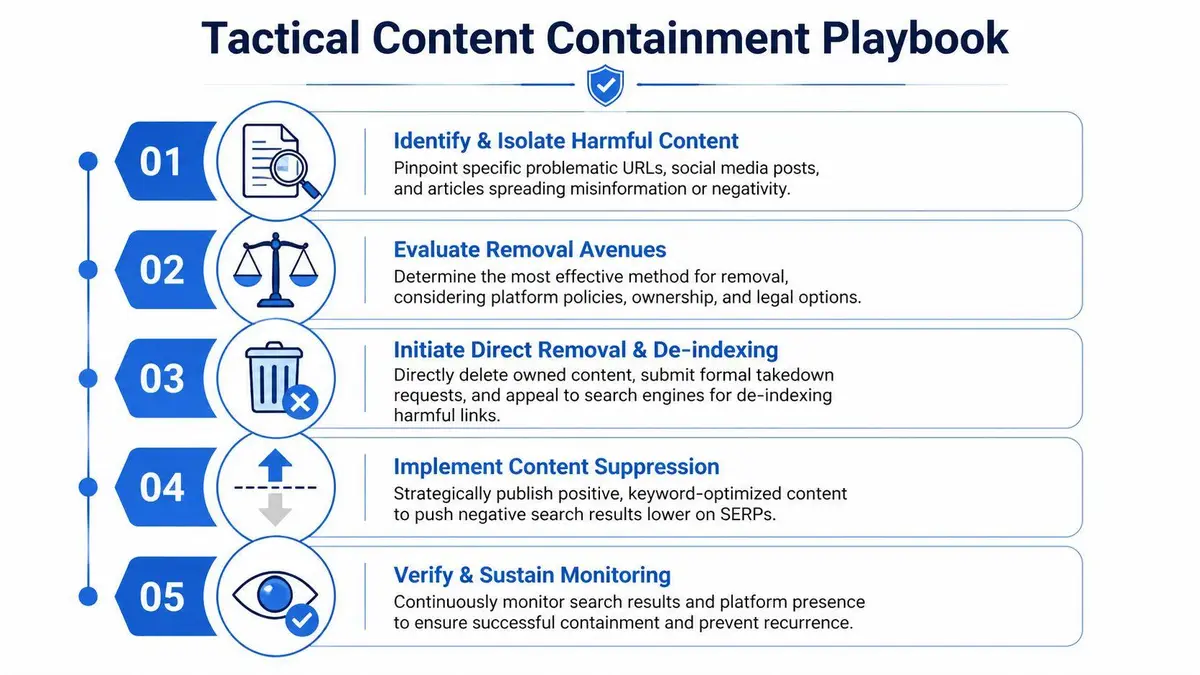
Executing Tactical Content Containment
Most crisis guides stop at messaging. That’s a mistake. The acute phase often turns on whether harmful material can be removed, disabled, de-indexed, or stripped of reach before it hardens in search and screenshots. An O’Dwyer’s discussion of the crisis continuum points to a real gap here: guidance usually emphasizes communication and monitoring, while neglecting rapid content removal and de-indexing during the acute crisis phase.
Here, you stop talking in abstractions and start matching content to the correct removal mechanism.
Match the claim to the mechanism
Not every bad post is removable. A lot of bad posts are. The difference is whether you can identify a valid platform, legal, or search-based predicate.
Use this working model:
- Copyright infringement: Use a DMCA takedown when someone has reposted photos, video, written material, graphics, or other protected content without authorization.
- Impersonation or harassment: Use the platform’s Terms of Service reporting route. The strongest filings are specific, documented, and tied to the platform’s actual policy language.
- NCII or intimate image abuse: Use the platform’s dedicated nonconsensual intimate image process immediately. These pathways are often separate from general abuse reporting and should be handled with precision.
- Defamation: Have counsel evaluate falsity, provable harm, jurisdiction, and whether a formal notice, retraction demand, or litigation hold letter should issue.
- Search de-indexing: If source removal lags or fails, request de-indexing or reduced visibility where applicable under the search engine’s policies and legal framework.
DMCA when the attacker used your content
DMCA takedowns work best when the infringement is clean. Your team needs the original work, proof of ownership or authority, the infringing URLs, and a statement made under penalty of perjury that the use is unauthorized.
The common error is overreaching. If the issue is a false statement, the DMCA route isn’t a substitute for defamation analysis. But if the attacker copied your headshots, internal deck pages, website text, or branded video, copyright can be the fastest lever.
A proper notice should identify each protected work with precision. It should list each infringing URL separately. It should come from the rights holder or authorized agent. Sloppy notices get rejected or ignored.
Platform reporting isn’t a customer service request
When you’re reporting impersonation, threats, harassment, or privacy violations, don’t write a narrative essay. Platforms respond better to policy-matched evidence than emotional description.
Build a clean packet:
- The exact violating URL or handle
- Screenshots showing the account and misconduct
- A short explanation tied to the platform rule
- Identity proof or authorization if required
- A copy list of related accounts or reposts
Large platforms process at scale, and if your report looks like panic, it gets treated like noise.
For practical implementation options, ContentRemoval.com’s content removal service is one example of a specialist workflow built around source removal, de-indexing, and repeat monitoring rather than generic brand messaging.
The best takedown request reads like a clean case file, not a plea for sympathy.
Defamation notices require discipline
Executives often want a threatening letter sent within minutes. Sometimes that’s right. Often it isn’t.
Before counsel sends a defamation notice, verify the statement, identify whether it’s opinion or asserted fact, determine where publication occurred, and assess whether the sender can prove falsity if challenged. A weak legal threat can provoke republication, anti-SLAPP exposure, or hostile media coverage.
A strong notice is narrow and factual. It identifies the false statements exactly. It states why they are false. It requests preservation of evidence and demands corrective action suited to the situation. If the publisher is a professional entity, your wording may be read by its general counsel within minutes. Draft accordingly.
Search de-indexing is not source removal
Clients often confuse the two. Source removal takes the material down from the website or platform. De-indexing aims to make it harder to find through search.
Use de-indexing when the source is slow, anonymous, offshore, or technically inaccessible. It can also help with duplicate pages, previews, snippets, or outdated search visibility after source removal. But don’t pretend de-indexing solves a content problem entirely. The page may still exist and continue circulating directly.
Suppression is a containment tool, not a substitute for removal
If the material is lawful but damaging, you may need to suppress it with stronger, accurate, better-ranked assets. That means controlled profiles, authoritative bios, press materials, executive thought leadership, company resources, and updated factual pages optimized for the relevant name or brand query.
Suppression works best when it follows source containment efforts. If the fire is still spreading, don’t start decorating the house.
Coordinating Legal PR and Technical Teams
A reputation emergency fails when three competent teams work in three different directions.
Legal wants precision and preservation. PR wants clarity and stakeholder confidence. Technical teams want speed, evidence capture, and platform execution. None of those priorities are wrong. They become dangerous when no one is in charge of sequencing them.
Research in the WJARR paper on crisis response and stakeholder perception points to three velocity components that improve outcomes: pre-approved messaging templates, designated spokespeople with clear authority, and real-time social listening technology. The operational lesson is straightforward. Authority must be explicit before the first public move.
Put one person in command
Name a Crisis Response Lead. Not a committee. One person.
That person doesn’t do every task. They control the order of operations. They decide when legal notice goes out, when the principal speaks, when the monitoring team escalates a copy, and when a draft statement is held back because it would undermine a takedown route.
Without that structure, you get predictable errors:
- Legal sends a notice while PR is privately offering conciliatory language that implies uncertainty.
- Technical teams report accounts while employees are publicly arguing with them, creating more screenshots.
- Executives speak off-script because nobody told them who owns the response.
Build three synchronized workstreams
Legal workstream
Counsel determines what can be said, what should be preserved, what should be demanded, and what exposure the company or principal already has. They also decide when silence is strategic.
A good legal lead doesn’t just review copy. They shape the perimeter of the response.
Communications workstream
Communications doesn’t exist to “say something fast.” It exists to say the right thing at the right time to the right audience. Customers, employees, investors, counterparties, and regulators do not need the same wording.
If you need outside counsel on internet defamation issues affecting senior leadership, this strategic guide for executive defamation consultation reflects the level of rigor these situations demand.
Technical workstream
The technical team handles evidence preservation, account security, URL mapping, search monitoring, platform submissions, and reupload surveillance. Their reports should feed the crisis lead at set intervals, not in a constant stream of panic.
A synchronized response feels slower in the first hour and moves faster over the next forty-eight.
Communication rules that prevent self-inflicted damage
Use pre-approved holding language for inbound inquiries. Keep it narrow. Confirm awareness, state that the matter is under review, and avoid factual assertions you can’t defend.
Designate one spokesperson. If the principal is emotionally involved, that person should not be the first voice unless there is a compelling strategic reason. Reputation crises become harder when the target becomes the loudest participant.
Use one internal update channel and one recordkeeping standard. If legal may need the material later, your process shouldn’t scatter key decisions across ten tools and private texts.
When to Escalate to Reputation Specialists
Some incidents can be handled internally with disciplined leadership and strong counsel. Others should be escalated immediately because failed first attempts make removal harder, not easier.
The commercial stakes are obvious. Companies actively managing their online reputation experience a 93% boost in customer satisfaction, 86% of consumers hesitate to buy from businesses with negative reviews, and 80% abandon purchases after a single negative review, according to reputation management statistics compiled by ElectroIQ. In practical terms, that means delay isn’t neutral. Delay gives harmful material more time to shape buyer behavior, partner confidence, and internal morale.
Escalate when the matter exceeds ordinary legal or PR handling
If the content has reached the dark web, internal teams usually don’t have the monitoring or remediation processes to map the spread. If platforms are unresponsive or the content keeps reappearing through copy accounts and mirrors, ordinary abuse reporting is no longer enough. If the attacker is anonymous and technically competent, you may need forensic support and jurisdiction-aware legal sequencing.
You should also escalate if the crisis crosses borders. Different jurisdictions treat defamation, privacy, image rights, intermediary liability, and injunctive relief differently. A domestic general counsel can be excellent and still not be the right operator for a fast-moving multi-jurisdictional online attack.
Signs you’re already losing time
Use this checklist truthfully:
- Your team can’t identify the right removal predicate. They know the content is harmful but can’t tell whether to use copyright, impersonation, privacy, NCII, or defamation channels.
- The content is multiplying faster than your team can track it. Copies, clips, screenshots, and reposts are appearing across multiple platforms.
- You have high-profile stakeholders. Boards, investors, counterparties, family members, and press contacts are asking questions at once.
- Your first reports were denied or ignored. Weak submissions create delay and can complicate later escalation.
- The incident affects both corporate and personal reputation. Those cases are politically sensitive and easy to mishandle.
- You need discretion. Public threats, clumsy outreach, and visible panic are unacceptable for executives and family offices.
Why specialist intervention can be the rational move
This isn’t about outsourcing judgment. It’s about recognizing that emergency reputation management often requires specialized takedown drafting, platform escalation history, forensic evidence handling, search visibility tactics, and monitoring systems that most in-house teams do not maintain.
If the cost of getting it wrong includes preserved search visibility, failed notices, unnecessary media attention, and a longer tail of reuploads, specialist intervention isn’t indulgence. It’s containment.
Transitioning to Long-Term Monitoring and Remediation
A contained crisis is not a finished crisis. It’s a stabilized one.
The internet has a memory problem. Harmful content gets reposted, clipped, summarized, scraped, indexed, and resurfaced by people who were nowhere near the original event. Long-term protection requires surveillance, documentation, and a deliberate effort to build stronger assets around the principal’s name, company, and core search terms.
Build a monitoring system that catches recurrence
Set alerts for executive names, company names, product names, campaign phrases, and known false claims. Monitor image-based reposts, not just text mentions. If the original issue involved leaked documents or intimate material, watch for filename variants, screenshots, and derivative uploads.
This monitoring should cover search, major social platforms, review environments, forums, video platforms, and closed-community spillover where possible. A spreadsheet won’t handle this for long. You need a system that logs incidents, tracks action taken, and records whether source removal, de-indexing, or suppression was used.
The real test of a post-crisis plan isn’t whether it sees the first attack. It’s whether it catches the fifth copy before anyone important does.
Replace fragility with a reputational firewall
A weak search presence invites damage. If the first page for an executive or company has thin profiles, outdated bios, and little controlled content, one bad result can dominate attention.
You need durable assets. That means accurate bios, current leadership pages, credible interviews, official profiles, thoughtful commentary, updated company content, and owned pages that answer the obvious queries cleanly. A useful way to think about this is not vanity but resilience. Baz Porter’s work on achieving leadership sovereignty is relevant here because it frames executive reputation as an asset that should be actively governed, not passively defended.
A solid post-crisis content strategy should do two things at once. It should strengthen truthful, high-authority material about the principal, and it should reduce the practical discoverability of stale or misleading material over time.
Use training and review cycles
Long-term remediation also means changing internal behavior. Review who had authority during the incident, where approvals slowed, which platforms were responsive, and which evidence was missing. Then build templates, reporting packets, and approval protocols before the next event.
This video offers a practical lens on sustained response and monitoring after the first wave of a crisis:
The point isn’t to live in permanent fear. It’s to avoid rebuilding your response capability from scratch every time someone decides to target you.
FAQ on High-Stakes Reputation Crises
How quickly can harmful content come down
It depends on the predicate and the platform. Clear impersonation, copyright infringement, and NCII reports can move faster than contested defamation matters. Anonymous sites, offshore publishers, and scraped copies usually take longer than mainstream platforms with formal reporting systems. The practical rule is to start source removal, de-indexing review, and copy mapping in parallel rather than waiting for one channel to finish.
Can you remove content from Google if the website refuses
Sometimes you can reduce visibility even when the source page remains live. That’s a search problem, not a source-control victory. You should pursue both tracks if the content is serious: remove at the source where possible, and separately assess whether search policies or legal rights support de-indexing requests.
What if the content is on the dark web
Dark web incidents require a different posture. You won’t handle them like an ordinary review dispute or a social media complaint. Focus on evidence capture, access control, credential review where relevant, legal analysis, and containment of any surface-web spread. If the material is likely to migrate outward, your visible-web monitoring needs to start immediately.
Can anonymous attackers be identified
Sometimes. The path usually involves preserving platform data, documenting publication, and working through counsel to assess subpoena options, host records, or related account evidence. Anonymous posting does not guarantee permanent anonymity, but identification takes process and the right factual foundation.
Should we threaten legal action publicly
Usually not at the start. Public threats can provoke reposting, mockery, or defensive coverage. A private legal notice, properly drafted and sent with evidence, is often more effective than a performative public warning.
Should the executive respond personally
Only if that serves a defined strategy. A principal’s direct response can humanize a situation, but it can also widen the audience and create admissions. In most high-stakes matters, the decision should follow legal review, not ego.
If you’re facing a live incident, ContentRemoval.com handles emergency reputation management with a focus on source removal, de-indexing, leaked content response, impersonation takedowns, and ongoing monitoring. Start with a confidential assessment, preserve the evidence you have, and get a controlled action plan before the next cycle of reposts begins.
Frequently asked questions
What is the first thing to do when a reputation crisis breaks online?
Freeze public output and preserve evidence: full-page screenshots, exact URLs, timestamps, account handles and search result pages. Appoint one crisis lead with authority over statements, takedowns and legal notices, and keep the war room small. Silent mobilization in the first hour matters more than a public statement.
Is a DMCA takedown useful in a reputation emergency?
Only when the attacker has used your protected content, such as headshots, deck pages, website text or branded video. A proper notice identifies each work, lists each infringing URL and comes from the rights holder or agent. It is not a substitute for defamation analysis when the problem is a false statement.
When should a company bring in reputation specialists during a crisis?
Escalate when your team cannot identify the right removal predicate, when copies multiply faster than they can be tracked, when platforms ignore first reports, when the incident crosses borders, or when both corporate and personal reputations are affected. Failed first attempts can make later removal harder.