
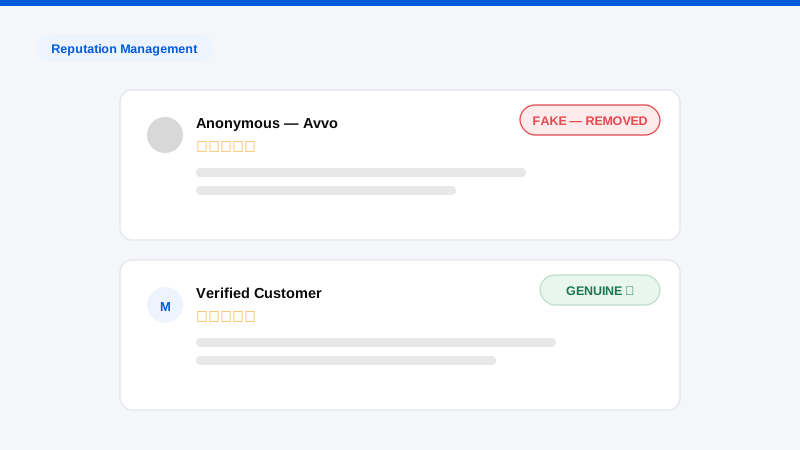
Reputation management for lawyers carries a particular irony: no profession understands defamation law better, and no profession is more exposed to online attack with less practical ability to respond. Clients vet counsel harder than they vet almost any other professional. A lawyer is hired precisely for judgment and trustworthiness, so a prospective client who finds a one-star pattern on Avvo, a hostile forum thread, or coverage of a bar complaint does not book a consultation to hear your side. They simply retain someone else, and the referral that sent them evaporates without a word.
Meanwhile, the attorney’s usual tools are compromised. Confidentiality rules mean you cannot tell your side of a client dispute in public. Advertising and solicitation rules constrain how you promote yourself. Suing a reviewer for defamation, the remedy you know best, is slow, expensive, frequently barred in practice by anti-SLAPP exposure and the Streisand effect, and terrible marketing even when you win. This is why sophisticated attorneys, including litigators who could draft the demand letter in their sleep, engage removal specialists: the highest-yield remedies for online attacks are usually not legal remedies at all, but platform-policy enforcement, publisher processes, and de-indexing mechanisms that reward operational expertise over litigation leverage.
This guide maps the lawyer’s exposure surface, the specific attack patterns aimed at attorneys, what can realistically be done about bar-complaint and case coverage, how to respond publicly without creating an ethics problem, and how to vet a reputation partner with the same rigor you would apply to opposing counsel’s expert.
Why clients vet counsel harder than any other profession
Hiring a lawyer is a high-stakes, low-information decision made under stress. The matter is often the worst thing happening in the client’s life or business; the fees are significant; and the client usually cannot evaluate legal skill directly, so they evaluate proxies, and the proxies live online. Reviews, peer ratings, news mentions, disciplinary history, and increasingly an AI assistant’s summary become the stand-in for the judgment they cannot assess.
Three features make attorney vetting uniquely unforgiving:
- Trust is the product. A restaurant can survive a complaint about slow service; “this lawyer missed a deadline” or “this lawyer overbilled me” attacks the exact attribute being purchased. Negative content about lawyers converts against you at a higher rate because it is always on-topic.
- The buyers are researchers. General counsel, claims professionals, and referring attorneys run diligence as a discipline: conflict checks, disciplinary-record searches, adverse-media sweeps. Sophisticated individual clients imitate them. This audience reads past page one, which is why burying content under SEO articles fails precisely with the clients worth the most.
- The record looks official. Bar records, court dockets, and judicial opinions naming counsel carry an authority that ordinary complaint content lacks. A dismissed bar complaint reported once in a legal blog reads, to a lay client, like a conviction.
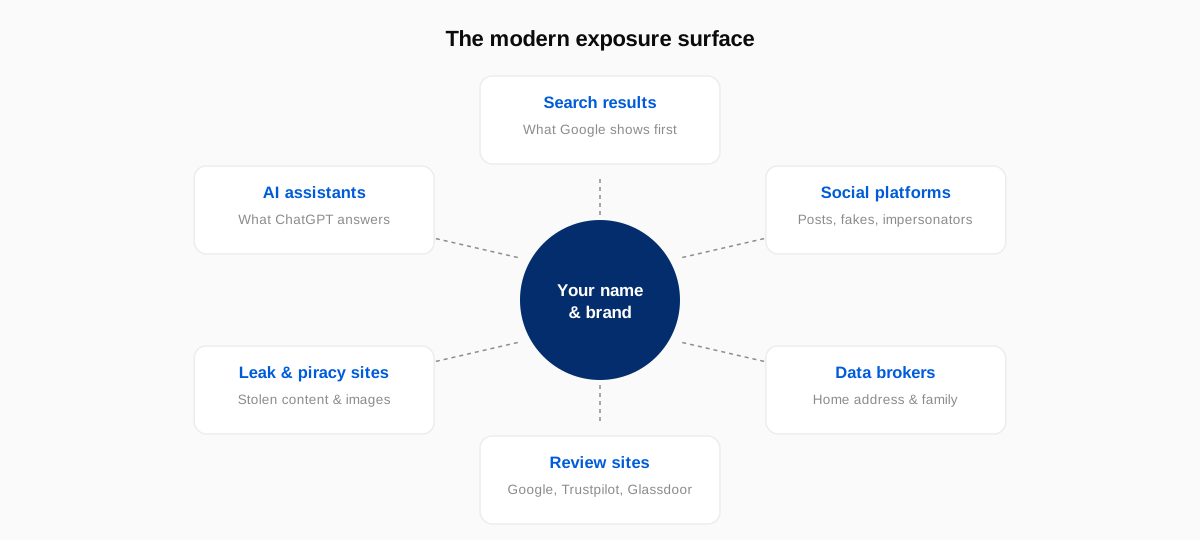
The full surface for an attorney runs wider than most realize: Google results for name and firm; Avvo, Google, Yelp, and legal-specific review platforms; state-bar listing pages and disciplinary databases; court-record aggregators republishing dockets; legal press and local news archives; Reddit and consumer forums; ripoff-style complaint sites; people-search brokers exposing home addresses (a genuine safety issue for family-law and criminal practitioners); and the AI layer summarizing all of it. Each element feeds the others, which is why our reputation-management practice audits the surface as a system rather than treating Google, reviews, and AI answers as separate projects.
Key takeaway: The clients most worth winning (GCs, insurers, referring counsel) are exactly the researchers who read past page one. For them, suppression is invisible ink; only content that has actually been removed stops appearing in their diligence.
The attack patterns aimed at attorneys
Lawyers face a distinctive adversary set, because legal work manufactures losers: disappointed clients, opposing parties, adverse witnesses, and the occasional obsessive litigant with unlimited time.
The disgruntled-client review
The classic pattern: a fee dispute, an adverse outcome the client attributes to counsel, or unreturned-call frustration recast as an accusation of incompetence or dishonesty. Some are legitimate feedback; a meaningful share cross into false statements of fact or violate platform policies, and unlike the lawyer, the reviewer is not constrained by confidentiality, so the account is often one-sided in ways you cannot publicly correct. The remedy path is review removal via platform-policy enforcement (non-client status, extortionate demands, false factual claims, prohibited content) built as an evidentiary submission and escalated past first-line moderation.
The opposing-party attack
Unique to law: the person attacking you was never your client at all. They were on the other side of your client’s case, and their review of your “ethics” is revenge for competent advocacy. Most platforms prohibit reviews from non-clients or parties with a conflict, making these among the most removable attacks an attorney faces. They are also among the most common, and firms that never audit for them carry damage that could have been eliminated years ago.
The serial-litigant campaign
A subset of attorneys draw a genuinely obsessive adversary: dozens of posts across complaint sites, forums, and self-published pages, sometimes spanning years. These campaigns are fought item by item across venues with different removal mechanics: platform policy here, terms-of-service enforcement there, defamation-content removal coordinated with independent counsel where false statements of fact support it, de-indexing where sources will not act. The strategic constant: deny the campaign search visibility and permanence, and avoid the direct engagement the campaigner is trying to provoke.
Complaint-site and copy-site amplification
Ripoff-style sites rank aggressively, refuse ordinary removal on principle, and are mirrored by scrapers. This corner of the industry is full of pay-to-suppress schemes adjacent to extortion; a reputable partner navigates the legitimate paths (court-order-based removals through counsel, search-engine policy mechanisms covering exploitative removal practices, and de-indexing remedies) and tells you plainly when a site is a suppression case rather than a removal case.
Bar complaints, dockets, and case coverage: managing the official record
Attorneys carry an exposure most professionals do not: an official disciplinary and litigation record, publicly searchable and journalistically privileged. Managing it requires precision about what can and cannot move.
What generally cannot be removed: state-bar disciplinary records themselves, court dockets and opinions, and accurate reporting of public proceedings. These are the record; treat any vendor promising to “delete” them as disqualified on the spot.
What frequently can: the amplification layer. Court-record aggregators republishing dockets out of context often honor removal or suppression requests, or violate their own policies. Legal-press and local-news coverage of a complaint later dismissed or a matter resolved is a strong candidate for publisher remedies: outcome updates, resolution context, de-indexing under dated-coverage policies, sometimes unpublishing. Forum threads misstating outcomes are policy cases, and where a bar matter ended in dismissal or private resolution, search-engine mechanisms can sometimes sever the residual coverage from name queries even when the source stands.
What the residue requires: accurate, authoritative context that outranks it, the firm’s own account of practice areas and results (within advertising rules), directory listings kept scrupulously current, and structured data that search engines and AI models treat as ground truth. Sized correctly, this is a small build, because removal has already shrunk the problem.
Key takeaway: You will not erase the official record, and you should not hire anyone who says otherwise. The winnable fight is the amplification layer (aggregators, dated coverage, misstatements) and that fight is won with platform and publisher process, not pleadings.
See your name the way a general counsel vetting you would.Free confidential Exposure Scan for attorneys: search results, review platforms, aggregators, and AI answers, walked through live in 15 minutes. The findings are yours to keep either way.
Book Your Free ScanWhy lawyers who know defamation law still hire removal specialists
Attorneys are the clients who least need convincing that a statement is actionable, and most need convincing that actionability is usually beside the point. The candid version, attorney to attorney:
- The best remedies are non-legal. The majority of harmful content about lawyers comes down via platform policy, publisher process, or de-indexing, mechanisms with no filing fee, no anti-SLAPP exposure, no discovery, and no press coverage. Knowing which of a platform’s policies a given review violates, how its escalation tiers actually behave, and which publisher honors which kind of petition is operational knowledge accumulated across hundreds of matters, not doctrinal knowledge. It is the difference between knowing the law of the forum and knowing the clerk’s office.
- Litigation is a last resort with a blast radius. Suing a reviewer converts a two-paragraph complaint into a documented controversy (docketed, reportable, and permanently attached to your name) with anti-SLAPP fee-shifting risk in many jurisdictions and the Streisand effect guaranteed. Where litigation is genuinely the right tool (identifying anonymous attackers, obtaining removal orders for clear defamation), a specialist coordinates with your chosen counsel; the specialist’s job is to make sure you exhaust the quiet remedies first.
- You cannot be your own advocate here. An attorney arguing publicly with a reviewer, or filing against a former client, is generating exhibit A for the narrative that they are difficult. Interposing a third party preserves your professional distance, the same reason trial lawyers hire jury consultants and appellate specialists.
- Your hours are worth more than this work costs. Review-platform escalations, broker opt-outs at scale, aggregator petitions, and continuous monitoring are volume operations. Running them personally at partner billing rates is the most expensive possible staffing model for the least leveraged work in your practice.
Responding in public without creating an ethics problem
The response itself is where attorneys get hurt. Confidentiality obligations survive the client’s own disclosures, a former client airing the matter online does not, under the prevailing view of professional-conduct rules, open the door for counsel to reveal representation details in reply, and self-defense exceptions are read narrowly and were not designed for review replies. Bar authorities have disciplined lawyers for exactly this.
Ethics-safe response practice: reply, if at all, without confirming a representation (“We take feedback about our firm seriously; professional obligations limit what we can say about any matter, but anyone with concerns is invited to contact us directly”); never discuss facts, fees, outcomes, or even the existence of the engagement; never respond in anger or at 11 p.m.; route hostile-review responses through a second reader; and stay conscious of advertising rules in anything that characterizes your results. As with physicians, the strongest compliance argument for a removal-first strategy is that removal requires no public statement at all: every illegitimate review or false post eliminated is an ethics-fraught conversation that never happens.
Handle it once, quietly, and correctly.Book a free confidential Exposure Scan: a 15-minute, attorney-appropriate review of everything attached to your name and firm online, with a candid read on what is removable. No obligation.
Book Your Free ScanA practical framework for attorney reputation defense
The sequence that works, for a solo practitioner or a 500-lawyer firm:
1. Audit both names. The attorney’s personal name and the firm’s name are distinct surfaces that cross-contaminate, a partner’s old matter drags firm searches; a firm’s review profile drags every partner’s. Inventory search results (including name + “complaint,” + “bar,” + “lawsuit”), all review platforms, aggregators, forums, broker sites, and AI answers for both. Rank items by visibility, severity, and audience.
2. Remove, in probability order. Work the register through the correct mechanism per item (platform policy, publisher process, aggregator petition, de-indexing, legal remedy through independent counsel where warranted) with a realistic probability call on each before spending. Include broker records: data-broker removal is a safety measure, not vanity, for attorneys whose adversaries include the recently divorced, the recently sentenced, and the recently sued.
3. Build the authoritative layer. Firm site, attorney bios, current directory profiles, structured data, and bar-compliant thought leadership, sized to the post-removal residue, and doubling as the source material that shapes what AI assistants say when a client asks about you.
4. Protect continuously. Monitoring across reviews, search, dockets-adjacent coverage, and AI answers, with defined response playbooks and time-to-action commitments. Attorney attacks cluster around case events (verdicts, withdrawals, fee disputes) and are cheapest to address in the first days. This standing defense is what our Protection Plans operationalize.
Vetting a reputation partner like a lawyer
Apply your professional skepticism; this industry rewards it. The checklist:
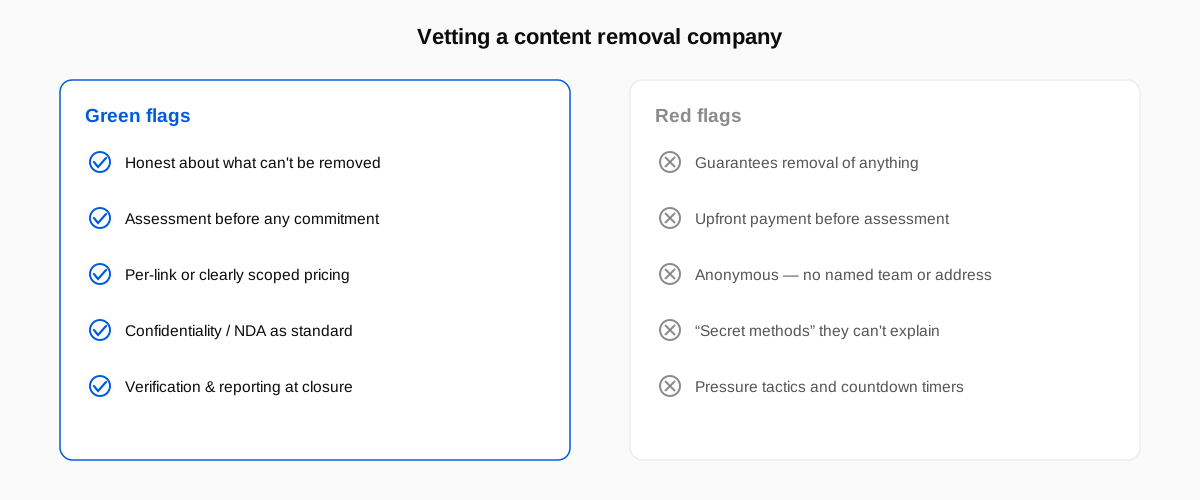
- Removal-first, with the ledger to prove it. Ask what fraction of their attorney matters involved source-level removals versus content publishing, and to walk mechanisms on anonymized examples. Vague answers mean you are buying SEO.
- No guarantees, anywhere. Platforms, publishers, and search engines are third parties; outcomes cannot be promised. A firm that guarantees removals is a firm that will later explain why yours was the exception, or worse, one using methods that create liability. You know what warranted representations look like; demand the honest version: probability bands per item.
- Clean boundaries with the practice of law. The partner should be fluent in the legal landscape, coordinate smoothly with counsel of your choosing when a legal remedy is the tool, and be unambiguous that they are not providing legal services. Equal skepticism for reputation firms quietly practicing law and law firms quietly selling SEO.
- Ethics literacy specific to attorneys. They should raise confidentiality and advertising-rule constraints before you do. A vendor proposing to ghost-write review responses about client matters has already failed the interview.
- Confidentiality engineered, not asserted. Named-individual access to your file, NDA by default, no client lists in marketing, and a stated policy for press inquiries about the engagement.
- Aligned economics, stated plainly. Ours, for calibration: removals are priced per link, quoted in writing once the free Exposure Scan has mapped the surface; continuous Protection Plans scale to surface and threat profile; the wider market spans cheap DIY dashboards to five-figure monthly ORM retainers that are mostly content production. Suppression-model pricing pays the vendor for your problem’s persistence; insist on a model that pays for its elimination, and check documented outcomes before you sign anything.
Frequently asked questions
Can a fake or false review of my firm actually be removed?
Frequently, yes, reviews from non-clients or opposing parties, extortionate reviews, and those containing false statements of fact or prohibited content violate platform policies and come down when the evidentiary case is properly built and escalated. Genuine client opinions about their experience generally do not, however unfair they feel. The professional work is separating the categories honestly and eliminating the first one completely rather than trying to outvote it.
Coverage of a bar complaint that was dismissed still ranks for my name. What are my options?
The disciplinary record itself will stand, but the coverage layer often moves: publisher petitions for outcome updates, resolution context, or de-indexing under dated-coverage policies; aggregator takedowns; correction of forum misstatements; and search-engine removal mechanisms for residual URLs. Dismissed and resolved matters are the strongest candidates. Expect months, not weeks, and expect probability rather than certainty, from us or anyone honest.
I’m a litigator. Why wouldn’t I just handle this myself?
Because the highest-yield remedies are operational rather than legal (platform escalation paths, publisher processes, de-indexing mechanics) and because self-representation here carries unique costs: public engagement with an attacker undermines the professional composure you are selling, litigation creates a documented controversy where a quiet removal creates nothing, and your billing rate makes you the most expensive possible operator for volume work. Use counsel where a legal remedy is genuinely the tool; use specialists for everything before that.
What does attorney reputation management cost?
At our firm, pricing works the way you would want to see it as counsel: per link or item, quoted in writing after the free Exposure Scan, with the exact price beside every URL before any engagement. Continuous Protection Plans are sized to the surface, a solo family-law practice and an AmLaw firm’s partner bench are different engagements. Across the market you will find $50-per-month monitoring dashboards (visibility without remediation) up to five-figure ORM retainers (often mostly content). Price against outcomes: items actually eliminated, both surfaces, attorney and firm, actually defended.
Every matter you take creates someone with a motive to attack your name, and every client you could win is researching that name before they call. The gap between those two facts is where attorney reputations are lost quietly. Close it deliberately: book a free, confidential Exposure Scan: 15 minutes, your full surface across search, reviews, aggregators, and AI answers, with a candid item-by-item read on what is removable. The findings are yours to keep, whether or not we ever work together.