
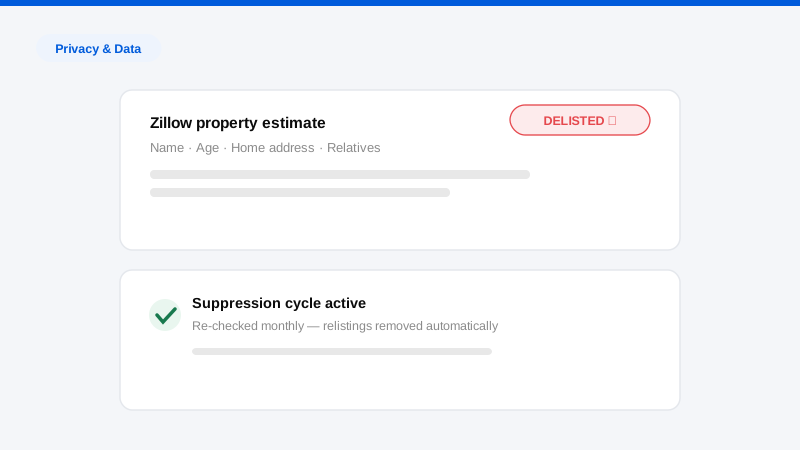
Type almost any residential address in the United States into Zillow and you’ll get a page most homeowners never asked for: an estimated value, square footage, bedroom count, tax history, sale history, and — if the home was ever listed — interior photos of the place where you sleep. For plenty of people that’s a curiosity. For others — executives, public figures, physicians, judges, domestic-abuse survivors, or anyone who simply believes their net worth shouldn’t be a free lookup — it’s a genuine problem. If you’re trying to remove property value from Zillow, this guide explains what’s actually possible, what isn’t, and why.
We’ll be straight with you from the first paragraph, because most articles on this topic aren’t: as of this writing, Zillow does not offer a general option to delete a property page or remove a Zestimate on request. The estimate exists because the underlying inputs — county assessor records, deeds, tax rolls, listing data — are public. What you can do is meaningful but different: claim the property, correct and constrain what the page shows, remove listing photos, exercise privacy-law rights where they apply, and address the much larger ecosystem of sites republishing the same data. Anyone who promises you a clean “Zillow deletion” either doesn’t understand the system or is hoping you don’t.
This guide walks through Zillow’s real mechanisms step by step, then widens out to the property-data broker ecosystem — because Zillow is the site people notice, but it’s rarely the worst exposure attached to a home address.
Why Zestimates exist and why they persist
Understanding the plumbing explains the removal options. Zillow’s property pages are built algorithmically from public and commercial data: county assessor and recorder filings (ownership, square footage, lot size, tax assessments), transaction records (sale dates and prices), and multiple listing service data where agreements permit. The Zestimate is a model output computed over those inputs, refreshed continuously across essentially every home in the country.
Three consequences follow:
- The page isn’t “about you” in Zillow’s framing — it’s about the property. Zillow’s position has long been that property pages reflect public records and that estimates are computed for virtually all homes, not published selectively. That’s why there’s no standard “remove my Zestimate” button.
- Deleting the output wouldn’t delete the inputs. The deed, the tax assessment, and the sale price remain public records at the county level, and dozens of other sites compute their own estimates from the same feeds. This is the same regenerating-data dynamic we see across all personal data removal work: suppress the display, and the pipeline can redraw it.
- Your leverage is at the edges, not the center. Accuracy, photos, personally identifying details, and privacy-law claims are all workable. The bare existence of an estimate mostly is not.
With expectations set, here’s what to actually do.
Step 1: Claim your home
Everything starts with claiming ownership of the property page.
- Create a free Zillow account (or sign in).
- Search your address and open the property page.
- Look for the ownership option on the page (typically labeled along the lines of “Claim this home” or reachable via the “More” menu) and follow the verification flow, confirming you’re the owner.
- Once claimed, the property appears in your profile with owner tools unlocked.
Claiming doesn’t remove anything by itself, but it’s the gateway to every control that follows: editing home facts, managing photos, and setting owner options. Do this even if you take no other step — an unclaimed page can be claimed by mistake or mischief by someone else, and disputing that later is more work than claiming now.
Step 2: Manage photos — usually the highest-value removal
For most owners we work with, the photos matter more than the number. Interior photos from a past listing show layouts, entrances, valuables, and security details — a genuine physical-security concern for high-profile households, and the part of the page that feels most invasive.
Once your home is claimed and is off-market, Zillow provides an option to remove the photos from the prior listing (found in the owner tools/edit options for the claimed page). A few practical notes from doing this at volume:
- Photo removal on Zillow is generally all-or-nothing for the listing photo set, and it applies to the off-market page — active listings are controlled by the listing agent and seller agreements, not this tool.
- Processing takes time; check back after a few days and re-submit if nothing changes.
- Removing photos from Zillow does not remove them from other sites that carried the same listing feed — Redfin, Realtor.com, Homes.com, Trulia (which Zillow owns), and an long tail of syndication sites each need their own request. If the photos have escaped listing sites entirely and show up in image search, that becomes standard image removal work: source-site requests followed by search-index cleanup.
If you’re about to sell, get ahead of this: agree with your agent in writing about which photos are taken, what they show, and that the photo set is removed from syndication after closing.
Step 3: Correct or constrain the home facts
Claimed owners can edit home facts — beds, baths, square footage, lot details, renovations. Owners typically use this to raise an inaccurate estimate before selling, but it cuts both ways: if the page overstates your home (phantom square footage, a renovation that never happened), correcting facts brings the estimate toward reality and removes exaggerated detail from public view.
Be aware of the honest limits here: edits influence the model; they don’t command it. And deliberately entering false facts to distort the estimate is a bad idea — it’s a violation of the platform’s terms, it’s discoverable, and in a sale context it can create real problems. Correct, don’t manipulate.
Step 4: Use privacy-law requests where they apply
Zillow, like other large consumer platforms, maintains a privacy request process for rights under state privacy laws such as the California Consumer Privacy Act — typically reachable through the privacy policy or a “privacy request” / “do not sell or share” link in the site footer. Through it you can request deletion of personal data Zillow holds about you and opt out of sale/sharing.
Set expectations accurately: these laws cover personal information about you as a consumer — your account data, browsing/contact data, and data tied to you as an individual. Publicly available government records generally sit outside deletion mandates, which is how property pages largely persist even after a successful request. Still, file it: it removes the personal-data layer, registers your objection formally, and matters more in specific safety situations. If you’re a protected category in your state — for example, states with address-confidentiality programs or judicial-privacy statutes covering judges, law enforcement, and abuse survivors — you may have far stronger removal rights across all these sites, and it’s worth getting proper legal guidance on invoking them. We’re not a law firm and none of this is legal advice; for statutory claims, pair removal work with a qualified attorney.
Step 5: Address the rest of the property-data ecosystem
Here’s the strategic reframe that changes most clients’ priorities: Zillow shows what your house might be worth. Other sites show that it’s yours — and that’s usually the more dangerous half of the equation.
The full exposure chain around a home address typically includes:
- Other estimate and listing sites — Redfin, Realtor.com, Homes.com, Trulia, and many smaller ones — each computing values and carrying listing histories and photos, each with its own claim/removal processes.
- County assessor and recorder websites, many of which now publish ownership and tax records in searchable form. Some counties offer redaction programs for qualifying individuals; most don’t for the general public.
- People-search and data broker sites — Whitepages, Spokeo, BeenVerified, and hundreds of peers — which fuse property records with phone numbers, ages, relatives, and past addresses into a one-stop dossier. This is where “how much is their house worth” becomes “here is where they live, who lives with them, and how to reach them.” Suppressing these listings is a continuous process, not a one-time errand, and it’s the heart of professional data broker removal.
- Search engines, which decide what surfaces when someone pairs your name with your address or town. Even where a record can’t be deleted at the source, keeping it off the first page of results for your name is often achievable — the discipline covered in our guide to removing yourself from Google.
For high-net-worth families and public-facing professionals, the coherent goal isn’t “make the Zestimate disappear” — it’s break the link between your identity and your address wherever that link is discretionary, and minimize what the remaining property pages reveal. In practice: photos down everywhere, facts corrected, broker listings suppressed continuously, ownership held less visibly for future purchases (many advisors recommend trusts or entities for exactly this reason — again, a conversation for your attorney), and monitoring so regressions get caught.
The complete checklist
- Claim your property on Zillow and verify ownership.
- Remove prior-listing photos from the claimed, off-market page; re-check after a few days.
- Repeat photo/claim processes on Redfin, Realtor.com, Homes.com, Trulia, and other listing sites carrying your home.
- Correct inflated or invasive home facts on claimed pages.
- File privacy requests (deletion and do-not-sell/share) with Zillow and peers under applicable state law.
- If you may qualify for statutory address protection (judiciary, law enforcement, survivors, state ACP programs), consult an attorney about invoking it.
- Opt out of people-search and data broker sites linking your name to the address — and calendar re-checks, because listings regenerate.
- Search your name plus address and town; address what surfaces via source removal or search-result cleanup.
- For future transactions: control listing photos contractually, and discuss title-holding privacy with your attorney before you buy.
- Monitor quarterly — property data refreshes constantly, and what you suppress can resurface.
Frequently asked questions
Can I get my Zestimate removed from Zillow entirely?
As of this writing, no — Zillow does not offer general Zestimate or property-page removal, because pages are generated from public records for essentially every US home. Your workable levers are claiming the home, removing listing photos, correcting home facts, and privacy-law requests for the personal-data layer. For most privacy goals, suppressing the surrounding ecosystem (data brokers linking you to the address) achieves more than fighting the estimate itself.
Why does Zillow have interior photos of my house, and can I remove them?
The photos almost certainly come from a past listing — when a home is listed, photos syndicate across listing platforms and typically remain on the property page after the sale. Once you claim the home and it’s off-market, Zillow’s owner tools let you remove the prior listing’s photo set. You’ll then want to repeat the request on Redfin, Realtor.com, and the other sites that carried the same feed, because each maintains its own copy.
Is my property value really a privacy problem?
That depends on who you are. A standalone estimate on an anonymous address is low-risk. The problem is aggregation: property pages plus people-search listings connect your name, face, home address, household members, and approximate net worth into a package useful to scammers, stalkers, aggressive litigants, and anyone targeting wealth. For executives, public figures, and anyone with a security concern, treating home-address exposure as part of an overall personal data removal program is standard practice.
If the data comes from public records, is removal pointless?
No — it just means the goal is friction, not erasure. County records will keep existing, but there’s an enormous practical difference between “findable by someone who knows which county portal to search” and “displayed on page one of Google with photos.” Removing photos, suppressing broker listings, and cleaning search results raises the effort required from seconds to real work, which deters the casual and opportunistic threats that make up most of the risk. The residue is why serious programs include ongoing monitoring rather than a single cleanup pass.
If your home address, property details, and family information are more visible than you’d like, start by seeing the full picture: our free exposure scan maps where your name, address, and household details appear across listing sites, data brokers, and search results. From there, you’ll know exactly which removals are worth pursuing — and if you’d rather have professionals run the whole sequence and keep it suppressed, that’s what we do every day.