

A Whitepages reverse address lookup starts with a street address and returns the residents, owners, phone numbers, email addresses, neighbors and property history linked to it. For an executive it is a surface symptom of a wider identity graph, so removal means suppressing the connected records across people-search sites, then monitoring for re-listing, not filing a single opt-out form.
Key facts
- Whitepages says its reverse address search covers more than 210 million U.S. address records.
- The same address typically resurfaces on Intelius, Spokeo, BeenVerified, TruePeopleSearch, Radaris and PeopleFinder.
- An opt-out hides a listing from one site while public records and upstream broker feeds remain.
- Verify suppression by re-running the original searches in a clean browser, not by trusting a confirmation email.
Where ContentRemoval.com comes in. ContentRemoval.com handles the address exposure this post describes as a household problem, not a single page: mapping the identity graph, suppressing the principal’s and family’s records across the major aggregators, escalating where a site re-lists, and running the quarterly re-scan. Family offices and executive protection teams usually make the first contact. A free 15-minute Exposure Scan maps every listing and its route, and the report is yours to keep. Get a Free, Confidential Exposure Scan or read how our content removal work is done.
You receive an alert showing your home address on Whitepages. Within minutes, you find the same residence attached to your name on several other people-search sites. The discovery may follow a hostile social-media post, a contentious board vote, a leaked corporate filing, or a reporter researching your background. Whatever triggered it, the visible listing is rarely the whole problem.
A Whitepages reverse address lookup is a surface symptom of a broader identity-graph exposure. The address may connect to relatives, prior residents, phone numbers, property records, and associated businesses. Your response should be controlled and systematic, not improvised through one opt-out form. The objective is durable suppression across the ecosystem, followed by monitoring that identifies reappearance before an adversary does.
When Your Home Address Becomes a Public Record Problem
A chief executive discovers the listing after a journalist asks about a residence that was never disclosed publicly. The Whitepages result shows the executive’s name, a current address, possible prior addresses, and associated contact details. A second search reveals related records on competing sites, each presenting a slightly different version of the same household.
That sequence creates understandable alarm, but panic produces poor operational decisions. The correct interpretation is that the address has entered a searchable commercial directory and may already be connected to other identity records. Whitepages says its reverse address service can search more than 210 million U.S. address records and may return residents, owners, phone numbers, email addresses, neighbors, and property information through its reverse address search. Previous addresses may also appear when public records show them, while address history is available through Premium or Pro API features.
Practical rule: Treat the first listing as an exposure indicator, not an isolated webpage.
The danger increases when the address connects a private residence to a spouse, child, executive assistant, family office, or corporate entity. A person looking for a way to contact or intimidate an executive doesn’t need a complete dossier. A single accurate association can provide enough context to locate relatives, identify routines, or make a message appear credible.
Propagation changes the response
People-search platforms often operate within a wider data supply chain. A record can move from public filing to a broker feed, then into an aggregator’s search index and onward to other services. The result visible today may therefore reflect an older underlying record that has already been distributed through secondary databases.
The first response should preserve evidence. Save the listing URL, screenshots, displayed names, associated records, and the date of discovery. Don’t edit or contact the subject of a hostile post before documenting the exposure. That evidence gives your privacy team a baseline for measuring suppression and identifying re-listing.
The rest of the response should focus on the network, not just the Whitepages page. Remove the highest-risk identity links first, submit suppression requests across the principal aggregators, and establish a repeatable review process. A home address indexed on Whitepages is a problem. A home address linked across an identity graph is the executive-protection issue.
How a White Page Reverse Lookup Address Search Works
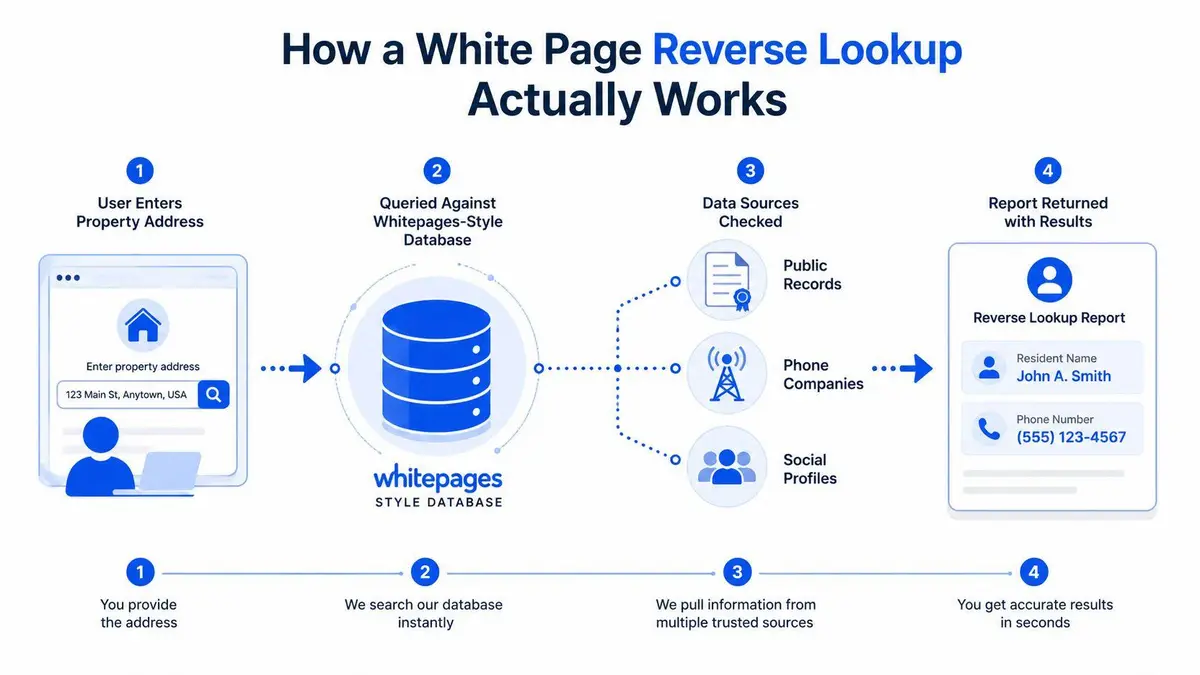
A white page reverse lookup address search begins with the property, then builds an identity graph around it. The user enters the street, city, state, and often ZIP code into a directory search field. The platform compares that location with records tied to the address, rather than starting with a person’s name or telephone number.
Whitepages describes its public directory products as returning names, current addresses, and limited landline phone numbers through people search, reverse phone lookup, and reverse address lookup. Independent services follow a similar method. They match an address with public records to produce information such as an owner name, contact details, and property history, as described in PeopleFinders’ address lookup explanation.
The matching process ranks possible results using identity-linked signals. These may include current and former residents, known associates, connected phone numbers, and property information. A result is often an indexed or cached record assembled from multiple sources, not a copy of one government document. Removing a visible page therefore may leave related records available elsewhere.
Why matching can be wrong
Reverse-directory coverage has limits. A survey-response study found that adding a reverse telephone directory increased geocodable respondents from 51.5% to 72.0%, with coverage differing across demographic and geographic groups, including rural respondents, younger respondents, women, African Americans, and people with less than a high school education. The study also found that 81% of returned addresses matched the same Census block group and 89% matched the same Census tract as self-reported addresses. Those findings support broad geographic matching, not apartment-level precision. Review the PubMed study on reverse-directory coverage.
Stale records can reflect a changed phone owner, multiple residents at one property, or a home occupied by different people over time. Whitepages Pro says its reverse phone lookup uses proprietary signals and a 28-year identity-resolution history, informed by tens of millions of monthly searches. It recommends combining a phone number with a name, email, or address for higher-confidence matching.
For an executive, the practical response is clear. Treat the result as an exposure lead, verify it against current public records and geography, then map the connected records before starting suppression. One returned street address is evidence to investigate, not definitive proof of current residence.
What a Reverse Address Report Reveals About You
A reverse address report is a reconnaissance document, not a harmless directory entry. Its threat comes from the connections between fields. A current resident linked to a former resident, relative, phone number, or LLC can expose more than any single record reveals.
| Report Field | What It Reveals | Executive Exposure Risk |
|---|---|---|
| Current residents | Names associated with the property | Identifies the household and helps confirm occupancy |
| Historical residents | Prior occupants or previous address links | Extends the identity graph across time |
| Phone numbers | Contact channels connected to the address | Enables targeted calls, phishing, and impersonation |
| Property ownership | Owner name and ownership relationship | Links a residence to personal wealth or an entity |
| Property history | Prior transactions and address changes | Helps reconstruct movement and household history |
| Lien records | Financial or legal interests tied to property | Creates means for social engineering or harassment |
| Voter registration status | Possible civic-record association | May strengthen identity matching |
| Associated businesses | Companies connected to the address | Bridges personal and corporate identities |
| Relatives and associates | Family and professional relationships | Accelerates doxxing and targeted outreach |
The highest-risk connections
For executives, the most sensitive information is often the relationship data surrounding the property. A spouse, child, family member, assistant, or business entity gives an unknown party a believable route from a public address to a convincing pretext.
Whitepages says its reverse address results can include residents, owners, phone numbers, email addresses, neighbors, and property information. Its public directory description also says free results may include names, current addresses, and limited landline numbers through directory searches. A white page reverse lookup address report can therefore become an identity-linked profile, not merely a location result.
The address is only the visible symptom. The underlying exposure is an identity graph that connects household members, contact channels, ownership records, and corporate affiliations. Suppression should target those connections in a defined order, rather than treating one listing as the whole problem.
Why context creates risk
A person conducting due diligence may use the report to understand ownership. A hostile activist may use it to identify a family connection. A fraudster may combine a relative’s name with a known address to make a call sound legitimate. These actors do not need the original deed or filing if an aggregator has already organized the clues into one searchable interface.
Review every connected field before requesting removal. Prioritize relatives, phone numbers, email addresses, and business records that let an adversary reconstruct the household. Removing the headline address while leaving those links visible can preserve the route to the same people and location. The objective is suppression of the identity graph, not a cosmetic change to one search result.
The People-Search Sites Feeding These Results
Whitepages is often the first result a subject notices, but it isn’t the only distribution point. Intelius, Spokeo, BeenVerified, TruePeopleSearch, USSearch, FastPeopleSearch, Radaris, and PeopleFinder can surface overlapping address, identity, and property records. Their interfaces differ, while their underlying data may draw from common categories of public and commercial information.
| Site | Primary Data Source | Removal Difficulty | Re-listing Risk |
|---|---|---|---|
| Whitepages | Directory records and identity-linked public data | Moderate to high | High when upstream records remain |
| Intelius | Public-record aggregation and people-search data | Moderate to high | High |
| Spokeo | Public records and marketing-oriented data aggregation | Moderate | High |
| BeenVerified | Public-record and identity-report aggregation | Moderate | High |
| TruePeopleSearch | Public directory and people-search records | Variable | High |
| USSearch | People-search and public-record data | Variable | High |
| FastPeopleSearch | Address and identity directory records | Variable | High |
| Radaris | Identity profiles and public-record aggregation | High | High |
| PeopleFinder | Address, identity, and property-related records | Moderate | High |
The labels in this table are operational judgments, not claims that every listing on every site follows the same process. Removal difficulty depends on whether the provider offers a working suppression path, requires identity matching, honors follow-up requests, or republishes information from a broker feed.
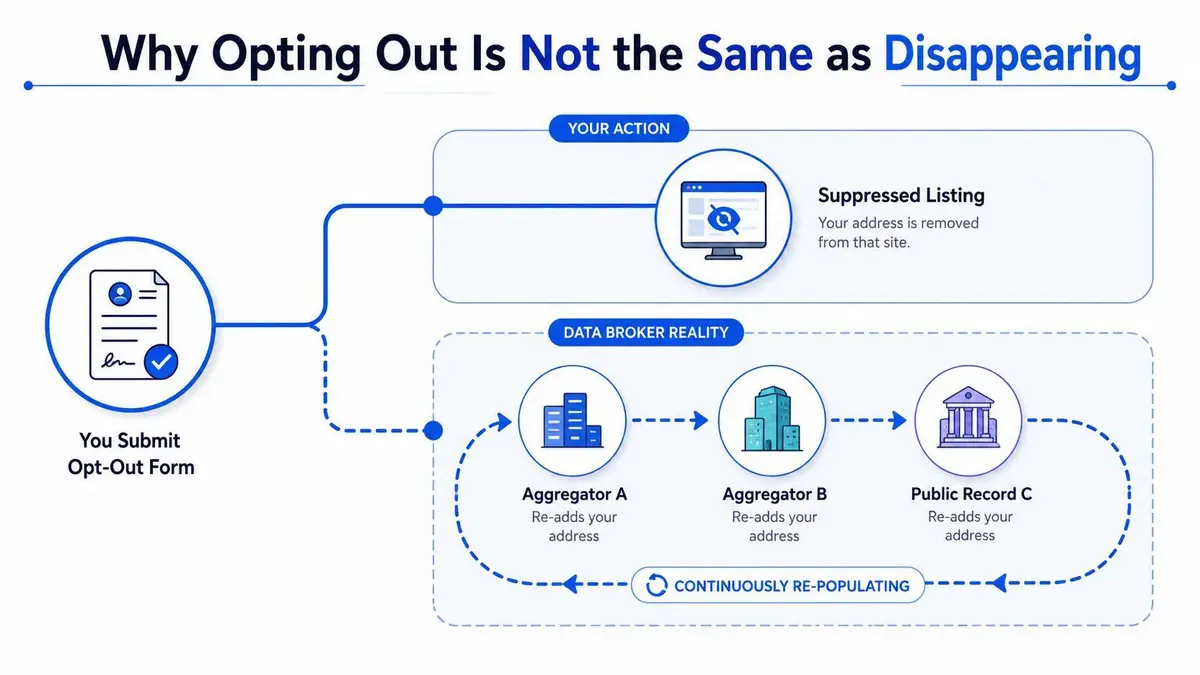
The cross-pollination problem is the core issue. An aggregator may license records from an upstream broker, purchase marketing data, process public filings, or combine directory information with other identity signals. A suppression request removes the user-facing profile on that service, but another provider may continue to display the same record or reintroduce it after a later feed refresh.
For a practical guide to the Whitepages-specific process, use ContentRemoval.com’s strategic Whitepages address-removal guide. Treat that process as one component of a broader campaign. A single form submission cannot address duplicated profiles, search-engine caches, or other sites holding the same identity relationship.
Why Opting Out Is Not the Same as Disappearing
An opt-out usually suppresses a listing from a provider’s public interface. It doesn’t necessarily delete the underlying record, remove the source filing, or stop an upstream broker from supplying the same information elsewhere.
One major address-lookup provider explicitly says that an opt-out can remove a record from its site while warning that the information remains in public records and other databases. That distinction is central to the problem. You can successfully suppress one page and still have the same address appear through another service because the wider data ecosystem hasn’t changed.
Suppression has a limited scope
The provider may hide the profile from its own search results while retaining internal data for matching, compliance, or future ingestion. Another site may hold a separate copy. A search engine may also retain a cached or indexed reference after the original page changes. Each layer requires its own verification.
Don’t rely on a confirmation email as proof of full removal. Check the original profile, search the exact address in multiple formats, review associated names, and test the result through a clean browser session. If a listing returns, record the date and the evidence. Reappearance is not a reason to abandon the process. It is evidence that the program needs monitoring and re-assertion.
The correct outcome isn’t “submitted.” It’s “not discoverable through the relevant search paths.”
The persistence problem also explains why moving homes doesn’t automatically solve exposure. A new record can connect to the same name, phone number, relative, or business entity. Removing one address without reducing the surrounding identity links leaves the matching system with enough context to generate another profile.
This is why opt-out belongs inside a maintenance program. The program should track each provider, profile URL, submission date, confirmation, verification result, and escalation status. For executive households, the process should cover the principal, spouse, dependents, trusts, family offices, and closely connected entities where lawful and appropriate.
The difference between a quick suppression and a durable privacy program is documentation. ContentRemoval.com’s executive privacy guide addresses that broader strategy, including the need to treat data-broker removal as an ongoing operational function rather than a single request.
An Executive Removal Workflow That Holds
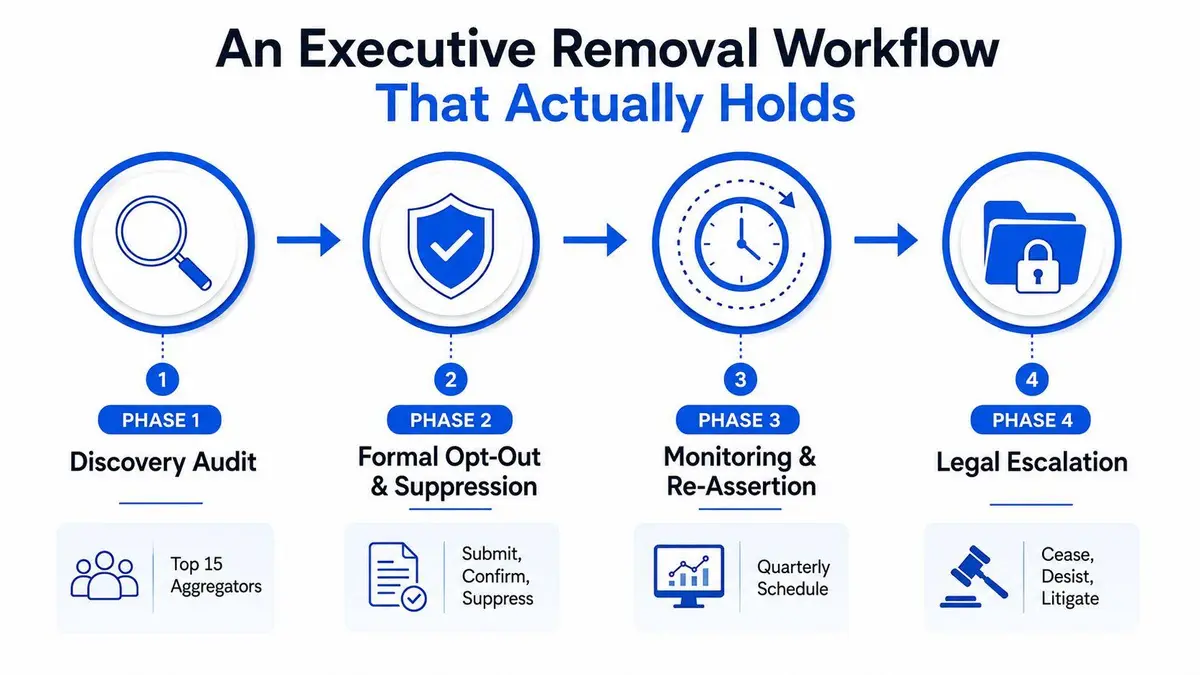
When an executive’s home address appears on Whitepages and competing people-search sites, the first task is not filing an opt-out. It is mapping the identity graph that connects the residence to phone numbers, relatives, trusts, LLCs, former addresses, and corporate records. Start with a controlled inventory, then search principal people-search sites, search engines, cached references, and relevant broker channels using spelling and address variants an adversary could try.
Discovery must produce evidence
Assign one owner to the exposure register. Record each profile URL, visible fields, associated individuals, source indicators, capture date, and risk rating. A stale name presents a different risk from a page that connects the address to a spouse, child, phone number, or business.
Use a tiered submission model:
- Bulk suppression first: Submit routine listings through provider-approved forms and preserve every confirmation.
- Individual escalation next: Prioritize profiles showing family relationships, phone numbers, email addresses, or ownership details.
- Formal rights requests when needed: If standard suppression fails, assess applicable consumer privacy rights, including CCPA or GDPR requests when the person and processing context qualify.
- Source-level review: Identify whether the information comes from a public filing requiring a separate correction, confidentiality request, or legal remedy.
Legal requests must match the provider, jurisdiction, data category, and requested remedy. Privacy laws differ in scope, exemptions, definitions, and response obligations. Have counsel review the request instead of sending a generic demand that overstates the executive’s rights.
Reduce future matching signals
A suppression request holds longer when new records do not reconnect the same household. A privacy-grade commercial mailing address can separate a residence from routine correspondence. Lawful changes to voter registration, utilities, business filings, and delivery records may also reduce unnecessary exposure, subject to counsel and local requirements. Never use a false address or inaccurate filing.
Review the household as a linked graph. A spouse’s public profile, a child’s social account, or an LLC filing can restore a connection removed from the principal’s profile.
Monitoring creates durability
Schedule recurring audits, set alerts for exact address strings, and assign escalation ownership before a listing returns. ContentRemoval.com provides data-broker suppression and digital reputation protection services, including removal and monitoring across search engines, websites, and social platforms. Whether the work stays internal or goes to a specialist, require a documented service level, evidence standards, and a defined route to legal escalation.
Long-Term Privacy Strategy and When to Escalate
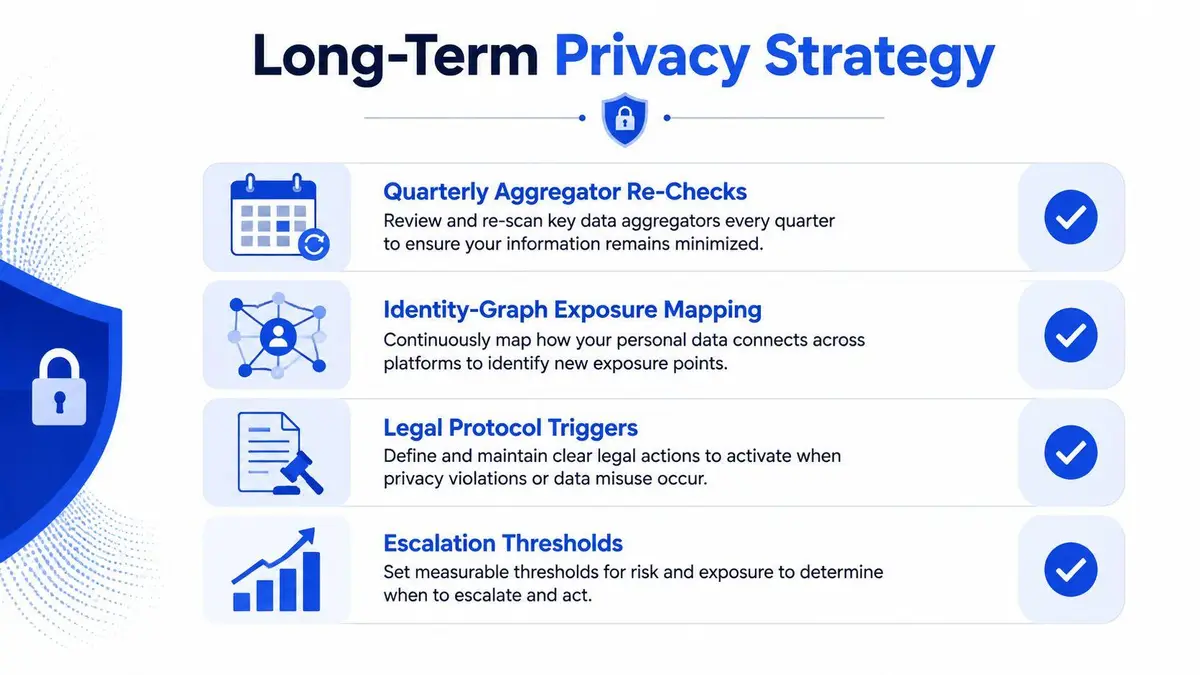
Home-address suppression should become part of executive protection, not a project that ends when the first Whitepages result disappears. Re-scan the major aggregators on a quarterly schedule, review relatives and related entities, and keep personal, family, and corporate footprints compartmentalized. The objective is to reduce the number of identity links that can recreate a residence profile.
Escalation is warranted when a provider re-lists a documented removal, when an address appears in a doxxing campaign, when someone expresses a physical safety concern, or when coordinated harassment links the residence to family members. Those circumstances require evidence preservation, counsel involvement, and coordination with physical-security professionals. Don’t let a routine privacy ticket become the only response to a credible threat.
Selecting outside support
An internal team can manage low-risk records if it has time, authority, and a disciplined register. High-profile households usually need specialized support when the exposure spans multiple jurisdictions, family members, corporate entities, and hostile content. Before appointing a vendor, verify its removal methodology, monitoring scope, escalation process, confidentiality terms, service-level commitments, and legal affiliations.
Ask whether the provider distinguishes source removal from search de-indexing. Ask how it verifies a listing after suppression, how it handles re-listing, and who owns the evidence. Avoid guarantees that promise universal deletion. Public records and third-party databases may remain outside a vendor’s control, as the opt-out limitations described by Intelius’ reverse address information demonstrate.
A written privacy policy can also clarify how a specialist handles personal information, communications, and client data. Haute Black’s privacy policy is a useful reference when assessing the transparency standards a privacy-focused service should publish.
Waiting for regulation to solve an immediate exposure is a poor strategy for a prominent individual. Use ContentRemoval.com’s home-address removal resource to inform the operational review, then decide whether your team has the capacity to execute and monitor the work. If the answer is no, bring in a specialist before the next public crisis forces the issue.
ContentRemoval.com helps executives, family offices, public figures, and high-net-worth individuals suppress home-address listings and related identity exposure across people-search sites, search engines, and other online sources. Its team combines removal workflows with ongoing monitoring so re-listed records and connected harmful content receive a documented response. Visit ContentRemoval.com to request a confidential assessment and receive a specific action plan for your address exposure.
Frequently asked questions
How does someone find my name from just my address?
People-search platforms match the address against public and commercial records, then rank results using identity-linked signals such as current and former residents, associated phone numbers and property data. The result is an assembled profile from many sources rather than a copy of one government document.
Will removing my address from Whitepages take it off the other sites?
No. Each aggregator holds its own copy and many draw from common upstream brokers, so a suppression on one service leaves the record visible elsewhere and open to reintroduction after a feed refresh. The article recommends bulk suppression across the principal sites, then individual escalation for profiles showing relatives or phone numbers.
Does moving house fix my address exposure?
Not on its own. A new record can connect to the same name, phone number, relative or business entity, and the matching system rebuilds the profile. Reducing the surrounding identity links, using a privacy-grade mailing address and keeping household footprints compartmentalized hold longer than a change of residence.