
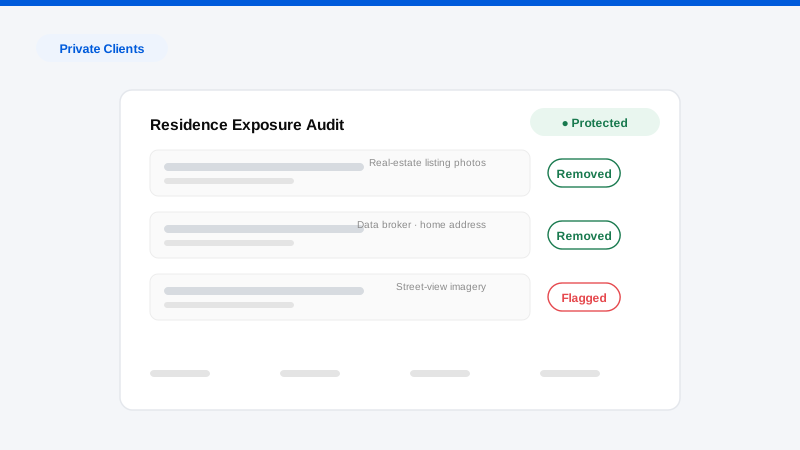
To remove your home from the internet is to close the single largest gap in most private clients’ physical-security posture. A residence that appears in real-estate listings, street-level imagery, aerial photography, and data-broker address records is not a private residence in any operational sense. It is a documented target: photographed room by room, mapped from the curb and from the air, and tied to your name in databases that anyone can query in seconds. For families who invest heavily in alarms, safe rooms, and residential security teams, this is the uncomfortable truth. The internet has already published the reconnaissance file.
Most owners discover the problem the same way. A security consultant, an insurer, or an executive-protection lead runs an assessment and finds the home’s interior on a listing archive, its floor plan on a real-estate portal, its driveway and sightlines on satellite view, and the owner’s name attached to the address on a dozen people-search sites. The question that follows, how do we make this disappear, is the right one. But it is not a weekend project, and it is not something a busy principal or family office should attempt through public opt-out forms and hope.
This briefing explains what home exposure actually consists of, why it matters at the level of physical security rather than mere discretion, and what professional removal and suppression work looks like when it is done properly and quietly.
What it means to remove your home from the internet
The phrase covers four distinct layers of exposure, and any serious effort has to address all of them, because an adversary planning against a residence will use whichever layer is available.
The listing layer. When a property sells, the transaction leaves a rich trail: the original listing with professional interior photography, staged-room walkthroughs, floor plans, lot dimensions, and price history. That material syndicates from the MLS outward to Zillow, Redfin, Realtor.com, Trulia, Homes.com, and dozens of secondary portals, and it does not expire when the sale closes. Years later, the listing archive still shows where the primary bedroom sits relative to the entry, where the safe-adjacent closet is, which doors face the pool, and how the ground floor flows. Interior photography is the most operationally sensitive material on the internet about your home, because it converts a burglary or home-invasion plan from guesswork into a rehearsal.
The imagery layer. Street-level photography shows gates, camera placement, fence lines, and approach angles. Aerial and satellite imagery shows roof access, outbuildings, perimeter vegetation, and the routes a vehicle or person could take onto the property unseen. Both are refreshed on the platforms’ schedules, not yours, and both can be blurred or restricted, but only through processes most owners never complete correctly.
The records layer. County assessor and recorder databases tie ownership to names or entities. Where a home was purchased in an individual’s name, that link is public. Even where an LLC or trust holds title, sloppy formation records, registered-agent filings, or a mortgage document signed personally can unwind the anonymity. Data brokers and people-search sites then ingest these records and republish them beside your phone numbers, relatives, and prior addresses, a one-stop dossier. Our data broker removal practice exists in large part because of this layer.
The narrative layer. Press coverage of a notable purchase, a neighborhood dispute, an architectural feature in a design magazine, a charity event hosted at the residence, each item confirms the address, describes the property, or photographs it. Individually harmless; in aggregate, a map.
Key takeaway: A home is not private because it feels private. It is private only when the listing archives, imagery platforms, public-record mirrors, and press references that describe it have been systematically found and addressed.
Why home exposure is a physical-security problem
It is tempting to file address exposure under “privacy”, an annoyance category, alongside spam calls. For ultra-high-net-worth households, that framing is wrong, and security professionals know it. Address and interior exposure changes the feasibility of specific categories of harm.
Targeted burglary and home invasion. Sophisticated theft crews select targets by researching them. Interior listing photos answer the questions that matter to them: what is visibly worth taking, where valuables are likely stored, what the alarm panel brand is (often visible in photos), how many seconds separate the point of entry from the primary suite. Aerial imagery answers the approach question. None of this requires skill to gather, only a name.
Stalking and fixated persons. Public figures, executives, and family principals attract fixated individuals whose behavior escalates over time. The difference between a disturbing letter and a person standing at the gate is usually nothing more than whether the address was findable. Every threat-assessment professional treats address confidentiality as the foundational control for this risk, which is why our digital executive protection programs begin with the residence.
Kidnap, extortion, and coercion planning. In jurisdictions where express kidnapping or extortion targeting wealthy families occurs, planning begins with pattern-of-life research: where the family sleeps, where children are dropped off, which routes connect them. A fully documented residence shortens that research from weeks to minutes.
Protest, harassment, and doxxing. Principals connected to controversial industries, litigation, or public positions face a different exposure: activists or online mobs publishing the home address as a call to action. When a doxxing incident includes a residence, the response window is measured in hours, and households whose addresses were already scrubbed from brokers and records mirrors are dramatically harder to re-expose.
Insurance and liability posture. Increasingly, insurers and family-office risk committees ask what residential digital exposure looks like before underwriting kidnapping-and-ransom or high-value property coverage. A clean exposure profile is becoming part of what a well-run household simply has.
Know exactly what's exposed, before someone else finds it.Free confidential Exposure Scan, live results on a 15-minute call, covered by strict confidentiality.
Book Your Confidential ScanHow homes end up exposed, even careful ones
Owners who bought through entities, who never posted about the property, and who instructed their agents to keep things quiet are routinely surprised by what an assessment finds. The exposure paths are structural, not behavioral.
Listing syndication outlives the sale. The seller’s agent controlled the original listing; you did not. Once photographs syndicated to portals and were archived by third-party sites, the material acquired a life independent of the MLS record. “Sold” does not mean “removed.”
Public records are published by default. Assessors, recorders, and permitting offices publish because statute or policy tells them to. Building permits alone can reveal a safe-room contractor, a security-system installer, and a renovation floor plan.
Data brokers re-link what entities were meant to separate. People-search sites correlate utility records, voter files, delivery data, and historical addresses. A trust-held property with a principal’s name on a single old record gets re-attached to the family within one broker cycle, and brokers repopulate continuously, which is why one-time cleanups fail and ongoing personal data removal programs exist.
The household leaks around the principal. A staff member’s social post, a contractor’s project-portfolio page, a landscaper’s before-and-after photos, a caterer’s event gallery. The principal’s own discipline cannot control a vendor’s marketing.
Prior owners and neighbors publish. A previous owner’s listing, a neighbor’s drone footage, a community association newsletter. The property has a public history that predates and surrounds you.
Key takeaway: Home exposure is created by systems (syndication, public records, broker correlation, vendor marketing) not by carelessness. It therefore has to be dismantled systematically, and kept dismantled.
What professional removal and suppression looks like
There is a meaningful difference between filing opt-out forms and running a residential exposure program. The former is what a determined assistant can do in a week and watch reappear in a quarter. The latter is what a specialist firm does, and it has a recognizable shape.
A full-spectrum residential audit. Before anything is removed, everything is found: listing archives and syndication copies, floor-plan repositories, street and aerial imagery, county and municipal records, broker and people-search profiles, press and social references, vendor and contractor sites, and the entity-record trails that connect the property to the family. The audit is the deliverable that most households have never seen, a complete picture of what an adversary could assemble.
Layer-by-layer remediation. Each exposure category has its own removal mechanics, its own decision-makers, and its own failure modes. Listing photography involves portals, MLS policies, photographers’ rights, and archive sites, each with different levers. Imagery platforms have restriction processes with specific eligibility standards. Records exposure may involve state address-confidentiality mechanisms where the family qualifies, coordinated with counsel. Broker profiles require suppression across hundreds of sites, on a recurring basis, because they repopulate. A specialist knows which lever fits which layer, in which order, and, critically, which requests would backfire by drawing attention.
Search-layer suppression where removal is not available. Some material cannot be removed: a news article about a notable purchase, a magazine feature, an archived record. Professional programs address the search layer directly, the work of search-result removal and suppression, so that what cannot be deleted is at least not the first thing a query returns.
Continuous monitoring. Imagery refreshes. Brokers repopulate. A new article publishes. A vendor uploads a gallery. Residences under real protection are monitored continuously through reputation and exposure monitoring, so that re-exposure is caught in days, not discovered by the next person who goes looking.
Coordination with the rest of the security apparatus. Residential digital exposure work should feed the family’s executive-protection team, household security, and, where a family office exists, its risk function. Our family office engagements typically cover every residence in the portfolio: primary homes, vacation properties, the ranch, the apartment held for a student, under one program with one point of contact.
Know exactly what's exposed, before someone else finds it.Free confidential Exposure Scan, live results on a 15-minute call, covered by strict confidentiality.
Book Your Confidential ScanWhy this is specialist work, and why discretion is the point
The do-it-yourself failure mode is well understood by anyone who has attempted it. Opt-out portals are designed to deter completion. Removal requests sent to the wrong party, or phrased the wrong way, are ignored, or worse, flagged internally as interesting. Progress made in month one silently reverses by month four because nobody was watching, and the person filing the requests has, by filing them, associated their own identity with the address across a new set of inboxes and databases.
A specialist firm brings three things a household cannot easily replicate. First, mechanism knowledge: which platforms honor which categories of request, what evidence each requires, and where the escalation paths run when a first request stalls. Second, persistence infrastructure: removal at this level is not a project but a standing function, with monitoring, re-suppression, and reporting built in, the structure of our protection plans. Third, discretion by design: requests made through a firm do not carry the family’s fingerprints, engagement details are held in strict confidence, and the work product is a quieter internet rather than a louder file.
It is worth saying plainly what a reputable firm will not do: it will not promise that every image or record can be erased, and it will not guarantee outcomes that depend on third parties’ policies. What it can do is find everything, remove what is removable, suppress what is not, harden the records layer going forward, and keep watch, which, for physical-security purposes, is the difference between a documented target and a hard one.
Key takeaway: The goal is not perfection; it is asymmetry. When reconnaissance that once took minutes now takes weeks and produces gaps instead of floor plans, most adversaries move on. That asymmetry is built by specialists and maintained by monitoring.
Who should treat this as urgent
Certain situations move residential exposure from important to immediate. A recent purchase, because the listing is fresh, widely syndicated, and often press-covered. A liquidity event or public role, because attention arrives before protection does. An active threat (a fixated individual, a hostile dispute, litigation, an online mob) because the address is the thing such actors look for first. Families with children at home, because pattern-of-life exposure compounds address exposure, and households already investing in physical security, because a documented residence quietly undercuts every dollar of that investment. Our private-client practice is built for exactly these households.
Frequently asked questions
Can old Zillow and real-estate listing photos of my home actually be removed?
In many cases, listing photography and property-detail pages can be removed or substantially reduced across the major portals and their syndication network, though the mechanics differ by platform and by who holds rights to the images. Archive and scraper sites require separate handling. No reputable firm will promise total erasure of every copy; the professional standard is to remove what the platforms’ processes allow, pursue the archives that respond, and suppress residual copies so they no longer surface for the searches that matter.
Does holding my home in an LLC or trust make this unnecessary?
Entity ownership helps, but it is a title strategy, not an exposure strategy. It does nothing about listing photos, street and aerial imagery, or press coverage, and data brokers routinely re-link entity-held properties to families through historical records, utilities, and correlated addresses. Many families come to us after discovering that their carefully structured purchase is attached to their name on a dozen people-search sites anyway. The entity and the exposure program work together; neither replaces the other.
How long does it take to meaningfully reduce a home’s online exposure?
The first wave of removals, the highest-risk listing material and the major broker profiles, typically moves within the opening weeks of an engagement. Records-layer work, imagery restrictions, and suppression of non-removable references unfold over subsequent months, and monitoring then holds the ground continuously. Timelines depend on third-party platforms and cannot be guaranteed, which is why we report progress against a documented baseline rather than promising dates.
We own several properties in different states. Can they be covered under one program?
Yes, and they should be. Adversaries research the family, not a single address, so a protected primary residence next to an exposed vacation home simply redirects attention. Multi-property coverage under a single program, common in our family-office engagements, applies the same audit, remediation, and monitoring to every residence, with one confidential point of contact and consolidated reporting for the principal or the office.
Your home is either documented or defended, on today’s internet, rarely both. A confidential Exposure Scan will show you, live on a 15-minute call, exactly what an adversary would find about your residence right now: the listings, the imagery, the records, the broker profiles. It is free, it is covered by strict confidentiality, and it is the fastest way to know where you actually stand. Book it before someone with worse intentions runs the same search.