
To remove personal information from search engines, work in three tiers. Direct action: log each URL, file Google’s personal information removal request where it fits, and ask the source site to delete. Legal escalation: DMCA notices, right to be forgotten requests or court orders when content is stolen or false. Professional intervention when data has replicated across mirrors and brokers.
Key facts
- Google accepts requests for phone numbers, addresses, ID numbers, financial details, signature images, medical records and credentials.
- Google reviews URL by URL; a removed result can still exist at the source and be copied elsewhere.
- A study of commercial PII-removal services found they removed about 48.2% of records in a month.
- Home address, children, staff or a coordinated attack make it an operational security issue, not a service request.
Where ContentRemoval.com comes in. ContentRemoval.com is the third tier this guide describes: source removal and de-indexing coordinated in the right order, escalation pressure applied only where it has influence, and monitoring after the first wave so copied material does not return unnoticed across websites, search engines and social platforms. Executives and family offices usually reach us through counsel, a chief of staff or a security advisor. A free 15-minute Exposure Scan maps what is removable, and the report is yours to keep. Get a Free, Confidential Exposure Scan or read how our personal data removal work is done.
An executive searches his name before a board meeting and finds his private phone number, home address, and a scraped profile tied to family members sitting in Google results. The instinct is to remove everything immediately. The correct move is narrower and more disciplined.
When you need to remove personal information from search engines, you are not dealing with one problem. You are dealing with several different threat classes that only look similar from the outside. A people-search listing is one kind of problem. A hostile forum post is another. A defamatory article, a doxxing page, and a mirrored archive all require different responses. If you treat them the same, you waste time, expose yourself further, and often make the problem harder to contain.
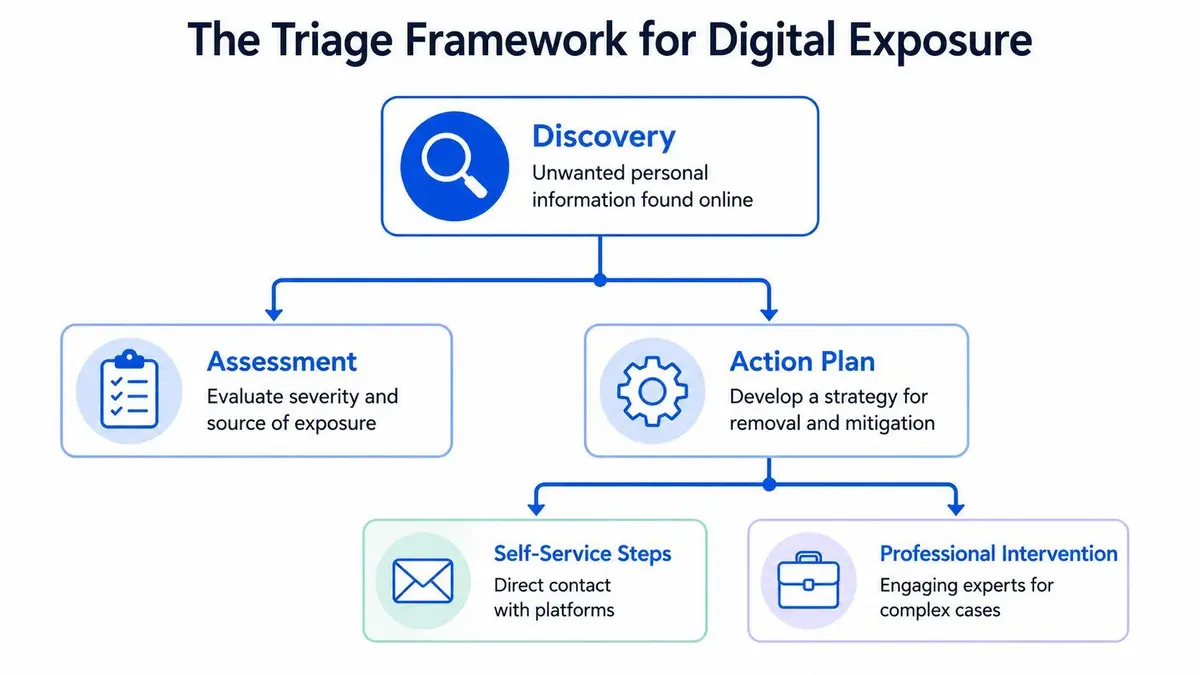
The Triage Framework for Digital Exposure
The first mistake clients make is asking, “How do I get this off Google?” Google is usually just the visibility layer. Instead, the question is: what exactly is showing up, who controls it, and what means exist to address it.
Treat the situation like a crisis intake, not a cleanup chore. Use three tiers only: Direct Action, Legal Escalation, and Professional Intervention. Anything else is noise.
Direct Action
Use this tier when the material is clearly personal data, the source is identifiable, and the platform offers a removal path. A phone number on a people-search site. An address on a directory page. A cached result tied to a profile you control. These are administrative problems. They require precision, documentation, and follow-up.
Legal Escalation
Use this tier when the content is unlawful or when the publisher won’t cooperate. That includes copyright infringement, impersonation, certain privacy violations, and provably defamatory material. Legal action is not a pressure tactic unless the legal basis is real. Weak threats fail. Strong, specific claims backed by evidence move the matter.
Professional Intervention
Use this tier when speed matters, replication has started, the exposure affects family safety or corporate reputation, or multiple jurisdictions and platforms are involved. For these reasons, high-value clients typically opt for this tier, because the visible result is rarely the full footprint.
Practical rule: If the exposure involves your home address, direct contact details, children, staff, or a coordinated attack, treat it as an operational security issue, not a customer-service request.
One more point. Search exposure now intersects with AI exposure. If your data is being indexed, scraped, summarized, or reused, you need to reduce both discoverability and source availability. If you’re reviewing tools and workflows for safer handling of sensitive information internally, this primer on offline AI privacy is worth your time.
For a deeper understanding of what search removal does, review this guide to de-indexing and search result removal. It will keep you from making the most common strategic error: confusing lower visibility with deletion.
Tier 1 Direct Action and Its Inherent Limitations
Your home address appears in search results on Monday. By Friday, a broker site has copied it, a second result is ranking for your name, and the original page is still live. That is the Tier 1 problem in plain terms. Direct action is your first response because it is fast, low-cost, and sometimes enough to contain a narrow exposure. It is also the tier clients overestimate most.
Google accepts removal requests for search results that expose qualifying personal information, including phone numbers, addresses, email addresses, government ID numbers, financial account details, signature images, medical records, and login credentials. It also reviews some doxxing-related requests. But its personal information removal policy is built around individual URLs. If Google removes a result, the page can still exist on the source site, still be copied elsewhere, and still appear through other search paths. That is visibility reduction, not deletion.
Treat Tier 1 as a disciplined triage process.
- Build an evidence log. Record the search query, exact URL, screenshot, date captured, and the specific data exposed on each page.
- Submit Google requests only where the page fits Google’s stated categories. Bad submissions waste time and weaken your workflow.
- Go to the source immediately. Ask the site owner, publisher, or broker to delete, redact, or anonymize the page itself.
- Track each URL as a separate case. One approved request tells you nothing about another result, even on the same domain.
If the underlying problem is on publisher pages, broker listings, or profile sites rather than search results alone, use this process for removing personal data from websites.
Direct Action Method Comparison
| Method | Target | Typical Success Rate | Timeline |
|---|---|---|---|
| Google personal information removal request | Search result URLs containing qualifying PII | Qualitative only. URL-specific review, no guarantee of approval | Varies by case |
| Website owner or webmaster request | The source page hosting the information | Qualitative only. Depends on ownership, policy, and responsiveness | Varies by site |
| People-search opt-out service | Broker and directory listings | Mixed results, with ongoing maintenance required | Ongoing, with maintenance |
The limit of Tier 1 is not effort. It is structure.
Each page has to be handled separately. Search engines, source websites, broker platforms, and archives all run on different rules. A broker may remove one listing and republish it after a later data refresh. A publisher may ignore you. A search engine may delist one URL while near-identical pages remain indexed.
This tier also breaks down when the harm is packaged as something other than plain PII. Direct requests can work for exposed contact details or financial identifiers. They are weak against attack pages, hostile commentary wrapped around true facts, copied images spread across multiple domains, and coordinated harassment. Those cases stop being customer service problems. They become legal or strategic containment matters.
Use Tier 1 hard and use it early.
But classify the threat correctly. If you are only suppressing one search result while the source stays live, replication continues, or the content carries reputational allegations, you have reached the limit of self-service action.
Tier 2 Legal Escalation for Defamation and Infringement
Your name surfaces beside a false accusation, or your photo appears on a site that had no right to publish it. At that point, stop treating this like a routine removal request. The issue is no longer exposure alone. It is unlawful content, and the response has to match that reality.

Tier 2 starts when the content crosses a legal line and you can prove it. It does not start because the page is ugly, unfair, or infuriating. Legal escalation works on evidence, ownership, falsity, jurisdiction, and procedure. If those pieces are weak, legal threats waste time and signal that you are bluffing.
A stolen headshot, copied article, leaked proprietary image, or unauthorized republication of your original work may support a DMCA takedown. That route is often effective because the claim is concrete. You can document authorship or ownership, identify the infringing material, and send a notice the platform already knows how to process.
Defamation is harder. A false accusation framed as fact requires proof of falsity, actual harm, the right jurisdiction, and a defendant you can identify or compel a platform to identify. Opinion is treated differently from fact. Anonymous posters create another layer of work. Offshore hosts shrink your practical options fast, even when your legal theory is sound.
Match the legal tool to the actual harm
Choose the wrong remedy and you lose speed, credibility, and money.
- DMCA takedown fits copied original content you own or control.
- Right to be Forgotten requests may apply in jurisdictions that recognize them, usually for outdated, irrelevant, or disproportionate search visibility.
- Court orders are the right move when the content is defamatory, invasive, or persistent and voluntary compliance has failed.
Strong claims change the publisher’s risk calculation. Weak claims teach hostile operators that you lack a credible threat.
This is also the point where clients confuse privacy cleanup with legal relief. Data broker opt-outs can reduce exposure, and a targeted data broker removal guide for executives is worth using, but broker cleanup does not resolve unlawful publication, false allegations, or stolen content. Different threat. Different tool.
Jurisdiction decides what actually bites
Clients routinely overestimate what one lawyer’s letter can accomplish across multiple countries and platforms. A U.S. claimant may have one set of rights against a domestic host, another against a search engine operating in Europe, and very little practical power against cloned material on foreign infrastructure. The strategic question is not whether legal action sounds justified. The question is where a legal remedy can be enforced and against whom.
This overview is useful if you want a short primer before involving counsel.
Use Tier 2 when the facts are clean, the evidence is organized, and the remedy fits the violation. Bring in counsel early when the content alleges criminal conduct, threatens revenue, targets a public-facing executive, or sits on hostile infrastructure. Legal escalation is a precision tool. Treat it that way.
The Challenge of Content Replication and Digital Persistence
Most clients think success means getting one page removed. That is not success. That is one move in a longer fight.
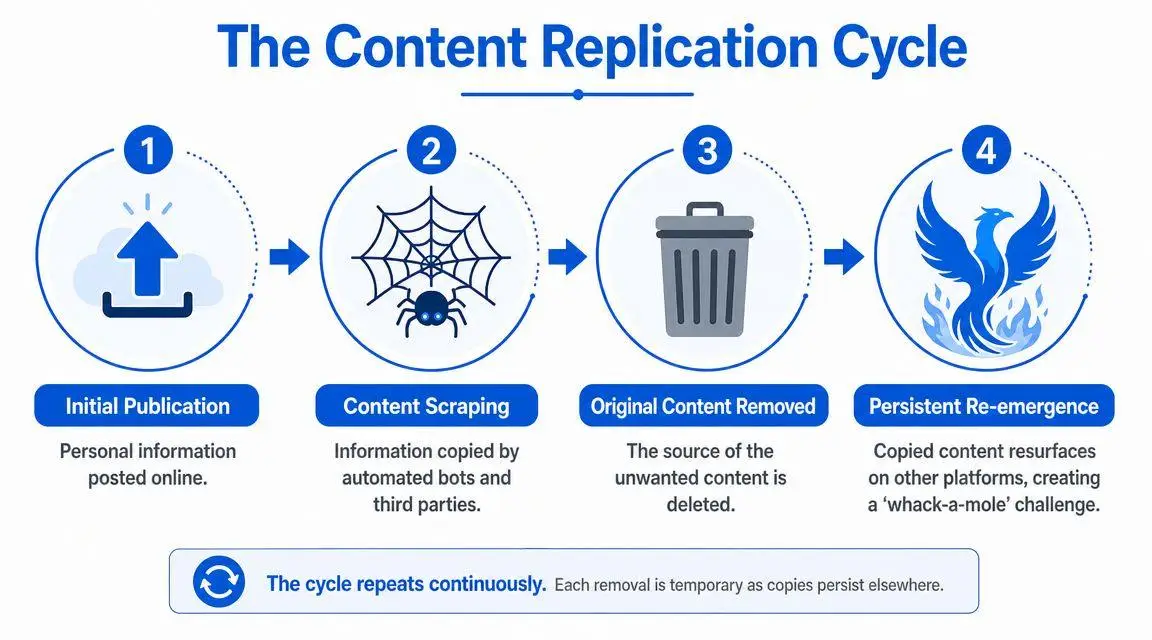
When personal information spreads online, it rarely stays in one place. A broker scrapes a source page. Another broker copies the broker. An archive stores the old version. A forum user reposts the same details. A foreign search engine indexes a duplicate. You remove one listing and the same facts return under a new URL.
Why the problem keeps coming back
The web is built for copying. Some copying is deliberate. Some is automated. All of it creates persistence.
Google expanded its removal coverage to include additional personal contact information, login credentials, and some aggregated personal information. But the policy still requires URL-by-URL review and does not guarantee approval, which becomes a serious limitation when hostile content appears across mirrors, archives, and broker ecosystems, as described in Google’s updated explanation of personal information removals.
That is why isolated takedowns feel like digital whack-a-mole. The process is fragmented because the web is fragmented.
The operational response
You need a repeatable containment model, not a one-off complaint.
- Map the source chain. Find the original publication point, then identify who copied it.
- Prioritize risk, not annoyance. Remove addresses, direct contact data, family links, and credentials before lower-risk exposures.
- Work in layers. Source removal, de-indexing, archive cleanup, broker suppression, and monitoring each solve a different part of the problem.
If broker amplification is part of your exposure, this executive guide to removing yourself from data broker lists is the practical place to start.
A search result is often the last stop in the chain, not the first. If you don’t find the upstream source, the exposure usually returns.
Clients often misread temporary disappearance as closure. It isn’t. A search result can drop because of a refresh, location variance, or indexing delay, then return when a duplicate is recrawled. That is why disciplined verification matters more than emotional relief.
What persistence changes strategically
Once replication begins, the job is no longer “remove this result.” The job becomes reduce the attack surface, eliminate the source where possible, and monitor for reappearance across platforms you don’t control.
That shift is where many self-managed efforts fail. People keep filing individual requests long after the matter has matured into a coordinated suppression and monitoring problem.
Tier 3 Professional Intervention and Strategic Suppression
By the time a high-net-worth client reaches this stage, the issue usually has at least one of these characteristics: replication, reputational harm, legal sensitivity, family safety concerns, or search visibility that won’t yield to direct requests. At that point, brute persistence is not strategy.
Professional intervention matters because automated and consumer-grade solutions stop where hard cases begin. A large-scale study of commercial PII-removal services found that they removed an average of 48.2% of identified records per user over one month, with performance varying substantially between services, according to the empirical study on commercial PII removal services. That is materially incomplete if the stakes involve extortion, investor confidence, board scrutiny, or residential security.

What expert intervention actually changes
A specialist team doesn’t just submit more forms. It changes the architecture of the response.
First, it coordinates source removal and search de-indexing in the right order. Second, it applies escalation pressure only where it has influence, whether through platform policy, publisher negotiation, evidentiary packaging, or legal channels. Third, it monitors the footprint after the first wave so copied material doesn’t return unnoticed.
One option in this category is ContentRemoval.com, which handles source removal, de-indexing, suppression, and ongoing monitoring across websites, search engines, and social platforms. That kind of scope matters because fragmented exposure requires a fragmented response that is still centrally managed.
Suppression is not a fallback. It is part of control.
Some content won’t disappear quickly. Some won’t disappear at all. In those cases, strategic suppression becomes necessary.
That means building and promoting legitimate, controlled assets that can outrank, displace, or dilute harmful results. Executive bios, authoritative media profiles, corporate leadership pages, thought-leadership content, and controlled social assets all serve a defensive purpose when deployed correctly. This is not vanity publishing. It is search environment management.
The objective isn’t only removal. The objective is control over what appears first, what persists, and what disappears from practical view.
When professional help becomes non-negotiable
If the content names your spouse, children, residence, travel patterns, staff, or financial identifiers, bring in specialists immediately. If the material appears on multiple domains, has been mirrored, or combines private data with threats or harassment, don’t run a solo campaign. If legal counsel is involved but the issue still spans search, source, social, and archives, legal work alone won’t finish the job.
Professionals become necessary when the exposure is no longer a page problem. It becomes an ecosystem problem.
Decision Matrix When to Act and When to Engage Experts
Individuals often wait too long to escalate because they misclassify the problem. Use a simple matrix. Match the scenario to the response tier and act accordingly.
Scenario comparison
| Scenario | Primary Risk | Correct Response Tier | Recommended Move |
|---|---|---|---|
| One outdated phone number on a single directory page | Privacy exposure | Tier 1 Direct Action | File platform request, contact site owner, verify removal |
| Home address on several people-search sites | Personal safety and aggregation | Tier 1 moving toward Tier 3 | Start removals immediately, then escalate if replication continues |
| False blog post accusing you of misconduct | Reputational and legal harm | Tier 2 Legal Escalation | Preserve evidence, assess defamation claim, target publisher and index visibility |
| Stolen headshot or copied article used without permission | Copyright infringement | Tier 2 Legal Escalation | Prepare ownership proof and use a DMCA-based approach |
| Doxxing page with contact details and threats | Immediate safety risk | Tier 3 Professional Intervention | Treat as urgent containment and removal matter across platforms |
| Multiple mirrors, archives, and broker copies of the same personal data | Persistence and spread | Tier 3 Professional Intervention | Run coordinated source removal, de-indexing, suppression, and monitoring |
The threshold tests
Use these tests to decide whether to keep handling it yourself.
- Containment test. If you can identify the source, the platform, and the exact remedy, Tier 1 may be enough.
- Replication test. If the same material appears on multiple URLs or domains, move beyond DIY.
- Legal test. If the content is false, stolen, invasive, or tied to threats, preserve evidence before taking action and assess legal remedies.
- Stake test. If the exposure can affect family safety, employment, transactions, litigation posture, or public standing, don’t economize on response quality.
If you are asking whether this has become serious enough for expert help, it usually already has.
You don’t need a massive crisis to justify intervention. You need an asymmetry of risk. When the attacker, scraper, publisher, or platform network has more time and persistence than you do, the correct move is to professionalize the response.
If your search results expose personal information, hostile content, or replicated data across multiple sites, request a confidential assessment from ContentRemoval.com. The sensible next step is not guessing. It’s getting a precise removal and containment plan built around the source, the search layer, and the risk to you and your family.
Frequently asked questions
Will Google remove my home address from search results?
Often, yes. Google’s personal information removal policy covers addresses, phone numbers, email addresses, government ID numbers, financial details, signature images, medical records and login credentials. The request is judged URL by URL, and approval removes the result from search without deleting the page at its source.
How do I know when my search exposure problem needs a specialist?
Apply four tests. Containment: can you identify the source, platform and remedy yourself? Replication: does the same material sit on several URLs or domains? Legal: is it false, stolen, invasive or tied to threats? Stakes: could it affect family safety, employment, a transaction or public standing? Failing the last three points to professional help.
Why did a search result disappear and then come back?
Results can drop because of an index refresh, location variance or crawl delay, then return when a duplicate is recrawled. A search result is usually the last stop in a chain; if the upstream source or a broker copy is still live, the exposure typically resurfaces, which is why verification matters more than temporary relief.