

Removing yourself from FastPeopleSearch means submitting the site’s opt-out one listing at a time: enter your email, pass the CAPTCHA, find the exact record, open View Free Details, choose Remove My Record, then click the confirmation link in your inbox. Processing starts only after that click. Once the page is gone, use Google’s outdated content tool to clear stale results.
Key facts
- The request is not live until the confirmation email link is clicked; check spam and quarantine folders.
- Duplicate records under prior addresses, maiden names or middle initials each need a separate opt-out.
- Alternate contact routes cited: PO Box 55071, Boston, MA 02205-5071 and (617) 229-7889.
- Verify the source page no longer loads before submitting a Google outdated content request.
Where ContentRemoval.com comes in. ContentRemoval.com handles people-search exposure for executives, physicians, attorneys and family offices where a FastPeopleSearch record is one of many, acting as authorized agent so staff stop re-entering private identifiers, and escalating when a listing returns or a broker ignores notice. Chiefs of staff, executive protection teams and counsel usually make contact after a self-search or threat review. A free, confidential 15-minute Exposure Scan maps every listing and which are removable, and the report is yours to keep. Get a Free, Confidential Exposure Scan or read how our data broker removal work is done.
You find it the way most executives do. Not through a planned audit, but through a moment of shock. A colleague mentions a people-search result. Your assistant googles your name. Suddenly your home address, old phone numbers, relatives, and fragments of your private life are sitting in public view on FastPeopleSearch.
For a public company officer, investor, founder, physician, attorney, or family office principal, that isn’t an irritation. It’s an exposure event. It expands the attack surface around your household, your travel, your children, your domestic staff, and your executive protection protocols. It also creates a reputational problem. Once personal data is assembled neatly on a public profile, bad actors don’t need to work hard. The site has already done the aggregation for them.
The right response is controlled, deliberate, and fast. If you’re trying to understand how to remove from FastPeopleSearch, the immediate objective is simple: suppress the listing at the source, clean up residual search visibility, and put a monitoring and escalation framework behind the initial removal to prevent the problem from re-emerging in another form.
Your Data Is Exposed What Happens Now
The first mistake people make is treating a FastPeopleSearch listing as a low-level annoyance. It isn’t. For a high-visibility individual, one exposed record can connect a professional identity to a residential one. That bridge is exactly what stalkers, disgruntled former employees, litigants, extortionists, scammers, and opportunists want.
A CEO discovers the listing after a threat-monitoring review. A founder in the middle of an acquisition process learns that her prior addresses and family associations are publicly indexed. A public-facing attorney finds that opposing parties can map personal contact details in minutes. Different facts, same conclusion: the issue isn’t embarrassment. It’s loss of control.
Treat the listing as a security event
The practical consequence of exposure is that your private data is no longer scattered. It’s organized. People-search sites turn fragmented public and commercial data into an easy lookup tool. That changes the risk profile because it reduces friction for anyone trying to identify where you live, who is connected to you, or how to contact you outside controlled channels.
That’s why the first question shouldn’t be, “Can I take this down?” It should be, “What else is now connected to this record?”
Start there:
- Check the full exposure chain: Search your name, phone numbers, prior addresses, and close relatives.
- Capture evidence before removal: Save screenshots and the listing URL for counsel, internal security, or follow-up.
- Review operational overlap: Determine whether the exposed data intersects with current residence, travel schedules, executive assistant workflows, or household staff routines.
For a broader understanding of why these listings exist and why they keep resurfacing, review this guide to data brokers and executive privacy risk.
Practical rule: Don’t outsource judgment to the website’s “opt-out” branding. A site can offer removal and still create meaningful risk before, during, and after that request.
Move from alarm to containment
Individuals often lose time because they react emotionally. They search repeatedly, click around, and start deleting random profiles elsewhere. That’s understandable, but it’s sloppy. You need sequence.
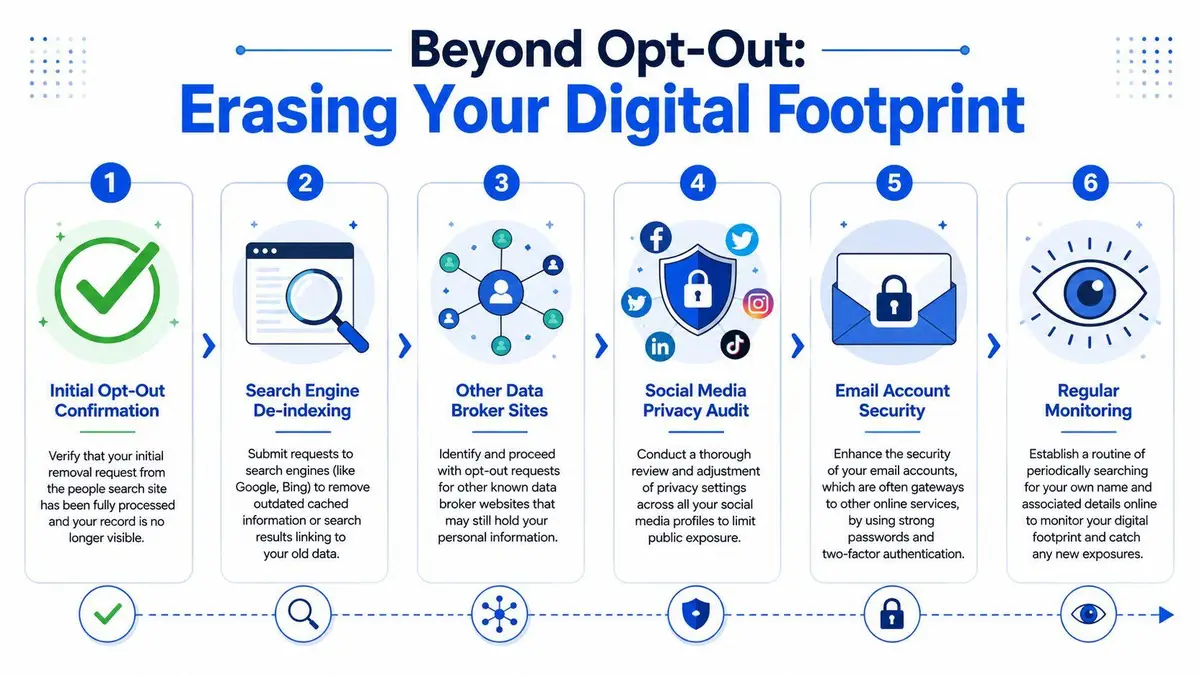
First, remove the record from FastPeopleSearch. Second, verify the source page is gone. Third, clear residual search visibility. Fourth, decide whether your profile requires broader broker suppression and legal escalation.
That sequence matters because executives don’t need noise. They need containment.
Executing the FastPeopleSearch Removal Request
Treat this as an evidence-driven takedown, not a casual privacy setting. FastPeopleSearch removes records one listing at a time. You need the exact profile, a working email address, and enough discipline to finish the confirmation loop the first time.
Follow the workflow exactly
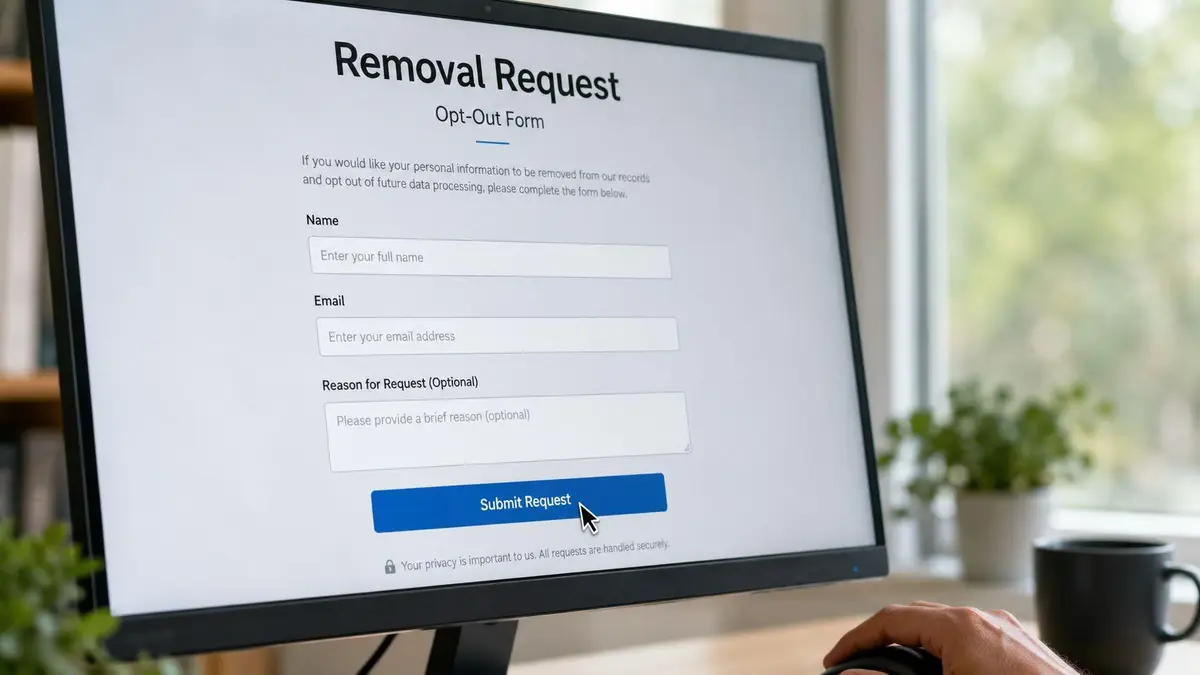
Use the site’s removal page and complete the process in order. Submit your email, pass CAPTCHA, search for the record, open “View Free Details,” select “Remove My Record,” and click the confirmation link sent to your inbox. FastPeopleSearch opt-out instructions published by third parties describe the same sequence and note that processing starts after email confirmation, not before, in this FastPeopleSearch opt-out guide.
Precision matters here. If you select the wrong profile, use an inbox you cannot access quickly, or ignore the confirmation email, the listing stays up and the risk remains active.
Match the exact record before you submit
FastPeopleSearch forces you to identify the specific profile tied to you. That sounds simple until you see duplicate names, old addresses, family associations, and stale data stitched into multiple records.
Use only details visible on the listing or details you can independently verify. Do not guess at a date of birth, address variant, or relative match just to get through the form. If you have several records tied to prior residences or name variations, treat each one as a separate project.
A disciplined search protocol looks like this:
- Search your current legal name and review every plausible match.
- Run prior cities, states, and ZIP codes if the first search misses the right listing.
- Check name variants such as a middle initial, suffix, maiden name, or previous surname.
- Open the profile and confirm the identifiers before submitting the opt-out.
- Log each URL removed so you can track gaps across other broker sites.
NordVPN’s FastPeopleSearch removal overview also notes alternate contact routes, including PO BOX 55071, Boston, MA 02205-5071 and (617) 229-7889, which can help when the web form fails to surface the correct listing.
If you are cleaning up more than one broker, use this guide to removing content from people search sites to standardize the workflow across vendors instead of improvising site by site.
Control the confirmation email
This is the failure point that wastes time. The request is not complete until you click the email confirmation link. Corporate filtering, delegated inboxes, spam controls, and shared assistants routinely disrupt that step.
Use an email account you control directly. Check spam and quarantine folders immediately. If staff handles the request, assign one owner and require written confirmation that the link was clicked.
Delegation without ownership is how supposedly removed records stay live for days.
For a visual walk-through, this video is useful before you begin the process:
Use alternate channels strategically
The web form is usually the fastest route. Phone or mail makes sense when the site will not match the record, when you need a cleaner paper trail, or when the profile touches a more sensitive issue such as prior court data or mistaken criminal associations. In those cases, document every contact and preserve timestamps.
If the listing references old legal matters, parallel cleanup may also require reviewing criminal record expungement options so the underlying source trail is addressed, not just the broker copy.
Do not confuse phone or mail with escalation. They are still basic opt-out channels. If FastPeopleSearch ignores a properly documented request, republishes the record, or leaves high-risk data live after notice, the issue shifts from routine removal to enforcement and broader reputation control.
Erasing the Digital Footprint After Removal
Removing the FastPeopleSearch page doesn’t automatically remove the visibility that matters most. Search engines may still show the result for a period of time, and users often mistake that residual search presence for a failed opt-out.
That distinction matters. Source removal and search engine de-indexing are separate problems.
Confirm the source page is dead first
Before you touch Google or Bing, verify the page itself no longer resolves in a meaningful way. If the FastPeopleSearch listing still loads, search engine cleanup is premature. You’ll ask Google to remove outdated content, but the source is still active, which weakens the request.
Once the source page is gone, then move to search cleanup.
Clear residual search visibility
Google’s outdated-content process exists for exactly this problem. If the search result still points to a page that has been removed or changed, submit a request through Google’s removal tool for outdated results. Bing has a comparable process. The point isn’t to litigate with the search engine. The point is to force a refresh.
Use a tight checklist:
- Verify the listing URL first: Open the old result and confirm the page no longer displays your record.
- Submit the exact stale URL: Don’t submit a homepage when the issue is a profile page.
- Search your name again after submission: Watch for cached snippets, alternate URLs, and duplicate results.
- Repeat with variations: Search old city-state combinations, prior phone numbers, and quoted name searches.
A stale search result is often a caching issue, not a compliance issue. Treat it as a technical cleanup task, not evidence that removal failed.
Expand beyond one broker
Generic guides often stop too early. FastPeopleSearch isn’t the internet. It’s one node in a wider broker network. If one profile was live, others often are too, and they may carry overlapping or older data that search engines still surface.
That’s why an executive privacy response should include review of other broker directories, social profiles, image metadata exposure, and any public records that have become easy indexing targets. If you’re handling this manually, this guide on how to remove yourself from data broker lists is a sensible next step.
In some matters, the underlying issue isn’t just broker aggregation. It’s the existence of a public record that keeps feeding the ecosystem. If the exposure involves criminal history, it’s worth understanding available criminal record expungement options because record-level relief can change the long-term cleanup strategy.
What complete cleanup actually means
A proper post-removal review answers three questions:
| Review point | What you need to see |
|---|---|
| Source page status | The FastPeopleSearch profile is no longer publicly available |
| Search visibility | Google and Bing no longer show stale or cached versions prominently |
| Replication risk | Other broker sites and public-facing records aren’t recreating the same exposure |
If even one of those remains unresolved, your digital footprint hasn’t been cleaned. It has only been disturbed.
When the Standard Opt-Out Fails
A common failure pattern looks like this. The profile stays live after submission. The listing disappears, then returns under a variation of the same name or address. Support requests go unanswered, or the broker demands another round of identity confirmation with no firm resolution. At that point, treat the matter as an enforcement problem.
For executives, public figures, and households with real security exposure, delay creates unnecessary risk. A failed opt-out leaves your home address, relatives, and historical records available for indexing, copying, and resale. The right response is disciplined escalation, tight documentation, and control over who handles the process.
Use an authorized agent when speed matters
If self-service stalls, stop running the same workflow again. Use an authorized agent to submit and track the request on your behalf. That shortens the chain of communication, reduces internal handling of sensitive identifiers, and creates a cleaner record if counsel needs to step in.
Legal escalation also becomes more credible when the file is organized from the start. Keep copies of the live URLs, submission confirmations, email exchanges, screenshots, dates, and any reappearance of the listing. If the broker ignores a valid request, counsel can evaluate cease-and-desist options and any rights available under the jurisdictions involved.
This is not administrative housekeeping. It is evidence preservation.
Know when DIY becomes inefficient
Manual removal makes sense for a single, low-risk listing with no recurrence. It stops making sense when the issue shows signs of replication, delay, or security impact.
Escalate the matter if any of these apply:
- The record reappears after a prior takedown.
- Multiple profiles exist under name variants, prior cities, or old addresses.
- Family members are exposed through household associations or linked records.
- Several jurisdictions are involved and the removal strategy depends on which rights apply.
- Confidentiality matters and you do not want assistants, staff, or vendors repeatedly handling private details.
Here is the practical comparison.
Data Removal Approaches Compared
| Factor | DIY Removal | Professional Service (e.g., ContentRemoval.com) |
|---|---|---|
| Time burden | You handle every search, submission, confirmation, and follow-up | The process is managed on your behalf |
| Documentation | Often inconsistent unless you build your own recordkeeping | Typically centralized with a clear audit trail |
| Privacy exposure | You or staff may need to repeatedly enter personal identifiers | Fewer internal touchpoints when delegated properly |
| Escalation readiness | Limited if requests are ignored or become repetitive | Better positioned for authorized-agent workflows and counsel coordination |
| Monitoring | Usually manual and irregular | Can be structured as ongoing review and suppression |
| Suitability | Single, low-stakes listing | Higher-risk, recurring, or multi-site exposure |
Decision point: If exposure has security, reputational, or family implications, the lowest-cost option is the one that resolves the issue cleanly and keeps it from resurfacing.
Escalation is a control decision
The objective changes once the first request fails. You are no longer asking for a favor. You are building a record of notice, identifying the strongest legal basis for removal, assigning the matter to an authorized representative where appropriate, and preparing counsel-led escalation if compliance does not follow.
That approach also fits the larger cleanup cycle that generic opt-out guides miss. One failed request often signals a broader data distribution problem, not an isolated listing. Handle the immediate takedown, but also treat it as a trigger for source tracing, legal review, and long-term suppression. That is how you reduce repeat exposure instead of managing the same problem every quarter.
Building Your Digital Privacy Fortress
FastPeopleSearch is rarely the root problem. It’s a symptom. The issue is that your personal data keeps entering systems that package, cross-reference, and redistribute it.
Executives who solve this well stop thinking in terms of isolated takedowns. They build a privacy architecture that reduces future data exhaust.

Reduce the inputs
The cleanest removal is the one you never need. That means limiting how often your true information is attached to signups, directories, event registrations, newsletters, warranty cards, and nonessential vendor records.
A workable executive protocol usually includes:
- Masked email use: Reserve your primary inbox for high-trust relationships. Use separate addresses for registrations, marketing, and public-facing forms.
- Virtual phone strategy: Keep your personal number out of routine business intake, vendor interactions, and low-trust signups.
- Address discipline: Avoid using residential addresses where a business, registered agent, office, or other lawful contact point will suffice.
- Data minimization: If a form doesn’t need date of birth, alternate phone numbers, or household details, don’t provide them.
Control the public layer
Your public-facing footprint needs periodic review. That includes social media biographies, family references, property-related exposure, and image backgrounds that reveal house numbers, schools, vehicle details, or routine locations.
This is also where continuous monitoring starts to matter. Manual checks work for a while, but they degrade because no one keeps doing them consistently under pressure. Some firms and privacy tools maintain recurring scans for broker listings, search visibility, and reappearance patterns. In higher-risk cases, ContentRemoval.com offers privacy protection, content removal, and monitoring services that can fit into that broader suppression workflow.
Build a standing review cadence
The strongest privacy programs are boring. They rely on habit, not adrenaline.
A sound cadence includes:
- Quarterly self-searches across major search engines and broker sites.
- Event-triggered reviews after a move, financing event, litigation filing, media coverage, or change in marital status.
- Household alignment so spouses, assistants, chiefs of staff, and protection teams understand what information should never be disclosed casually.
- Vendor scrutiny because luxury service providers, event staff, and concierge networks often become weak points.
The actual fortress isn’t secrecy. It’s disciplined exposure control.
Taking Definitive Action on Your Online Presence
If you came here looking for how to remove from FastPeopleSearch, the direct answer is that you can submit the site’s opt-out request and complete the email verification. But that’s the narrow answer. It doesn’t solve the larger executive problem.
The larger problem is uncertainty. You don’t know whether the record was the only one, whether search engines will keep showing stale results, whether the listing will return, or whether your broader data footprint is already replicating across other brokers. For high-stakes individuals, that uncertainty is the true cost.
A professional response is faster because it removes hesitation. You document the exposure, execute the removal correctly, clear residual search visibility, and escalate when the site or broader broker ecosystem doesn’t cooperate. You also build forward controls so the same issue doesn’t keep resurfacing under new URLs and old addresses.
That’s also why privacy work and reputation work increasingly overlap. A public figure who wants to manage your executive reputation can’t ignore personal data exposure, because unwanted discoverability becomes a reputational vulnerability long before it becomes a legal one.
You can handle a single listing yourself if the risk is low and your time is expendable. Most executives reading this don’t fit that profile. They need discretion, documentation, and a repeatable process that doesn’t depend on remembering to check another broker site at the end of a long week.
The right choice isn’t free versus paid. It’s unmanaged exposure versus controlled outcomes.
If you want a confidential assessment of your FastPeopleSearch exposure, residual search visibility, and broader broker risk, speak with ContentRemoval.com. The process is discreet, strategy-led, and built for clients who need decisive action rather than another generic opt-out checklist.
Frequently asked questions
Why is my FastPeopleSearch listing still showing in Google after I opted out?
Usually because search engines are showing a cached result rather than because the removal failed. Confirm the profile page itself no longer displays your record, then submit the exact stale URL through Google’s outdated content tool and Bing’s equivalent. Search name, old city and phone variations afterward to catch duplicates.
How long does FastPeopleSearch take to remove a record?
Processing begins after you click the confirmation email, not when you submit the form. The article does not give a fixed processing time, and it warns that the most common delay is a confirmation link that lands in spam or a delegated inbox and never gets clicked.
What if my record comes back on FastPeopleSearch after removal?
Treat it as an enforcement matter rather than repeating the same form. Keep the original URLs, confirmations and screenshots as a record of notice, use an authorized agent to submit and track requests, and have counsel evaluate cease and desist options under the jurisdictions involved. A returning record often signals the same data is live on other brokers too.