
A Social Security leak means your SSN has been exposed in a breach, paste or forum. Because the number cannot be replaced like a password, the response is a case playbook: freeze all three credit files, add a fraud alert, secure email and financial accounts, request an IRS Identity Protection PIN, then remove exposed listings and monitor for reuse.
Key facts
- Freeze credit with Equifax, Experian and TransUnion first; a freeze blocks new credit, an alert asks for extra verification.
- An FTC identity theft report is only needed once there is actual misuse, per the SSA.
- The 2024 National Public Data incident exposed about 272 million Social Security numbers.
- Google de-indexing does not delete the source page; each listing needs its own removal request.
Where ContentRemoval.com comes in. ContentRemoval.com handles the public side of an SSN exposure: tracing where the breached data is being republished, removing data-broker listings, fake loan profiles and impersonation pages, de-indexing search results and watching criminal channels for reuse. Executives, family offices and the advisers who spotted the alert usually make contact. A free 15-minute Exposure Scan maps what is removable, and the report is theirs to keep. Get a Free, Confidential Exposure Scan or read how our leaked content removal work is done.
At 11 p.m., a credit-bureau alert arrives while you’re trying to close the day. Minutes later, you find your name, address, date of birth, and Social Security number in a breached dataset or pasted into a forum thread. The immediate fear is understandable, but panic is a poor incident-response strategy. A compromised SSN isn’t a password you can replace. It’s a permanent identifier that may be combined with other records and reused long after the original breach disappears from the news.
The right response is a controlled case playbook. First, contain new-account fraud and protect existing accounts. Then create an evidence trail, report only through channels that can change the outcome, remove exposed material where possible, and monitor the identity graph for signs of reuse. For executives, public figures, family offices, and professionals whose names carry commercial value, mechanical remediation is only one layer. Search results, impersonation profiles, broker listings, and fraudulent public records can create a separate reputation emergency.
The Call That Changes Everything
The first call I expect after an SSN exposure is rarely calm. A client has received a bureau notification, seen an unfamiliar inquiry, or found a file that appears to contain their identity. Sometimes the discovery comes from a breach notice. Sometimes it comes from a search result showing a data-broker page or a loan listing built from information the client never supplied.
The first hour isn’t about proving every detail. It’s about separating confirmed exposure from speculation and preventing the attacker from gaining more access. I preserve the original alert, capture the page or dataset location, record the date and time, and identify exactly which fields appear exposed. A Social Security number alone creates risk. An SSN joined to a birth date, address, phone number, employer information, or account metadata creates a much more actionable impersonation package.
Practitioner rule: Preserve evidence before requesting removal. A deleted page may be useful for protection, but it can be difficult to use later as proof of what was published.
The immediate sequence is deliberately unglamorous. Freeze credit with all three national bureaus, review credit reports and account activity, secure email and financial accounts, and determine whether misuse has occurred. The Social Security Administration’s fraud guidance distinguishes exposure from confirmed identity theft. If an SSN was lost, stolen, shared, or exposed in a breach, an FTC identity-theft report generally isn’t required unless there’s actual misuse.
That distinction matters. Over-filing reports without evidence can create paperwork without creating protection. The case should instead be organized around four questions: What was exposed? Where is it visible? Has anyone used it? Which institution can stop the next transaction?
The work then expands beyond the first response. A complete engagement may include credit and tax containment, account restoration, evidence preservation, data-broker removal, search de-indexing, impersonation takedowns, dark-web monitoring, and civil or criminal escalation. The objective isn’t to make the breach disappear. It’s to reduce the number of places where the compromised identity can be recognized, sold, or used.
Why SSN Exposure Is an Identity Graph Problem
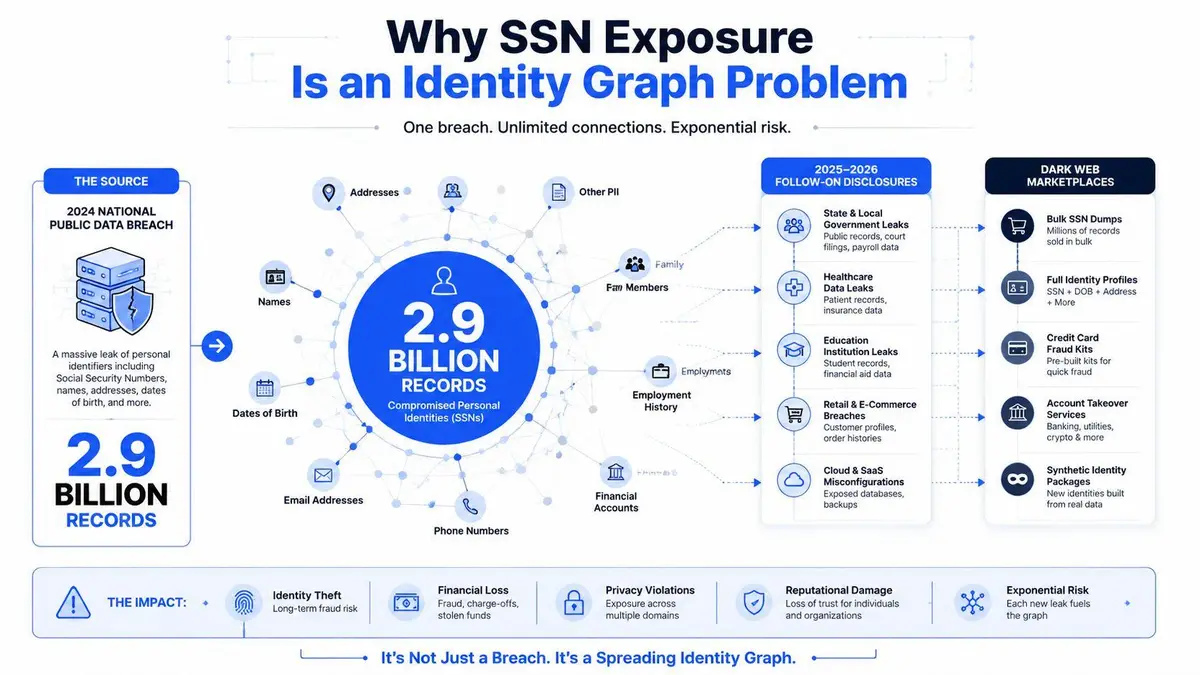
A Social Security leak is often described as though one number belongs to one event. That model is too narrow. The 2024 National Public Data incident illustrates the scale: analysis indicated that about 292 million people were exposed, with 272 million Social Security numbers included, while the dataset contained roughly 2.9 billion records across the U.S., U.K., and Canada, according to Constella’s verification of the National Public Data breach.
Those records don’t remain neatly grouped. Criminals, data brokers, fraud rings, and automated systems can associate an SSN with names, former addresses, phone numbers, dates of birth, relatives, employers, email addresses, and support records. The result is an identity graph, a connected collection of identifiers that can be tested against credit, tax, employment, benefits, lending, and account-recovery systems.
The 2015 federal background-investigation breach shows why the problem is not new. The U.S. Office of Personnel Management said hackers stole Social Security numbers from 21.5 million people, and overlap with a separate compromise brought the combined impact to 22.1 million. The exposed information also included fingerprint records and other sensitive data, as reported by Fox News in its account of the OPM breach.
More recent disclosures have made the graph denser. The Identity Theft Resource Center counted a record 3,322 U.S. data compromises in 2025, while later reporting described an exposed database involving 2.7 billion records with SSNs and a separate TransUnion incident affecting more than 4.4 million consumers, as documented in the 2025 ITRC Annual Data Breach Report. The figures describe different incidents, not one unified database, which is precisely the point. Repeated exposure across vendors makes “was my SSN leaked?” less useful than “which connected records are circulating, and which systems can recognize them?”
An industry analysis found that SSNs appeared in 69% of breaches in 2023, up from 60% the prior year, while a Congressional Research Service summary recorded 332,927 Social Security fraud allegations in FY2024. About 23.9% involved SSN misuse and 26.7% involved false personation, according to Security Magazine’s reporting on the breach analysis. A freeze remains essential, but it can’t sever every relationship in an identity graph. Ongoing monitoring and source removal address risks that a credit file alone can’t see.
The First 72 Hours of Containment
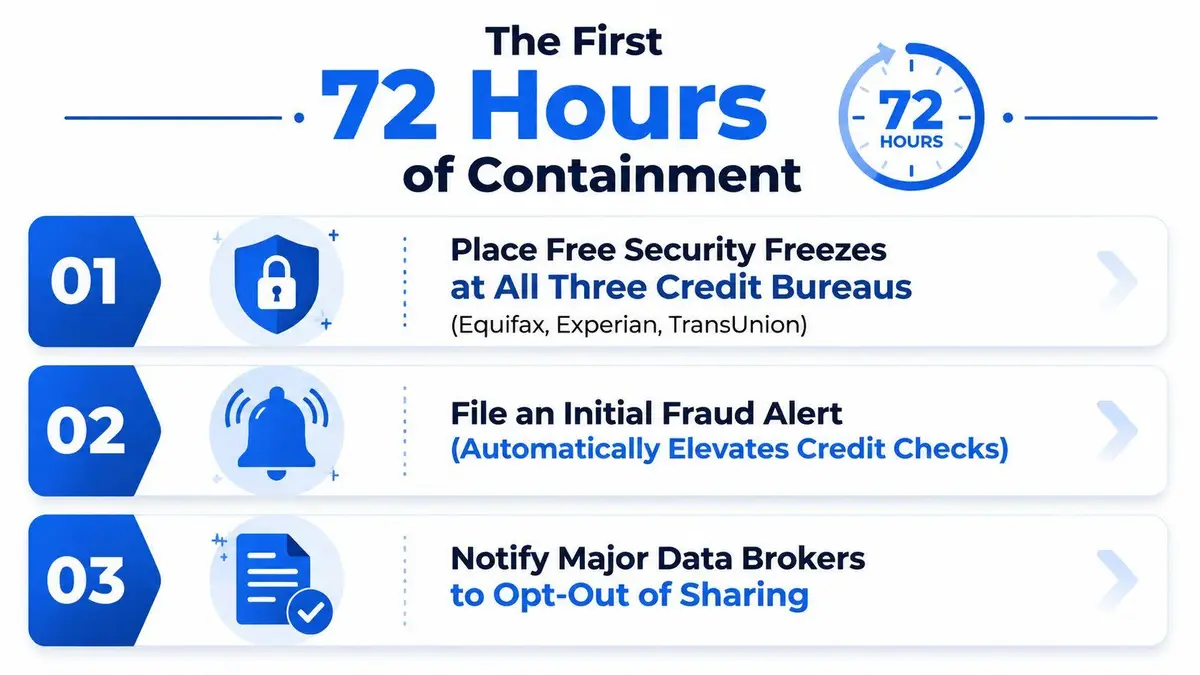
The first 72 hours should follow a sequence, not a collection of disconnected tips. Begin with the controls that block new credit activity, then secure the accounts that can reset everything else, and finally protect tax and government records.
- Freeze all three credit files. Place free security freezes with Equifax, Experian, and TransUnion. The FTC explains through its credit freeze guidance that a freeze makes it harder for an attacker to open new credit in your name, although you’ll need to lift or manage it when applying for legitimate credit, a phone service, or another screened product.
- Add an initial fraud alert. An alert tells prospective creditors to take additional steps to verify an applicant’s identity. Don’t confuse it with a freeze. A freeze restricts access to the credit file, while an alert asks creditors to validate applications more carefully. If misuse is confirmed, discuss the documentation needed for an extended alert with the bureaus.
- Secure the identity-control accounts. Change the password for the primary email account first, then banking, brokerage, payroll, cloud-storage, and social accounts. Replace reused passwords, remove unknown recovery addresses and phone numbers, and use a passkey or hardware security key where the provider supports it. Email deserves priority because it can reset other accounts.
Protect tax and benefits records early
Request an IRS Identity Protection PIN and contact the IRS if tax-related exposure or suspicious filing activity appears. Review IRS records available to you, including recent wage and income information where appropriate, and inspect your Social Security earnings record through My Social Security for anomalies. These steps address risks that a credit freeze won’t catch.
Don’t file an FTC identity-theft report merely because a breach exposed your SSN. The SSA fraud resource says an FTC report isn’t necessary after exposure unless there’s actual misuse. If misuse appears, use IdentityTheft.gov, notify affected institutions, and consider IC3 and police reporting based on the facts.
Build the evidence file
Save breach notices, screenshots, URLs, bureau notifications, account alerts, EFX logs, correspondence, and transaction records in a dated case folder. Include the original files, not only edited screenshots. If a page is removed later, your evidence should still show what appeared, where it appeared, and when you found it.
If public listings or exposed records are already circulating, a specialist can begin source identification and removal while financial controls are being applied. For urgent publication of SSNs, impersonation pages, or doxxing content, ContentRemoval.com’s 72-hour emergency removal service is one possible escalation route.
Reporting the Leak Through the Right Channels
Reporting works when each agency receives a problem it can address. It doesn’t work when victims submit the same narrative everywhere and expect one report to freeze every downstream account.
| Channel | What It Actually Does | When It Changes Outcome |
|---|---|---|
| FTC IdentityTheft.gov | Creates an Identity Theft Report and supporting affidavit | Confirmed misuse, fraudulent accounts, creditor disputes |
| Social Security Administration | Records fraud concerns and helps protect My Social Security access | Suspicious SSA activity or compromised electronic access |
| IC3 | Routes internet-enabled and potentially interstate crime information to the FBI | Financial loss, account takeover, organized or interstate conduct |
| IRS Identity Protection Specialized Unit | Addresses tax-related identity theft and taxpayer protections | Fraudulent returns, tax-account compromise, or SSN exposure tied to filing risk |
| Local police | Creates a local incident record | A creditor, insurer, court, or investigator requires it, or criminal facts need local documentation |
| State attorney general | Receives consumer-protection complaints and may support state-level escalation | A business refuses statutory privacy or identity-theft remedies |
Start with the FTC only when there’s evidence of misuse. The resulting report can become the affidavit a creditor, bank, or bureau requests before investigating fraudulent activity. Attach the report to written correspondence, preserve confirmation numbers, and keep copies outside the compromised email account.
The SSA isn’t a replacement-number hotline for every exposed SSN. Its practical role is narrower: record suspected fraud, secure access to My Social Security, and address misuse involving Social Security benefits or records. A person shouldn’t expect the agency to erase the old SSN from private-sector databases.
IC3 becomes more useful when the incident involves online account takeover, financial loss, fake profiles operated across jurisdictions, or a coordinated scheme. A local police report can support documentation, but it doesn’t automatically trigger federal action. The report should state the concrete conduct, not only that a breach occurred.
For tax risk, contact the IRS Identity Protection Specialized Unit and request an Identity Protection PIN. Notify banks and other affected institutions directly when their systems or accounts appear involved. Each submission should have a date, reference number, recipient, and next action. Paperwork becomes evidence only when it can be retrieved and tied to a specific dispute.
Identity Restoration When Misuse Appears
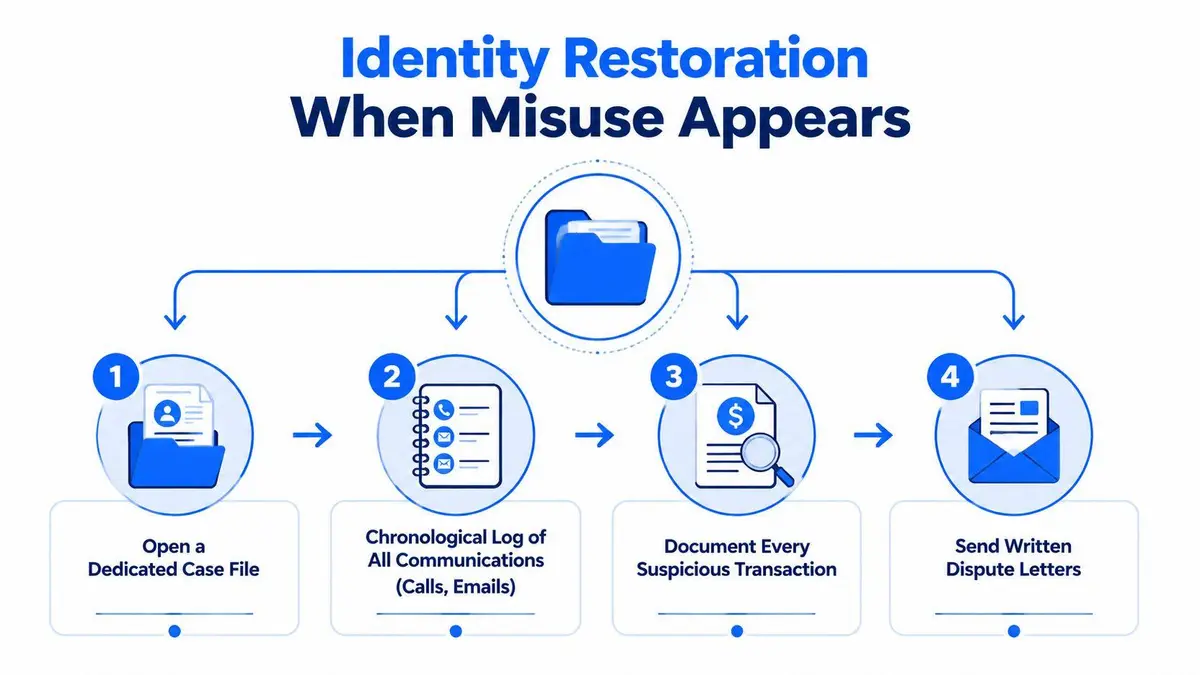
Restoration starts when an unauthorized account, transaction, tax filing, benefits claim, or employment record appears. At that point, monitoring becomes an active investigation. Open a dedicated case file and create a chronological log covering every call, email, letter, account number, representative, promise, and deadline.
Written disputes carry more weight than verbal assurances. Send each creditor a fraud affidavit with the FTC Identity Theft Report, police report number when available, and supporting documents. Request closure of the fraudulent account, removal of unauthorized charges, and written confirmation of the institution’s decision.
Treat every bureau as a separate dispute
Dispute fraudulent tradelines directly with Equifax, Experian, and TransUnion. Identify each account precisely, explain that it resulted from identity theft, and provide the evidence needed to support an investigation under the Fair Credit Reporting Act. Send disputes using a method that produces delivery and receipt records.
A credit freeze can remain active throughout the process. Where confirmed misuse supports it, pursue an extended fraud alert or other available identity-theft protections. The precise remedy depends on the facts and the bureau’s documentation requirements.
Rebuild the compromised access layer
Changing one bank password isn’t enough if the same email, recovery address, phone number, or authentication factor remains attached to the identity graph. Reassign passwords and recovery methods across email, financial accounts, payroll, investment platforms, benefits portals, and high-value business services. Review authorized users and connected applications rather than focusing only on login credentials.
If a creditor stalls or refuses to investigate, submit a complaint to the Consumer Financial Protection Bureau and attach the prior correspondence. A structured identity theft credit repair plan can help organize bureau disputes and restoration work, but it shouldn’t replace direct reporting to the institution that opened or serviced the fraudulent account.
Evidence standard: Keep originals, delivery confirmations, screenshots, and response letters. The same packet may later support a regulatory complaint, civil claim, or criminal referral.
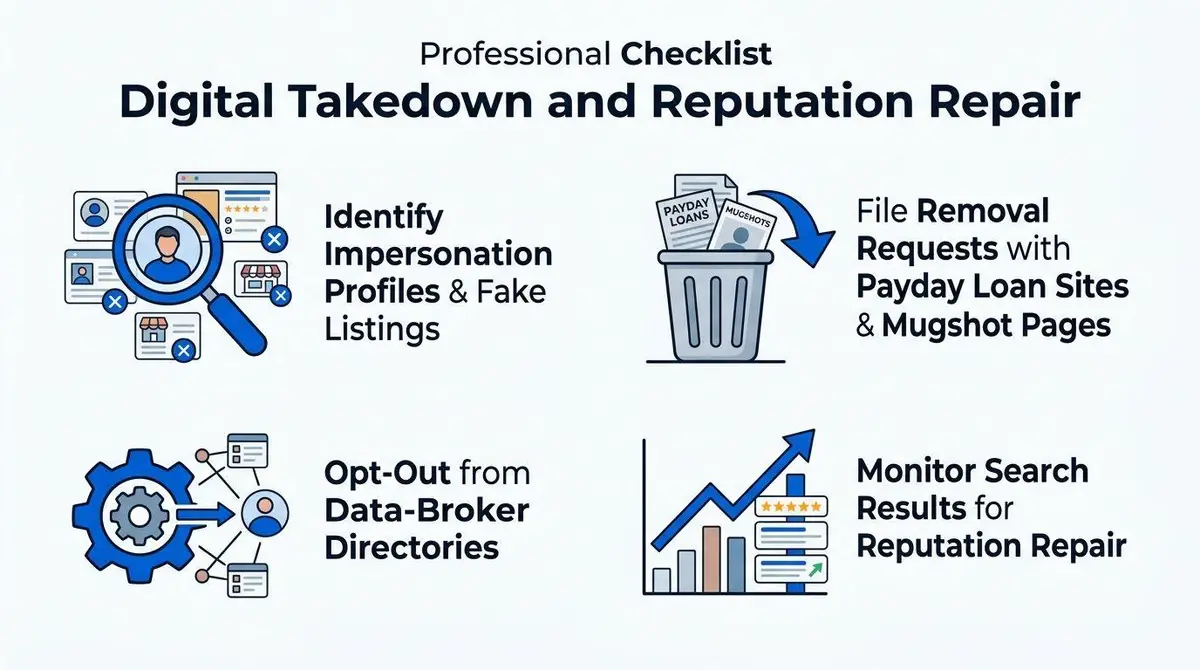
Digital Takedown and Reputation Repair
An SSN exposure can create damage that never appears on a credit report. Criminals may use the identity to create payday-loan listings, fake business profiles, mugshot-style pages, social accounts, or directory entries. Search engines can then associate the victim’s name with debt, criminality, or impersonation, even when the underlying conduct belongs to someone else.
Source removal comes first. Identify the host, data broker, people-search service, platform, and page owner. Submit a targeted request under the site’s privacy process, applicable state privacy law, or platform rules. Preserve the request and any refusal because a written denial can support escalation.
Google removal can address certain exposed personal information and policy-violating content, but de-indexing is not the same as deleting the source. A page may remain accessible through its original domain, alternate search engines, direct links, or copied versions. Requests should include the exact URL, screenshots, timestamps, and evidence connecting the publication to the breach or impersonation.
Match the legal lever to the publisher
DMCA notices may apply to copyrighted material, but they aren’t a universal remedy for personal information. Platform-policy reports are more appropriate for fake accounts, impersonation, doxxing, and fraud listings. Privacy requests may work with data brokers, while a court order can become necessary when an operator refuses removal, conceals ownership, operates across borders, or monetizes the data.
For executives and public figures, the search problem often requires suppression alongside takedown. Verified biographies, authoritative professional profiles, legitimate company pages, and accurate press coverage can give search engines stronger alternatives to residual breach material. That strategy doesn’t excuse source removal. It reduces the commercial harm while removal and legal escalation proceed.
A professional firm is warranted when the source operator is unresponsive, the content has been copied across domains, the listing is tied to an active impersonation campaign, or the victim’s name is being commercially exploited. This strategic guide to removing personal information from Google after a data breach explains why source identification, documentation, and de-indexing must be handled as separate tasks.
ContentRemoval.com handles personal-data exposure, database dumps, search de-indexing, impersonation, mugshot-style content, and dark-web monitoring as distinct but coordinated workstreams. The right engagement should produce a takedown log, copies of submissions, responses, escalation decisions, and a record of what remains visible.
Prevention, Monitoring, and Long-Term Posture
A freeze is a control, not a conclusion. The durable response to a social security leak is a monitoring program that tracks how the compromised SSN connects to other identifiers and how those connections surface in financial, employment, tax, benefits, and reputation systems.
Set a recurring cadence that matches the exposure. Sample credit reports across all three bureaus weekly while an active incident is being investigated, then adjust frequency when the case stabilizes. Review bank, brokerage, payroll, benefits, and tax activity for anomalies. Monitor the SSN and relevant combinations, such as the last four digits with a birth date, or the full identity with former addresses, on paste sites and criminal marketplaces.
Monthly dark-web review is more useful when it searches for variants rather than one exact string. Quarterly, review authorized users, recovery methods, employer records, dependent information, and connected financial services. Annually, map the identity graph: current and former addresses, phone numbers, email addresses, relatives, dependents, employers, and service providers that may hold matching data.
Free consumer monitoring can identify some credit-file changes and breach notifications. It usually doesn’t provide continuous investigation of synthetic identities, mule-account associations, broker listings, impersonation profiles, or cross-platform reuse. A specialist program can add those layers through dark-web monitoring and remediation, but the value depends on the quality of the search, the speed of escalation, and whether someone acts on an alert.
Escalation trigger: Engage a specialist when you find a confirmed broker listing, a mule-account linkage, or reputational cross-contamination. Waiting for a financial loss can leave the public record problem harder to unwind.
Tools that help map public identity exposure vary widely. If you’re comparing services that search people-finder or identity records, a resource covering alternatives to Social Catfish may help clarify what a consumer-facing search can and can’t reveal. Those tools can support discovery, but they don’t replace evidence preservation, source-specific removal, or legal escalation.
Reissued SSNs and the old-number problem
The SSA may consider assigning a different SSN in narrow circumstances, including continuing harm or serious disadvantage tied to the existing number. Exposure alone doesn’t guarantee reassignment. The agency evaluates the facts, and a new number can create administrative friction because employers, creditors, insurers, tax agencies, and benefits systems must connect the new identity to legitimate history.
A replacement number also doesn’t erase the old number’s footprint. Both numbers require monitoring, and the old one may remain present in historical records, credit files, tax records, and vendor systems. Retaining the original number is often simpler when misuse hasn’t occurred, while reassignment may warrant consideration when documented harm continues despite containment.
Children and deceased relatives
A minor’s SSN can appear in family-tree records, benefits files, school or medical systems, and household data. Parents or guardians should preserve proof of exposure, review available child identity protections, and ask each affected organization what controls apply to minors. Don’t publish the child’s identifying details while seeking help.
A deceased relative’s exposed SSN presents a different risk profile. Fraudsters may target dormant credit, tax, benefits, or estate records, while probate files can expose names, addresses, relatives, and account relationships. The executor or authorized representative should coordinate with creditors, the IRS, financial institutions, and estate counsel, preserving documents that establish authority to act.
What a professional engagement should deliver
A credible engagement should produce more than screenshots and generic monitoring access. Expect a written case file, evidence packet, source inventory, takedown log, reporting matrix, escalation plan, and recurring status updates. The provider should distinguish confirmed exposure from unverified claims and explain which items can be removed, de-indexed, suppressed, or pursued through civil process.
State privacy and identity-theft laws can change the available opt-out and freeze procedures. Employers may have notification, security, or record-handling obligations depending on the incident and jurisdiction, but a breached custodian’s free monitoring offer rarely covers every connected identity or reputation risk. Review the terms, duration, data scope, and response process before treating the offer as a complete remedy.
The most effective posture is layered. Keep credit controls active, secure the accounts that control recovery, protect tax and government access, inspect the identity graph on a defined schedule, and remove public manifestations of the exposure. If the SSN is being paired with identity details to create false accounts or public profiles, professional takedown and legal coordination can prevent a financial incident from becoming a lasting reputation record.
ContentRemoval.com can investigate exposed personal data, coordinate source and search-engine removal, address impersonation and fraudulent listings, and monitor for reappearance across public and criminal channels. If your SSN exposure has created visible online harm or involves a high-profile identity, request a confidential assessment through ContentRemoval.com and obtain a specific action plan for containment, takedown, and escalation.
Frequently asked questions
Should I get a new Social Security number after a leak?
Usually not. The SSA considers reassignment only in narrow cases of continuing harm, and exposure alone does not qualify. A new number creates administrative friction with employers, creditors and tax agencies, and the old number still needs monitoring because it stays in historical records.
Do I need to file an FTC identity theft report if my SSN was in a data breach?
Not unless someone has used it. The Social Security Administration says an FTC report is not required after exposure without actual misuse. If a fraudulent account, tax return or benefits claim appears, file at IdentityTheft.gov and use that report as the affidavit creditors and bureaus will ask for.
How do I get my Social Security number removed from a website?
Identify the host, data broker or platform, then submit a targeted request under its privacy process, state privacy law or platform rules, keeping a copy of the request and any refusal. Google removal can de-index pages showing personal information, but the source page stays live until the operator or a court order takes it down.