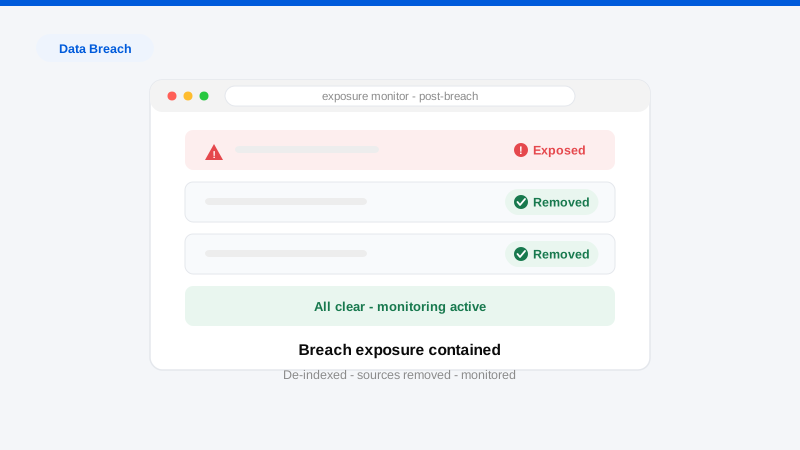
To remove personal information from Google after a data breach, work three fronts at once: Google’s own removal tools (the Results About You tool for contact details and the personal-information removal form for financial data, ID numbers, and credentials) which de-index qualifying results from search; the sites republishing your breached data (paste sites, breach-lookup services, forums, data brokers), which need source-level takedowns because de-indexing alone leaves the data live; and monitoring, because breach data recirculates for years and shows up in places Google never indexes, including dark-web markets. Google will remove search results that expose your address, phone, email, government ID, financial account numbers, and login credentials, but only per-URL, and only from search.
The distinction that shapes everything: Google indexes breach fallout; it doesn’t host it. Cleaning search results is genuinely valuable (it’s where employers, clients, and casual searchers encounter your data) but treating de-indexing as the whole job is the most common post-breach mistake.
What qualifies for removal from Google after a breach?
Google’s personal-information policies cover most of what breaches expose:
- Contact information: home address, phone number, personal email. The Results About You tool (in your Google account, also available as an app feature) both accepts removal requests and continuously scans for new results showing your contact details.
- Government identifiers: Social Security and other national ID numbers, always removable.
- Financial data: bank account and credit card numbers, and images of signatures.
- Login credentials: usernames and passwords exposed in dumps, explicitly covered.
- Medical records: personal health documents.
- Doxxing contexts: contact info shared with intent to harm gets an expanded standard; if your breach data has been weaponized (posted with threats, in harassment threads), report it under that policy and see our doxxing removal response.
What doesn’t qualify: news coverage about the breach that doesn’t expose your specific data, the mere fact your name appears somewhere, and content on pages Google deems broadly in the public interest. Also understand the limits of approval, a granted request removes that URL from Google results (sometimes only from queries containing your name), while the page itself stays live and reachable directly, via other search engines, and via links.
Step-by-step: the post-breach cleanup protocol
- Contain the account-security fire first. Before any removal work: change compromised passwords, enable two-factor authentication everywhere, freeze your credit with all three bureaus if financial identifiers leaked, and alert your bank. Removal without containment protects a reputation while the accounts burn.
- Map the spread. Search Google for your email addresses in quotes, your phone number in several formats, and your name plus “breach,” “leak,” and “database.” Check a breach-notification service to learn which breach and which fields. List every URL exposing your data. This list drives everything.
- File Google removals for every qualifying URL. Use Results About You for contact details and the personal-information removal request form for IDs, financial data, and credentials. One request per URL, categorized precisely. Enable Results About You’s ongoing monitoring. It catches new indexed results automatically. Our Google hub covers the full toolset, and repeat the sweep on Bing.
- Attack the sources. Paste sites and breach forums have abuse contacts and takedown processes, usage varies from responsive to hostile, which is where professional leverage (host-level and registrar-level escalation for non-responders) earns its keep. Breach-lookup sites often honor opt-outs. This source-level work is the core of personal data removal.
- Suppress the broker layer. Brokers ingest breach data and enrich it: your leaked email joins your address, relatives, and phone in a single profile. Post-breach is precisely when data broker removal matters most, the breach made the raw data available; brokers make it findable.
- Extend visibility to the dark web. The copies that matter for fraud never get indexed: combo lists, market listings, Telegram dumps. Dark web monitoring tells you what’s circulating, which credentials to consider permanently burned, and when your exposure escalates.
- Re-sweep on a schedule. Breach data recirculates: old dumps get repackaged and re-posted for years. Monthly quoted-phrase searches at minimum; continuous monitoring if the exposure was serious. Removal is an event; staying removed is a practice.
Get a Free, Confidential Exposure Scan
Honest timelines and success expectations
Google’s personal-information removals typically resolve in days to three weeks, with clear-cut categories (SSNs, financial data) at the fast end. Source takedowns at cooperative sites: days to weeks. Hostile or offshore breach sites: weeks to months, sometimes achievable only at the infrastructure level, occasionally not at all, in which case de-indexing plus monitoring is the honest fallback, and it removes the practical harm for most scenarios. Broker suppression: one to six weeks per broker, recurring indefinitely.
What no one can promise: deleting a breach dataset from existence. Once data is in circulation, copies exist beyond anyone’s reach. The achievable goals are making your data hard to find (de-indexing, source removal, broker suppression), useless to exploit (credential rotation, freezes), and loud when it resurfaces (monitoring). Those three, executed well, are the difference between a breach that becomes a permanent vulnerability and one that becomes a bad month.
Frequently asked questions
Does Google’s Results About You tool remove my information from the internet?
No: it removes qualifying results from Google search, which dramatically cuts who finds the data, while the source pages stay live. Treat it as the visibility layer of a three-layer cleanup: Google removals, source takedowns, and broker suppression together approximate actual removal.
My email and password showed up on a breach-lookup site. Can that be removed?
Often, yes, several lookup services honor opt-out or delisting requests, and pages displaying credentials qualify for Google de-indexing under the credentials policy. Rotate the password first; removal protects your privacy, not an active credential. The dump itself will persist in circulation, which is what monitoring is for.
The breach data is on a foreign site that ignores takedown requests. Now what?
Escalate up the infrastructure: hosts, CDNs, and registrars each have abuse processes and legal exposure that site operators don’t. In parallel, de-index every URL from Google and Bing, for a non-cooperative source, removing its audience is the practical win. This escalation work is where our team spends much of its time; see our process.
Why did my information reappear after I removed it?
Three usual causes: brokers re-scraped and republished (suppression must recur), the dump was re-posted at a new URL (each URL needs its own de-indexing), or a new breach re-exposed the same fields. This is why every serious post-breach plan ends in monitoring rather than a completion date. It’s the model behind our Protection Plans.
Should I pay a breach site to remove my data?
No. Paying data-holders marks you as someone who pays, invites repeat extortion, and often funds the exact operation that exposed you, and sites that charge for removal are prime candidates for policy-based de-indexing, since exploitative removal practices are exactly what search engines’ policies target. Route around them: de-index, escalate at the infrastructure level, and monitor.
If your information is circulating after a breach, the first step is seeing the full spread: indexed, unindexed, and dark web. Request a free, confidential Exposure Scan and we’ll map every exposure point and walk you through our process for closing them, before you commit to anything.