
A restaurant’s online reputation is a control system for revenue, search visibility and legal exposure, not a social media task. The playbook builds review generation before review reaction, centralizes monitoring with a daily scan, responds to legitimate criticism with controlled accountability, and escalates fake reviews, extortion demands, impersonation and coordinated smears to evidence preservation and removal rather than public replies.
Key facts
- Cited Harvard Business School research links a one-star increase to a 5 to 9 percent revenue boost for restaurants.
- Claim Google Business Profile, Yelp and TripAdvisor first, then prompt satisfied guests at the table via QR codes or SMS.
- Escalate on verifiable falsehoods, extortion language, reviewers with no booking record, coordinated patterns or defamatory assertions.
- A cited survey suggests 34 percent of negative restaurant reviews are now suspected to be AI-generated.
Where ContentRemoval.com comes in. ContentRemoval.com handles the escalation lane for restaurants and hospitality groups: fake review challenges with bundled evidence, extortion cases, defamatory posts, AI-generated kitchen photos and damaging search results taken down or de-indexed, with monitoring afterward. Owners, operations directors and the group’s marketing agency usually make contact after platform flagging has gone nowhere. A free 15-minute Exposure Scan maps what is removable, and the report is yours to keep. Get a Free, Confidential Exposure Scan or read how our reputation management work is done.
Saturday dinner service is full. A manager glances at Google between ticket runs and sees three new one-star reviews, one accusing the staff of racist treatment, another claiming food poisoning, and a third attaching a grimy kitchen photo nobody recognizes. Reservations for the next week start softening before the night is even over. At that point, you’re not dealing with “marketing.” You’re dealing with a live asset impairment.
That’s the right frame for restaurant online reputation. It isn’t a vanity project for the social team. It’s a control system for revenue, search visibility, customer trust, and legal exposure. If you own a serious hospitality business, you need a playbook that separates normal criticism from coordinated abuse, and you need escalation paths that go beyond posting cheerful replies under hostile content.
The Financial Reality of Your Digital Footprint
A restaurant can survive a bad night. It struggles to survive a bad first page of search results.
The numbers on this are clear. Harvard Business School research, revisited in 2022, found that a one-star increase on review platforms correlates with a 5 to 9 percent revenue boost for restaurants according to Sunday’s review of restaurant reputation trends. The same source states that one adverse article can cause a 22 percent loss in customers, and 94 percent of diners will actively avoid a venue due to negative reviews.
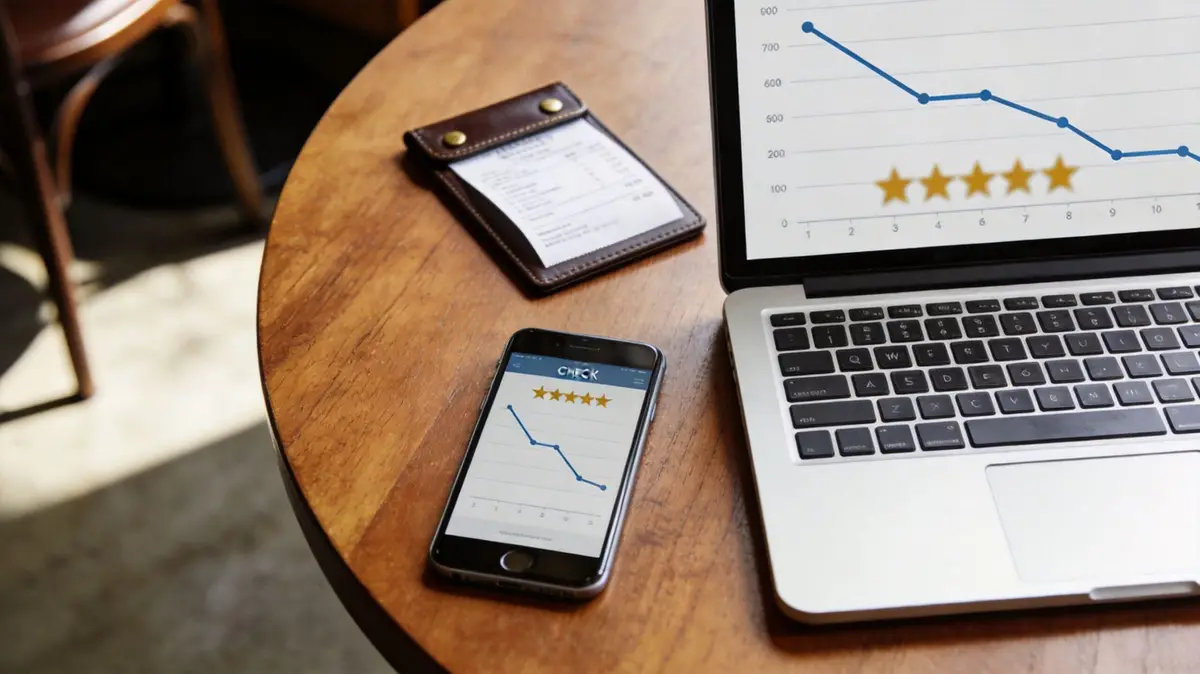
That means your rating profile, review mix, and branded search results sit much closer to your P&L than most operators admit. A chef can execute flawlessly in the dining room and still lose business because a searcher sees a contaminated result set before they ever reach the menu.
Revenue follows trust signals
Review platforms now function like a distributed due diligence layer. Guests don’t just ask whether your food is good. They ask whether your operation feels safe, consistent, and credible. A weak digital profile signals risk. A strong one lowers perceived risk and pulls bookings forward.
There’s also a visibility issue. If you’re trying to boost restaurant visibility with local SEO, reputation is part of the job, not adjacent to it. Search performance and trust performance reinforce each other. You don’t rank cleanly if your review environment looks unstable.
Practical rule: If a damaging review pattern or article can affect bookings this week, it belongs in the same category as any other urgent operating issue.
Inaction has a cost
Many owners still treat review problems as something to “watch for a bit.” That’s usually a mistake. Delay gives negative content time to index, spread, get screenshotted, and influence undecided diners. Once that happens, the cleanup gets slower and more expensive.
A more disciplined way to think about this is asset protection. Star ratings, review recency, and branded search integrity all influence whether a guest chooses you or your competitor. If you want a sharper breakdown of that cost logic, read this strategic analysis of the financial realities of online reputation management.
| Digital signal | What customers infer | Business effect |
|---|---|---|
| Low star rating or unstable review pattern | Operational risk | Fewer bookings and walk-ins |
| Negative article in search results | Serious underlying issue | Brand distrust and drop-off |
| Sparse recent positive feedback | Stale or inconsistent experience | Lost conversion at search stage |
Building a Proactive Reputation Defense Framework
Most restaurants build no defense at all. They wait for a public complaint, then improvise. That’s not a system. It’s exposure.
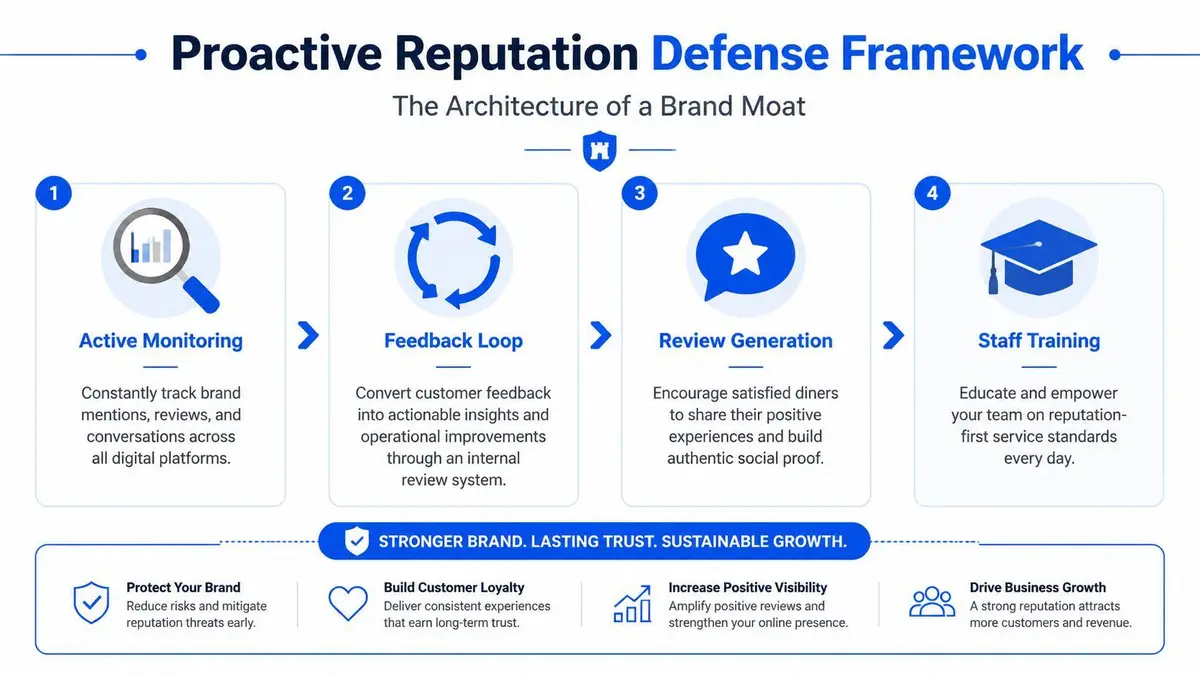
A proper defense framework does four things at once. It monitors what’s being said, collects private signals before they become public attacks, asks satisfied guests for honest reviews, and trains staff to avoid preventable triggers. Done correctly, it creates a buffer around the business. Done badly, it leaves every location vulnerable to randomness.
Start with review generation, not review reaction
The single biggest mistake I see is assuming happy customers will volunteer public praise on their own. They usually won’t. InMoment reports that proactive encouragement campaigns can yield a 128 percent review growth in 90 days, and 70 percent of customers won’t review unprompted. The same source says an ethical prompting framework can shift a review ratio from 40:60 to 15:85 in favor of positive feedback through better collection discipline and timing, as explained in InMoment’s restaurant reputation management guidance.
That matters because volume and recency dilute outliers. One hostile review in a thin profile can define your listing. The same review inside a healthy stream of recent, credible, positive feedback loses force.
The framework that actually works
You don’t need a bloated enterprise stack at the beginning. You need operational consistency.
- Claim the major profiles first. Google Business Profile, Yelp, and TripAdvisor need complete, accurate ownership and consistent business information. If these are fragmented or outdated, every later step gets weaker.
- Prompt at the right moment. QR codes on receipts, table tents, and post-meal SMS or email work because they catch the diner while the experience is still fresh. Don’t ask every guest blindly. Ask when staff can identify a clearly satisfied table.
- Route private complaints inward. A guest who felt ignored should have an easy path to tell management directly. That prevents some legitimate issues from hardening into public accusations.
- Train the floor to protect the brand. Reputation starts in service recovery, not software. A server who handles a delay with confidence can stop a bad review before it exists.
Don’t build a review campaign that feels like begging. Build one that feels like a clean continuation of the guest experience.
Monitoring has to be centralized
Even a single-location restaurant gets mentioned in more places than most owners track manually. A group with multiple venues has no chance without centralization. Google alerts alone won’t cut it.
Use a dedicated monitoring workflow and make someone accountable for it every day. If you need a cleaner operational model, this guide to reputation monitoring is a useful starting point.
A simple internal cadence works well:
- Daily scan: Check major review platforms and social mentions.
- Weekly review: Identify recurring complaints by theme, not by emotion.
- Monthly action: Tie feedback to actual operational fixes, menu adjustments, and staff coaching.
That’s how restaurant online reputation becomes a managed business function instead of a recurring surprise.
Strategic Response Protocols for Public Reviews
A public response isn’t mainly for the reviewer. It’s for the larger audience evaluating whether your business is stable.
That changes how you should write. The goal is not to “win” the exchange. The goal is to show control, fairness, and operational seriousness. A weak response looks defensive or canned. A strong one signals that the restaurant can absorb criticism without losing composure.
Legitimate criticism needs controlled accountability
If the complaint is plausible and specific, acknowledge the issue without drafting a confession that creates unnecessary liability. Thank the guest for raising it. Refer to the category of concern, not every allegation in detail. Move the resolution off the public thread quickly.
Bad response:
“You’re completely right, our kitchen was a mess and our service failed.”
Better response:
“Thank you for the feedback. What you described doesn’t reflect the standard we expect. We’d like to review the details directly and follow up with you.”
That approach does three things. It avoids arguing facts in public, it signals standards, and it invites a private channel where the issue can be verified.
Vague attacks should not control the script
Some reviews are designed to provoke. They use broad accusations, little detail, and emotionally loaded language. Don’t match the energy. Don’t speculate. Don’t over-apologize.
Use a short, calm reply that asks for specifics through a direct contact route. If the reviewer never responds, readers notice that too. Silence after a reasonable request often tells its own story.
Your reply should sound like management speaking to future customers, not a stressed owner typing in anger at midnight.
Praise deserves a strategy too
Positive reviews are wasted if you answer them lazily. A flat “Thanks so much” does nothing for the next prospect reading the thread. Use those responses to reinforce what the restaurant is known for. Mention hospitality, pace, atmosphere, or a distinctive part of the guest experience in natural language.
That said, not every negative review should be answered at all. If the post appears fabricated, malicious, or policy-violating, a public reply can legitimize it and preserve it in search snippets. In those cases, the better path may be platform challenge and removal. TripAdvisor creates its own procedural issues, which is why this guide to removing a TripAdvisor review is worth understanding before you engage impulsively.
| Review type | Best move | Main risk |
|---|---|---|
| Specific and plausible complaint | Brief public response, move offline | Over-admitting fault |
| Vague emotional attack | Calm request for details | Getting pulled into argument |
| Clear fabrication or impersonation | Preserve evidence, pursue removal | Validating falsehood by replying |
| Positive review | Reinforce brand strengths | Wasting social proof |
Escalating from Response to Remediation and Removal
Not every attack deserves a conversation. Some deserve a takedown.
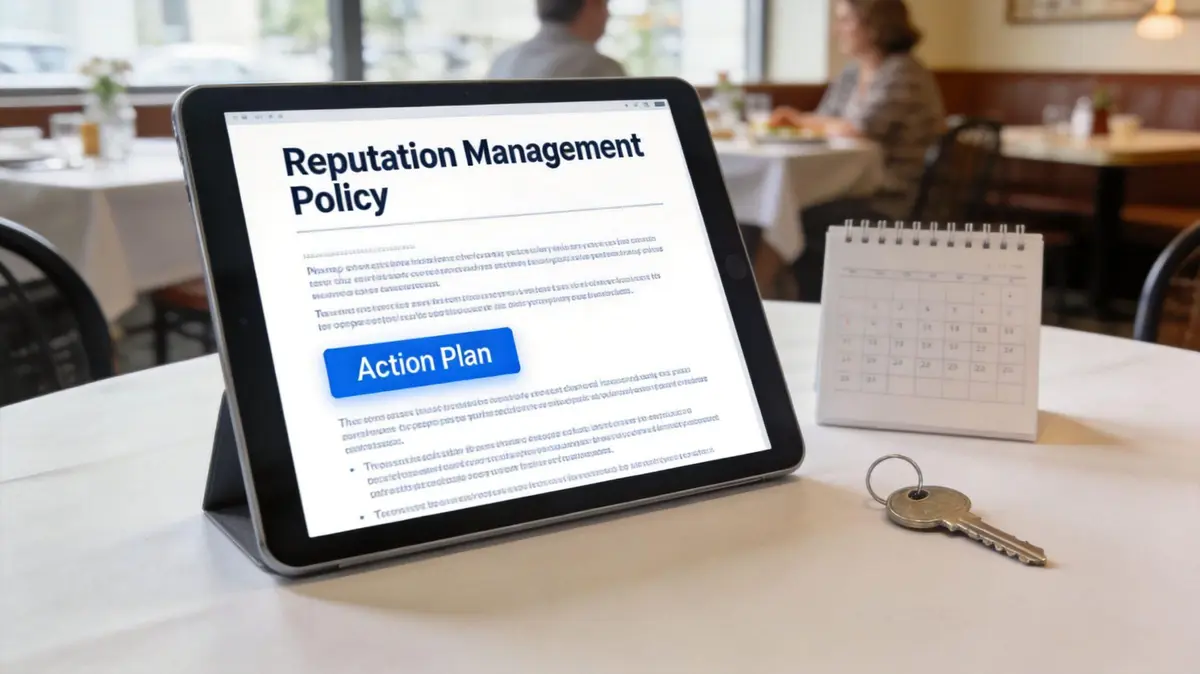
This is the dividing line most restaurant advice misses. A real guest complaint sits in one category. A fake review, extortion demand, impersonation post, or coordinated smear sits in another. If you treat both the same way, you hand an advantage to the attacker.
Know the trigger points
You should escalate immediately when a review or post includes one or more of these features:
- Verifiable falsehoods: Claims about visits, interactions, or events that records plainly contradict.
- Extortion language: Demands for free meals, refunds, or payment tied to threats of negative posting.
- Impersonation indicators: The reviewer cannot be matched to any booking, order, or service record.
- Coordinated patterns: Similar wording, timing, or accounts pointing to organized abuse.
- Defamatory factual assertions: Statements presented as fact that accuse the restaurant or staff of serious misconduct.
Here the numbers matter. An estimated 27 percent of negative reviews contain verifiable falsehoods or are part of coordinated attacks, while only 12 percent of restaurant owners pursue takedowns, according to Sunday’s discussion of reputation best practices for restaurants. The same source states that specialized firms can often achieve removal of fraudulent content within 48 to 72 hours, which is often better than posting a public response that amplifies the false claim.
Public replies can make a bad situation worse
Owners often reply because silence feels weak. In fraud cases, that instinct is usually wrong.
A public reply can do three harmful things. First, it tells platforms and readers that the content belongs in a normal customer-service lane. Second, it can repeat the accusation in your own words, giving it more semantic weight in search. Third, it can invite a malicious actor to continue the exchange for visibility.
If the content is false and removable, don’t debate it. Preserve it, document it, challenge it, and push for removal.
The remediation ladder
The correct sequence is procedural, not emotional.
| Threat type | First action | Second action | Third action |
|---|---|---|---|
| Fake review | Preserve screenshots and metadata | File platform policy challenge | Escalate with legal or specialist support |
| Extortion attempt | Stop direct bargaining | Preserve communications | Report and pursue removal |
| Defamatory article or post | Assess factual falsity and reach | Request correction or removal | Consider de-indexing and legal notice |
| Coordinated attack | Map accounts and timing | Submit bundled evidence | Pursue source and search-level remedies |
A lot of operators also ignore search contamination after the original post is gone. If a hostile result has already started ranking, you may need broader strategies to fix negative search results rather than treating the issue as a single-review problem.
The serious point is this: fraud is not feedback. Don’t manage it like feedback.
Managing High-Stakes Reputation Crises
A single bad review is operational noise. A viral allegation is a crisis.
The difference is speed, spread, and audience. When a hostile TikTok clip, Reddit thread, or local news mention starts moving beyond your usual review ecosystem, the issue leaves the customer-service department and enters containment mode.
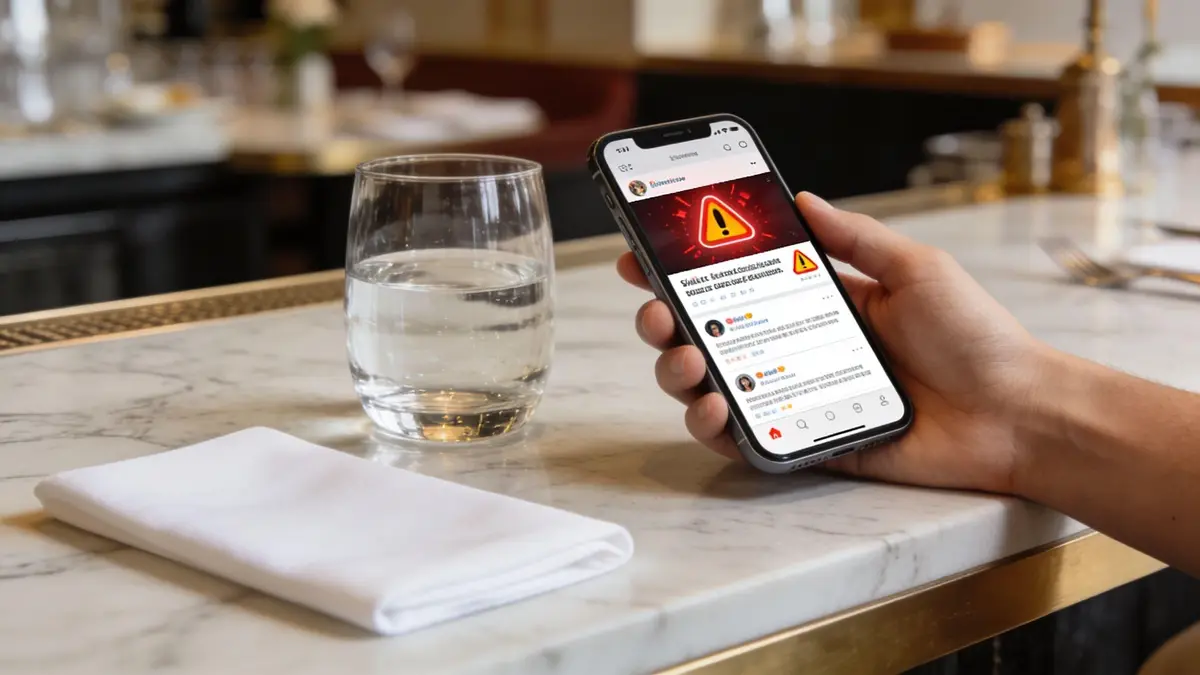
A common pattern looks like this. Someone posts a dramatic claim about the restaurant. Then come reposts, stitched videos, reaction comments, and search autocomplete shifts. Staff start discussing it internally. Guests call the host stand asking if it’s true. Reporters or local bloggers send messages for comment. At that point, your normal review-response process is irrelevant.
Deepfakes have changed the risk profile
The newer problem is synthetic content. A recent survey cited by Adam Petrilli’s discussion of social media and restaurant reputation says 34 percent of negative reviews are now suspected to be AI-generated, while viral deepfake photos of “dirty kitchens” can erode foot traffic by up to 15 percent. The same source says standard platform tools only detect about 40 percent of these fakes automatically in the context of emerging 2026 threats, as described in this analysis of social media’s impact on restaurant reputation.
That means you can no longer assume a photo, screenshot, or cluster of comments is organic. Verification now matters before response.
The first 24 hours decide the shape of the crisis
In a real crisis, management needs one decision-maker and one evidence file. Not five people posting their own explanations.
Use this sequence:
- Freeze improvisation. Staff should stop replying from personal accounts or ad hoc brand channels.
- Preserve everything. Capture posts, comments, timestamps, account handles, and any direct messages.
- Verify the underlying event. Pull camera footage, booking records, POS records, cleaning logs, and shift notes where relevant.
- Separate truth from fabrication. Some crises combine a real service failure with exaggerated or false viral framing.
- Choose the lane. Public statement, platform report, legal notice, media response, or quiet removal effort.
A short explainer on crisis communication can help leadership align before they speak publicly:
Containment beats chatter
If the issue is spreading across search and social, your priorities are containment and result control. That may include platform escalation, counsel review, media handling, and suppression work to displace harmful search results over time. It may also include direct outreach to reservation partners and priority stakeholders if false allegations are affecting high-value bookings or events.
In a crisis, speed matters. Accuracy matters more. A rushed statement that validates a false narrative can become the most damaging document in the case file.
Some crises are survivable with one disciplined response. Others need technical takedowns, legal pressure, and search remediation running in parallel. The mistake is waiting until the narrative hardens.
Building Long-Term Resilience and Measuring What Matters
Most restaurants measure reputation too narrowly. They look at the average star rating, feel relieved or alarmed, and stop there. That’s insufficient.
A durable restaurant online reputation program tracks momentum, not just snapshots. You need to know whether review volume is healthy, whether sentiment themes are shifting, whether response times are slipping, and whether branded search results remain clean. Leadership should review those signals the same way it reviews labor, food cost, and guest retention.
The metrics that deserve executive attention
Not every metric deserves board-level oxygen. These do:
- Review velocity: A healthy pace of recent feedback protects against distortion from isolated attacks.
- Sentiment themes: Repeated complaints about wait times, staff attitude, or cleanliness need operational correction.
- Response discipline: Consistency matters more than theatrics.
- Search result integrity: Branded queries should lead with assets you control or trust.
- Escalation rate: Track how often content moves from routine response into removal or legal review.
There is measurable upside to systemization. Birdeye reports that a centralized reputation management system can increase review volume by over 120 percent in 90 days and improve Local SEO visibility by 40 percent. Prompt and consistent responses alone can boost Google star ratings by an average of 0.2 to 0.5 points, according to Birdeye’s restaurant reputation management analysis.
Resilience comes from integration
The strongest operators don’t treat monitoring, response, and removal as separate silos. They integrate them. Reviews inform operations. Operations reduce legitimate complaints. Monitoring catches anomalies early. Removal handles abuse. Search management protects the long tail.
That integrated model is the only sane way to operate if your restaurant matters financially, reputationally, or personally. Owners who rely on charm and reactive apologies eventually run into an attack that requires evidence, procedure, and technical enforcement. When that day comes, you want a system, not a scramble.
If your restaurant is facing fake reviews, extortion threats, defamatory posts, AI-generated deepfakes, or damaging search results, ContentRemoval.com provides confidential assessments and decisive action plans built for high-stakes reputation threats. The firm handles source removal, de-indexing, false review takedowns, and long-term monitoring for clients who need discretion, speed, and real control.
Frequently asked questions
Should a restaurant reply to a fake review?
Usually not. A public reply tells platforms and readers the content belongs in a normal customer service lane, repeats the accusation in your own words, and invites the attacker to keep the exchange visible. Preserve screenshots and metadata, file a platform policy challenge, and escalate with legal or specialist support if it stalls.
How do restaurants get more positive reviews without breaking platform rules?
Prompt at the right moment with QR codes on receipts, table tents and post-meal SMS or email, and ask when staff can identify a clearly satisfied table rather than blanket-asking every guest. Route unhappy diners to a private complaint path first. Volume and recency dilute the effect of any single hostile review.
What should a restaurant do when a viral TikTok or Reddit post makes a false claim?
Freeze improvisation so staff stop replying from personal accounts, and preserve every post and comment. Verify the underlying event against camera footage, POS and booking records, separate any real service failure from the fabricated framing, then choose one lane: statement, platform report, legal notice, media response or quiet removal.