
Law firm reputation management is a governance function that operates under ABA conduct rules and FTC endorsement rules. It means auditing every owned, controlled and uncontrolled surface, classifying findings as administrative, friction, actionable or crisis, challenging only content that is false, impersonating, doxxing or platform-prohibited, suppressing lawful but damaging material with stronger truthful assets, and documenting every step.
Key facts
- Firms cannot post fake praise, buy reviews, coerce deletions or reveal client information in responses.
- Source removal needs a legal or policy basis; de-indexing leaves the page live; suppression takes time.
- Review responses are published advocacy and need an approval standard covering confidentiality and client status.
- A holding statement acknowledges the issue, says it is under review and avoids detail that could prove wrong.
Where ContentRemoval.com comes in. ContentRemoval.com supports managing partners and their counsel when a fabricated review, impersonation profile, leaked document or partner-name search result needs removal or de-indexing without creating an ethics exposure. The firm’s general counsel, marketing director or the managing partner usually gets in touch once a platform report has been rejected. A free 15-minute Exposure Scan maps what is removable under a compliant strategy, and the report is yours to keep. Get a Free, Confidential Exposure Scan or read how our reputation management work is done.
You search the firm name because a client mentioned “something odd” on Google. The first page is worse than expected. A critical review outranks your homepage. An outdated directory profile signals sloppiness. A forum thread about a complaint you thought had died is indexed for a partner’s name. A local news story about a former partner is still sitting in branded search results.
That is not a marketing problem. It is a firm risk problem.
Law firm reputation management controls who contacts you, which matters prospects raise before intake, whether recruits hesitate, and how fast a negative narrative hardens into the public record. Firms that treat search results, review responses, directory accuracy, and third party profiles as side work create liabilities they could have prevented with basic governance.
Lawyers also face a tighter ethical perimeter than most businesses. Aggressive reputation defense is necessary, but it has to survive scrutiny under professional conduct rules and advertising standards. You cannot post fake praise, buy deceptive reviews, threaten every critic, or answer public accusations by disclosing client information. You also cannot let fear of ethics rules become an excuse for passivity.
The right approach is disciplined and forceful. Challenge content that is false, defamatory, impersonating, doxxing, or platform prohibited. Correct what you control. Suppress what you cannot remove by building stronger, accurate assets that outrank it. Document every step so your firm can show that its response was lawful, truthful, and consistent with ABA duties and FTC rules on endorsements and deceptive practices.
Hope is not a strategy. A command system is.
Your Reputation Precedes Your Retainer
A managing partner gets the email at 6:12 a.m. A prospective client was ready to sign, then went silent after a branded search surfaced a hostile review, an old news item, and a complaint thread naming one of your partners. By 8:00 a.m., the question is no longer whether the content is unfair. The question is whether your response will fix the problem or create a second one under ethics and advertising rules.
Start there. Reputation defense for a law firm is not a vanity exercise and it is not ordinary marketing. It is a risk function that sits uncomfortably close to ABA duties, confidentiality limits, solicitation rules, and FTC restrictions on deceptive endorsements. Firms get into trouble when they confuse speed with permission. A rushed takedown demand, a careless public reply, or a vendor using fake reviews can turn a manageable search problem into a bar complaint, a platform penalty, or discoverable evidence of bad conduct.
The right first question is simple. What can the firm lawfully remove, what should it rebut with a controlled statement, and what must it outcompete with stronger truthful assets?
Prospective clients judge your firm before intake speaks to them. They read reviews, scan headlines, compare attorney bios, and draw conclusions from whatever ranks first. That means your search results are already part of your screening process, whether you manage them or not. A disciplined firm monitors branded search, review sites, directory listings, and stale press mentions with the same seriousness it applies to conflicts checks. Use a formal reputation monitoring system for law firms, not occasional Googling by a marketing coordinator.
One point deserves blunt treatment. Aggressive suppression is appropriate when the content is false, defamatory, impersonating, doxxing, or plainly barred by platform rules. It is reckless when the tactic depends on deception, intimidation without basis, or disclosures that expose client information. Law firms do not get extra room to improvise here. They get less.
Your reputation starts before consultation. It starts at search, and it is judged against a stricter ethical standard than almost any other business category.
Treat that reality as governance. Assign ownership. Set approval rules. Keep records of removal requests, review responses, and factual support for every challenge you make. If your firm cannot show that its reputation campaign was truthful, documented, and ethically defensible, then the campaign itself has become a liability.
Establishing Your Digital Command Center
Most law firms don’t need more noise. They need visibility, triage, and a chain of command. If you can’t see your full digital footprint, you can’t manage it. If you can’t distinguish nuisance chatter from a genuine threat, you’ll either overreact to trivial issues or miss the one post that turns into a crisis.

Audit every surface that can rank or spread
Start with a full inventory. Not a casual search. A documented audit.
Map your owned assets first: firm website, attorney bios, Google Business Profile, social accounts, subdomains, blog archives, press pages, PDF publications, and local office listings. Then move to controlled third-party assets such as Avvo, Justia, Martindale-Hubbell, Lawyers.com, bar listings, and speaking-event pages. Finally, identify uncontrolled surfaces: review platforms, complaint boards, Reddit threads, local news archives, data broker listings, image search, video mentions, and cached results.
Use a worksheet that tracks at least these fields:
| Asset type | What to check | Why it matters |
|---|---|---|
| Firm website | Name consistency, outdated bios, old case references, indexable pages | Inaccurate owned content weakens credibility and creates confusion |
| Lawyer profiles | Correct jurisdictions, titles, office locations, headshots | Partner-specific searches often surface profile pages before your homepage |
| Review platforms | Star profile, review themes, impersonation signs, response history | Reviews shape first impressions and often dominate local intent searches |
| News and blogs | Whether the item is factual, outdated, anonymous, or defamatory | Not all negative coverage is removable, but all of it needs classification |
| Search results | What ranks for firm name, partner names, and branded queries | This is the practical battlefield, not an abstract visibility report |
The goal isn’t to produce a pretty dashboard. The goal is to identify liabilities early. An inaccurate attorney bio won’t cause a bar problem by itself, but if that bio appears next to a complaint post and stale review responses, the cumulative signal is sloppiness. Clients notice that.
Separate nuisance from legal risk
Once the inventory exists, classify what you find. I use four buckets.
- Administrative issues
Wrong addresses, duplicated profiles, broken review links, inconsistent lawyer credentials, and neglected directory pages. These are easy wins. Fix them immediately. - Reputational friction
Mixed reviews, unflattering but lawful commentary, stale articles, negative forum threads, and critical social posts. These usually require response strategy, suppression work, or stronger positive asset development. - Potentially actionable content
Impersonation, fabricated reviews, privacy violations, copied content, false factual claims, or posts that expose confidential material. These need legal analysis and evidence preservation. - Active crisis indicators
Viral spread, journalist outreach, coordinated review attacks, allegations against named partners, leaked documents, or posts triggering client calls. These require immediate escalation.
Operational rule: Don’t let your intake team decide whether content is “serious.” Build written criteria before the next incident.
Build a monitoring stack with escalation rules
A command center needs more than Google Alerts. It needs layered monitoring around the names and phrases that matter to the firm.
At minimum, monitor:
- Firm brand terms: firm name, common misspellings, old firm names, abbreviations
- Key individual terms: managing partner, rainmakers, high-profile litigators, office heads
- Practice-linked terms: firm name plus “review,” “scam,” “complaint,” “lawsuit,” “ethics,” “discipline,” “settlement”
- Content risk terms: leaked PDFs, copied bios, unauthorized profiles, social impersonation
Use a tiered alert model. Daily summaries work for routine review collection and directory movement. Real-time alerts belong on high-risk brand terms, executive names, and crisis signals. Someone should own first review, someone should own legal classification, and someone should approve public response. If those roles aren’t assigned in advance, panic fills the gap.
A formal reputation monitoring system helps centralize alerts and decision-making, but software alone won’t solve the problem. The discipline is in the escalation path. Who screenshots the issue, who preserves URLs, who checks indexation, who reviews platform policy, and who decides whether the matter is PR, ethics, employment, or takedown work.
Monitor sentiment, but trust evidence more than dashboards
Sentiment tools are useful, but law firms shouldn’t outsource judgment to a score. A negative article about a former associate may not matter. A short anonymous review accusing a partner of misconduct might matter a great deal, even if it appears on a low-traffic platform. Weight matters more than volume.
That’s why your monitoring system needs both automation and human review. Automation flags movement. Human review determines risk.
The firms that handle reputation best don’t wait for a disaster. They build an internal intelligence function. That sounds grander than it is. In practice, it means someone can answer three questions at any time: what’s live, what’s spreading, and what can be challenged.
Building a Defensible Digital Moat
A managing partner usually notices reputation risk too late. The call comes after a prospective client has already searched the firm, found a stale bio, an empty knowledge base, three inconsistent directory listings, and one ugly result with no strong assets above it. At that point, you are not building reputation. You are trying to recover lost control.
A defensible moat is built before the attack. For a law firm, that means branded search results are filled with accurate, current, high-authority pages that your firm owns, edits, or can reliably influence.

Build assets that can hold the first page
Your website is the core asset. For many firms, it is also badly underused.
Partner bios should read like evidence of judgment and experience, not recycled resumes. Practice pages should answer real client questions and show command of the matter, the process, and the stakes. Articles should be attached to the lawyers whose names matter in search. Media quotes, bar association profiles, speaking pages, and firm announcements should support the same identity signals across the web.
That work creates search gravity. It gives Google, directories, reporters, and referral sources a stronger set of materials to rank and cite.
A serious moat usually includes:
- Partner bios built to rank: complete, current, and written with enough depth to stand on their own
- Practice pages with actual substance: clear explanations of matters handled, industries served, and outcomes discussed within ethical limits
- A steady publishing calendar: alerts, articles, commentary, case analysis, podcast appearances, and event pages tied to priority lawyers and offices
- Controlled third-party profiles: bar listings, legal directories, chamber profiles, local business listings, and attorney databases that match your core firm data
- Review acquisition systems: repeatable requests for honest feedback from real clients at appropriate moments in the engagement cycle
If you need a practical framework for removing harmful online content while building stronger owned search assets, start there. Suppression works better when there is something credible to rank above the problem.
Fix inconsistency before you publish anything new
Many firms rush to create articles and videos while their foundation is still fractured. That is a mistake.
If one directory lists a partner as retired, another uses an outdated firm name, and your own site has old office addresses, you are sending conflicting trust signals into branded search. Search engines do not reward that confusion. Neither do discerning clients.
Run a quarterly audit across firm names, lawyer names, office addresses, phone numbers, practice labels, headshots, and biography language. Tighten the record. Then publish.
Use review generation as an operating process, not a scramble
Reviews help, but sporadic review requests create thin coverage and awkward timing. The better approach is procedural.
Set clear trigger points. Matter closed. Milestone reached. Client expresses unsolicited satisfaction. At those moments, ask for candid feedback through a standard process that does not script the substance of the review. Spread requests across offices and practice groups so your profile reflects the actual firm, not one enthusiastic team.
A useful parallel exists outside legal marketing. Compliance failures often start when professionals treat public claims as sales copy instead of risk-bearing statements. The same pattern appears in tax and advisory promotions, where Promoter Penalty Laws target misleading representations. Different field, same lesson. If your public-facing claims overreach, scrutiny follows.
Treat review responses as permanent reputation assets
A review response is published advocacy under your firm’s name. It should be drafted with the same restraint you would expect in a letter to the court or a regulator.
Keep responses short. Show professionalism. Avoid defensiveness. Do not let marketing staff improvise around complaints that may involve confidentiality, fee disputes, or allegations against an individual lawyer. The public is not looking for a clever rebuttal. They are looking for signs that your firm exercises judgment under pressure.
Use a written approval standard that covers identity verification, client-status checks, confidentiality risk, and who has final sign-off.
A short visual briefing can help frame this internally before you set policy.
Build cumulative authority, not bursts of activity
Reputation strength comes from accumulation. One article will not protect a partner name. Ten weak posts will not protect it either.
What works is sustained publication under the right names, consistent profile maintenance, credible third-party mentions, updated bios, and a review pipeline that reflects real client experience. Keep improving older pages that already rank. Expand thin pages that should rank but do not. Retire outdated content that confuses the record.
The objective is simple. When a prospective client searches your firm or your partners, they should find a dense wall of accurate information that you control and a thin margin for hostile material to break through.
Executing Legal Takedowns and Content Suppression
A managing partner gets a call at 7:15 a.m. A former prospect has posted a fabricated review accusing the firm of misconduct. By 9:00, the review is ranking for the firm name, a partner wants to reply publicly, and marketing is asking whether they should “push down” the result. That is how firms create a second problem while trying to solve the first.
A takedown campaign needs legal discipline before it needs speed. If a review is fake, a post exposes private facts, a site republishes false accusations as fact, or search results connect your firm to someone else’s conduct, a polite reply is often useless. You need to decide whether to pursue source removal, de-indexing, suppression, or all three in a controlled sequence.

Know the difference between removal and suppression
Partners use “remove” as shorthand for everything. That imprecision costs time and creates bad instructions.
Use the right category from the start:
| Method | What it does | When it fits | Main limitation |
|---|---|---|---|
| Source removal | Removes content from the original website or platform | Defamation, impersonation, policy violations, privacy exposure, copied content | Requires a valid legal or policy basis, plus evidence |
| De-indexing | Limits visibility in search results without removing source content | Search harm tied to outdated, unlawful, or platform-sensitive material | The content can still remain live at the source |
| Suppression | Pushes harmful content lower by strengthening stronger, relevant assets | Lawful but damaging content that will not be removed | Takes time and does not eliminate the source |
If the content is false and actionable, pursue the source first. If the content is ugly but lawful, stop pretending a single complaint will make it disappear. Build a suppression program around pages, profiles, articles, and citations that deserve to rank above it.
Aggressive defense requires ethical control
The legal risk here is not the complaint itself. It is the firm’s response to the complaint.
A firm can challenge false statements hard. It can file platform reports, send preservation notices, assert copyright, and press for removal where policy or law supports it. It can publish accurate countervailing content and improve the visibility of assets it already controls. What it cannot do is manufacture a cleaner record with fake reviews, concealed sponsorships, false personas, coerced deletions, or misleading “client feedback” programs.
That is where ABA and FTC exposure enters the picture. The bar does not care that your vendor called it suppression strategy. Regulators do not care that your marketing team thought the language was harmless. If the tactic creates a misleading public record, you have shifted from reputation defense to conduct that can be examined in a grievance, civil case, or regulatory inquiry.
Use a simple test. If you would not want the tactic produced in discovery, approved in writing by the managing partner, and read aloud to a disciplinary committee, do not approve it.
What you can challenge, and what you should leave alone
Firms waste money fighting content that is plainly protected opinion. They also miss strong removal opportunities because no one classifies the issue correctly at intake.
Content is often challengeable when it involves:
- Fabricated reviews posted by non-clients, competitors, bots, or coordinated fake accounts
- Impersonation profiles using your lawyers’ names, photos, or credentials
- Defamatory factual assertions that can be disproved with records
- Privacy violations involving personal data, sealed matters, confidential documents, or sensitive contact information
- Copyright misuse involving copied bios, articles, alerts, videos, or firm-owned images
- Platform policy violations involving harassment, threats, doxxing, explicit material, or prohibited disclosures
By contrast, a harsh opinion from a real client may be painful and still remain untouchable. So may accurate reporting on a filed lawsuit, sanctions order, or disciplinary record. Treating true material as if it were removable is how firms provoke wider distribution and lose credibility with platforms.
Preserve evidence before anyone speaks
The first job is record preservation.
Capture the URL, screenshots, timestamps, cached versions, account history, search results, and any clues tying the content to a former employee, opposing party, competitor, or impersonator. Save the page source if necessary. Record what ranked, when it ranked, and what queries triggered it. If litigation becomes necessary, weak evidence handling will hurt you more than the original post.
Direct contact with the poster is often a mistake. Anonymous grievance actors, unstable posters, and attention-seeking accounts may escalate once they know they have reached the firm. Some repost. Some create mirrors. Some widen distribution across review sites, Reddit threads, and social channels. Decide first whether silence, a platform report, a lawyer letter, or immediate court action gives you the best odds.
Use specialists when the matter crosses legal, technical, and platform lines
Defamation counsel may understand pleading standards and injunctive limits. They may not understand how search indexing, platform escalation paths, or mirror-site reposting work in practice. A public relations shop may write a clean statement and still create ethics risk by suggesting deceptive review tactics or undisclosed sponsored placements.
For false reviews, copied content, harmful articles, or search visibility problems, online content removal options can support counsel and communications staff as part of a coordinated response. Keep ownership inside the firm. Outside vendors should execute against written legal and ethical rules, not invent them.
Follow the right order
Sequence matters. Sloppy order creates waiver problems, confidentiality problems, and unnecessary amplification.
Use this order:
- Preserve the evidence before the post changes or disappears.
- Classify the issue correctly: opinion, false factual claim, privacy violation, impersonation, copyright issue, or platform-rule breach.
- Decide whether any public response creates confidentiality, admissions, or escalation risk.
- Assess source removal options, including platform reporting, legal notices, and court remedies where justified.
- Use suppression only when removal is unavailable, incomplete, or too slow to contain the harm.
- Monitor for reposts, mirrors, autocomplete effects, and ranking changes.
The goal is not cosmetic cleanup. The goal is an accurate digital record, defended aggressively, without handing the bar, a court, or a regulator a new problem to examine.
Your Firm’s Crisis Response Protocol
When a reputational issue turns acute, the first mistake firms make is talking too much. The second is talking through too many people.
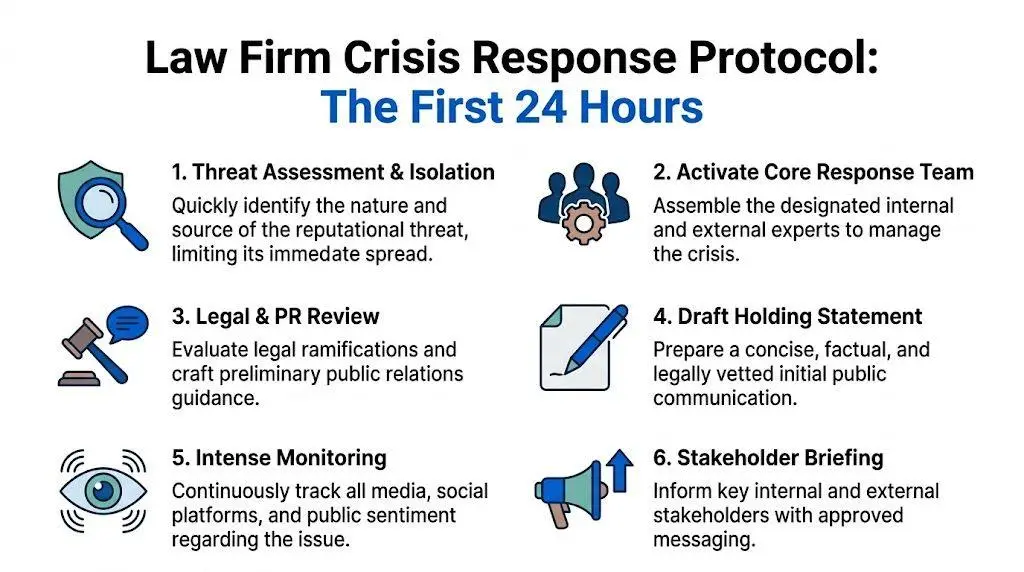
A crisis protocol must be boring, disciplined, and fast. If a negative article is spreading, a data exposure has occurred, or allegations against a partner are circulating, you need a response structure that reduces improvisation.
The first decisions
In the first hours, don’t argue publicly about the facts unless counsel has cleared the statement. Don’t let practice group leaders freelance on LinkedIn. Don’t allow intake staff to reassure callers with improvised explanations. Centralize communication immediately.
Use this command sequence:
- Isolate the threat
Identify where the issue started, what is indexed, who is amplifying it, and whether the content includes confidential, defamatory, or security-related material. - Activate a small response group
The managing partner, internal or outside counsel, communications lead, and one operations owner are enough at the start. Bigger teams create delay and leaks. - Freeze unsanctioned statements
Tell partners, associates, intake staff, and reception that no one comments externally without clearance. That includes private “off the record” conversations.
Silence is not indecision. In the first hours, silence is containment.
Draft a holding statement, not a manifesto
A holding statement should be factual, narrow, and legally reviewed. Its job is to buy time while you verify what happened. It is not the place to litigate motives, question accusers, or defend the firm’s honor in grand language.
A workable holding statement usually does three things:
- acknowledges awareness of the issue
- states that the firm is reviewing the matter
- avoids detail that could later prove inaccurate or prejudicial
If the issue is plainly false and documentation exists, your statement can be firmer. If facts are incomplete, stay tight. The public rarely punishes restraint in the opening window. It does punish contradictions.
Build parallel workstreams
A crisis response fails when every task gets lumped into “communications.” Break it apart.
| Workstream | Owner | Immediate task |
|---|---|---|
| Legal review | Internal or outside counsel | Assess liability, confidentiality, preservation, and takedown options |
| Communications | Designated spokesperson or PR lead | Prepare holding language and stakeholder guidance |
| Monitoring | Marketing or specialist vendor | Track search, social, platform changes, reposts, and journalist activity |
| Internal ops | COO, office manager, or managing partner delegate | Coordinate staff instructions, client messaging, and documentation |
This structure matters because legal facts, platform action, and public perception move at different speeds. If one person tries to own all of it, something gets missed.
Brief the people who can make the situation worse
Most crisis plans focus upward. They should also focus outward and inward.
Your receptionist needs approved language. Your intake team needs a script for anxious prospects. Key clients may need direct outreach if they’re likely to hear about the issue from someone else. Recruiters, referral partners, and office heads may need guidance on what to say and what not to say.
A short internal memo beats rumor every time. Keep it plain. State the issue is being handled, identify the point of contact, and prohibit ad hoc commentary.
Decide early whether outside support is necessary
Handle it internally if the issue is small, local, factually straightforward, and unlikely to spread. Bring in outside crisis support if the matter involves cross-platform amplification, executive exposure, potential regulator interest, or legal claims that need coordinated takedown and communications work.
The worst choice is the middle choice. That’s where a firm insists it can handle a major threat in-house, but still operates without a real command structure. By the time leadership accepts the matter is larger than expected, screenshots are circulating and third parties have framed the narrative for you.
Measuring the ROI of Your Reputation Strategy
If you can’t tie reputation work to business outcomes, budget pressure will eventually kill it. That’s a management failure, not a finance problem.
The right way to evaluate law firm reputation management is to ignore vanity metrics and focus on commercial effect. Did branded search results improve. Did review quality and volume improve. Did intake report fewer trust objections. Did partner-name searches stop surfacing harmful noise. Did referral conversations get easier. Those are business questions.
The strongest data point available here is straightforward. Research summarized by Jasmine Directory from Reputation.com states that businesses actively monitoring and managing their online reputation see an average 510% increase in review volume and maintain 88% positive review share. Firms with high satisfaction scores experience 40% higher client retention rates and generate 60% more referrals. For a law firm, those aren’t branding curiosities. They map directly to retention economics and pipeline quality.
What to measure quarterly
A useful reputation report should fit on a few pages and answer whether the firm is becoming easier or harder to trust online.
Track:
- Search visibility quality for firm name and key partner names
- Negative result displacement for known harmful pages
- Review footprint strength across priority platforms
- Response discipline including whether replies comply with internal standards
- Lead quality signals from intake notes and consultation conversion patterns
- Recruiting and referral friction tied to online perception
You don’t need to force every line item into a precise dollar figure. Some value is directional. But you should insist on trend lines that management can interpret.
Tie activities to financial consequences
Here is the core logic.
If review quality and consistency improve, more prospects arrive with baseline trust. If harmful branded results are displaced or removed, fewer prospects enter the intake call with suspicion. If partner-name searches look credible, lateral candidates and referral sources do less silent self-selection against your firm. If client satisfaction is visibly reflected online, referrals become easier to generate and easier to close.
That’s why I recommend pairing online metrics with operating metrics. Your marketing lead, intake lead, and management committee should review them together, not separately.
A practical framework for a quarterly report might look like this:
| Category | Example measure | Business meaning |
|---|---|---|
| Search results | Share of first-page branded results that are accurate and favorable | Indicates whether prospects meet your narrative or someone else’s |
| Reviews | Volume, themes, and platform distribution | Shows trust signals available before contact |
| Response handling | Compliance with internal response standards | Reduces confidentiality and admissions risk |
| Takedown progress | Removed, de-indexed, disputed, or monitored items | Shows whether legal remediation is reducing exposure |
| Intake feedback | Common objections or concerns linked to online research | Connects digital reputation to conversion reality |
For firms that want a more formal budgeting discussion, a strategic cost analysis of online reputation management can help frame spend against retention, referral generation, and risk mitigation rather than treating it as discretionary marketing overhead.
Reputation spending is justified when it protects revenue, shortens trust-building, and reduces preventable damage. That is a business case, not a branding slogan.
Frequently Asked Questions on Law Firm Reputation
The questions below usually arrive after leadership understands the strategy but wants clear tactical boundaries.
| Question | Answer |
|---|---|
| Can our firm pay to remove negative reviews | Paying for review removal is risky and often the wrong move. If the payment is conditioned on changing public sentiment, you may create ethical and disclosure problems. Challenge false reviews through platform rules, preserve evidence, and use lawful removal or suppression strategies instead. |
| Can we ask only happy clients for reviews | Be careful. You can ask satisfied clients for honest feedback, but a system designed to create a misleading public record can become a problem. Broad, voluntary, non-incentivized review collection is the safer approach. |
| What’s the difference between suppression and removal | Suppression pushes harmful items lower in search by strengthening other assets. Removal targets the source or search index directly. Removal is cleaner when available. Suppression is often necessary when content is lawful but damaging. |
| Should we respond to every negative review | No. Some reviews should be answered carefully. Some should be challenged first. Some should be left alone while you preserve evidence and prepare a broader strategy. Public response should never come at the cost of confidentiality or admissions risk. |
| Can a lawyer deny representation in a review response | Sometimes that creates more risk than it solves. Even saying someone was never a client can have consequences depending on context. Review every proposed response through an ethics and confidentiality lens. |
| How long does law firm reputation management take | Administrative fixes can move quickly. Review collection and profile cleanup can show progress sooner. Suppression takes longer because search visibility changes over time. Source removals depend on platform policy, legal grounds, and jurisdiction. Anyone promising instant, universal cleanup is selling fiction. |
| Is SEO enough to solve a serious reputation problem | No. SEO helps with visibility and suppression. It does not remove defamatory content, impersonation, privacy violations, or fabricated reviews by itself. Serious matters usually require legal analysis and platform-specific action. |
| When should we bring in outside specialists | Bring them in when the issue involves false factual claims, privacy exposure, impersonation, coordinated attacks, executive-level visibility, or cross-platform spread. Those problems cross legal, technical, and strategic lines quickly. |
If your firm is dealing with false reviews, damaging search results, privacy exposure, or high-stakes negative content, ContentRemoval.com can assess the matter confidentially and outline what can be removed, de-indexed, suppressed, or monitored under a compliant strategy. For managing partners under pressure, the value is clarity. What’s actionable, what isn’t, and what should happen first.