
A reputation damage repair service contains and removes harmful online material at the source rather than managing perception over time. It works through source removal, search de-indexing, account enforcement against fake profiles, leak containment and residual suppression, then monitors for reposts. It suits defamation, fake reviews, impersonation, leaked media and coordinated smear content tied to specific URLs.
Key facts
- Source removal deletes content from the host; de-indexing stops search engines surfacing it for name searches.
- The workflow runs in four phases: triage, strategy, removal and suppression, then monitoring and prevention.
- Privacy, impersonation and non-consensual content often contain fastest; publisher and cross-border disputes take longer.
- Red flags include promises of removal everywhere, SEO tricks sold as repair, and no recurrence plan.
Where ContentRemoval.com comes in. ContentRemoval.com is a repair firm in exactly this sense: evidence preserved, a removal or de-indexing route chosen for each URL, fake accounts enforced against, and reposts tracked after the first takedown. General counsel, chiefs of staff and PR agencies usually reach out once a result is already shaping investor or customer conversations. A free 15-minute Exposure Scan maps what is removable, and the report is yours to keep. Get a Free, Confidential Exposure Scan or read how our reputation management work is done.
A search result with your name, company, or product in the headline is already costing you before anyone calls. Prospects vet you. Investors do it. Journalists do it. Recruiters, counterparties, and opposing counsel do it too. If the first page is polluted, the damage isn’t theoretical. It’s operational.
Most firms still answer that problem with a PR plan, a listening dashboard, and a content calendar. That’s too slow for a live incident. A reputation damage repair service exists for a different class of problem. It starts with containment, moves to removal where possible, and uses de-indexing, suppression, and monitoring to stop the spread.
What Defines a Reputation Damage Repair Service
At 8:15 a.m., a board member forwards a search result accusing your company of fraud. By noon, prospects have seen it, employees are sharing screenshots, and a reporter has asked for comment. That is not a branding problem. It is a live digital asset causing measurable harm.
A reputation damage repair service is built for that moment. Its job is not to improve sentiment over the next quarter. Its job is to contain, remove, de-index, and neutralize harmful material as fast as the facts and platform rules allow.
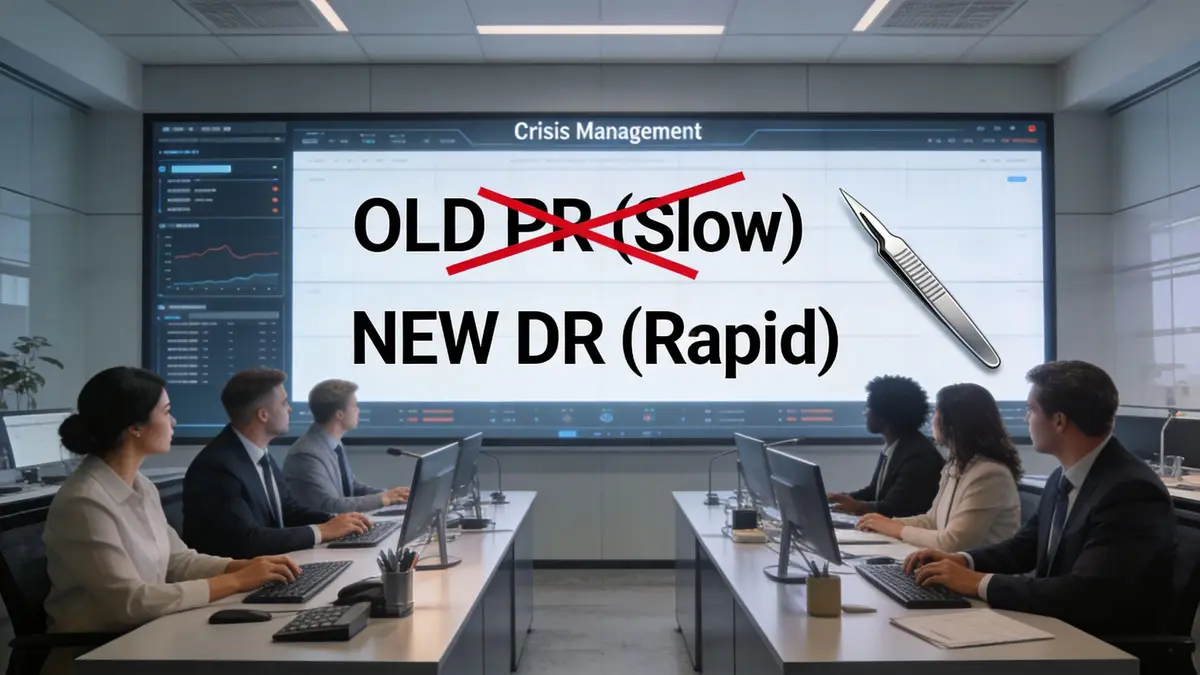
Management talks around the problem. Repair attacks the source.
Traditional PR management shapes perception over time. It has a place in product issues, corporate controversy, leadership messaging, and long-cycle trust work. It does not remove a false article, shut down an impersonation account, stop stolen private media from spreading, or get an unlawful page out of search.
Repair starts with control points. Who published the material. Who hosts it. Which policy, statute, or platform rule applies. Whether search engines are indexing it. Whether there is a basis for takedown, delisting, account enforcement, or legal escalation.
That is the dividing line clients need to understand. One discipline manages narratives. The other fixes digital exposure at the source.
Analysts at SailPoint describe reputational risk as an issue that demands immediate containment. That point matters because delay changes the case. Once harmful content is crawled, copied, reposted, and attached to name searches, cleanup gets slower and more expensive.
Practical rule: If the content is false, unlawful, impersonating, stolen, or privacy-invasive, ask whether it can be removed or de-indexed now. Do not start with messaging.
The work is surgical, not theatrical
A real repair mandate is specific. Remove what should not be online. Reduce visibility where removal is blocked. Stop reposting, cloning, and account abuse before the issue hardens into a long-term search problem.
That usually means using several mechanisms at once:
- Source removal: Press the host, publisher, forum, platform, or site operator to delete the material.
- De-indexing: Get search engines to stop surfacing a result for name, brand, or executive queries.
- Account enforcement: Shut down fake profiles, cloned sites, spoofed pages, and fraudulent review accounts.
- Leak containment: Remove private media, internal documents, and copied files across mirrors and repost chains.
- Residual suppression: Publish and structure accurate assets so older or less-removable content loses ranking strength.
This is why repair firms are not PR shops with a faster tone of voice. The operating model is different. The work depends on evidence, platform policy, search behavior, legal grounds, and procedural timing. In many executive matters, public comment makes the harmful asset more visible. A takedown specialist, investigator, and counsel often do more good than a spokesperson in the first phase.
Speed changes the outcome
Early action determines whether an incident stays containable. Harmful material that sits untouched gets indexed, screenshotted, syndicated, and cited by others. Each step makes the next one harder to reverse.
That is why specialist firms act first and explain second. ContentRemoval.com, for example, states that it initiates takedown action within 24 to 48 hours. That is the right framing for a repair service. Immediate containment comes from filing requests, preserving evidence, identifying responsible intermediaries, and pressing the channels that can remove or delist the asset.
A repair mandate is concrete. Remove what can be removed. De-index what can be delisted. Contain what cannot yet be eliminated.
When repair is the right model
Use a reputation damage repair service when the problem is tied to a specific digital object or abuse pattern. That includes defamation, fake reviews, impersonation, doxxing, mugshots, leaked media, copied articles, cloned websites, counterfeit listings, and coordinated smear content.
Use conventional PR when the issue is mainly public positioning. Product disappointment, executive messaging, regulatory scrutiny, and broad trust erosion usually require a communications program.
Some matters need both. The order still matters. First contain the harmful asset. Then decide whether public messaging serves the objective or makes the problem bigger.
The Arsenal of Digital Remediation Services
Most clients arrive with one urgent question. “What can be done?”
Plenty, if the case is handled with precision. Different harms require different tools. The mistake is treating every reputational problem like a press issue. It isn’t. Some matters are platform-enforcement problems. Some are search-index problems. Some are evidentiary legal problems.
The core tools and what each one solves
Here is the operating catalogue I’d want a client to understand before making any decision.
| Service | Primary Target | Typical Use Case |
|---|---|---|
| Source removal | Website host, publisher, forum, platform | False article, invasive post, copied page, unlawful publication |
| De-indexing | Search engines | Harmful result remains searchable even when source is hard to remove |
| Defamation takedown support | Publishers and platforms | False accusations, fabricated misconduct claims, coordinated smear content |
| Impersonation enforcement | Social platforms, domain registrars, marketplaces | Fake executive profile, cloned brand page, spoofed account |
| Review fraud removal | Review platforms and business directories | Fake negative reviews, extortion reviews, competitor abuse |
| NCII and leaked media removal | Platforms, hosts, search engines | Intimate imagery, private videos, stolen photos, repost chains |
| News suppression | Search results and high-authority publishing channels | Legacy coverage that ranks disproportionately against current reality |
| Mugshot and arrest record removal | Data brokers, record sites, search engines | Old booking images and aggregator pages dominating name searches |
| Dark web monitoring and remediation | Hidden forums, leak sites, breach surfaces | Stolen data, leaked credentials, private documents, extortion material |
| Reupload monitoring | Platforms and index surfaces | Repeat reposting after successful takedown |
Removal and de-indexing are not the same thing
Clients often use those terms interchangeably. They shouldn’t.
Source removal means the underlying content is deleted from the host or publisher. That’s the stronger outcome because the material no longer sits on the public-facing page.
De-indexing means the content may still exist at the source, but search engines stop surfacing it for relevant searches. That can be the fastest route to practical relief when the source is slow, hostile, or protected by a publisher that won’t cooperate.
Both approaches have a place. If the content is obviously unlawful or violates platform rules, push for removal. If the source is stubborn but the search display is the primary harm, de-indexing may cut off most of the damage.
The highest-risk categories need specialist handling
Some matters need immediate escalation, not routine support tickets.
- Impersonation: Fake executive accounts and cloned brand pages can trigger investor panic, customer fraud, and media confusion.
- NCII and private media leaks: These matters require urgent, discreet platform action and sustained reupload tracking.
- Defamation: You need evidence preservation, clean factual analysis, and a strategy that doesn’t accidentally republish the allegation.
- Dark web exposure: The point isn’t visibility management. It’s identifying where the material sits, what threat it poses, and how to contain the downstream harm.
One practical option in this market is ContentRemoval.com’s content removal and digital reputation protection work, which includes de-indexing, source removal, impersonation takedowns, leaked media removal, and ongoing monitoring.
If a vendor can only “improve sentiment” but can’t explain the mechanics of host removal, search delisting, account enforcement, and reupload prevention, they are not a repair firm. They are a marketing firm.
Suppression has a role, but only after discipline
Strategic suppression is useful when the harmful asset can’t be removed cleanly. It is not a substitute for takedown work. Used properly, it helps legitimate pages outrank stale or marginally removable material. Used badly, it looks manipulative and fails.
Serious operators know the order. First legal and technical remedies. Then search reshaping, if needed.
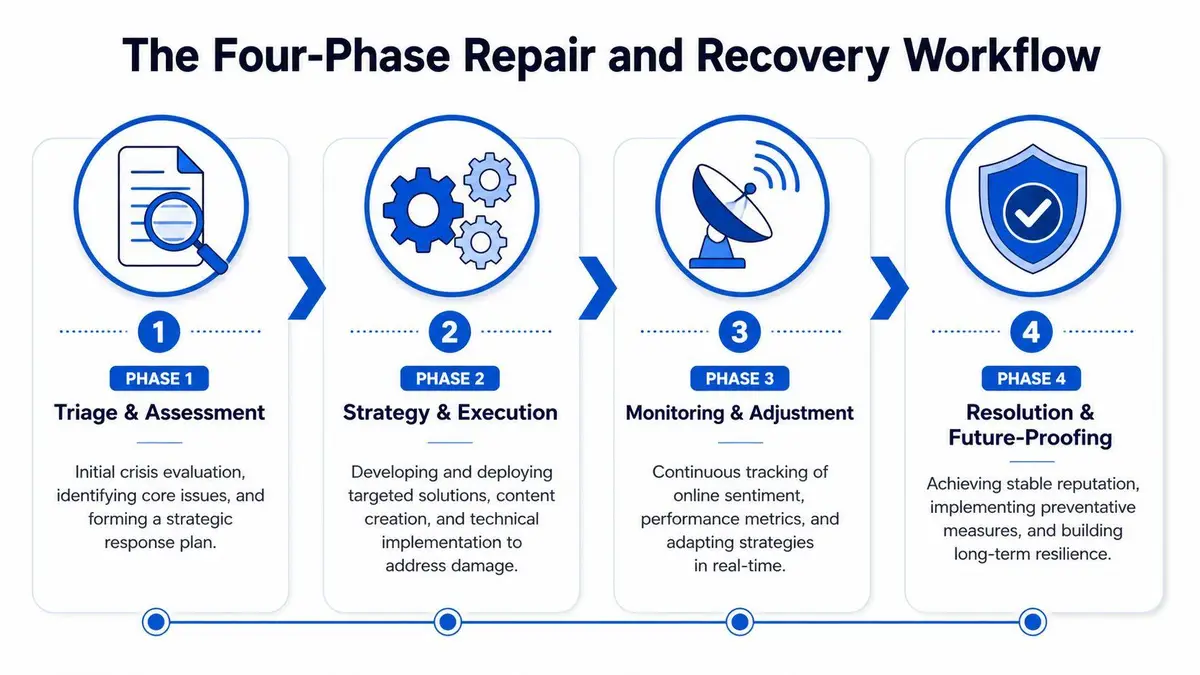
The Four-Phase Repair and Recovery Workflow
At 7:12 a.m., a board member forwards a search result to the CEO. By 8:00, a journalist has emailed questions. By 9:30, someone inside the company is proposing a public statement. That sequence is common, and it pushes teams toward the wrong first move.
Repair work starts with containment. Traditional PR manages perception around a story. Reputation damage repair goes after the asset itself through host removal, account enforcement, legal notice, and search de-indexing. The workflow has four phases, and each one has a distinct job.
Phase one triage and assessment
The first phase is diagnosis under pressure. You identify the exact URLs, profiles, images, videos, and search queries causing harm. You confirm where each asset sits, who controls it, how widely it has spread, whether mirrors exist, and which audience is seeing it.
That classification step matters because the remedy depends on the asset type. A fake executive profile calls for platform enforcement. A privacy breach needs evidence preservation and a rights-based removal route. A defamatory publisher post requires a different legal and technical plan. Some assets are removable. Some are delistable. Some will need suppression only after direct remedies have been exhausted.
Evidence handling is part of this phase, not an administrative afterthought. Preserve URLs, source code, timestamps, account identifiers, cached appearances, and ranking positions. If the matter escalates, weak records slow removal and weaken legal pressure.
Phase two strategy and action
Once the case map is complete, the team sets the attack order. Repair diverges from PR management at this juncture. You are not drafting sentiment messages first. You are deciding which assets can be removed at source, which can be de-indexed from search, which require platform escalation, and which need parallel legal action.
Speed matters because the first response window shapes the rest of the case. The Marketing Agency’s online reputation case study notes stronger recovery when organizations respond within 24 hours, then follow with structured stakeholder communication and operational fixes over the following days and weeks. The practical lesson is simple. Delay gives harmful assets time to spread, get indexed, and attract commentary.
For a concrete example of how specialist teams sequence these actions, review the content removal process used in active remediation cases.
Phase three removal and suppression
This is the execution phase. Notices go to hosts and platforms. Search delisting requests are filed where the facts support them. Abuse reports, impersonation claims, privacy complaints, copyright notices, and evidentiary packages are adapted for the target system rather than sent as generic templates.
Good repair work is coordinated. Legal pressure without search action often leaves a visible trace in results. Search work without source removal leaves the underlying asset live and ready to resurface.
Some removals happen quickly. Others require repeat submissions, escalation paths, jurisdiction-specific arguments, or direct engagement with publisher counsel. When an asset cannot be removed cleanly, suppression becomes a secondary tool. Used properly, it reduces visibility of the remaining residue while the source-side fight continues.
The same case study cited earlier reported a substantial shift in first-page search sentiment over six months, along with a measurable increase in new patient calls. The point is not the headline number. The point is that repair produces business outcomes when removal, delisting, and search reshaping are run as one plan.
Phase four monitoring and prevention
Removal is not closure. It is the start of control.
A serious firm tracks reposts, cloned accounts, copied text, review bursts, autocomplete changes, and sudden ranking volatility. Bad actors often test whether the target has stopped watching. If no one is monitoring, the same material returns under a new URL, a new profile, or a new domain.
A stable outcome depends on two controls:
- Repeat-incident control: Ongoing monitoring, evidence capture, and fast re-submission when material reappears.
- Digital hardening: Strengthening legitimate assets so future attacks have less room to dominate branded search.
Clients usually relax during this phase because the matter stops feeling chaotic. They can see what was removed, what was delisted, what still needs pressure, and how recurrence will be handled. That is the standard. Repair is not vague reputation management. It is a disciplined containment and recovery process built to reduce visible harm fast and keep it from coming back.
Defining Success and Realistic Timelines
At 7:30 a.m., your general counsel sends a screenshot. A defamatory article is ranking for your name. An investor has asked about it. Sales has already lost two calls. In that moment, “How long will this take?” is too blunt to be useful. The true question is narrower and more important. How fast can we contain visible harm, and what specific result counts as repaired?
Success in reputation damage repair is operational. Traditional PR management aims to influence perception over time. Repair is different. It targets the asset causing the damage and uses removal, de-indexing, platform enforcement, and search containment to reduce exposure fast. If a damaging page is gone, de-listed, or pushed out of decision-making visibility, that is progress you can verify.
What success looks like in practice
For an active matter, I judge results against a short list of hard indicators:
- Source-level removal: The publisher, platform, host, or forum deletes the content or disables the account behind it.
- Search de-indexing: The URL stops appearing for the person, company, or branded query that matters.
- Decision-page cleanup: Harmful results no longer control page-one visibility where customers, employers, investors, or reporters form impressions.
- Recurrence suppression: Reposts, mirrors, and cloned profiles are caught and handled before they regain traction.
- Business stabilization: Inquiry quality improves, objections decline, and avoidable revenue loss starts to slow.
That last point is where weak firms get exposed. If they cannot tie repair work to reduced visible harm and restored commercial function, they are selling PR language, not remediation.
Timelines follow the mechanism
A clear platform policy breach can move quickly. Privacy violations, impersonation, non-consensual content, and some copyright matters often produce the fastest containment. Publisher disputes, anonymous site operators, and cross-border matters take longer because the route is more contested and the enforcement options are narrower.
Clients should expect progress in layers, not all at once. Day-one work is usually containment. That may mean submitting platform reports, preserving evidence, contacting hosts, preparing legal notices, or seeking de-indexing where removal is blocked. Full resolution can take longer, but visible harm often starts shrinking before final takedown.
If you want a grounded view of timing by remedy type, this guide on professional timelines for removing a search result explains what tends to move in days, weeks, or longer.
The benchmark is simple. Harmful visibility should decline. Your options should expand. The chance of recurrence should drop.
ROI in repair is measured in regained control
Repair is not a brand-awareness exercise. It protects revenue, negotiations, hiring, partnerships, and leadership credibility. The financial effect can be material when the damaging asset is prominent enough to interrupt buying decisions or trigger stakeholder concern.
A useful way to assess return is to track four things: how many harmful results were removed or de-indexed, how quickly branded search improved, whether high-value conversations stopped derailing, and whether the issue stayed contained after the first wave of action.
You do not need a promise of instant perfection. You need a firm that can define the target state precisely, choose the shortest legal or technical path to get there, and show you week by week whether the damage is being repaired.
How to Vet and Select a Specialist Firm
At 7:30 a.m., your general counsel sends a screenshot. A false allegation is ranking on page one for your company name, investors are seeing it, and a junior PR agency is proposing a press release. Reject that approach. You do not need reputation management in that moment. You need repair. That means a firm that can isolate the asset, preserve evidence, choose the strongest removal or de-indexing route, and contain spread before the next stakeholder call.
The market is crowded with polished sales teams. Very few firms can explain, in plain language, which assets are removable, which require search de-indexing, which need platform enforcement, and which facts support each step. Hire the team that talks about legal hooks, platform rules, evidentiary standards, and search mechanics. Ignore anyone selling vague “brand improvement” without a case strategy.

The red flags I’d treat seriously
Some firms are merely inexperienced. Others will make the situation worse.
- Guaranteed removal claims: No credible operator can promise removal across every publisher, platform, and jurisdiction.
- No legal or policy fluency: If the team cannot speak clearly about defamation, privacy, copyright, impersonation, harassment, terms-of-service enforcement, and proof requirements, it cannot run a serious repair matter.
- SEO tricks presented as repair: Link spam, fake profiles, fabricated reviews, and other manipulation tactics often trigger more scrutiny and create fresh liabilities.
- No recurrence plan: Harmful content often reappears on mirror sites, repost networks, or new accounts. A firm that files one complaint and disappears is not protecting you.
- Unclear staffing: You should know who handles legal drafting, technical escalation, search issues, and reporting. If that remains fuzzy after the first call, walk away.
The questions a sophisticated client should ask
Ask questions that force operational detail.
| Question | Why it matters |
|---|---|
| What percentage of this case is removal, de-indexing, and suppression respectively? | Reveals whether the firm understands the mechanics of repair rather than defaulting to PR or generic SEO |
| What facts, laws, or platform rules support action on each target URL? | Tests whether they can build a credible removal case |
| Who drafts notices and who handles escalations? | Separates specialists from lead-generation shops |
| How do you preserve evidence before outreach begins? | Protects your position if the matter escalates into litigation or regulator review |
| What is your plan if the content is copied or reposted? | Shows whether they can contain recurrence |
| What will you refuse to do in this matter? | Competent firms define limits early and clearly |
Executives who want a tighter screening standard should review this guide on evaluating professional content removal services for executive teams.
Price matters less than case-handling ability
A low fee is irrelevant if the firm picks the wrong remedy, contacts the wrong party, or tips off an anonymous attacker before evidence is secured.
Analysts at Modern Luxury note that digital perception can materially affect brand value, and they describe monthly online reputation engagement costs ranging from $2,000 to $5,000 or more. That pricing context matters less than fit. A firm built for media relations will not necessarily know how to get a false profile removed, force a host review, or pursue de-indexing on a technically weak but commercially dangerous page.
Judge the firm on method. Ask for a sample workflow, a reporting cadence, and a clear explanation of likely outcomes by asset type. A strong first call should leave you with a sharper plan, a shorter path to containment, and a realistic view of what can be repaired fast.
Case Summaries in Reputation Recovery
Abstract descriptions don’t help much when your own matter feels unique. Most aren’t unique. They are variations of a few recurring attack types.

The defamed executive
A senior executive was targeted by a small network of blogs and social accounts alleging misconduct that had not occurred. The first requirement was not publicity. It was evidence preservation, source mapping, and identification of repeated language across multiple posts.
The response combined publisher notices, platform complaints, and search-focused mitigation for the assets least likely to disappear quickly. Fake supporting profiles were also challenged as inauthentic amplification. The practical result in a case like this is usually phased relief. The worst assets lose visibility first, then the source network starts to weaken.
The brand hit by impersonation and counterfeit listings
A consumer brand found fraudulent marketplace listings and spoofed social profiles using its name and imagery. This was not a media problem. It was a trust and fraud problem.
The repair campaign focused on account enforcement, marketplace complaints, image and copy ownership issues, and search cleanup for branded queries. At the same time, the legitimate web and social footprint was strengthened so customers could identify authentic channels quickly. When that sequence is handled properly, the brand regains control of the buying path instead of merely issuing warnings about fraud.
The private individual facing a media leak
A private client discovered intimate and personal material circulating across social platforms and repost sites. The first objective was to stop recirculation, not to debate the facts publicly.
That kind of matter requires urgent takedown routing, careful handling with platforms, and persistent monitoring because repost behavior often follows initial removal. The emotional intensity is high, but the process still has to remain disciplined. Capture evidence, remove where possible, track mirrors, and continue until the repost cycle breaks.
Anonymous attackers are rarely as invisible as they appear. Their infrastructure, posting pattern, reused assets, and platform footprint usually create openings for action.
Frequently Asked Questions About Reputation Repair
Can harmful content be removed permanently
Sometimes yes. Sometimes no.
If the source deletes the content and major platforms stop surfacing copies, the practical effect can be close to permanent. But permanence depends on whether third parties reposted it, archived it, quoted it elsewhere, or cloned the original account. That’s why monitoring is part of the service, not an optional add-on.
What if the attacker is anonymous
Anonymous does not mean untouchable. It means you start with infrastructure and behavior rather than identity.
A specialist team looks at hosting, usernames, linked accounts, reused wording, publication patterns, old cached pages, and policy violations. In many cases, action can begin without naming the person behind the content. Removal and account enforcement often matter more than attribution in the first instance.
Should we issue a public statement right away
Not automatically.
A public statement is useful when stakeholders need direct reassurance, when responsibility must be acknowledged, or when silence creates more risk than speech. It is a poor first move when the content is false, fringe, or likely to gain attention from your response. Many clients worsen a containable problem by feeding it oxygen.
Is de-indexing enough if removal fails
Often, yes, from a practical standpoint.
If the page still exists but stops appearing for the searches that matter, the commercial and reputational harm can drop sharply. It is not as clean as source removal, but it can be decisive. The right answer depends on whether discovery through search is the actual threat or whether the source itself is actively driving damage.
Will trying to remove content make the issue more visible
It can, if the work is clumsy.
That risk is reduced by preserving evidence discreetly, choosing the correct legal or policy basis, contacting the right party first, and avoiding performative public disputes. Specialist handling matters because escalation strategy matters. The internet punishes noisy mistakes.
How should a CEO act in the first hours
Keep the circle small. Preserve evidence. Stop staff from arguing online. Identify the exact URLs, accounts, and search queries involved. Separate lawful criticism from false or invasive material. Then engage a firm that can assess removal, de-indexing, and enforcement immediately.
The first hours are not the time for committee language or broad brand messaging. They are the time for precise action.
If you’re facing a live issue, ContentRemoval.com offers confidential assessments for executives, brands, public figures, and legal teams that need a clear action plan for removal, de-indexing, and ongoing digital risk containment.