
Reporting videos on YouTube works best when you treat it as evidence handling. YouTube offers two tracks: a Community Guidelines report for harassment, impersonation, privacy abuse and manipulated media, and a legal takedown route for copyright and trademark claims. Choose the correct track, name the exact violation, attach timestamped evidence, and escalate with the case ID if the report stalls.
Key facts
- Community Guidelines reports cover harassment, impersonation, privacy invasion and harmful manipulated media such as deepfakes.
- Copyright claims require a formal DMCA notice through YouTube’s portal under 17 U.S.C. section 512.
- There is no direct appeal for denied reports; the options are resubmission or legal escalation.
- A counter-notification moves a copyright dispute onto a legal timetable and forces a litigation decision.
Where ContentRemoval.com comes in. ContentRemoval.com handles YouTube removals where a report has stalled, a counter-notice has landed, or the same video keeps returning under new titles and channels. Executives, their chiefs of staff and their counsel usually make contact once the clip has already spread beyond YouTube. A free 15-minute Exposure Scan maps which videos and mirrors are removable and by which route, and the report is yours to keep. Get a Free, Confidential Exposure Scan or read how our YouTube content removal work is done.
A damaging YouTube video rarely arrives at a convenient time. It appears during a fundraising process, a board dispute, a product launch, a divorce, a campaign, or a media cycle that was already unstable. Your instinct is to hit “Report,” send a few angry emails, and push your team to make noise. That usually wastes the most valuable window you have.
Reporting videos on YouTube works when you treat it as evidence handling, not emotional reaction. You need the right path, the right language, and the right escalation sequence from the start. If you misclassify the issue, overstate the claim, or rely on mass reporting, you make a bad situation slower and harder to clean up.
YouTube’s scale is the first reality to accept. The platform sees over 500 hours of video uploaded every minute and 2.5 billion monthly active users in 2024, which is exactly why reporting has to be precise rather than improvised, according to YouTube’s channel reporting documentation. The platform can act quickly, but only if your report fits the system it already uses.
Your First 24 Hours Navigating a Content Crisis
The first mistake clients make is assuming every bad video belongs in the same reporting funnel. It doesn’t. YouTube effectively gives you two tracks. One is the Community Guidelines route for conduct-based violations such as harassment, impersonation, privacy abuse, or harmful manipulation. The other is the legal takedown route for rights-based claims such as copyright and trademark misuse, and in some matters where legal counsel needs to frame the issue outside ordinary user reporting.
If you choose the wrong track, you lose time and credibility.
Separate outrage from evidence
Start with preservation. Save the video URL, channel URL, screenshots, timestamps, title text, description text, comments that amplify the abuse, and any mirrored posts on other platforms. If the content is likely to spread or reappear, put monitoring in place immediately through a system built for reputation monitoring, not ad hoc searches by your assistant.
Then classify the harm with discipline.
- Use a Community Guidelines report if the video contains impersonation, targeted harassment, threats, privacy invasion, non-consensual exposure, or deceptive identity use.
- Use a legal takedown path if the video republishes your protected footage, stolen course material, leaked production content, or branded assets used without authorization.
- Prepare both tracks in parallel if the same video violates platform policy and legal rights. A deepfake using your likeness may also include copyrighted footage. A leak may also expose private information.
Practical rule: Don’t start by arguing that a video is “unfair.” Start by identifying the exact rule or right it violates.
What to do before anyone on your team responds publicly
Public rebuttals can harden the uploader’s behavior and increase visibility. Most hostile uploaders want one of three outcomes: attention, negotiation power, or monetized traffic. Don’t feed any of them until your evidence file is complete and your reporting path is selected.
Use this triage standard in the first day:
- Immediate identity harm: Prioritize impersonation, fake endorsements, and deepfakes.
- Immediate privacy harm: Prioritize leaked intimate, family, medical, or home-address content.
- Immediate revenue harm: Prioritize pirated product, course, event, or investor-facing materials.
- Immediate reputational spread: Track clips, reposts, and search indexing before the original upload is touched.
Your first 24 hours should produce one thing: a clean decision on whether this is a policy report, a legal takedown, or both. That’s the difference between a contained incident and a prolonged reputational mess.
Executing a Community Guideline Violation Report
Most failed YouTube reports aren’t denied because the reporter was wrong. They’re denied because the reporter was vague. Review systems reward classification. If your issue is impersonation and you file it as generic spam, you’ve already undercut your own case.
The numbers make the point. Reports for harassment or hate speech achieve a 78% removal rate, versus 45% for generic spam flags. Escalating to policy@youtube.com with a case ID after 48 hours of no response can increase the success rate to 91%. For impersonation of a public figure, attaching a notarized ID is also critical. Those figures come from the verified expert data provided for this brief.
Pick the violation YouTube can actually enforce
A reviewer doesn’t need your life story. They need a match between conduct and category. That means naming the violation narrowly and supporting it with timestamps and attachments that fit the category.
Here is the working framework I use with clients:
| Violation Type | Primary Use Case | Evidence Required | Typical Outcome |
|---|---|---|---|
| Harassment or hate speech | Targeted abuse, degrading attacks, threats, coordinated intimidation | Timestamped screenshots, transcript excerpts, context showing the target | Stronger removal posture than generic spam if the abuse is explicit |
| Impersonation | Fake executive channels, fabricated celebrity accounts, deceptive AI likeness use | Channel URL, comparison to official identity, notarized ID for public figures where appropriate | Faster review when the identity claim is documented cleanly |
| Privacy | Exposure of personal data, sensitive family material, non-consensual private visuals | Exact timestamps, screenshots, explanation of why the material is private | Useful when the issue isn’t ownership but unauthorized exposure |
| Harmful acts or misinformation | Deepfakes, manipulated clips causing reputational harm | Screenshots, timestamps, corroborating comparisons, neutral factual explanation | Effective when the manipulation is specific and documented |
Build the report like a case file
Use concise factual language. Don’t write that the uploader is evil, obsessed, or ruining your life. Write what happened on screen, when it happened, why it violates the selected category, and what evidence supports that conclusion.
A strong report usually includes:
- Exact timestamps: Identify the segment where the violation occurs.
- Identity comparison: For impersonation, show the mismatch between the official account and the fake one.
- Neutral wording: State facts and observable conduct only.
- Supporting captures: Screenshots of titles, thumbnails, descriptions, and any cross-platform mirrors if relevant.
A reviewer can act on a timestamped policy violation. They usually can’t act on a rant.
When silence means escalate
If the report sits without action, don’t keep filing duplicates. Wait the stated period, keep the case ID, and escalate in a controlled way. The goal is to show that your original filing was specific, supported, and correctly categorized.
That escalation should include the case ID, the exact category chosen, a short factual summary, and the most probative evidence. If the issue involves a public figure impersonation or an advanced deepfake, the quality of your documentary support matters more than the number of people reporting.
Mass reporting is not a strategy. Precision is.
Filing a Formal Legal Takedown Notice
A legal takedown is not a stronger version of a normal report. It is a different instrument entirely. If the video infringes your copyright or misuses protected brand assets, stop trying to persuade a community reviewer to solve a rights dispute. File the legal claim properly.

The legal route works when the evidence is exact. It fails when people file broad, sloppy claims. The verified data is unambiguous here. A formal DMCA notice through YouTube’s portal is required for copyright infringement. Success depends on forensic proof such as SHA-256 hashes and a properly drafted notice under 17 U.S.C. § 512. In these matters, 12% of cases receive a counter-notice, and vague claims fail 75% of the time.
What belongs in a serious DMCA filing
You need to identify the original work and the infringing work with precision. “They copied my content” is not enough. You should be prepared to submit the original URL or source location, the exact infringing URL, a statement of good faith, and a declaration under penalty of perjury.
If the video is a leaked corporate presentation, pirated webinar, paid course module, or stolen production file, add proof that ties the uploaded copy to your original asset. That may include internal timestamps, watermarking, metadata, or forensic comparison.
For a legal overview of how rights claims are framed more broadly, LA Law Group’s discussion of Intellectual Property Violation is useful context before filing.
Precision beats volume
A common failure pattern is overreach. Reporters list an entire channel when only two videos infringe. They claim ownership over material they licensed but don’t own. They describe “similar content” instead of showing actual copying. That’s how legitimate claims get rejected or delayed.
If you need a practical walkthrough before filing, review this guide on how to write and file a DMCA takedown notice.
The filing itself should read like this:
- Identify the protected work clearly: Name it, locate it, and show that you own or control the rights.
- List each infringing URL exactly: Don’t make reviewers hunt.
- Attach technical proof where available: Hashes, metadata, publication sequence, or frame comparisons strengthen the record.
- Use disciplined legal language: The declaration matters. So does accuracy.
For a quick orientation on the mechanics, this overview is useful before you submit:
Don’t file a DMCA notice for the wrong problem
Defamation, humiliation, and reputational damage are real harms. They are not automatically copyright claims. If the uploader created an original smear video using none of your protected material, a DMCA notice may be the wrong tool. Misusing legal takedowns can expose you to pushback and weaken your position in later filings.
Use legal takedowns when you are enforcing a right you can prove. If you can’t prove ownership, don’t bluff. Build the right claim instead.
Managing Report Outcomes and Counter-Notifications
A submitted report is not progress unless you track it. Too many people file, wait, and then assume silence means review is underway. Sometimes it does. Sometimes it means the report was too weak to move. You need to know which.

The first checkpoint is YouTube’s report history page, which is where status tracking begins. That same verified source makes the next point just as clear. There is no direct appeal process for denied reports. If denied, your options are resubmission or legal escalation. It also notes that AI-generated content flags spiked 300% in 2025-2026, which helps explain why false negatives and inconsistent outcomes are now common.
Read a denial for what it is
A denial does not necessarily mean the content is acceptable. It often means your evidence didn’t fit the route you chose, or the violation wasn’t obvious enough from the material submitted. That distinction matters.
If your first report was a policy report, ask three questions before resubmitting:
- Was the category correct: Harassment, impersonation, privacy, or harmful manipulation each trigger different review logic.
- Did you isolate the conduct: If the violation appears in a short segment, your timestamps need to pinpoint it.
- Did you submit evidence, not opinion: Reviewers respond to documentation, not anger.
Decision rule: If the facts are strong but the report was denied, improve the file. If the rights issue is clear, switch tracks and escalate legally.
Counter-notices are the real pressure point
Copyright complaints have a separate risk. The uploader can issue a counter-notification. That changes the matter from platform moderation to a legal timetable. Once a counter is filed, you have to decide whether to pursue legal action to keep the content down.
That decision shouldn’t be made casually. Review your ownership proof, the commercial harm, the uploader’s identity, and the jurisdictional realities before moving. A weak claimant should not invite a fight. A strong claimant should be ready for one.
If your team also creates video content, you should tighten your own publishing practices while this unfolds. TimeSkip’s guide to preventing YouTube copyright issues is a useful operational reference for reducing future claim disputes from your side.
What disciplined follow-up looks like
Post-submission management is procedural. Keep a chronology of every filing, confirmation, response, case ID, and status change. Preserve the removed content record even after the video disappears. If the uploader resurfaces with a mirror or edited variant, your earlier file becomes evidence for the next action.
A clean paper trail gives you options. A messy one forces you to restart.
Building a Defense Against Reuploads
Many users believe the job is done once the first video comes down. That assumption is why bad actors win the second round.
A determined uploader rarely treats removal as defeat. They treat it as a prompt to re-edit, retitle, crop, mirror, repost, or distribute the same material through alternate channels. If your defense depends on manual searching, you are already behind.
Why manual monitoring breaks down
Manual defense sounds responsible. Set Google Alerts. Ask staff to search YouTube daily. Watch comments. Save links in a spreadsheet. That approach collapses as soon as the uploader starts making small edits or dispersing the content across accounts.
Reuploads often appear with altered thumbnails, clipped intros, mirrored orientation, changed audio, or renamed titles. A human reviewer can miss those variants for days. That’s enough time for search indexing, reposting, clipping, and third-party commentary to spread the damage.
What an actual defense system requires
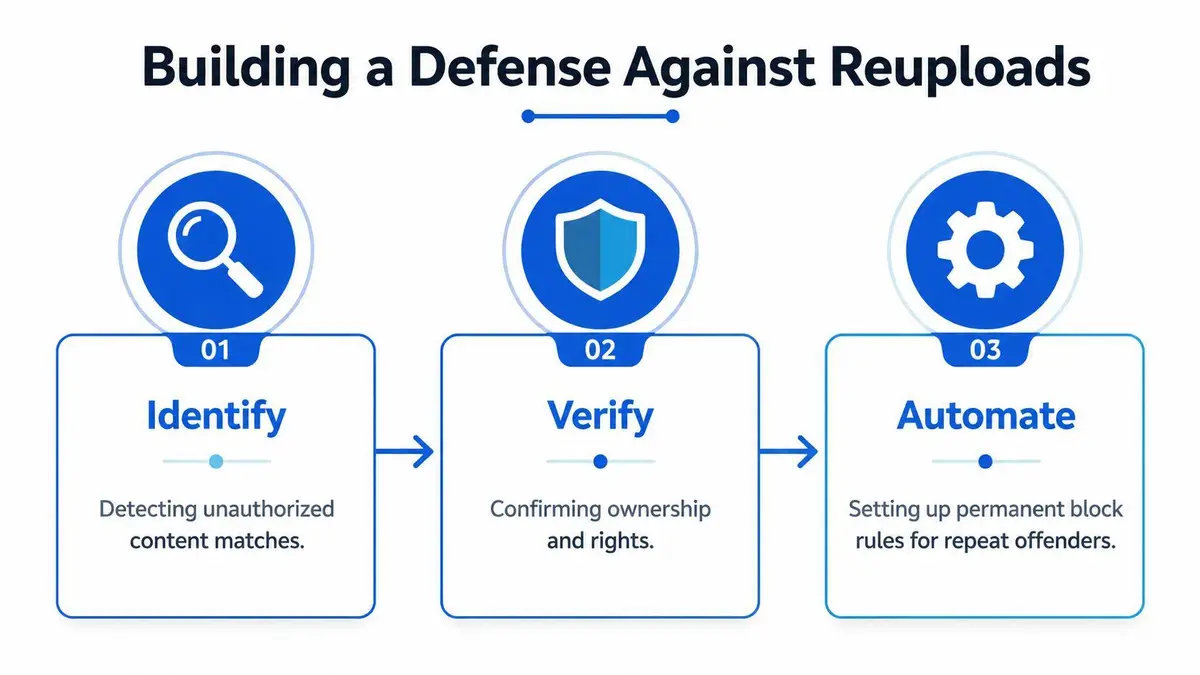
You need three layers working together.
First, identification. That means detecting likely matches even when the file has been modified. Reverse video search, frame comparison, and content hashing are all part of that discipline.
Second, verification. Someone has to confirm that the detected match is actionable, not just similar. Ownership records, publication history, and prior takedown files matter here.
Third, automation. Once the pattern is established, repeat offenders and known asset matches should trigger immediate review and action rather than waiting for a fresh panic cycle.
A practical setup usually includes:
- Asset fingerprinting: Preserve clean source files, publication dates, and comparison copies.
- Watchlists for names and brand terms: Include executive names, product names, campaign terms, and common misspellings.
- Cross-platform review: Harmful YouTube videos often travel to search results, social platforms, forums, and low-quality mirror sites.
- Repeat-offender documentation: Archive prior channel IDs, aliases, thumbnails, and metadata patterns.
The objective isn’t to remove one upload faster. It’s to make reappearance harder and shorter-lived every time.
Treat reuploads as a system problem
If the same attacker keeps surfacing, the problem is no longer “a bad video.” The problem is an adversarial distribution pattern. That requires process, not vigilance alone.
The strongest defense posture is boring by design. Files are archived. Alerts are tuned. Variants are logged. Rights records are ready. New matches are assessed quickly. This is how you stop spending executive time on the same crisis in new packaging.
When to Retain a Specialist Removal Firm
Self-help works on straightforward incidents. It fails on complex ones. Knowing the difference saves time, money, and reputation.
The hard truth is that standard reporting only solves a small slice of the problem set. YouTube’s own help-related material indicates that only 5.5% of the 1.2 billion videos removed in 2025 came from user flags, while 94.5% were caught by proactive detection, and the same verified source notes that standard reporting often fails for defamation, impersonation, and persistent reuploads of leaked content. It also states that specialist intervention can achieve source removal in under 48 hours in the right cases, as summarized in YouTube’s reporting help context.
Red flags that mean you should escalate now
If any of the following are true, stop assuming this is a do-it-yourself platform issue.
- The attack is coordinated: Multiple channels, clipped reposts, and off-platform amplification usually require a broader suppression and takedown strategy.
- The content uses deepfakes or synthetic identity manipulation: These cases move quickly and often confuse ordinary reporting categories.
- The material is legally sensitive: Leaks, intimate imagery, private family content, investor materials, or stolen paid content need exact handling.
- The uploader is fighting back aggressively: Counter-notices, hostile legal threats, and repeated reposting signal that this won’t end with one form submission.
- The video has crossed platforms: Once search engines, forums, X, Reddit, Telegram, or secondary video hosts are involved, YouTube reporting becomes only one piece of the cleanup.
What specialist intervention changes
A specialist firm brings structure that individuals and in-house teams usually don’t have under pressure. That includes forensic review, route selection, evidentiary packaging, jurisdiction-aware escalation, and persistent monitoring after the initial removal. It also means someone is managing the matter as a campaign rather than as a single report.
This matters most for executives and public figures. Your problem isn’t merely whether a video violates policy. Your problem is whether the content remains searchable, repostable, quotable, and discoverable after the first takedown. That is a broader reputational containment exercise.
If you are evaluating providers, use a stricter standard than brand polish. Ask how they handle denied reports, cross-platform mirrors, legal escalation, and repeat-offender monitoring. This overview of companies that clean up your online presence is a useful starting point for that comparison.
The right time to retain a specialist is earlier than most clients think. Once a harmful video is ranking, clipped, mirrored, and discussed elsewhere, every hour adds cleanup work. The cheapest stage of the crisis is the beginning.
If a YouTube video is harming your name, business, or family, don’t treat it like a routine support issue. ContentRemoval.com handles high-stakes removals for executives, public figures, brands, and legal teams that need fast, discreet action. Start with a confidential assessment, get a direct view of the viable takedown paths, and move before the next upload turns one incident into a recurring liability.
Frequently asked questions
What happens if YouTube denies my report?
There is no direct appeal for a denied report. Check whether the category was correct, whether your timestamps isolated the conduct, and whether you submitted evidence rather than opinion, then resubmit a tighter file. If the matter is a clear rights issue, switch to the legal takedown track instead.
Can I use a DMCA notice to remove a defamatory YouTube video?
Only if the video uses your protected material such as footage, course content or branded assets. A smear video made from original material is not a copyright claim, and filing a DMCA notice for the wrong problem invites pushback and weakens later filings. Defamation and humiliation need a different route.
How do I stop a removed YouTube video from being reuploaded?
Build three layers: identification through reverse video search and content hashing, verification against ownership records and prior takedown files, and automated review for repeat offenders. Keep clean source files, watchlists for names and brand terms, and an archive of prior channel IDs, aliases and thumbnails so each reappearance is handled faster.